AI is a magnifying glass, not a magic wand: it won’t help you develop advantages you don’t have, it will only honestly magnify what you already have.
*▲ AI will not help you develop advantages that you do not have, but it will honestly amplify what you already have, including your diligence and laziness. *
A live broadcast I stumbled upon by chance
Tonight’s live broadcast forced me to think again: What exactly has AI amplified in me?
Tonight, I listened to an online live broadcast by Sun Zhihua, dean of Strategic Thinking Business School and Liao Yubo (Believe). The theme was the application of AI in life. I originally thought it was a sharing about AI tools or application courses, but after hearing about it, I kept thinking about my own things. What really makes me remember is never the tool, but the mentality of facing the AI era.
Lesson 1: The idea of streamlining troublesome matters
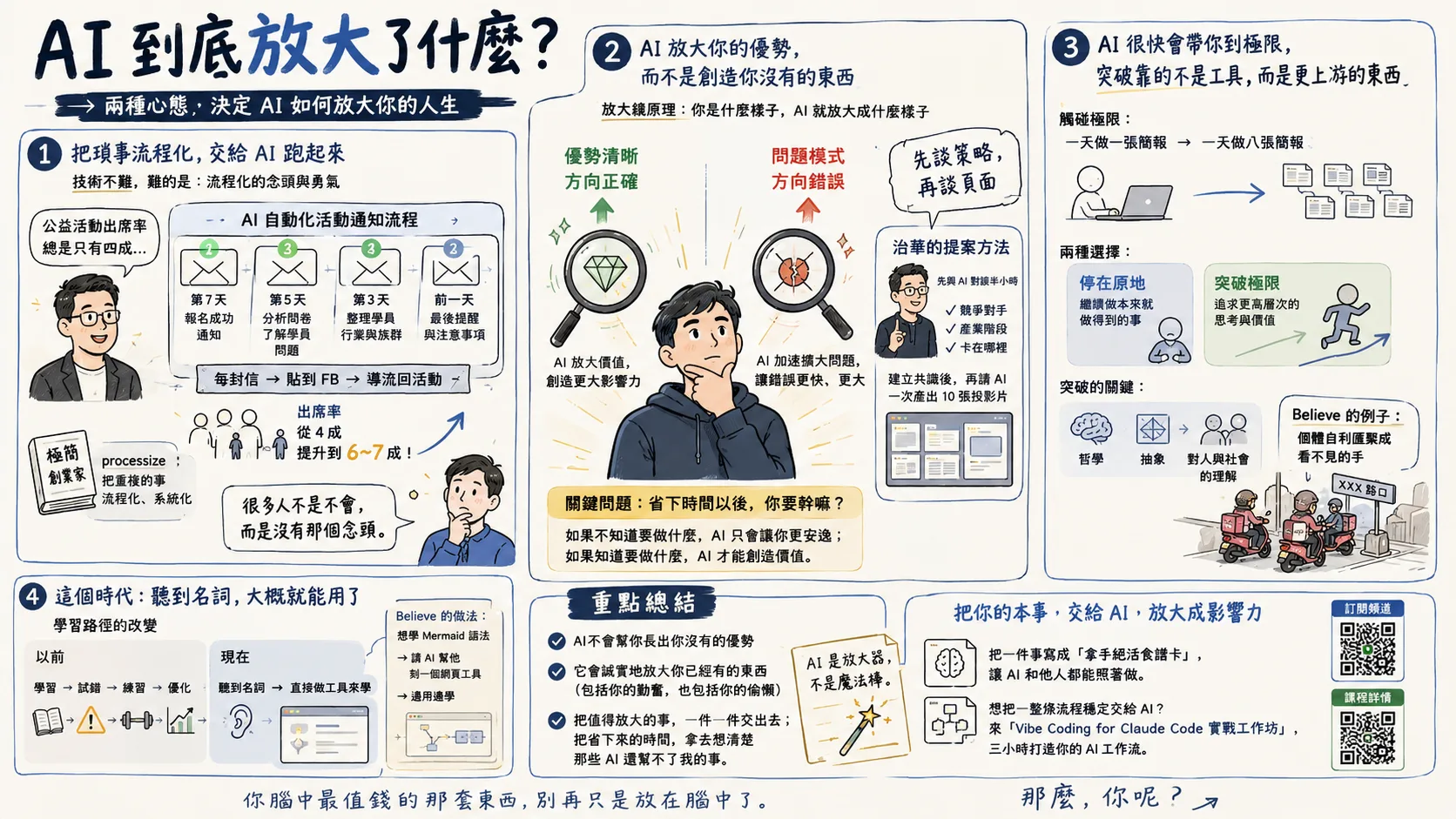
Let me tell you an interesting thing first. Zhihua said that he often organizes charity or free activities, and the biggest pain point is the attendance rate: 100 people have signed up, but I don’t know how many people will come? He later did something that I think is worth learning. He asked AI to help him automatically send four notification letters on the seventh day, the fifth day, the third day, and the day before the event. The first letter is that the registration is successful, the second letter is to download the registration questionnaire and analyze the problems that the students want to solve this time, the third letter is to sort out which industries and which ethnic groups will come this time, and the last letter is a final reminder. And every time he sent it, he copied and pasted it into a Facebook post, and then directed the traffic back to the event. As a result, the attendance rate increased from the normal 40% to 60-70%.
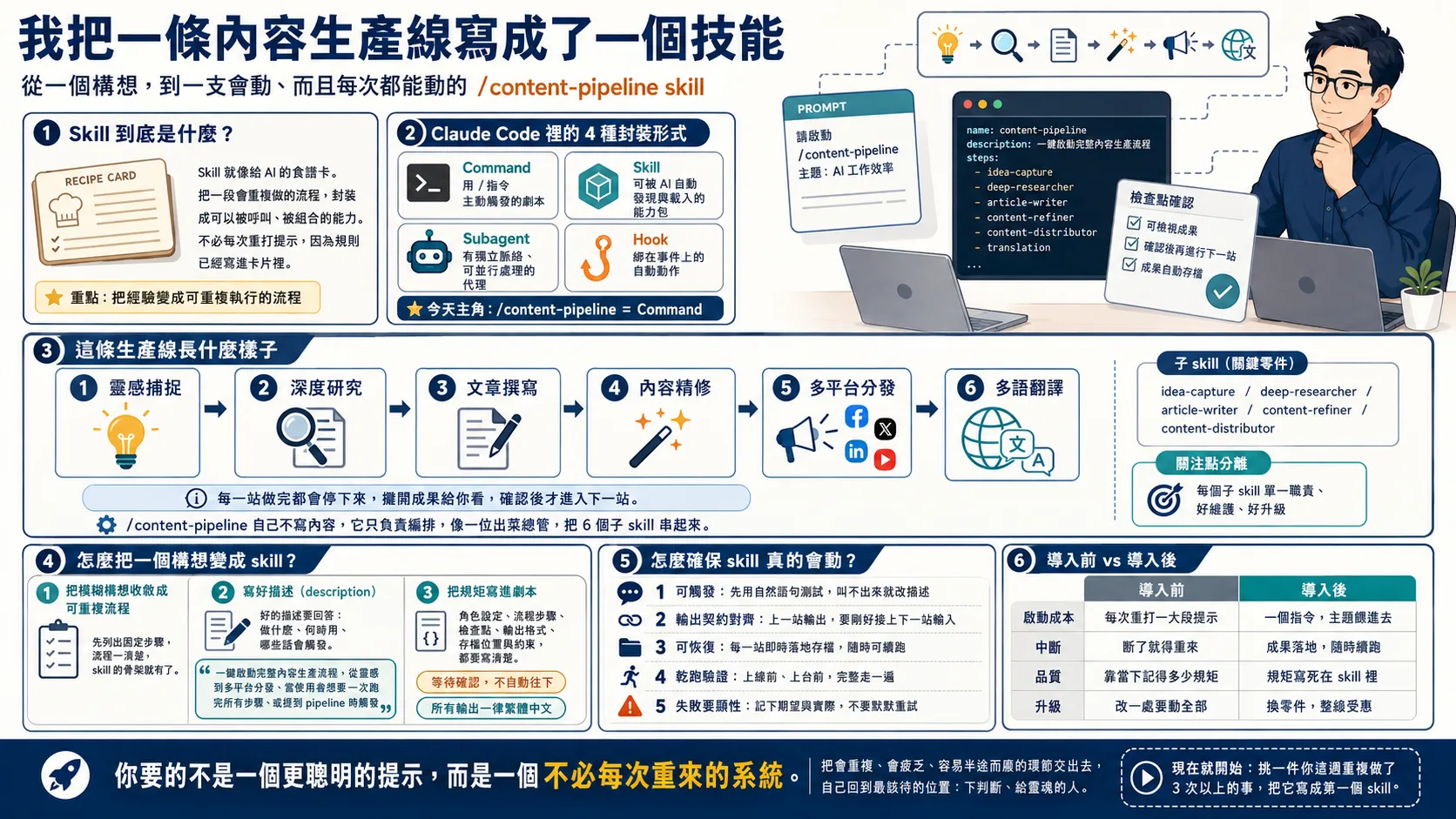
After listening to it, I found it very interesting. Technically speaking, it’s nothing. The difficult thing is another thing: does he have the idea and courage to streamline and systematize this matter? Hearing this, it reminded me of processize talked about by Sahil Rawinja in the book “The Minimalist Entrepreneur” (https://www.eslite.com/product/1001127112682338930006). As a side note, Sahir Lavenja has also developed a complete set of Claude Code Skills. Friends who are interested can try it.
Zhihua said politely that he didn’t understand the technology very well at first, so he asked AI directly. Unexpectedly, he got it right after just asking. This reminds me of many professionals who have a bunch of trivial tasks that need to be done again every time, but there may be very few people who actually hand it over to AI. I guess it’s not that I won’t, but that I don’t have the thought. This is what I have always emphasized: The starting point for making full use of AI is not to choose tools, but to dismantle your workflow.
Lesson 2: AI is a magnifying glass, not a magic wand
The second thing that made me chew on it over and over was a sentence from Believe: AI can amplify your advantages, but those advantages must be already formed. He used the analogy of new venture capital. If you invest money in a business model that is already problematic, AI will only accelerate the expansion of that broken thing. This is almost exactly the same as what I have been telling students in the past two years. Many people think that AI is a magic that can turn you from zero to one. In fact, it is more like a magnifying glass. It magnifies what you are like.
This is why the same set of AI tools will divide freelance workers into two ends: putting a magnifying glass on strengths will magnify the value, and putting a magnifying glass on weaknesses will only magnify flaws.
After saving time, what will you do with it?
Following this train of thought, the two of them also talked about a more heart-wrenching question: What will you do after you save time? Zhihua said that he now does proposal briefings and rarely does it himself, and AI also helped him win consulting projects. But he particularly emphasized that he would never tell AI what to put on the first page and what to put on the second page. Instead, he would talk to AI for half an hour to talk about the company’s competitors, industry stages, and where it was stuck, and then build a consensus before asking it to produce ten slides at a time.
Well, I agree with this order: first talk about strategy, then talk about pages. This is actually the same thing as the workflow transformation I talked about in Review of “When AI Meets Briefing”. Let’s go back to the question just now. If you don’t know what to do with the two hours saved, AI will only become a tool that makes you more comfortable, and will not become a tool that creates value.
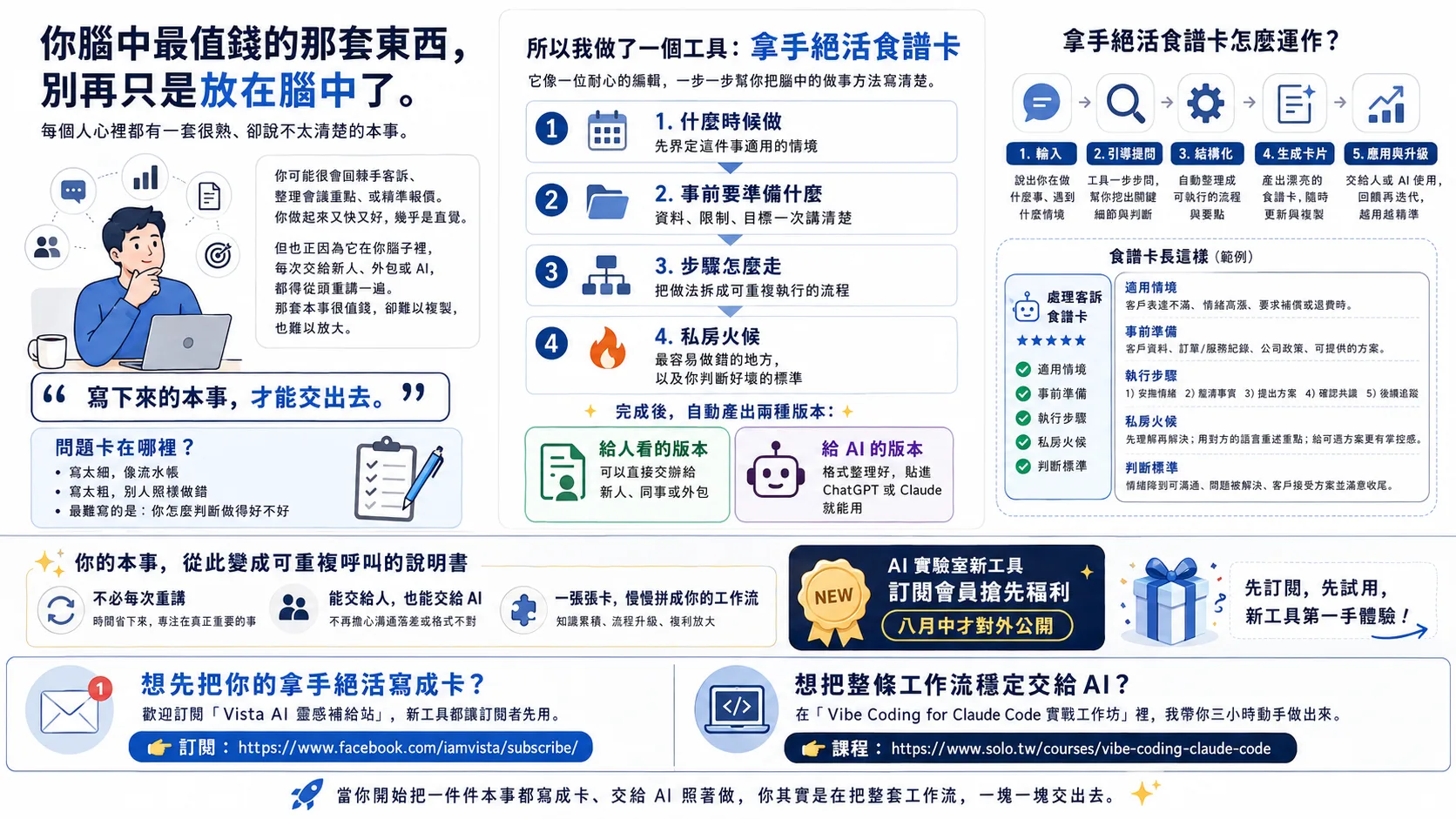
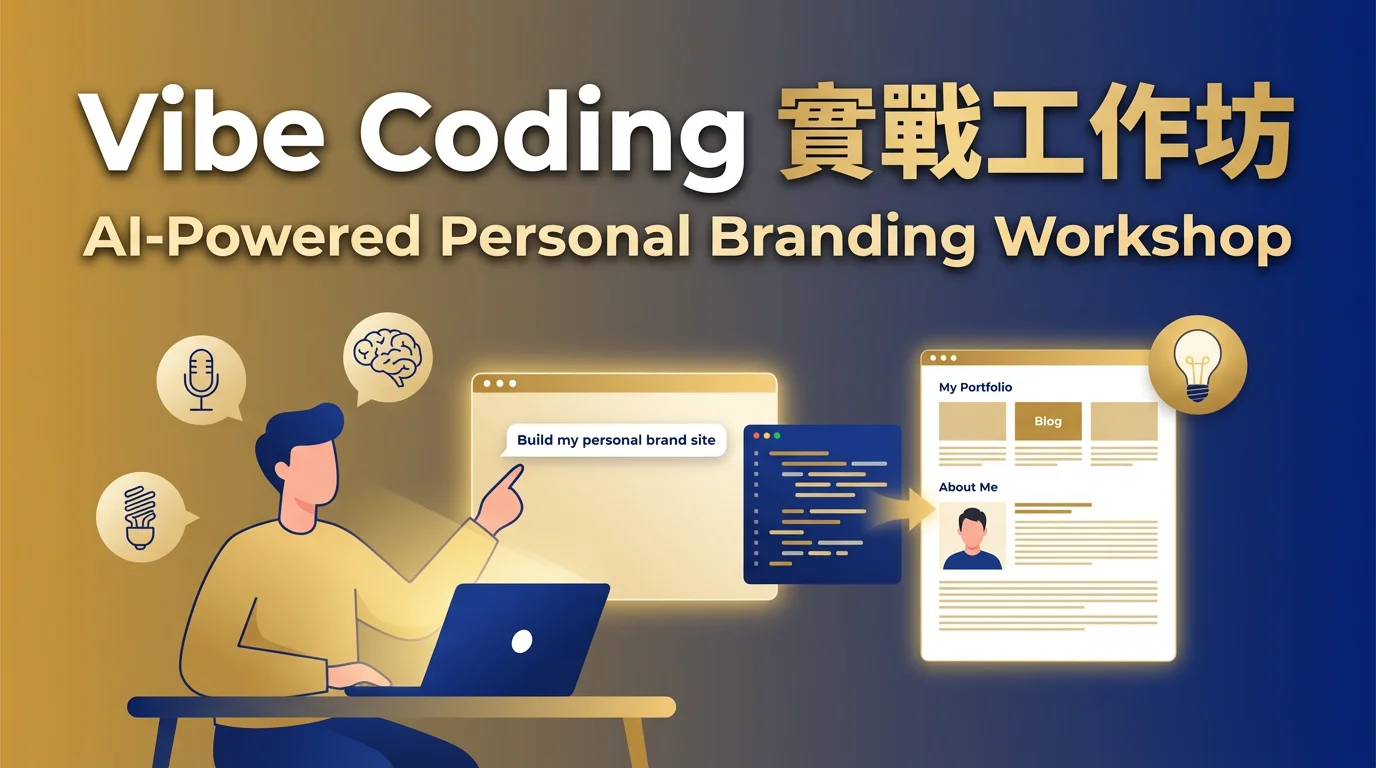
**Turn ideas into works, this live broadcast gave me the deepest reminder. ** If you also want to learn to describe your ideas in everyday language and let AI turn your ideas into an online work with a website on the same day, welcome to my Vibe Coding Practical Workshop: zero foundation, no engineering background required, and you can take home a work that truly belongs to you in three hours.
Lesson 3: AI will quickly push you to your limits
Believe also has a piece to share that I also like very much. AI will quickly push you to your limits, he said. For example, I used to make one briefing a day, but now I can make eight. That’s the limit. But after reaching the limit, people will be divided into two types, one will stop there and continue to only do what he can already do, and the other will find ways to break through the limit. To make a breakthrough, we no longer rely on tools, but on something more upstream: philosophy, abstraction, and understanding of people and society.
He gave a very real life example, why foodpanda’s delivery guys always gather at a certain street corner, that is actually the invisible hand formed by individual self-interest. I was very touched when I heard this, because this is exactly the same thing I have been thinking about these days: when the threshold of tools is wiped out by AI, the real value is no longer execution, but the ability to ask questions and your own voice.
When you hear a noun, make a tool on the spot to learn it
He demonstrated a move that I think best represents this era. In order to learn a flow chart grammar called Mermaid, he did not read the tutorial, but directly asked AI to help him carve a web page tool and learned while using it. He said something very thought-provoking: In this era, if you hear a noun, you can probably use it. In the past, our learning path was to learn first, then try and make mistakes, then practice, and then optimize. Now, after hearing the noun, we make a tool on the spot to learn it.
This experience is all too familiar to me. A while ago I can’t compose, but I used AI to make a piano song that I could play. That experience made me more certain: what is truly scarce is never skills, but judgment. When everyone can make similar things, taste will be your last moat.
Finally, AI honestly amplified me
After listening to this live broadcast, I didn’t learn much new knowledge, but what I took down was a reminder. AI will not help you develop advantages that you do not have, but it will honestly amplify what you already have, including your diligence and laziness.
What I want to do is to continue to output those things that are worthy of amplification one by one; and then use the saved time to think clearly about those things that AI cannot help me with.
So, what about you?