
Verify first, then build: Dismantling Ali Abdaal’s million-dollar career roadmap, a reverse reminder for knowledge workers
*▲ First make sure someone is waiting for you on the other side before building that bridge - this is the sentence I want to share with you most after re-watching Ali Abdaal. *
Over the years, I have seen too many videos with the slogan “Teach you how to make money”. Most of them I turned off after watching the beginning. It’s not that they miss the point, it’s that I no longer believe in the romance of “as long as you make the product, the world will naturally make way for you.” So when I clicked on Ali Abdaal’s “If I Wanted to Make My First $100K in 12 Months, I’d Do This” (If I Wanted to Make My First $100K in 12 Months, I’d Do This), I originally just wanted to confirm my prejudice.
Unexpectedly, after reading it, I was struck by one of the contrarian concepts. And that moment just reminded me of myself. I’ll attach the original film here first, and you can watch it and compare it with my subsequent disassembly:
Let’s look at the whole picture first: breaking down making money into five identifiable stages
Ali Abdal draws the growth of a lifestyle business as a curve from low to high, and finally flattens out, and marks five stages along the line: ideation, verification, momentum, and then leverage and freedom. He specifically reminded that the key nodes of revenue are not linear, but jump in units of three times - one hundred thousand, three hundred thousand, one million, three million - every time it doubles, the method that originally worked well will begin to fail, and the entire game rules will be forced to be rewritten.
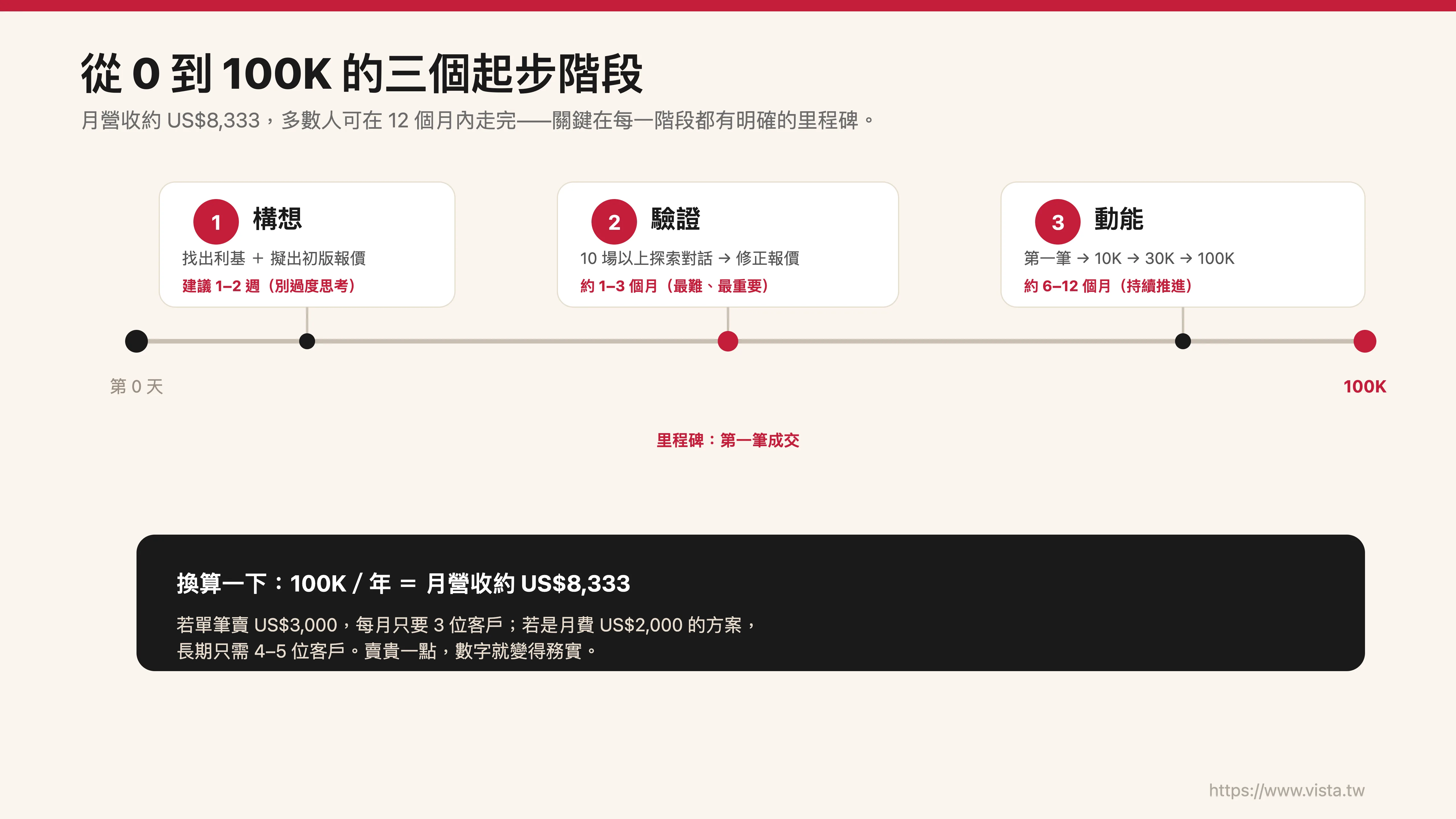 *▲ From 0 to 100K, the real difficulty lies in the first three starting stages: converging the idea, verifying it, and then cultivating momentum. *
To be honest, this observation is actually very delicate. It explains something that I often see in the corporate consulting field: many people are not stuck in not working hard enough, but stuck in using a 100,000-yuan-scale strategy to support a million-dollar business. Having said that, when the stage is different, the tools have to be changed; it’s just that most people don’t realize it until they hit a wall.
But frankly, this curve is just the beginning. What really made me stop and chew on it was the next sentence.
The most worth copying sentence in the entire video: What you sell is a quote, not a product.
Ali Abdal used his own book as an example: the product is the text in the book, the content itself; and the quotation is the book title, subtitle, cover and recommendation - it is the packaging. He said that when readers spend money in bookstores or online, what they buy is actually the price, and what they get is the product.
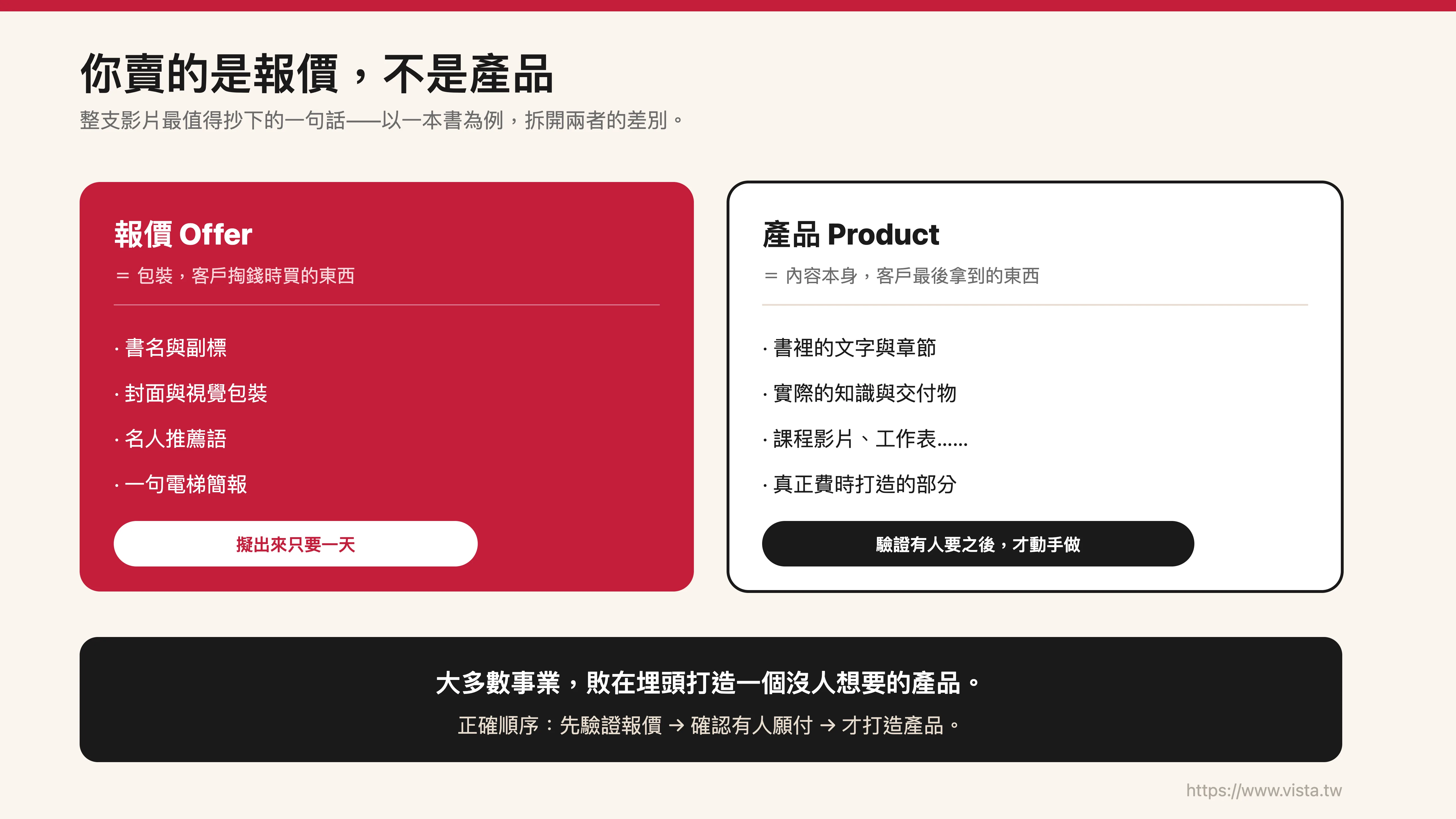 *▲ When customers pay, they are buying the price (packaging and promise); they only start consuming the product after they get it. The order determines what you should do first. *
Therefore, he came to an almost cruel conclusion: most businesses fail, and they fail because they focus on building something that no one wants at all. The correct sequence should be reversed - first spend a day drafting the offer (name, subtitle, or an elevator pitch), then take it to the market to measure the water temperature; wait until someone is really willing to pay, then go back and make the product.
This passage is not difficult to understand, and it reminds me of so many scenes. How many people spend two or three years writing a book, only to find out after it is published that there are no readers; how many people close the door and record the online course to perfection, but no one cares about it when it is put on the shelf. As a result, we mistake “can do it” for “can sell it” and “I think it’s valuable” for “the market is willing to pay.” Ali Abdar quoted a military saying that was adapted from the military and said it very well: [No battle plan can survive contact with the enemy] (https://en.wikipedia.org/wiki/No_plan_survives_first_contact_with_the_enemy) - In the same way, no quotation can survive intact after contact with the market.
To me, this is not only an entrepreneurial mentality, but also a kind of humility as a creator: advancing the time of verification from the completion of the work to the germination of the idea. This is actually the same thing as the Cruel Divide I talked about before - in the AI era, will it be verified that people are being divided into two types?
Six elements of quotation: Translate “I want to make something” into a verifiable proposal
In my opinion, the most effective tool in this video is what he calls the six Ps: Person, Problem, Promise, Plan, Product and Price.
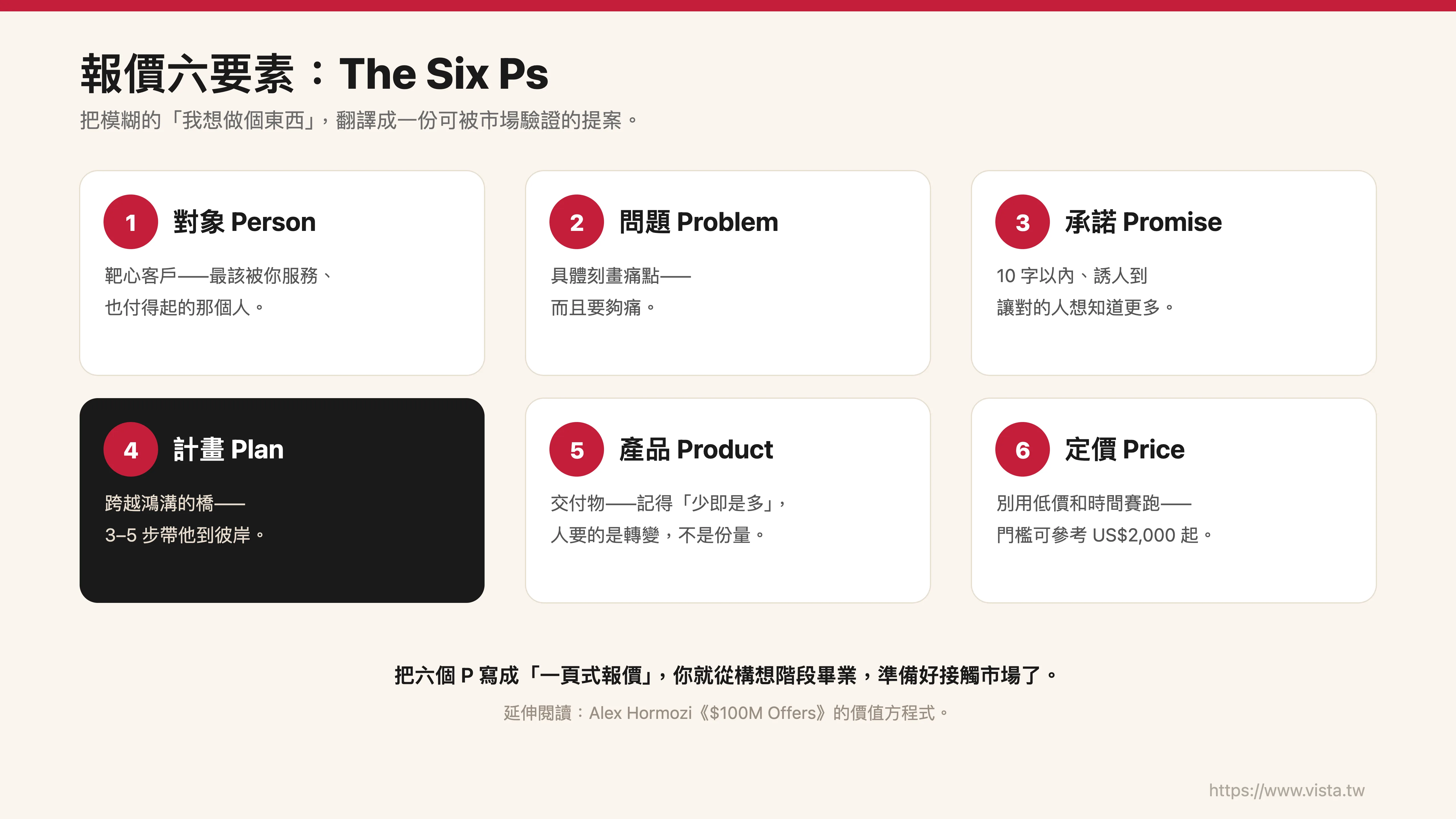 *▲ Six elements of quotation: object, problem, commitment, plan, product, and pricing. Translate the vague “I want to make something” into a proposal that can be tested by the market. *
Well, I particularly like the middle two. The promise should be within ten words and be so enticing that the right person wants to know more, rather than rushing to explain a bunch of provisos; the plan is like building a bridge between two cliffs, taking three to five steps to bring the other person from their current situation to the other side of their dreams. As for the product, he instead reminded that “less is more” - what people want is the change, not the accumulation of information in the two-hundred-hour video. This is a gentle reminder to Taiwanese lecturers and creators who are accustomed to using “give good and give full” to prove their sincerity: What customers remember is never how much you gave, but where you took them.
It’s a little more expensive. How should I read it in Taiwan?
Ali Abdal has repeatedly argued that it is easier to make a million in business by selling expensive things than by selling cheap things. He even defined “expensive” as more than two thousand dollars.
Putting this sentence in Taiwan requires a little translation. Our market size, customer unit price structure and consumer psychology are all different, so it is not pragmatic to stick to that number. But what he really wants to say is not to set the price high, but to stop using low prices to race against time - it’s not that you can’t get rich with cheap things, it’s just that you have to sell more and run longer. For those of us who have to teach, write, and accompany the community at the same time, time is precisely the scarcest asset (this is also what I felt most deeply when reading [“One-person Company Management in the AI Era”] (https://www.vista.tw/blog/ai-era-one-person-company-book-review)). So instead of asking “how much should I order?”, we should first ask ourselves: Have we found a group of people whose problem is painful enough and who can afford it? Price is never an isolated number, but the result of the joint determination of value and object. Regarding this point, I also recommend you to read [Dismantling the secrets of high-priced public courses] (https://www.vista.tw/blog/unraveling-the-secret-of-high-priced-public) - solve the students’ problems first, and the profits will naturally follow.
Before you start selling, figure out who your niche is.
The phrase “a group of people whose problems are painful enough and who can afford it” actually hides the most critical step in the entire roadmap, but one that is most easily skipped: choosing a niche.
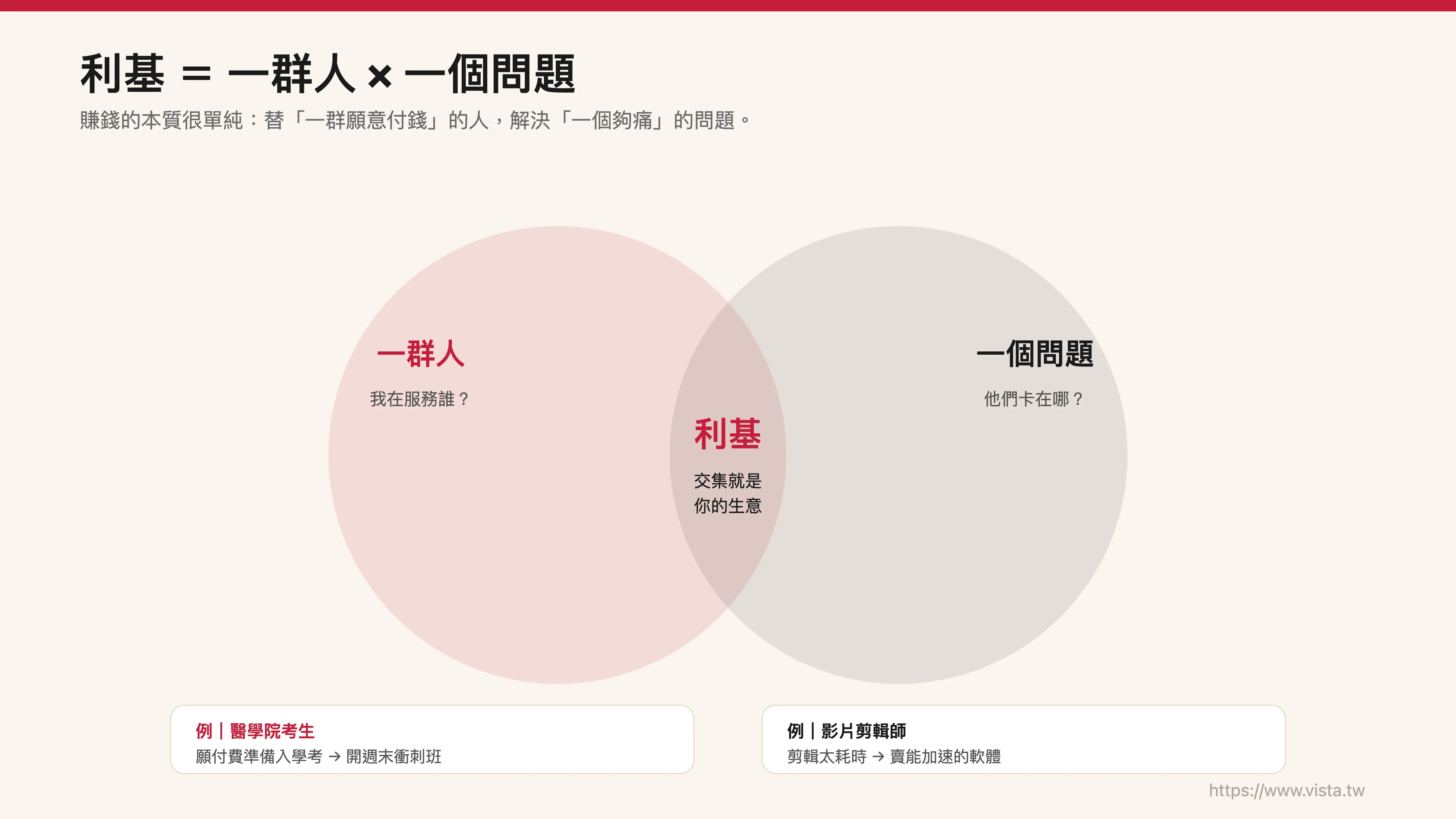 *▲ Niche is not an unpopular topic, but a multiplication: a group of specific people multiplied by an issue they really care about. *
My own understanding is simple: a niche is not “unpopular”, but a multiplication - a group of specific people multiplied by an issue they really care about. Without either side, the offer will fall flat. To a group of people you can’t tell who they are, no one will accept your promise no matter how beautiful it is; to solve a problem that actually doesn’t hurt, even if the target is clear, they won’t pay.
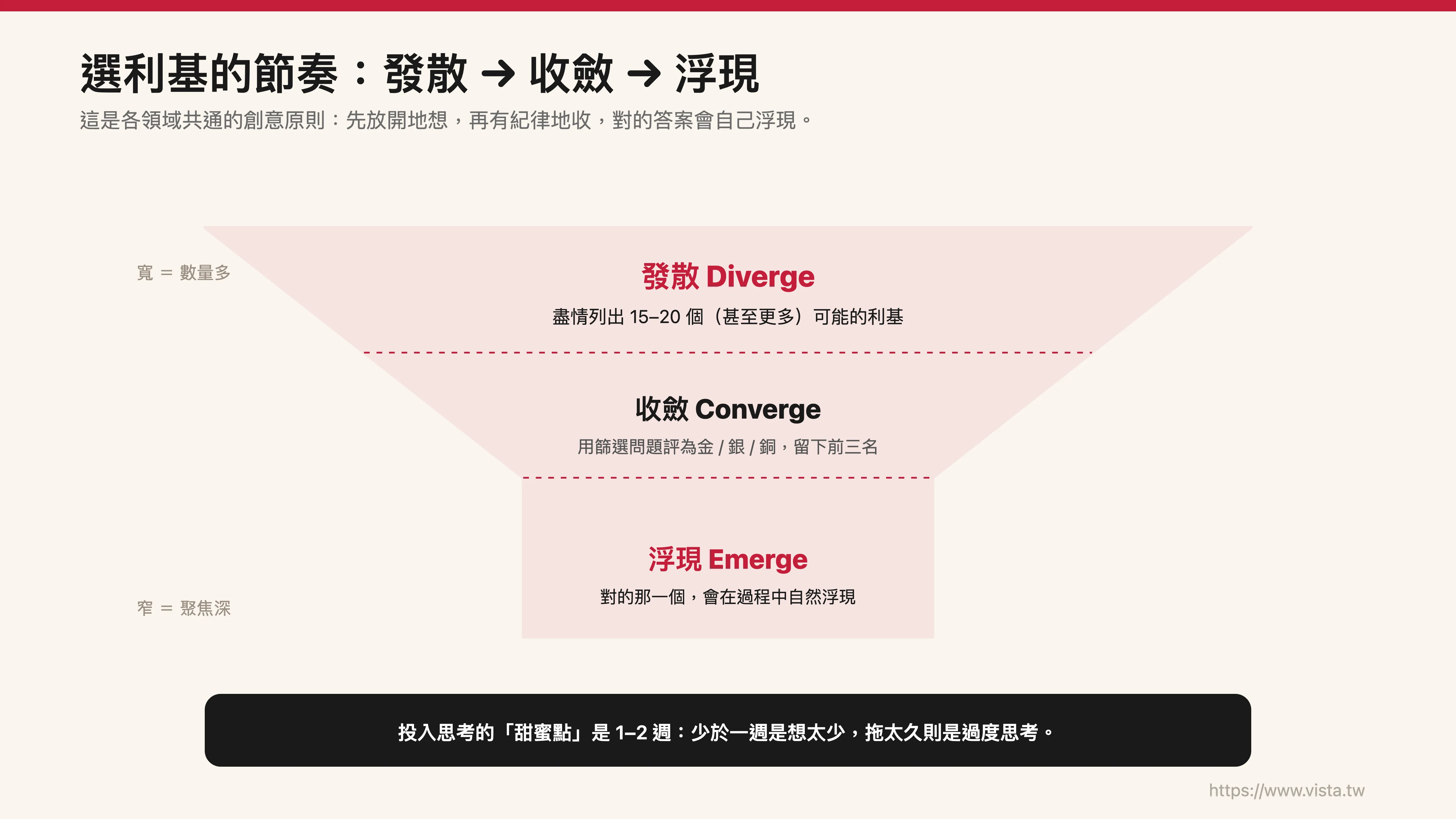 *▲ Choosing a niche is not a one-time decision, but a rhythm: first diverge and think about a few more, then converge and filter, and let the right one slowly emerge. *
More importantly, choosing a niche is not a decision made before starting work, but a rhythm: first diverge, and try to list as many possibilities as possible; then converge, use a few criteria to filter out the obviously wrong ones; and finally, let the really right one slowly emerge during the back-and-forth dialogue between you and the market. People who change the track four times are not necessarily worse than those who get it right once - I wrote The Story of Huang Yaojun, which is exactly the reason.
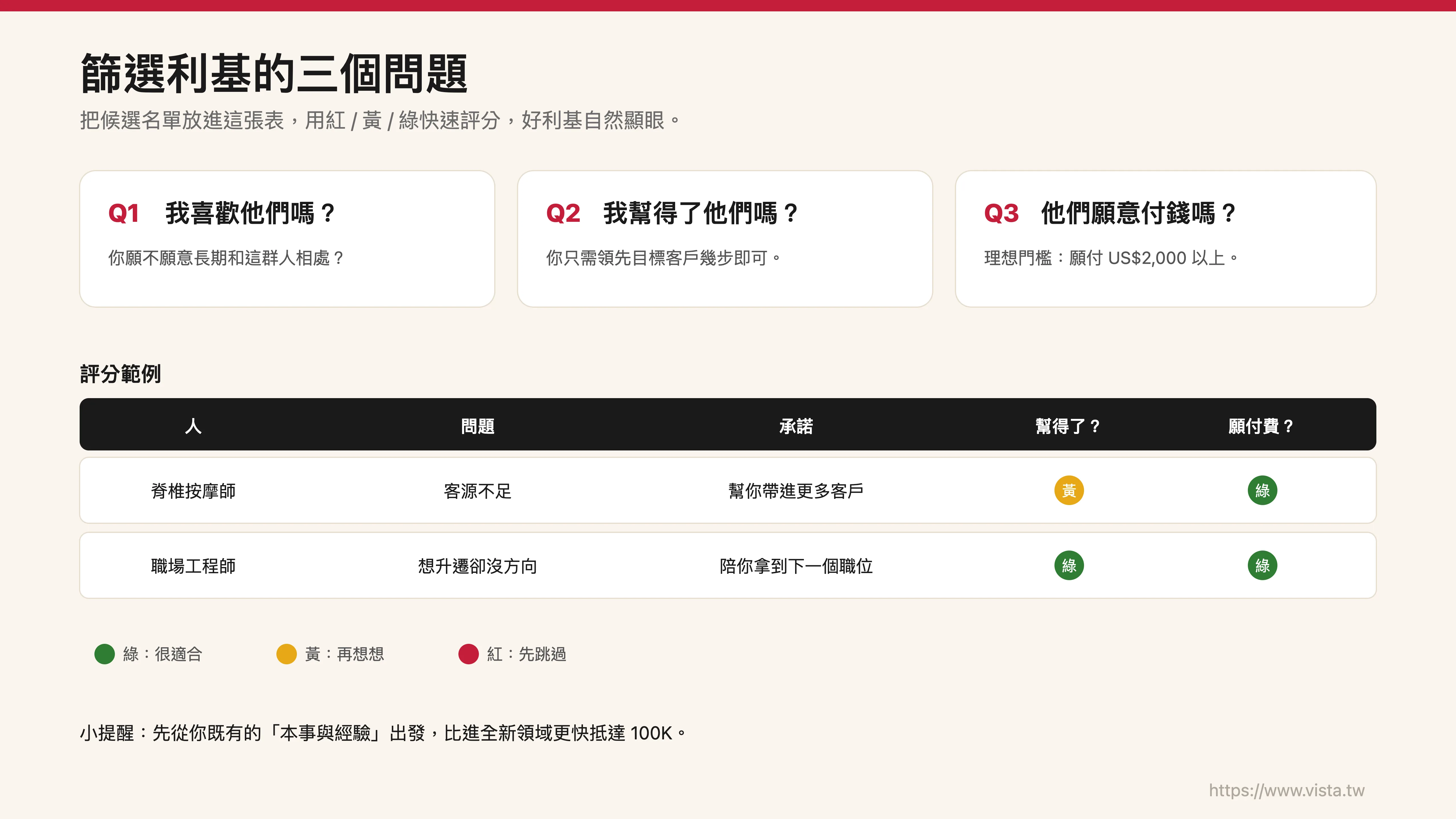 *▲ When converging, I will use three questions to score each candidate niche: Can this group of people find it? Is this problem painful enough? Can they afford it? *
So, what should we use as a sieve when converging? I am used to using three questions to score each candidate niche: Can I find and contact this group of people? Is this problem so painful that they are willing to pay to solve it? And can they afford it? If you answer “yes” to all three questions, then this niche is worth your time. This also echoes what I have been reminding everyone in Vista Reading Club: it is far more important to carefully build your own niche for resumption of business than to rush to start selling.
Don’t feel like you’re selling: Three conversational frameworks
For many friends who are thin-skinned and afraid of sales, the three frames of exploratory dialogue in the film are worth remembering.
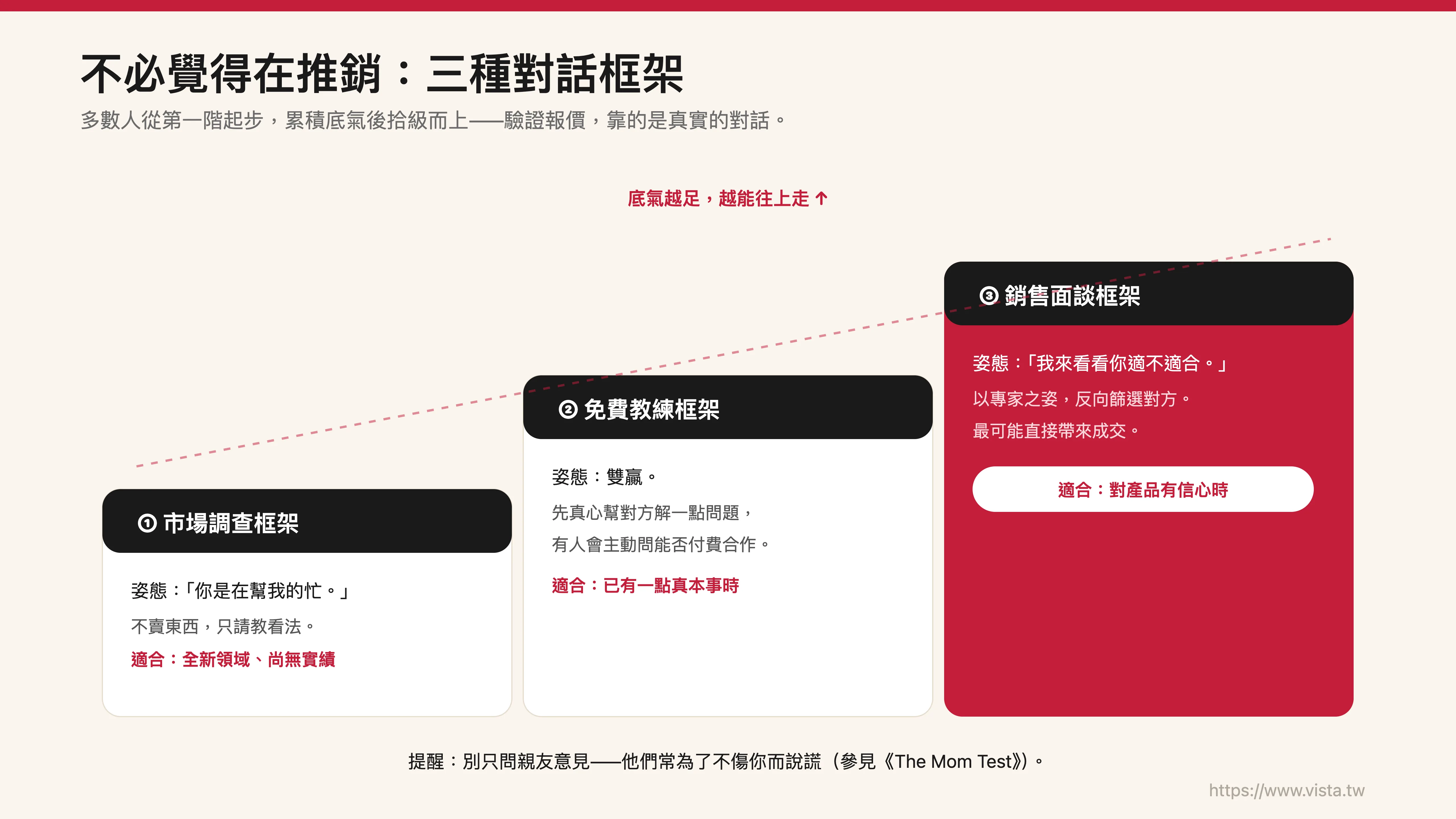 *▲ The three dialogue frameworks are like a ladder: market research, free coaching, and sales interviews—most people start from the first level and climb up the stairs after accumulating confidence. *
The first is a market research framework: “I’m not trying to sell you anything, I just want to ask for your opinion.” The attitude is humble and suitable for you when you are still a novice and have no actual results yet. The second is the free coaching framework: you first sincerely help the other party solve some problems. In a win-win situation, someone will take the initiative to ask if they can pay to cooperate with you? The third type is the sales interview framework: as an expert, you look back and see if the other person is suitable to join? The three frameworks are like a ladder. Most people start from the first step, accumulate some confidence and then climb up.
But here comes the question: Where can we find people to carry out these conversations?
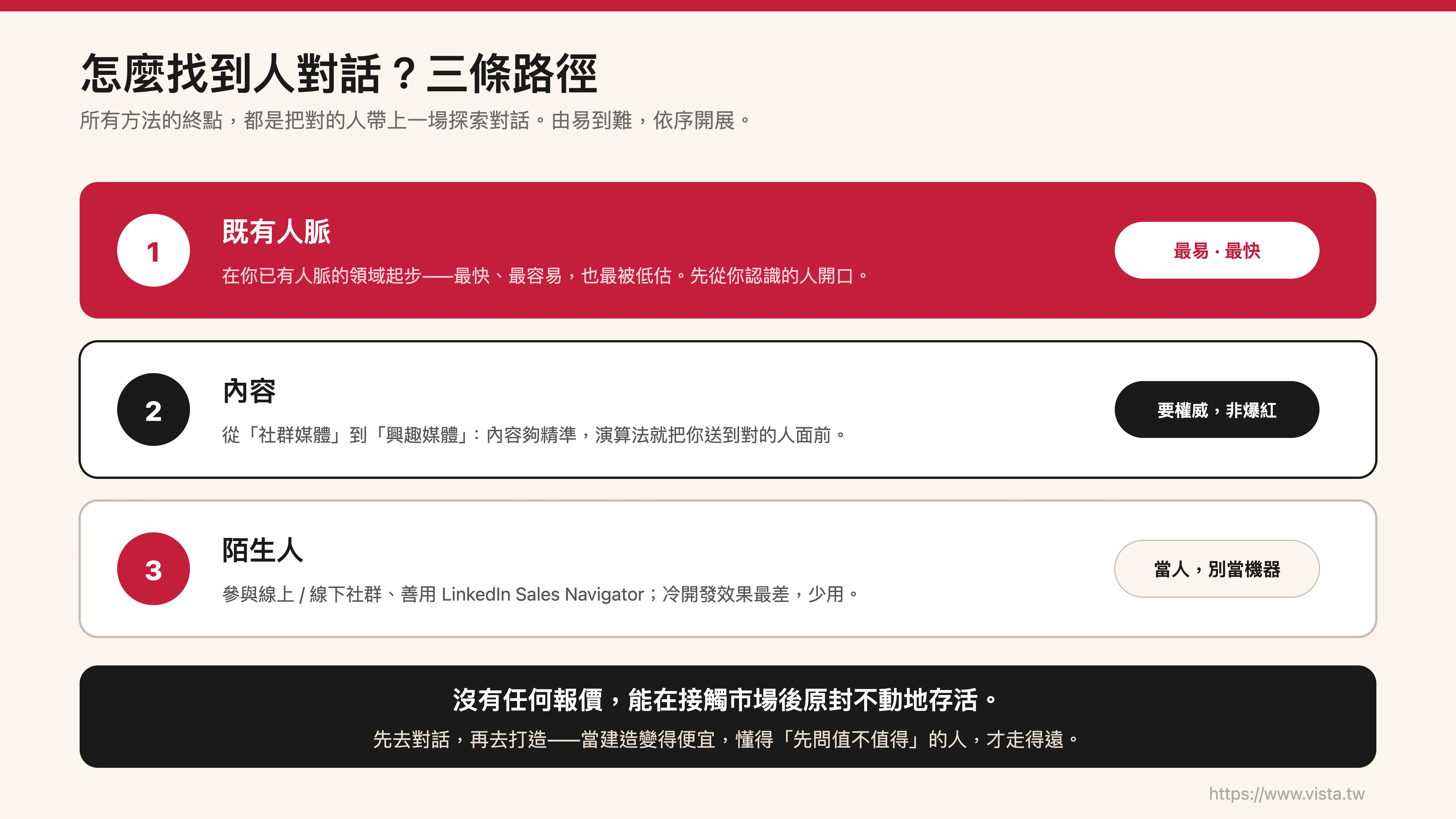 *▲ There are three ways to find people to talk to: start from existing connections, go to a community where the right people gather, or use content to attract the right people. *
I would take three paths: the first is to have existing connections, starting with people you already know and trust you, which has the lowest threshold; the second is to go to places where the right people gather, such as communities, forums, and clubs, where you can stay and sincerely participate, instead of posting advertisements; the third is to attract people with content, keep writing and speaking, and let the right people take the initiative to approach you because of your views. Here, Ali Abdal also buried a reminder that is easy to ignore: Don’t just ask relatives and friends for their opinions, because they will probably lie to avoid hurting your heart (this is the core of the book [“The Mom Test”] (https://www.momtestbook.com/). The real verification requires exposure to real markets and real people.
If you already have a concept that you want to verify, but don’t know how to actually go through the conversation - from drafting a quote, finding the right person, to turning it into real income, this is exactly what I want to do with you by setting up [“Concept Realization Training Camp”] (https://www.solo.tw/courses/concept-monetization-bootcamp). Instead of immersing yourself in guessing alone, it is better to have someone with you to push your ideas to the market step by step.
From social media to interest media: the role of content has changed
As someone who has been talking about content strategy for many years, I am particularly impressed by the way he redefines content. He said that this era is no longer social media, but interest media - in other words, the algorithm has become so smart that as long as your content accurately solves a specific problem for a certain niche, it will automatically push you to the right people.
In other words, the purpose of content is no longer to become popular, but to establish authority in a niche. You don’t need to be seen by everyone, you just need to be seen repeatedly by the right group of people. This is in the same direction as the [content flywheel] (https://www.vista.tw/blog/ai-content-flywheel) thinking that I have always advocated: instead of chasing the fireworks of traffic, it is better to accumulate the compound interest of trust. After all, in this era of AI-sensing articles flying all over the sky, being able to be trusted and remembered is the real scarcity.
What this video doesn’t say
Of course, I also retain some sobriety. After all, this roadmap is highly focused on high-margin, low-delivery-cost businesses such as coaching or information products, and may not be fully transferable to physical, manufacturing or asset-heavy fields. It is also tinged with survivor bias - we see students who have succeeded, but we cannot see those who followed the same steps but failed. And behind those ten or thirty seemingly light dialogues is intensive emotional labor and the tolerance of rejection. Ali Abdal described it too lightly.
But these reservations do not detract from its value. It is more like a map than a guarantee: it tells you the direction and terrain, but you still have to walk the road yourself.
Closure: When construction becomes cheap, verification becomes expensive
After reading this, the most distant thing I thought about was actually related to AI.
When generative tools allow the cost of “making something” to quickly approach zero, and you can produce a finished product in a few minutes that would have taken several days, the truly scarce and expensive ability is to judge “whether this thing is worth doing.” In other words, the bottleneck is moving entirely from production to verification. What I said in The prompt words will expire, but you won’t is the same thing: when execution becomes cheap, what is valuable is the ability to ask questions and judge. The contrarian wisdom of Ali Abdal’s film is therefore more important, not more outdated, at this moment in 2026.
As for “making things cheaper”, what I have experienced most in the past year is vibe coding - using natural language to command AI to directly turn ideas in your mind into active websites, tools or product prototypes. The barriers to building are lower than ever, which makes “verification first” even more critical: you can build it in a weekend, but you should first confirm whether anyone really wants it.
*▲ If you also want to make the “construction” step cheaper and faster, welcome to my [Vibe Coding Practical Workshop] (https://www.solo.tw/courses/vibe-coding) - I will take you step by step to use AI to make your ideas, so that you can have enough time to focus on the really expensive “verification”. *
Talk first, then build; first make sure someone is waiting for you on the other side, then build the bridge. This is not only a set of entrepreneurial processes, but also an attitude towards facing this era - in a world where everyone can produce quickly, only those who know how to ask “whether it’s worth it” will go far.
And if what you want is not just to make something, but to really push a concept to the market and receive the first money, welcome to join my online companion program - I will turn the “verify first, then build” discussed in this article into a rhythm that you can take with you and do.
👉 Understand and sign up for the “Concept Realization Training Camp”
Dear friends, let’s meet in class.
(This article is the compilation and reflection after watching Ali Abdaal’s “If I Wanted to Make My First $100K in 12 Months, I’d Do This”.)