Stop chatting with AI: How small and medium-sized enterprises use AI Agent to improve operational efficiency
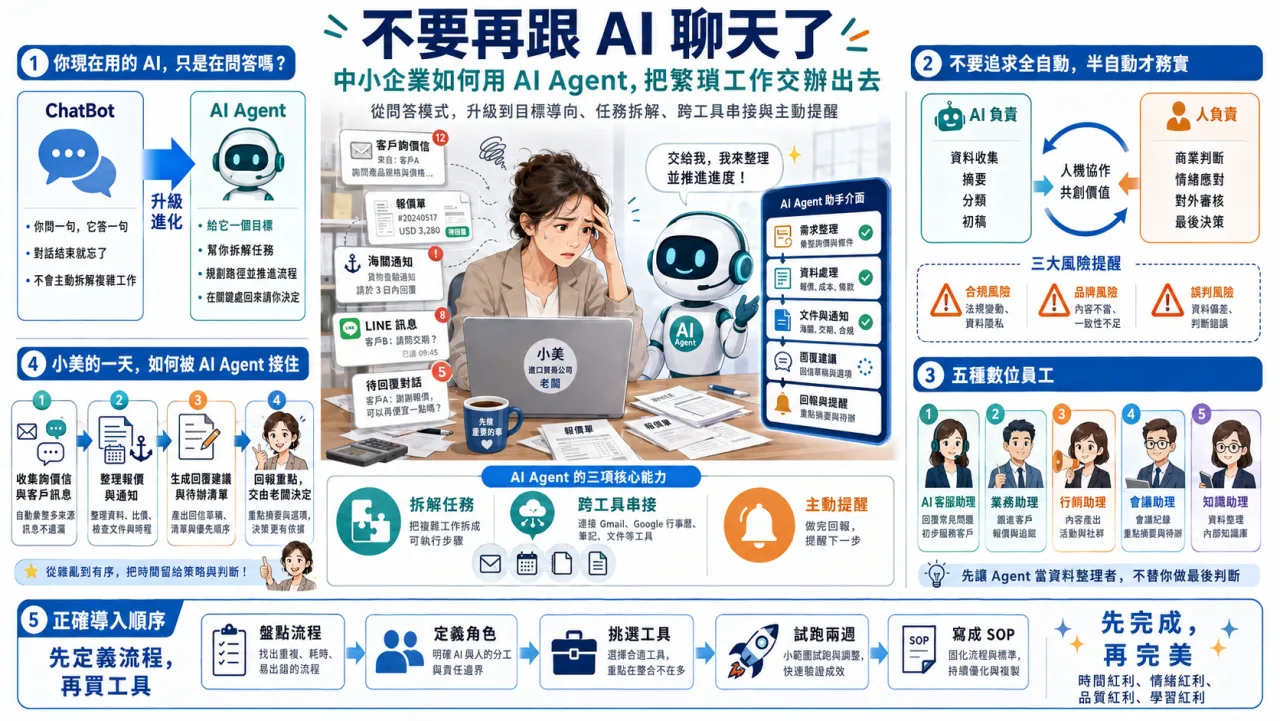
Every morning, as soon as Xiaomei, the proprietress of a trading company, sits down and turns on her computer, the screen is filled with excitement: customer inquiry letters, quotations, customs notices, and a bunch of unfinished conversations on LINE. It’s not that she doesn’t know how to use AI. Over the past two or three years, she has long been accustomed to asking ChatGPT to help with drafting and copywriting. But after a busy day, she still had a question in her mind: Why didn’t things really seem to get better after using AI?
This day of Xiaomei is actually the epitome of many small and medium-sized enterprises in Taiwan. We don’t lack AI tools, what we lack is a new way to use them. If you have the same feeling, then today I want to talk to you about a key turning point: **From “chatting with AI” to “assigning tasks to AI Agent”. **
Is the AI you are using now just for Q&A?
Since the advent of ChatGPT in November 2022, everyone is familiar with AI. But please think about it honestly: Are you using AI just to ask and answer questions? You ask it a question, and it answers you; you ask it to write a copy, and it writes a copy; and if you ask it to draw a chart, it draws a chart. This is the “question and answer model”: you ask, it answers.
Q&A is certainly useful, but it has two inherent limitations. First, it often forgets once the conversation is over; second, it will not take the initiative to help you break down a complex task. However, our real work is never a single task that can be explained in one sentence, but a series of interlocking processes that require several tools to be completed.
Entering 2026, the focus is no longer on how enthusiastic you chat with AI, but on whether you can let it finish a whole thing. This is the most fundamental difference between AI Agent and traditional chatbots.
What’s the difference between ChatBot and AI Agent?
To put it simply: the traditional chatbot is “you ask it and it answers”; the AI Agent is “you give it a goal, it helps you break down the task, plans the path, executes part of the process, and then goes back to remind you to take the next step.”
It can advance several steps simultaneously in the background and stop at key points to ask for your opinion. It will do the repetitive and trivial things for you; it will not step on the truly important decisions without authorization, but will hand them over to you for decision-making. In other words, it’s more like a colleague you can trust than a machine that just talks back.
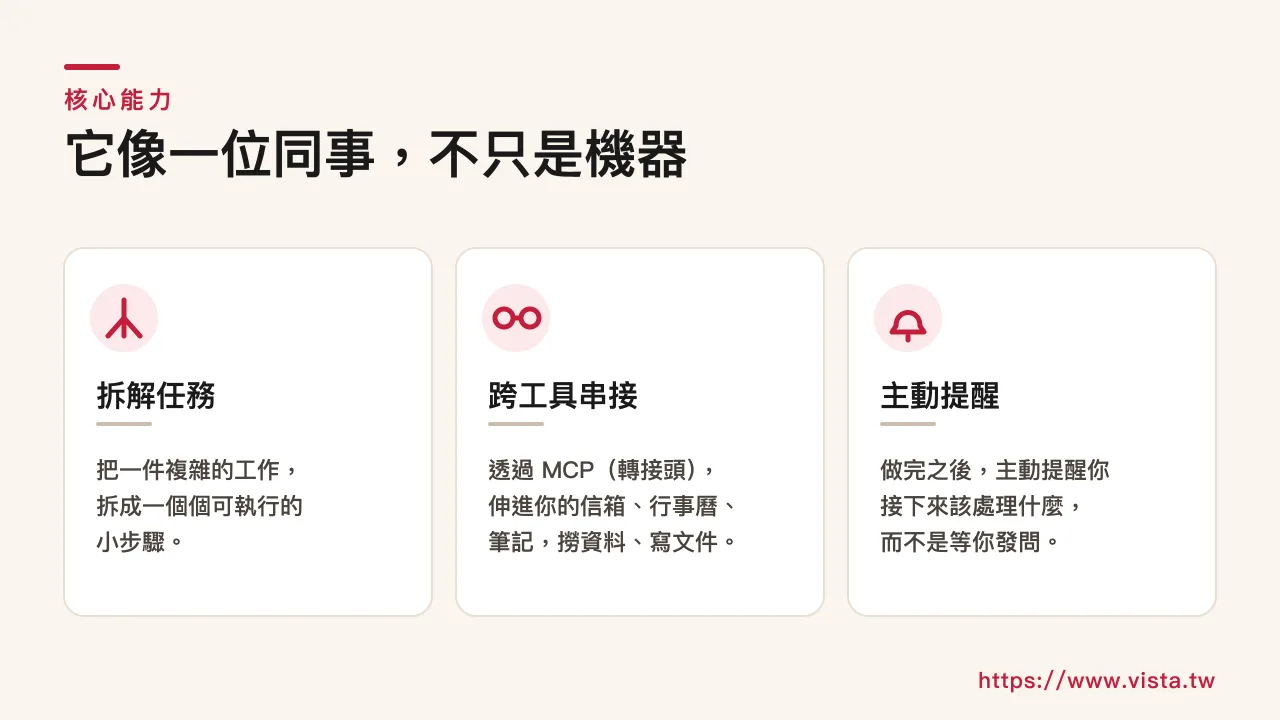
AI Agent has three core capabilities, which are worth remembering:
- Disassembly Task: Break down a complex task into executable steps.
- Cross-tool connection: Through a technology called MCP (you can think of it as an “adapter”), AI can reach into your Gmail, Google Calendar, and note-taking software to help you retrieve data, check information, and write documents.
- Active Reminder: After finishing, it will proactively remind you what to do next.
I have a team of virtual secretaries on my computer. Every morning I turn on the computer and say good morning to the AI, and the head secretary will appear. The members of the dispatch team will help me check which important meetings there are today, which letters have not been answered, and which things are still waiting for me to deal with. Think about it, what would it be like if you had such a considerate digital helper who could sort out everything for you every day?
Don’t pursue full automation: adopt the “semi-automatic” philosophy
After hearing this, you may be thinking: AI Agent is so powerful, why not just leave it all to it? I have to be honest: technically it can be done, but should it really be done? My suggestion is that semi-automatic is a more pragmatic and safer approach. **
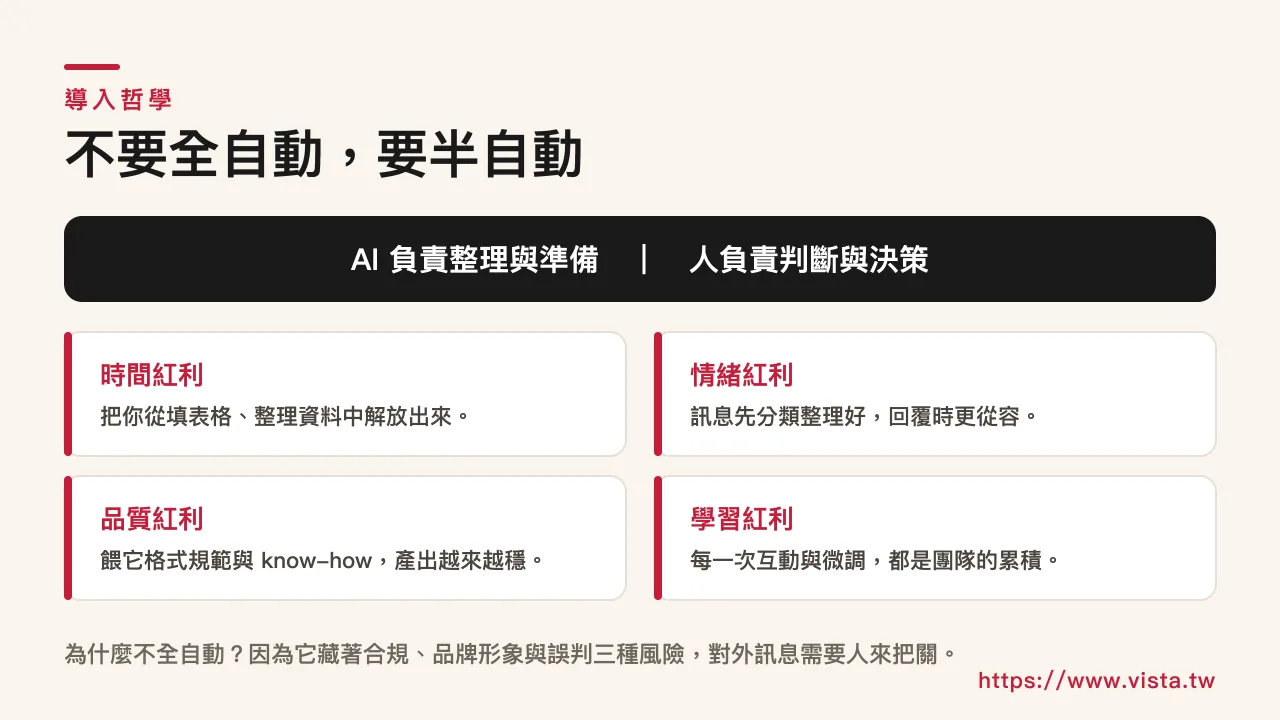
Its spirit is simple: **AI is responsible for sorting and preparation, and humans are responsible for judgment and final decision-making. **
Why not take the leap to full automation? Because there are three risks hidden in full automation: compliance and regulatory risks, brand image risks, and misjudgment risks. No matter how smart the AI Agent is, it will inevitably have hallucinations or misjudgments. All documents and public information that are to be released to the outside world need to be finalized and proofread by humans.
Therefore, the division of labor can be divided like this: data collection, abstracts, and first drafts can be left to AI; business judgment, emotional interpersonal response, and review of external messages can be left to humans.
Many people think that the only benefit of introducing AI is “saving time”, but this actually underestimates it. Semi-automatic brings at least four bonuses:
- Time Bonus: Free you from filling in forms and sorting out information.
- Emotional Bonus: When AI organizes and categorizes customer messages first, you will feel much more relaxed when replying.
- Quality Bonus: Feed it your format specifications and know-how, and the output will become more and more stable.
- Learning Bonus: Every interaction and every fine-tuning is an accumulation for you and your team.
Small and medium-sized enterprises can first introduce these five types of “digital employees”
It doesn’t have to be done in one go. According to my observations in industry coaching, these five roles have the lowest threshold and are the safest: **AI customer service assistant, business assistant, marketing assistant, conference assistant, and knowledge assistant. **
They have one thing in common: each one is a “data organizer” and does not make the final judgment for you. So let the Agent tidy up the information first, and the quality of your and your colleagues’ judgment will naturally improve accordingly. Just follow a few principles when designing: single-point breakthrough, fixed output format, retaining manual levels, and weekly fine-tuning and iteration.
A few real cases may give you a better picture:
Interior Design Company (8 people): Customer needs are often vague, and the boss has a headache every time he receives an inquiry. Later, a business assistant was hired to sort and filter the customer’s LINE and emails, so that the boss could see at a glance whether the other party was interested in price, style or materials, and even generated three versions of reply directions for him to choose from. As a result, responses become faster, customers feel more valued, satisfaction increases, and the boss’s work pressure decreases.
Central Machinery Equipment Factory (80 people): Overseas after-sales service problems are very scattered. As long as the two senior engineers are busy, the customer’s reply time will be very long. They integrate product manuals and technical information into an AI knowledge base, and use AI to provide first-line responses. More than 70% of problems can be solved immediately. What’s more valuable is that this process slowly extracts and precipitates the know-how in the minds of senior engineers into the company’s assets.
Local tourism operators: By stringing together scattered moments and tourism information that were originally separate and independent, and introducing AI recognition and personalized recommendations, not only did they see customer behaviors and trends that had been ignored by intuition in the past, but their revenue also grew accordingly.
You will find that the things these companies do right are very similar: sorting first, then importing, semi-automatic division of labor, and weekly update and review. **
Dispelling three common myths
Many bosses are hesitant to take the first step because they are often stuck by three misunderstandings:
- “Is AI Agent expensive?” In fact, it is not the case. The entry-level versions of most AI tools now are quite affordable.
- “Do you need to be able to write programs?” No. Even liberal arts students and people with humanities and social backgrounds can get started, because you use natural language to tell it. As long as you can type Word and use Excel, you will definitely use Agent.
- “Is importing a big project?” It doesn’t have to be complicated at the beginning. A better approach is for the boss himself or one or two supervisors to try it first, and then share the experience with colleagues before deciding how to promote it comprehensively.
Correct import sequence: define the process first, then buy tools
I go to many places to teach or serve as a consultant, and the most common question I get asked is “Which tool is better and which software should I buy?” But the focus is not on the tools. Please remember this order:
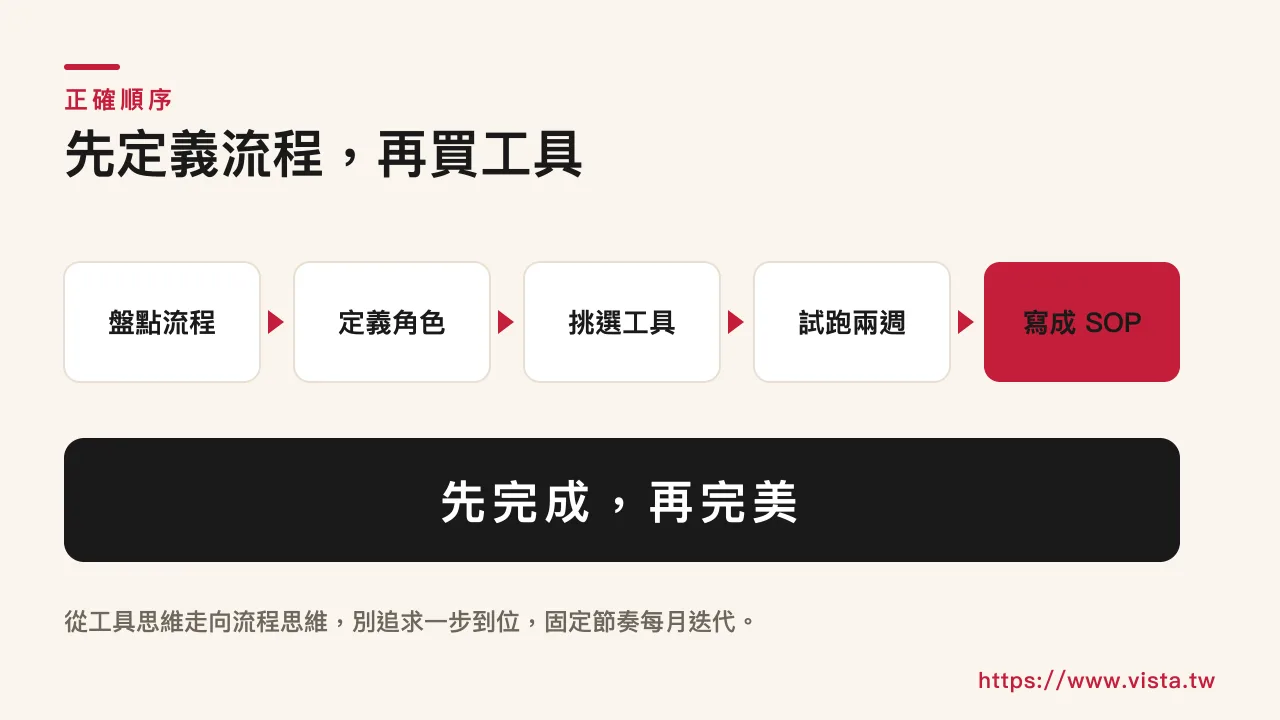
**Inventory process → Define roles → Select tools → Trial run for two weeks → Write SOP. **
Gradually move from “tool thinking” to “process thinking”. When you think about the process clearly and then use it with AI, you will be successful. There are only eight words in my heart: first complete, then perfect. **Don’t pursue one-step perfectionism, proceed step by step, revise as you go, and iterate at a fixed pace every month.
As for data security, don’t neglect it: personal information and business secrets must be well protected. Set up restricted list, anonymity processing, account stratification and audit records for Agents. If necessary, ask the company’s MIS to plan together.
Give you an immediate action
If today’s sharing makes you excited, don’t rush to buy tools yet. Let me give you a little exercise you can do today: **Make a list of the three things you spend most time on every day, pick the one you feel most passionate about, and try to hand it over to the AI Agent first. ** Start here and slowly spread outward.
When you want to go one step further and turn AI Agent into the company’s combat power, I have planned two practical workshops at solo.tw, which just correspond to the two most common needs of everyone.
The value of AI Agent does not lie in how cool it is, but in that it can take over the “organizing work that no one else can do” for you, allowing you to return your time to strategy and leave your energy to judgment. I hope you can also find the most qualified digital colleague for yourself and the company.
📖 深入探索相關主題