What the 3,997 list taught me: Why does a one-man company build its own list system?

This article was originally published in “Vista Electronic News (opens in a new tab)” No.140
Accumulating and managing an accurate List (opens in a new tab) is the core of business operations and sales success, because performance essentially depends on the product of list, skills and time.
Last week, I checked my database and wanted to know how many people had accumulated from the first list received in early March to August 27?
The answer is 3,997.
Well, there are still three people to go before reaching four thousand. I stared at that number for a while, and my first thought was not that I was happy, but that I was a little confused: In the past six months, I have spent far more time maintaining this system than I have spent writing posts. And if you look at Facebook’s social data, the reach of everyone’s posts in the past six months has generally dropped.
Two things happened at the same time, which is why I want to talk to you about this topic. Since I started Vibe Coding, I have paid special attention to this data. Even if I see something wrong, I will want to modify it.
In the next few issues of the e-newsletter, I plan to dismantle this audience management system from beginning to end: this issue will talk about its origin and why it is important, the next issue will talk about the transcripts and magnet design of nineteen free resources, the third issue will talk about the backend technical architecture and the pitfalls I have encountered, and the fourth issue will talk about how to make a stranger willing to hand over email.
Of course, I’ll include the real numbers, including the not-so-pretty ones.
When did I realize something was wrong?
Let me first talk about something that everyone knows, but few people actually account for.
I started writing blog very early, and I have experienced Yam Blog, Pixnet, Wuming Station, Blogger, Facebook, Medium, Fanggezi⋯⋯ and other content platforms. Every time the platform changes, I have to accumulate and summon readers again. Of course, every time the algorithm adjusts, my reach drops.
The most touching time was a few years ago. I have a considerable number of followers on an international content platform. One day I posted a long article that I thought was well written, and the number of hits stopped at three digits. I asked a few friends in the stratosphere, and everyone said: Yes, that’s how it is now.
I did one thing that day: I opened the backend and wanted to compile the list of people who were following me.
Well, the system does not provide this function.
Those people “tracked” me, but I had no way of actively finding them. They are not my readers, they are users of the platform who just happen to pass by me. I operated on that account for several years, and the accumulated assets were neither legally nor technically mine.
There is a more precise way of saying this:
I have been renting and the lease can be modified unilaterally at any time.
This is why I later wrote this article Let you be seen, starting from choosing the right content platform. Choosing a platform is important, but more importantly, you must have a piece of land that will not be taken back by others.
What’s the difference between email lists?
I know that the four words “Business List (opens in a new tab)” have been mentioned a bit tiredly. So what I want to talk about is not a slogan, but three differences that are specific enough to be verified.
The first difference is reach.
I just checked my delivery record: this system has sent a total of 7,927 letters, of which 7,785 were successfully delivered to the inbox, with a delivery rate of 98.2%. What this number means is that once I hit send, my message will reach 98.2% of the people. There was no algorithm deciding whether to give me traffic or not, no reach discounts.
There are all kinds of social platforms, but no one can guarantee to reach 98% of my followers. Yes, not even once.
The second difference is ownership.
My list is naturally stored in my own database. I can export to CSV, change mailing service providers, move to another cloud, and back up the entire copy to a hard drive. This thing sounds boring, but it determines a very real problem: if the price of the letter delivery service I use triples tomorrow, I can move out quickly; but if a social platform changes its algorithm tomorrow, I can only endure it.
The third difference is the density of information.
On social platforms, I know how many people like it, but I don’t know who it is, what he cares about, and which article he knows me from? On the other hand, in my system, I know every list: which free resource he left an email for, which page he came in from, whether he used a mobile phone or a computer, and which country he was in.
What is the use of this information? Give a practical example. When I want to hold a workshop on AI-powered academic writing, I will not send it to all subscribers. I will only send it to the 593 lists that originally requested academic writing resources. If the content is relevant to them, I won’t waste the attention of another three thousand people, and my appeal rate won’t increase.
By the way, the total number of spam complaints out of these 7,927 letters is 1.
Complete report card for six months, including the not-so-pretty parts
I don’t want to just give you pretty numbers, so here are the full numbers.
There are 3,997 items on the cumulative list, 3,489 of which are still subscribed, and 93 mailboxes are marked as bounced letters.
However, I want to make a correction here, and it is a correction of my own.
Before I started writing this e-newsletter, I kept telling others smoothly, “I have a list of four thousand items.” Today I ran an additional query to find out the unique email numbers: 3,448.
3,997 is the number of columns in the data table, and 3,448 is the real number of people. There is a difference of 549, because if the same person requests two free resources, two columns of records will be generated. When my data table was designed, there was no uniqueness restriction on Email, so this thing has always existed, but I didn’t look at it.
The gap isn’t huge, but the habit is dangerous. If I talk about “a list of four thousand transactions” and think it is four thousand people, then all my judgments about this group of people will be a little higher: the conversion rate is low, the cost per person is low, and the influence I think is greater than it actually is.
So starting with this newsletter, I’m going to be talking about 3,448 subscribers. The numbers may not be that pretty, but they are right and they are real.
In addition, 93 mailboxes among these 3,448 people were marked as bounced, a rate of 2.3%. You should keep an eye on this number. If it exceeds 3%, it means that the quality of the list has begun to deteriorate, and the mailing service provider will also start to downgrade your domain.
Editor’s note: As of August 30, the total number of lists has exceeded 4,000.
The sources for the list are distributed across nineteen different free resources, spanning topics such as academic writing, AI content production, personal branding, entrepreneurial leadership, and lecturer preparation.
Device distribution: 2,571 mobile phones and 1,388 computers. 64.3% of people filled out the form using their mobile phones. This number later directly changed the design of my landing page. I will leave this matter for later.
Regional distribution: Taiwan 3,285, Hong Kong 208, Malaysia 152, United States 99, Japan 43. There are more overseas Chinese readers than I originally expected, which is one of the reasons why I later decided to make several websites into multilingual versions.
Growth curve: February 172, March 2,688, April 303, May 197, June 58, July 369, August 210.
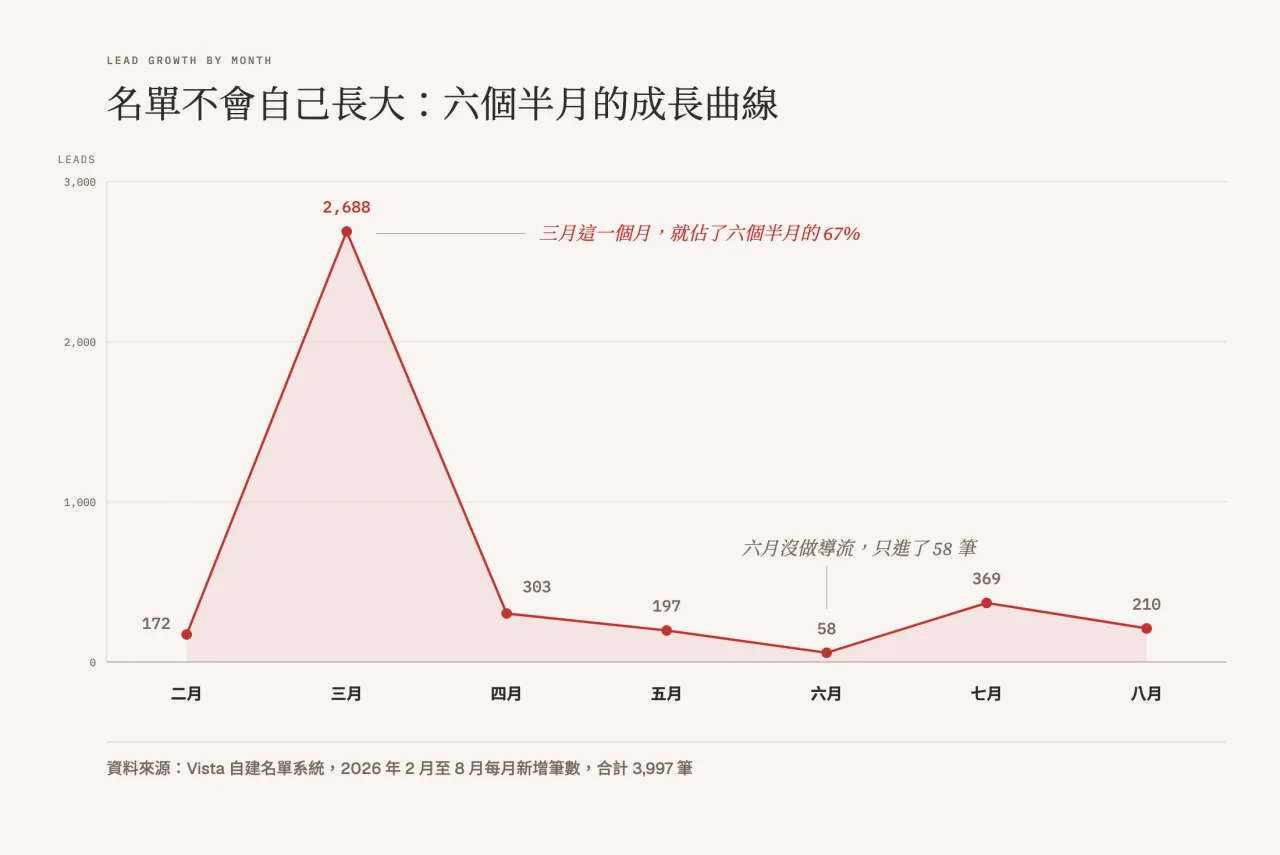
See that 2,688 in March? Six-and-a-half-month lists, 67% came in in a single month. I happened to have a wave of high-intensity exposure that month. There were only 58 transactions in June, because I was busy with other things that month and did almost no traffic diversion.
The lesson this curve taught me was straightforward: Roster systems don’t grow on their own. It’s a container, not an engine. If you don’t push traffic in, it will sit there quietly and give you 58 transactions a month.
Now for the ugly part.
The only number of letters I pulled out of the database that were opened was 1,054. Compared to 7,785 letters delivered, the open rate is about 13.5%. Clicks were 262, about 3.4%.
By industry standards for electronic newspapers, this is not a good result. And I know the reason very well: a very high proportion of these 7,927 letters are automatically sequenced letters, and there are several letters in those sequences that I wrote casually when I was rushing to go online and never looked back.
I’ll break this down honestly in the next two issues. But here’s the conclusion first: owning a list and operating a list are two completely different things. The former is a technical problem that can be solved in a weekend; the latter is a content problem that will follow you for a lifetime.
If you only do the former, you’ll end up with a database of 4,000 columns and an open rate of 13.5%. As for how to write a letter so that someone will open it, I talked about it in Master three keys to make your e-newsletter more attractive. Looking back now, I haven’t implemented all those principles myself.
Three things I didn’t expect at all
The first thing: the largest resource eats everything.
Of the nineteen free resources, the most popular one brought in 2,565 listings, accounting for 64.2% of the total. Second place was with 593 transactions. Third place 304 pens. Then it dropped all the way to double digits and single digits, with the minimum amount being only 1 transaction.
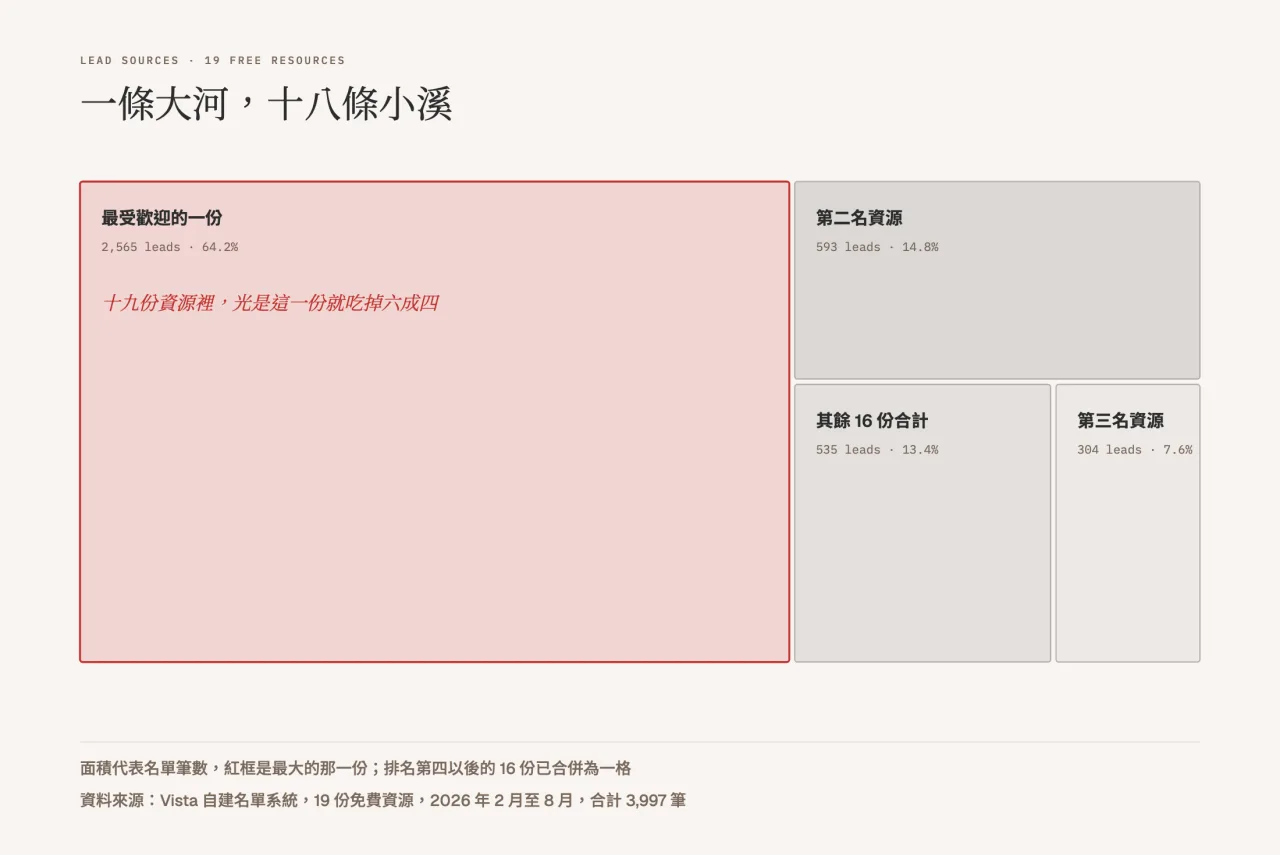
I originally thought that by providing 19 resources, I would get a steady stream of nineteen streams. What I actually got was one big river and eighteen creeks, some of which had no water at all.
Second thing: I don’t know where most of the people are from.
Among the 3,997 items listed, 3,812 items do not have any source mark, accounting for 95.4%. The only ones marked are: Facebook 118, Substack 56, Instagram 11.
What does this mean? It means that I spent six and a half months collecting lists, but I couldn’t answer the most basic question of “Which channel is the most effective?” Because I didn’t do a good job tracking the parameters at the beginning, by the time I wanted to analyze it, the data had been lost forever.
This is the decision I regret most in this entire system. If you’re just getting started, do this first, it’ll only take you half an hour longer.
Number three: I turned on the faucet before the sink was covered.
That resource that brought in 2,565 listings had an automatic cultivation sequence that I added as an afterthought. So among those 2,565 people, only 21 people actually went through the complete training process.
After more than 2,500 other people got their files, they never received any planned letters from me until a few months later when I manually added 500 of them into a recovery sequence.
That was the most expensive class I have taken in the past six months. The person has come in, the first impression has been made, but there is no second chance to remedy it. As for how to design these sequences, the notes left in the “Email Marketing Automation” Course are particularly dazzling to read now.
If I had to do it again
I will summarize this newsletter in three sentences.
First, make sure you have a clear next step before you start collecting lists. The list itself has no value, the list plus “what will these people experience next” has value. The mistake I made was to reverse the order.
Second, tracking parameters needs to be done right on day one. It was the cheapest and most rewarding step in the whole thing, and I skipped it.
Third, don’t be superstitious about quantity. The number four thousand looks good on a social post, but after removing the duplicates, there are 549 less. After deducting the people who never open letters, there is even less left. The real person interacting with me is the person behind those 262 clicks. I’d rather have 500 people who reply than 4,000 people who never open a letter.
This matter is similar to what I talked about a while ago 89% vs. 12% AI application gap. It is actually two sides of the same problem: good-looking numbers are the easiest to obtain and the least valuable; only numbers that you are willing to face honestly will tell you what to do next.
In the next issue, I will spread out the report cards of the nineteen resources in full, and analyze one by one why some can bring more than two thousand transactions, and some can only bring one transaction. I will give you four design criteria that I use now, as well as some negative teaching materials that I have personally made bad mistakes.
If you want to go faster
I wrote this system myself, using the same method I taught in the course. No engineering background is required, but you do need to know what to build and in what order. If you are interested in this system, you can also read my new book “Zero Basics of Vibe Coding”, which has more introductions.
Want to learn hands-on AI with me? See upcoming courses →
If your situation is special, or you already have something on hand and are just stuck in a certain link, one-on-one consultation will save time. We will look directly at your actual situation and can usually decide on a direction within an hour: Make an appointment for one-on-one consultation (opens in a new tab).
In addition, the 19 free resources mentioned in this e-newsletter are all currently on the shelves in vista.tw’s resource library. You can take a look at how I display them. I will explain the reasons behind each design in the next issue.
If this newsletter is helpful to you, please share it with your friends or colleagues. See you in the next e-newsletter.
Next step
Bring this topic to your team
Vista Cheng speaks and runs workshops on AI workflows, writing and content systems for companies, schools and public agencies.