Reading experience of "Emotional Overwork": Leading people is more tiring than doing work. How to repair the emotional labor of supervisors

Why am I attracted to this title?
I guess everyone who leads a team has probably experienced this kind of day: there are only four meetings on the schedule, which doesn’t seem full, but when the work is done, the whole person feels drained. Looking at it all, what really takes effort is not decision-making, but something else. You need to remain stable when a client suddenly changes his mind, you need to catch your subordinate when his eyes are red and he says something happened at home, and when you are anxious yourself, you need to sort out the expression on your face before entering the conference room.
These things don’t appear in any job description, and no one counts them as hours worked. “Emotional Overwork” (opens in a new tab) The first thing this book does is to name this invisible work: emotional labor. It does not happen by the way, it is the work itself, and it is the most depleting and least recognized part of the supervisory role. The depletion I felt when I talked about Supervisor Leading People and Leading Hearts is actually a different aspect of the same thing.
The original title of the book is “Emotionally Charged: How to Lead in the New World of Work”, and the combination of the two authors is noteworthy. Dina. Deng Han. Smith is an executive coach with clients including Adobe, Google, Netflix, and Goldman Sachs; Alicia. Grandy is a professor of organizational psychology at Pennsylvania State University and a long-term researcher in the field of emotional labor. A manager who hears his breakdown every day during coaching sessions, and a manager who has more than 60 papers (opens in a new tab) cited in the top 1%. The advantage of this combination is that the advice in the book does not stop at “you have to take care of yourself” which is correct but has no point of application.
The passage that hit me the most: Why the more tired I am, the more I refuse to rest.
Chapter 6 talks about “The Recovery Paradox”. I paused for a long time while reading it.
The scene described by the author is this: you stare at the screen, your eyes are out of focus, and you haven’t eaten for several hours. You know you should rest, but you feel that you “can’t afford it,” so you hold another meeting, reply to another letter, and complete another report. In this state, people are most likely to make mistakes and lose their temper with those around them.
The explanation they gave was not a lack of willpower, but a combination of two reasons.
The first level is social norms. In an environment where value is measured by output, it is easy for us to believe that continuous action equals continuous progress, and the busier we are, the more accomplished we will be. When you are tired, your default reaction is to grit your teeth and push through, rather than stop.
The second level is more ruthless, and the author calls it the dopamine scam. Every time you cross off a to-do item or mail a letter, your brain gives you a sip of reward. The book quotes an experiment: Researchers implanted a chip in the brain of a mouse so that its button could trigger dopamine. As a result, the mouse repeatedly pressed the button until it stopped eating, and eventually starved to death.
I don’t want to overly mythologize this experiment. It is an extreme condition in the laboratory and cannot be directly equated to human behavior in the office. But it captures one thing that’s true: the satisfaction of completing a task and “it’s worth the effort now” are two different things. The former is a chemical reaction and the latter is a judgment. When these two things are mixed together, you feel like you’re doing the right thing when you need to stop.
This paragraph is particularly painful to me, because no one in One Person Company will tell you to get off work. There is no supervisor, no clocking in, and no sound of colleagues collecting things to remind you that the day is over. The list is never finished, and the feeling of crossing things off is your only stable source of feedback.
DARE: Break down rest into four executable actions
The solution in the book is called the DARE Restoration Framework, which is based on Sabine Sonnentag’s years of workplace recovery research. The four letters are the four repair types:
- Detached: stop thinking about work.
- Autonomous: You decide what to do after work.
- Relaxed: Let the body and mind really rest.
- Engagement: engaging in fulfilling activities outside of work.
I think the value of this framework is not in the four words themselves, but in that it turns “rest” from a vague moral directive into a checklist that can be checked. Many people’s “rest” actually only satisfies one of the following: lying down and scrolling on the phone is relaxing, but not detached, because the work information is still on the same phone; watching a drama is detaching and independent, but there is almost no sense of participation, so after watching it, I don’t feel supplemented.
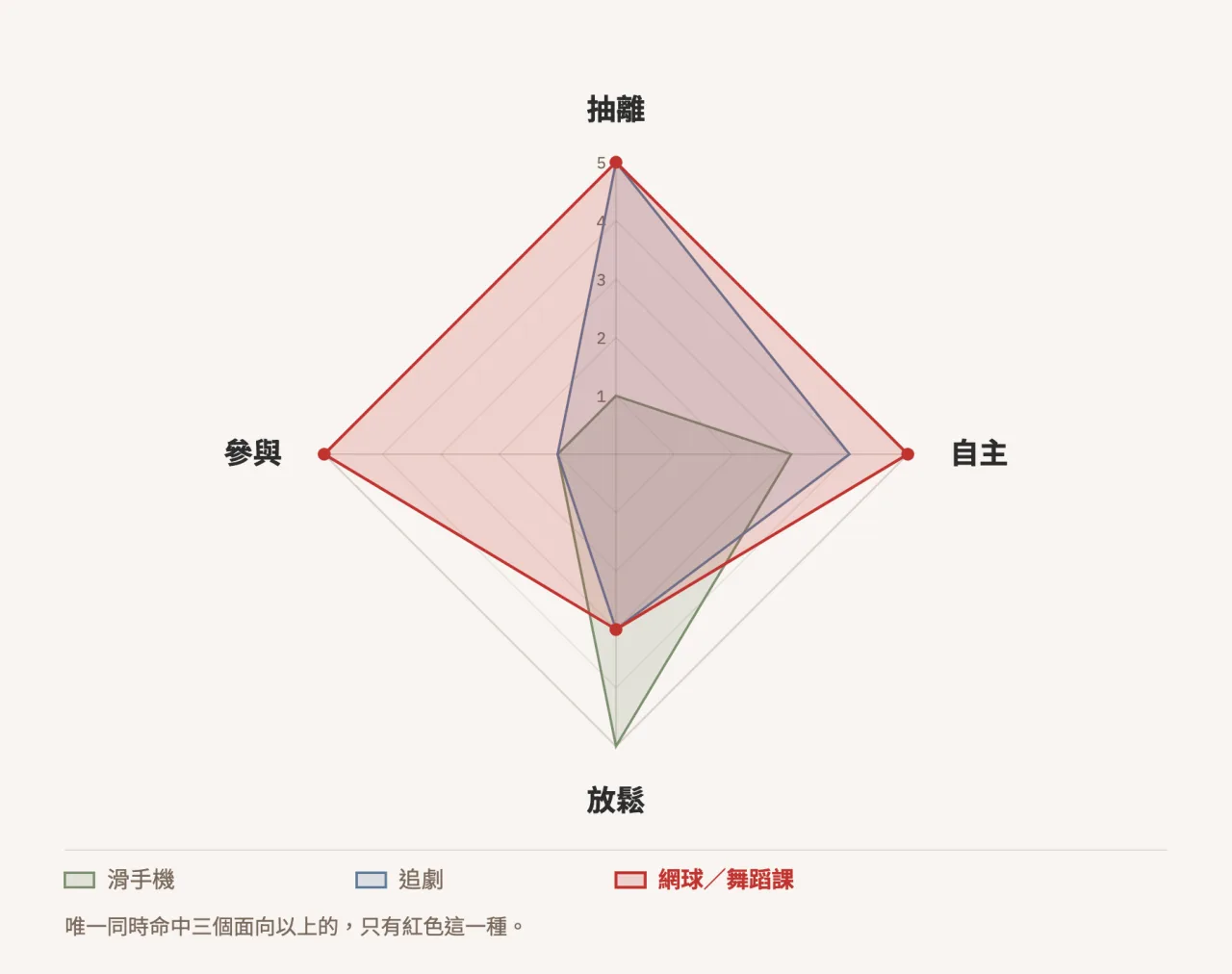 *▲ It’s the same kind of rest, but the aspects of hitting it are completely different: swiping on the phone only satisfies relaxation, watching dramas satisfies detachment and autonomy, and only activities like tennis and dance classes can hit the three items at once. *
The book gives Alicia’s own example: going to tennis and dance classes to satisfy autonomy, detachment, and participation at the same time, spending only two hours a week. The reason this example is persuasive is that it works out: not “leave more time for yourself”, but two hours per week, hitting three categories.
The authors also add a useful argument for supervisors: Self-healing is not selfish. They cite research that shows that after leaders perform restorative activities, their physical and mental state, leadership effectiveness, and creativity are better the next day, and this state of affairs spills over to their followers. This direction of inference is reasonable, but let me make it clear: I can’t see the sample, design, and effect size just by looking at the trial. This type of diary study of “every other day effect” usually has little effect and is context-dependent. I would treat it as “evidence-backed direction” rather than a guarantee that “following it will improve performance.”
The sentence I most want to use: You are not the employee’s psychotherapist
This sentence is written directly in the subtitle of Chapter 11 of the book. To me, this is the most practical line in the entire book.
Today’s supervisors can easily be pushed into a role misalignment: employees’ emotions need to be taken over, but there is no one else in the organization to take over, so the supervisors themselves fill the role. If you make up for it for a long time, there will be two kinds of harm: one is that the supervisor is hollowed out, and the other is more hidden, which is the person who really needs professional help. Because there is a supervisor who is “fairly willing to listen”, he delays asking for help.
Empathy does not mean taking it all in. What can be accepted is “I see that you are feeling very uncomfortable now. Let’s see how we can adjust our work together.” What cannot be accepted is to deal with the other person’s life for him. Where the line is drawn is more important than how beautifully it is drawn.
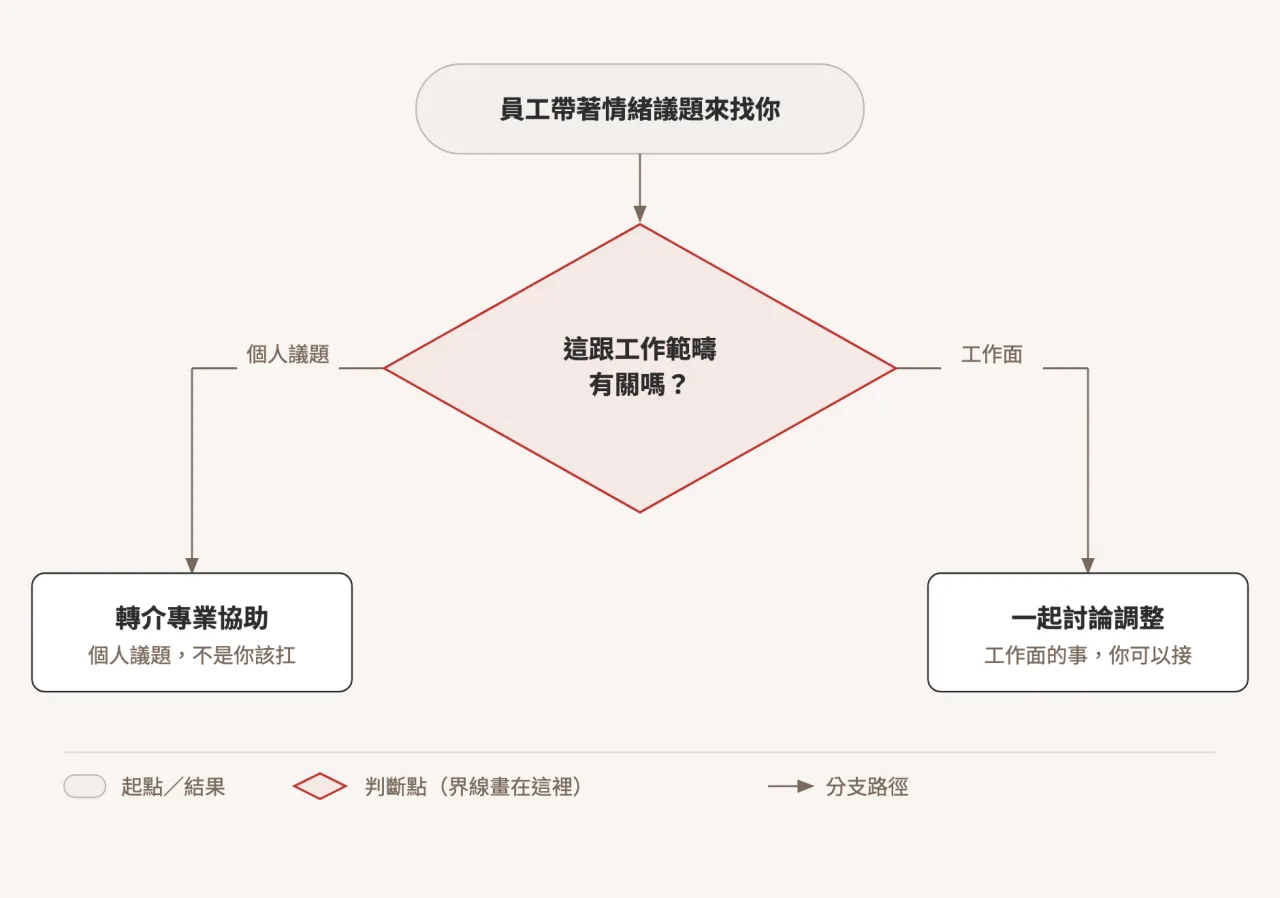 *▲ Empathy does not mean absorbing everything: first determine whether this is a matter within the scope of work. You can accept adjustments to the work surface. Personal issues should be referred to real professionals. *
Also in the same section is Chapter 10, which talks about “What to do when your work causes others pain”: layoffs, denying promotions, giving feedback that makes people feel uncomfortable. This is the least talked about part of a supervisory job, because admitting it hurts is tantamount to admitting you’re not professional enough. I’m looking forward to seeing what the author does with this chapter, as most leadership books on the market would just skip it.
A little reservation
There are two places where I have to keep some.
First, the intended readers of this book are managers who have an organization to rely on: there is HR, there is EAP, and there are levels to report to. If you are a one-person company, a freelancer, or a founder with a team of only three people, many of the suggestions in the book will need to be translated by yourself. For example, DARE’s four types of repairs are almost all based on the premise that the boundary of “off duty” exists, and this premise does not hold true for many people.
Second, the strength of the book’s evidence is mixed. The authors make it clear: the content is drawn from existing scientific research, their own coaching experiences, and in-depth interviews with thirty current managers. The interviews of thirty people are good material and can give flesh and blood to the concept, but they are qualitative data and cannot be used as causal evidence. When reading, it is worth paying attention to the source behind each piece of advice. This is also my common reading method for all books that are “science-based and practical-based”.
I mention these two points not to give a discount recommendation, but because this book itself teaches the distinction between fact and fiction (the title of Chapter 4), so it should be an appropriate tribute for readers to use the same ruler to measure this book.
Three things I plan to do
Just writing down your reading experience without taking action is equivalent to not reading. So, I gave myself three specific guidelines for action:
- Two hours of three hits per week. Follow Alicia’s approach, find a fixed itinerary that satisfies autonomy, detachment, and participation at the same time, arrange the schedule and treat it as a meeting, and do not accept being covered.
- Write two lines before an emotionally stressful event. Corresponds to Chapter 7 “Anticipating Road Curves”. Next time before you get into a tough fight, just write down “the emotions I expect to arise” and “what I want the other person to take away with them”. Just two lines.
- Draw a boundary for yourself. Think clearly about which words I will answer and which words I will directly suggest to the other party to seek professional assistance. Write them down first instead of making temporary judgments on the spot.
Who to recommend to?
If you are coaching people, especially at the stage where you are doing well but leading people is particularly hard, this book is worth reading. If you don’t have anyone with you, the chapters about self-healing in the second part (chapters 6 to 9) can be read alone. If you want to understand how “tiredness” itself keeps replaying in your mind, you can also read it together with the Reading Experience of “Perspective on the Workplace Iceberg” that I wrote before.
If you are looking for quick and effective communication skills, this is not it. The point is to first acknowledge that emotional labor is a real work burden, and then talk about how to distribute this burden. Admitting this fact itself is already the hardest step for many people.
Further reading:
- Why are they still unmotivated even though you are so nice to your team? Four keys for managers to lead people in the AI era
- One-person company is also taking the same test paper: The five major cross-pressures taught me by “System Leadership”
- The most tiring thing is not doing things, but replaying unfinished things in your mind: read “Perspective on the Workplace Iceberg” to understand the four survival postures of internal friction in the workplace
📚 Book purchase link: “Emotional Burnout (opens in a new tab)”
Next step
Bring this topic to your team
Vista Cheng speaks and runs workshops on AI workflows, writing and content systems for companies, schools and public agencies.