89% vs. 12%: The gap between marketers’ use of AI hides the real password for becoming stronger

Originally published in “Economic Daily (opens in a new tab)”
In the past few years when generative AI has swept the world, the deepest anxiety in the workplace is no longer whether I will be replaced by the tool, but why my influence and performance have not improved at all despite using it every day?
A survey illuminates the collective plight of marketers
A survey of marketers from CMI (opens in a new tab) and MarketingProfs (opens in a new tab) shows that up to 89% of marketers use AI for content production, with images, videos and SEO accounting for 53% and 41% respectively. However, as we move towards core business values, the data declines, with only 16% used for advertising and personalized recommendations. 14%, but the predictive analysis that can most determine the life or death of a company is only 12%.
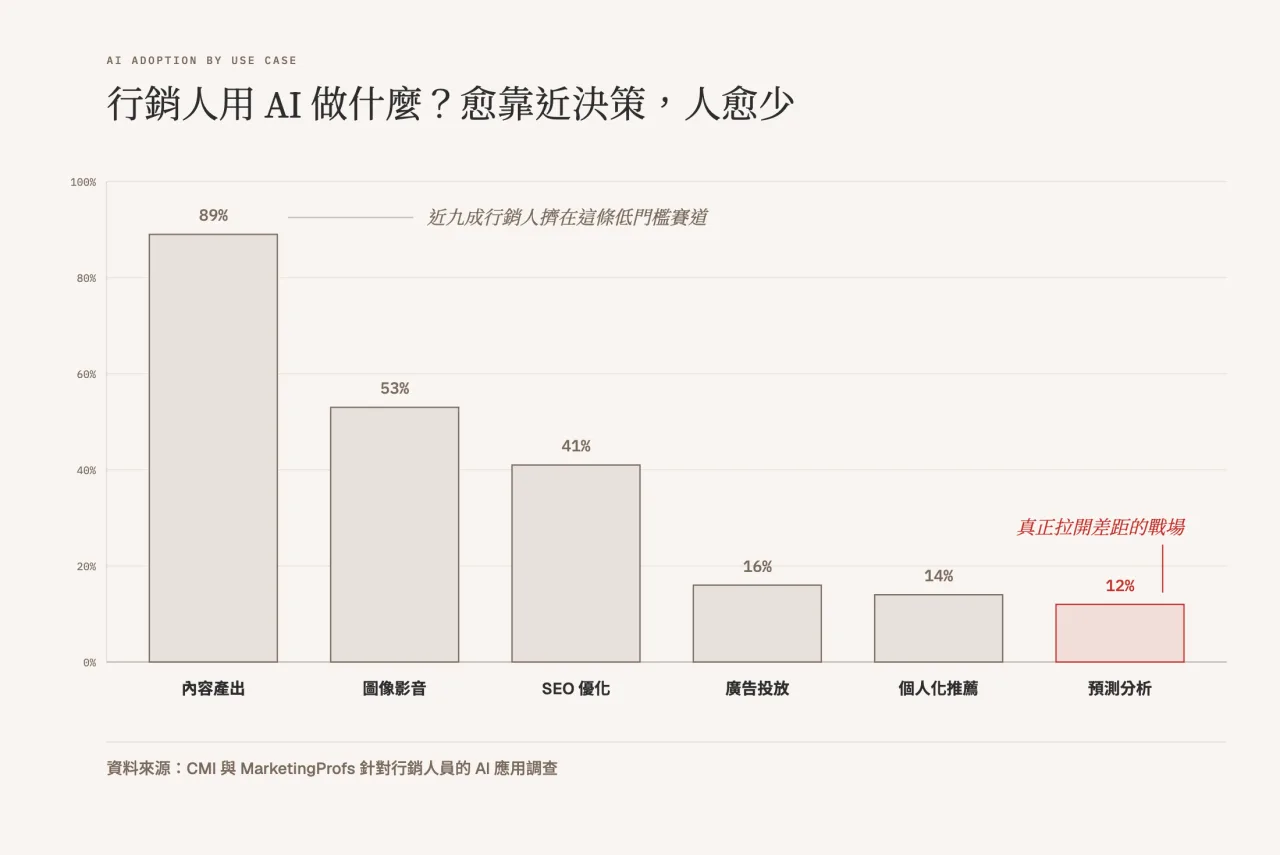
These figures paint a picture of the collective dilemma of marketers, who have downgraded their most powerful strategic weapon into a free typewriter.
Interestingly, this is not an isolated case. I have talked about the performance gap of B2B marketing teams before, and I also mentioned the phenomenon when dismantling Kai-Fu Lee’s new book that 90% of companies spend money to introduce AI but only 40% make back. In fact, the same mistake is made at the individual level and the organizational level: using tools where it is easiest to see movement, rather than where it can best change the results.
Expansion of production capacity does not mean a jump in competitiveness
Walking into the marketing departments of most companies, the most common sight is that colleagues skillfully give instructions to the system to generate dozens of posts and copywriting in a few seconds. Efficiency has indeed increased several times, but the expansion of production capacity does not equal a jump in competitiveness.
When nearly 90% of people are crowded into the low-threshold track of content production, the market is instantly flooded with a large amount of mediocre information that seems to be fluent and logical but has no soul.
The audience’s attention has long been over-diluted, and algorithms have begun to fatigue with homogeneous content. This has led many people to fall into the illusion of busyness, mistakenly believing that producing a large amount of copy every day is promoting business, but ignores that such content cannot bring about substantial conversions and accumulation of trust. If you also begin to feel that your articles are increasingly easy to be replaced, it is probably not that your writing is not good enough, but that you are standing on a starting line that everyone can stand on.
The real reason for being top-heavy: avoiding hard-core business thinking
The fundamental reason for this top-heavy phenomenon is that most people are accustomed to staying at the safe executive level and evading real hard-core business thinking.
Asking a tool to write a social copy will not bear much responsibility even if the performance is mediocre; but if you want to introduce predictive analysis, conduct dynamic audience segmentation, or simulate pricing strategies, what is needed is solid business acumen, data integration capabilities, and the ability to be responsible for the decision-making results.
Most people are complacent about saving two hours of typing time, but that is only a negligible labor saving; the battlefield that can truly widen the gap by a hundred times is always hidden in the 12% of predictions and decisions, because that is where exponential business revenue is created.
Transformation of the content layer: quit standard answers and replace them with your own flesh and blood
To break the paradox of high productivity but low efficiency, marketers must complete a role transformation from the inside out.
At the content level, we must completely abandon reliance on standard answers and instead inject irreplaceable personal style and practical insights. Because the market will never lack empty theories, only content with distinctive personality, unique viewpoints and real flesh and blood can establish real persuasiveness and professional moat among the noise.
This is why I have always advocated that instead of pursuing the perfection of a single article, it is better to spend energy on establishing a content production system: so that opinions, materials and experiences can be called repeatedly, instead of starting from a blank page every time.
Transformation of thinking: turning one-time output into a business flywheel
At the thinking level, you must force yourself to step out of the comfort zone of pure text, start to hand over historical data, customer feedback and market dynamics to the system for in-depth cross-analysis, learn to ask for forward-looking strategic solutions from the tool, and even further connect the data flow into an automated business flywheel, so that you can be promoted from a tired executor to a strategic commander with an overall view.
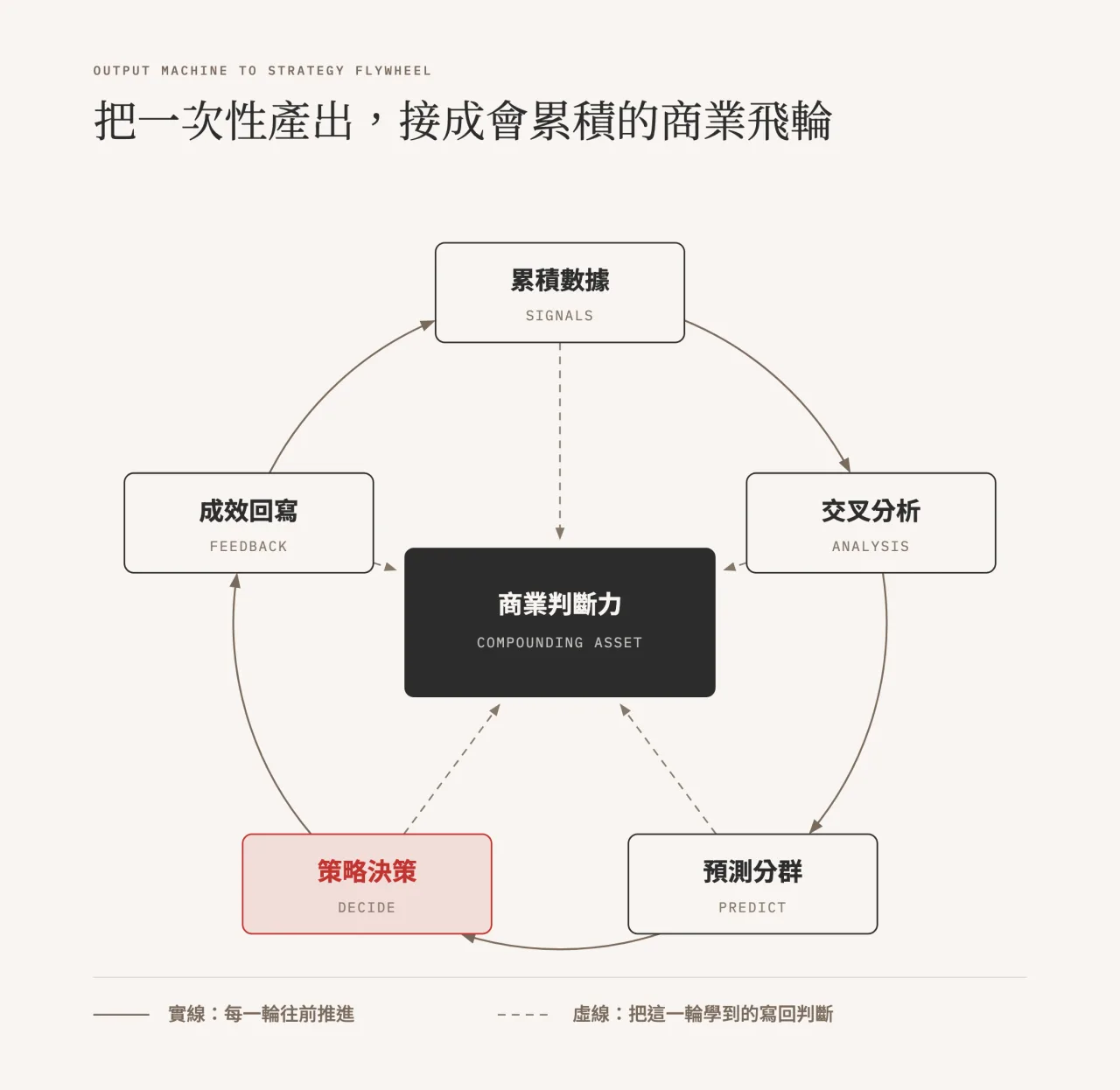
The biggest difference between a flywheel and a typewriter is that it accumulates. The typewriter restarts every day, and with each revolution of the flywheel, the “business judgment” in the middle becomes more accurate. You don’t have to import a complex system from the beginning. You can start by disassembling your own workflow and see which section of the output can be fed back to the next section.
The real difficulty is often not in technology, but in translation: translating the running numbers into decisions that the boss can understand and the business is willing to implement. I talked about this in more detail when I talked about Precise Data Storytelling; and if you want to see what predictive analysis looks like on the marketing side, How CDP allows brands to take action before consumers can be used as a map to get started.
89% is a mirror, 12% is a treasure map
The disparity between 89% and 12% in the report is both a mirror that reflects collective confusion and a treasure map that marks excess returns.
It clearly reminds us that the value of any field that everyone can easily jump into is rapidly depreciating; and the high-threshold links that are prohibitive to everyone and have extremely low usage rates are the key to determining future worth. Only when we no longer regard new technology as a tool for laziness, but as a lever to amplify business value and in-depth thinking, can we truly get rid of the predicament of being busy and usher in substantial breakthroughs and strength.
Don’t indulge in the illusory sense of accomplishment that “I asked AI to write five more copies today.” Get rid of the 89% of text quagmire, bring your irreplaceable business judgment, human insight and strategic vision, and firmly move towards the 12% of prediction and decision-making core.
Only when you no longer regard AI as a shortcut to make tricks, but as a lever to amplify business value, can you truly master the underlying code that becomes stronger in this era. After all, in the end, the answer will become less and less valuable, judgment is your only compound interest asset.
Next step
Bring this topic to your team
Vista Cheng speaks and runs workshops on AI workflows, writing and content systems for companies, schools and public agencies.