Reading experience of "SCRUM: Use Half the Time to Do More than Twice the Things (AI Application Updated Edition)": AI × Agile Management Multiplier Effect that One-person Company Managers Can't Ig...

It takes a traditional car factory thirty hours to build a car, but Tesla only takes two and a half hours. The book “SCRUM: Doing More Than Twice the Things in Half the Time (Added Edition of AI Applications)” throws out this twelve-fold gap at the beginning, and immediately blocks the easiest explanation: the gap is not because Tesla employees work harder, but because they use a completely different operating system.
This opening is very attractive to me, because the routine I am most afraid of seeing in business books is to attribute efficiency to some kind of spiritual theory, such as: overtime, willpower, or hard work, etc. At the beginning of this book, this approach is rejected.
Waste is a sin: What SCRUM really wants to solve
SCRUM (opens in a new tab) I have heard of this framework for a long time. I often hear friends in the software development circle mention some terms, such as: stand-up meeting (opens in a new tab), sprint, and to-do list. But this book made me think again: what is really being solved behind these processes is waste. There is a chapter in the book called “Waste is a Sin”, which regards waiting, heavy work, overproduction, and unused talents as losses that need to be dealt with, rather than the inevitable costs of the work itself. This perspective is particularly relevant to me, a one-person company operator, because I don’t have a large team that can rely on manpower to cover the gaps in the process. If any link is stuck, the wasted time will be directly reflected in the output.
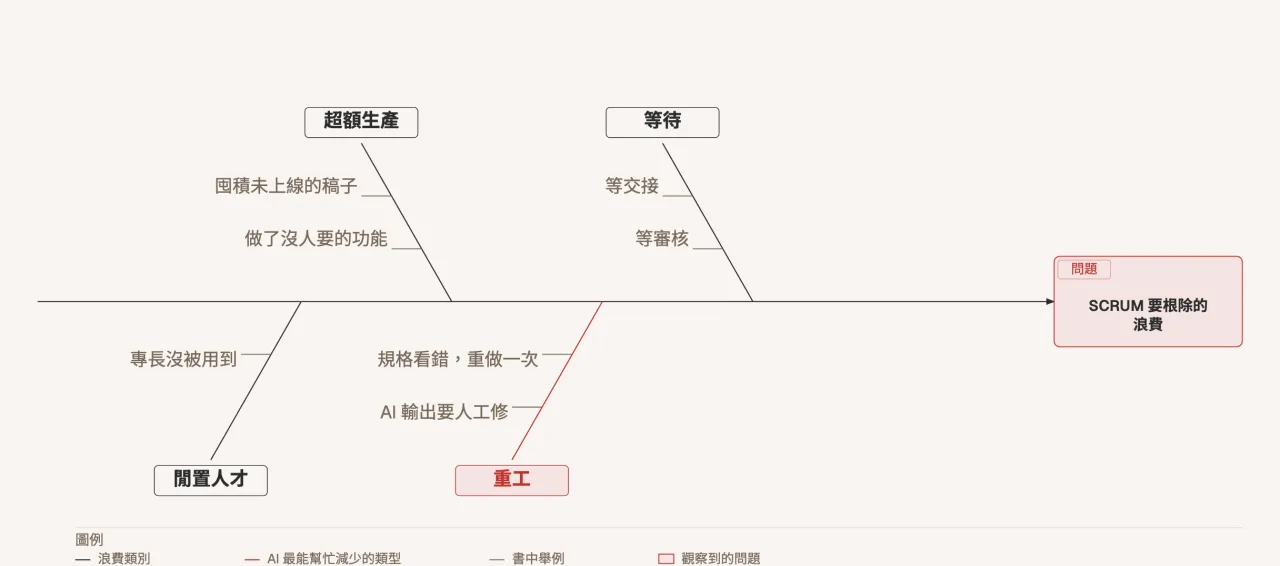 *▲ In the book, waiting, heavy work, overproduction, and idle talent are all considered as wasted costs; among them, heavy work is the type that AI can best help prevent in the human-machine collaboration chapter later. *
Transparency, inspection, adjustment: the three pillars are easier said than done
The three pillars repeatedly emphasized in the book: transparency, inspection, and adjustment sound simple, but are actually not easy to implement. Transparency means that everyone sees the same real progress, not a glorified report; inspection requires stopping regularly to look at the actual results, rather than waiting until the end of the project to review; adjustment means immediately correcting the direction based on the gaps detected, rather than sticking to the original plan to the end. This logic holds true for any type of work. The book also gives examples of shipbuilding, vaccine development, and even preparing Thanksgiving dinner to illustrate that it is not exclusive to the software industry.
 (opens in a new tab)
*▲ Do you like the practical thinking of this kind of AI × efficiency methodology? Welcome to subscribe to Vista AI Inspiration Supply Station (opens in a new tab). I will continue to interpret the latest tool usage and trends and send them to you as soon as possible. *
The most practical part of the updated version: enterprise-scale introduction and human-machine collaboration
This Updated Edition (opens in a new tab) focuses on the large-scale introduction of enterprises and the human-machine collaboration framework. For me now, it is the most practical part. The author mentioned that the top teams in the future will regard artificial intelligence as a member of the team, allowing AI to eliminate repetitive human errors and heavy work, while humans focus on decisions that require judgment. I have been adjusting the way I collaborate with AI in the past few years. I am increasingly inclined to do less hands-on work and more break down tasks clearly, set acceptance criteria, and then assign them to appropriate roles for execution, and go back to confirm the results myself. The logic of human-machine division of labor described in the book is almost the same thing as the method I have explored, except that they use the language of organizational management. I came up with it from the practical experience of collaborating with AI.
AI is the acceleration engine, SCRUM is the navigation system
There is a passage in the preface of the updated edition that impressed me deeply: AI is a powerful acceleration engine, and SCRUM is a navigation system that ensures the correct direction. Only by combining the two can a real multiplier effect be exerted. This sentence points out a premise that many people ignore when importing AI tools: speed itself is not the goal, the direction is wrong, and the faster you run, the faster you reach the wrong place. In the past few years, we have seen too many teams treat AI as a universal accelerator. As a result, processes that were originally misaligned were accelerated, and the output became even more chaotic. What this book reminds us is to straighten out the operating system first, and then talk about accelerating it.
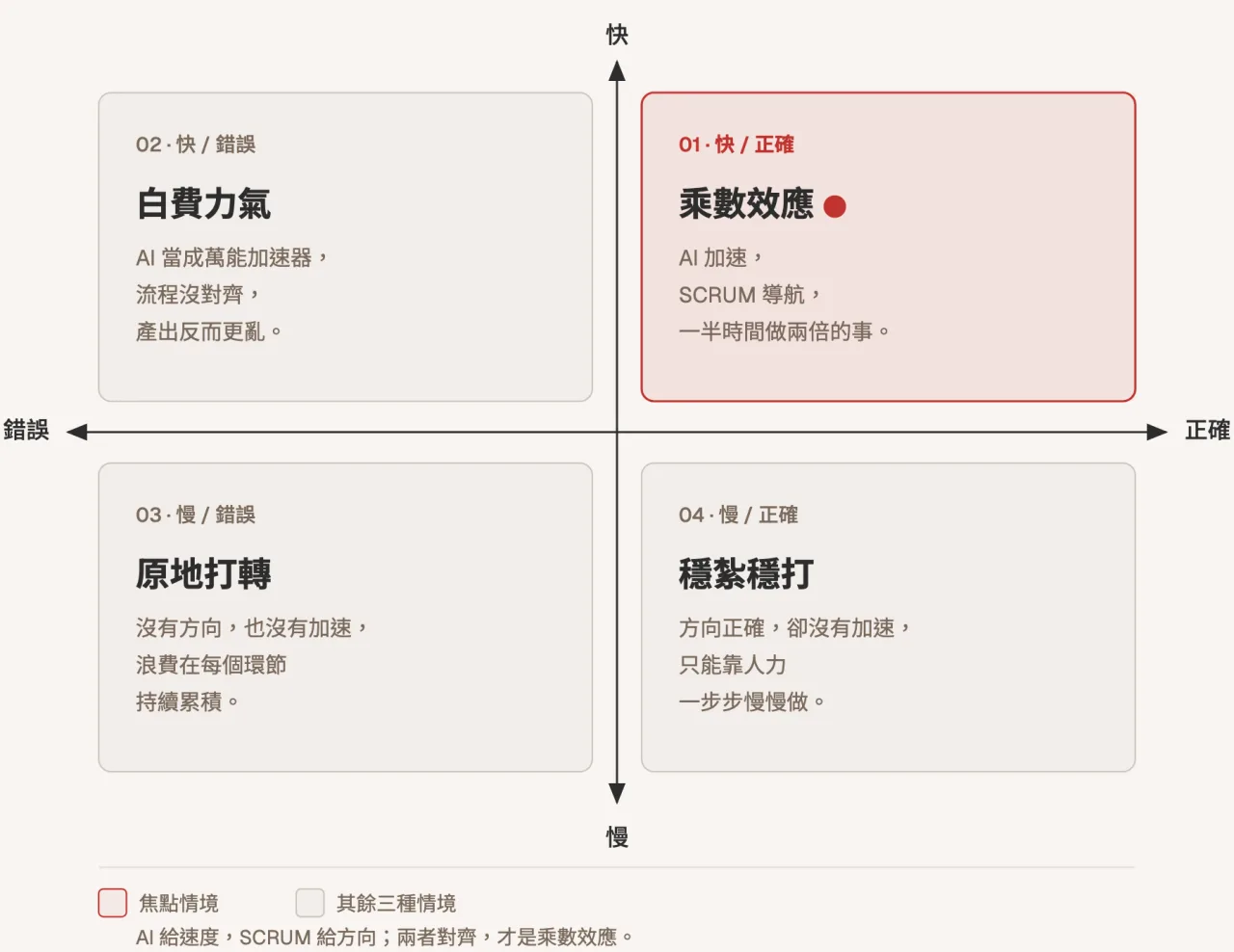 *▲ Speed and direction are two independent variables: only the square where the two are aligned has a multiplier effect; speed alone will only make you run in the wrong direction faster. *
The biggest obstacle to large-scale introduction of enterprises is political competition
What surprised me more is that the book spends a lot of space discussing the political struggle of large-scale introduction of enterprises. The author honestly admits that when promoting SCRUM from a single team to the entire organization, the biggest resistance is often not that the method itself is difficult to understand, but that vested interests are unwilling to let the operation method be tested in the sun. This is consistent with the phenomenon I have observed when coaching many companies to undergo digital transformation: the process is not transparent, and sometimes it is precisely the state that some people deliberately maintain, because transparency will make links without output invisible.
Conclusion: Efficiency is not achieved by working harder.
After reading this book, my biggest gain is not to learn any new tools or new terms, but to reaffirm one thing: efficiency is not achieved by working harder, but by identifying waste, shortening the feedback cycle, and placing decision-making power in the hands of those who actually do the work, step by step. When we add AI to the mix, this logic is not obsolete, but becomes even more important: because the faster the tool runs, the more critical it is that the operating system is correct.
Further reading:
- Stop doing everything yourself: a six-step workflow to hand over the work to the AI army
- Reading experience of “One-person Company Management in the AI Era”: Start your entrepreneurial journey with the price of a cup of coffee
- When AI Meets Briefing: A Practical Guide to Rethink Your Workflow
📚 Book purchase link: “SCRUM: Doing More than Twice the Things in Half the Time (AI Application Updated Edition) (opens in a new tab)”
Next step
Bring this topic to your team
Vista Cheng speaks and runs workshops on AI workflows, writing and content systems for companies, schools and public agencies.