Reading experience of "OGSM 2.0 Bringing Out High Collaboration Teams": The company uses a table to align the goals, and your year-end self-evaluation is to turn in the paper

*Everyone’s KPIs were met, but the company fell short. The problem is often not that we don’t work hard enough, but that everyone is not working from the same table. *
Everyone works hard, but the company does not meet the standards.
As November approaches, many companies are busy with two things: urging employees to submit their annual performance self-evaluations, and holding meetings to set goals for next year.
At this point in time, Tianxia Culture published teacher Zhang Minmin’s new book “OGSM 2.0 brings out high-collaboration teams: one table connects strategies and departments, aligns goals, acts accurately, and creates profits!” (opens in a new tab)》. Opening the book, the first problem is shocking: employees’ KPIs have been met, but the company’s overall performance has not met expectations; cross-department meetings have been held one after another, but in the end everyone still does his or her own thing.
I have heard this scene many times in corporate internal training sessions. The supervisor said that colleagues were working very hard, and colleagues said that their goals were all met, but when the accounts were settled at the end of the year, the company’s numbers just didn’t look good.
The diagnosis given by teacher Zhang Minmin in the book is very direct and clear: The problem of the enterprise is not that there is no strategy, but that between the goal and the implementation, there is a lack of a management language that the whole company can understand.
Four questions are a common language
I have previously written a column in the “Economic Daily” “[Make good use of OGSTM strategic tools and build an action blueprint”, introducing the same family of goal management tools. This time I read “OGSM 2.0 Bringing Out High Collaboration Teams”. What I like most is that it condenses the entire method into four questions that anyone can ask:
-O (Objective): What will it look like when we succeed?
- G (Goal, specific goal): What specific results do we want to achieve?
- S (Strategy): With limited resources, what method do we choose to use to win?
- M (Measure, verification): How do we know that the method is effective and the progress has declined?
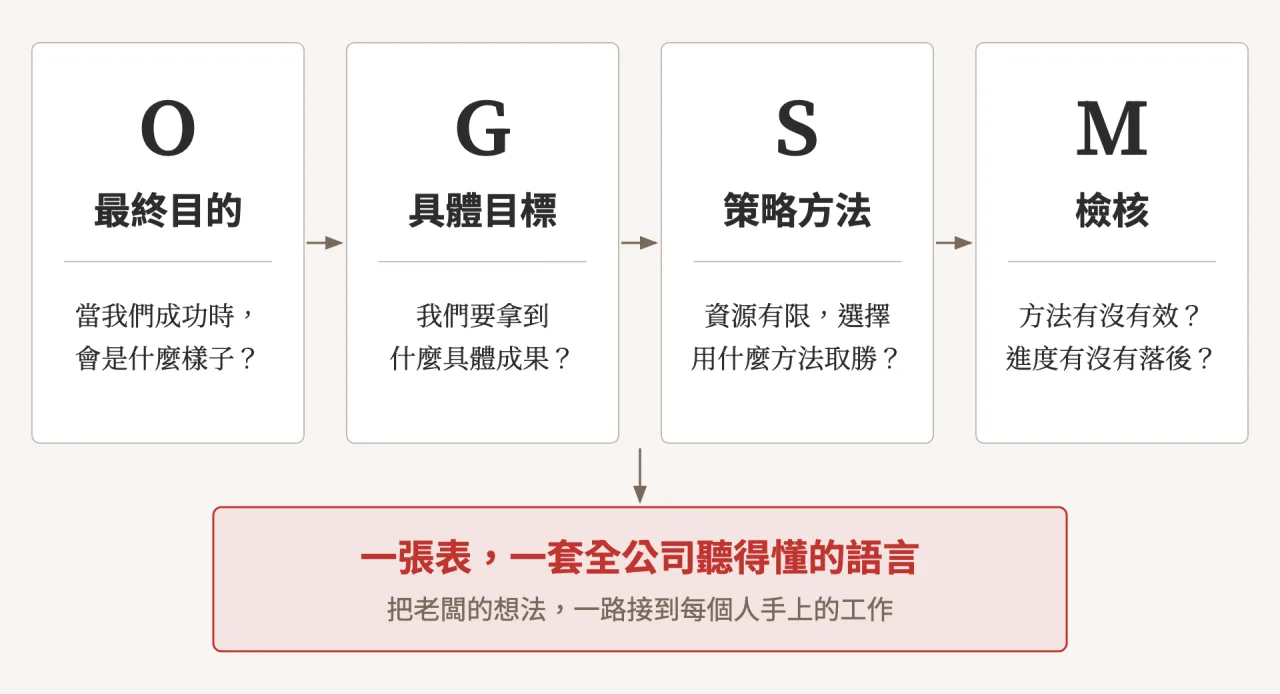
These four questions seem simple, but if you really want to write them down on a table, you will find that it is difficult to connect them. The purpose is beautifully written, but the goal is not consistent; the strategy is listed with seven or eight items, but in fact it is just a list of everything that needs to be done; the review column is written about revenue, but the revenue will not be known until the end of the year, and there is nothing to look at in between.
The author makes the difference between 1.0 and 2.0 very clear: 1.0 focuses on table writing, while 2.0 pays more attention to strategic thinking, logical series and implementation. In other words, the form is just a carrier, what really needs to be practiced is the ability to connect thinking.
I think the four concepts most worth taking away
The whole book is divided into three parts: strategy casting, strategy execution, and undertaking and collaboration. It covers how to choose strategies and how to hold meetings and how to make dynamic corrections. Here are a few of the things I took back to the office after reading it.
1. Goals and indicators are not the same thing
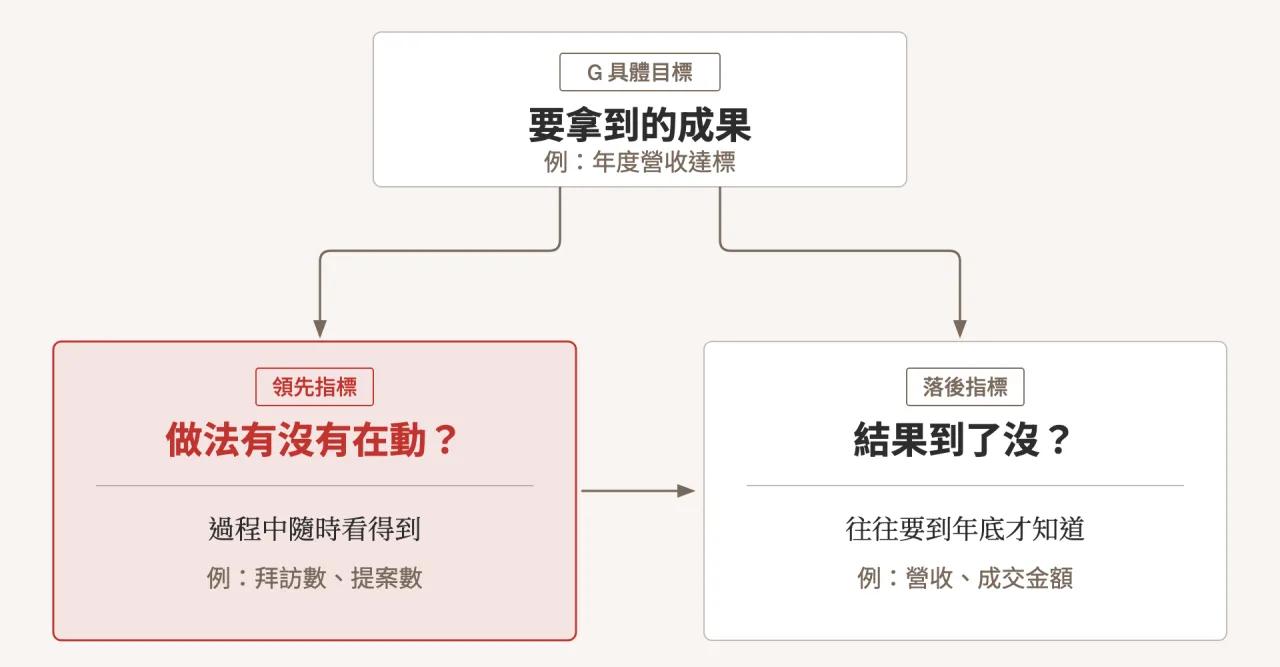
There is a section in Chapter 7 titled “Goals and indicators are not the same thing.” Many teams mix G and M together, and the result sheet is full of numbers, but it is impossible to tell which number represents success and which number is just for tracking progress.
The book divides measurement indicators into leading indicators and lagging indicators, and also outlines four methods for finding leading indicators. My understanding is: lagging indicators tell you whether the results have been achieved, and leading indicators tell you whether the current practice is moving. Teams that only look at lagging indicators often have to wait until the end of the year to realize that their work this year has been in vain.
2. Write from front to back and read from back to front
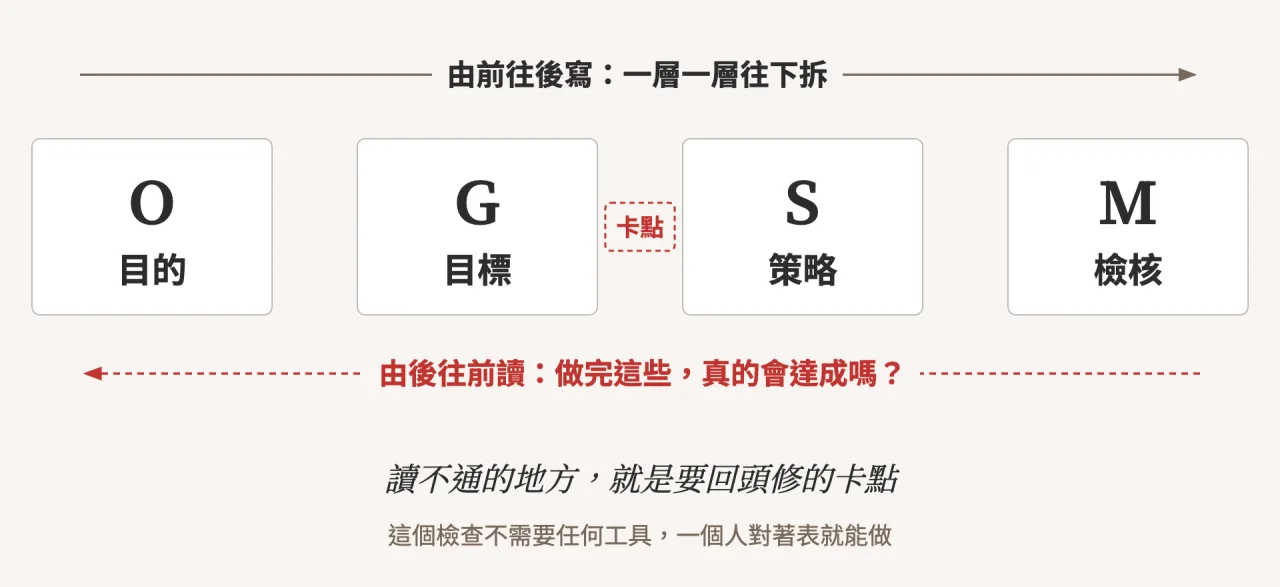
This is one of my favorite checks in the book. When writing, work down from the purpose to the action; after you finish writing, read back from the action and ask: After doing these things, will you really achieve this goal?
If you can’t read it clearly, it’s stuck. Chapter 12 also specifically talks about how to use logical pushback to find the stuck points of OGSM. This action does not require any tools, can be done by one person looking at the watch, and is very honest.
3. You can hold a meeting with just one table
Chapter 10 talks about cross-department collaboration and proposes seven principles for using OGSM to hold meetings. The core spirit is: all information is written on the table, only progress and problems are discussed in meetings, and decisions have a common basis.
To be honest, many companies can cut meeting time in half by just talking about progress and problems during meetings. The most common place where cross-department collaboration gets stuck is when everyone holds different information and speaks different words; with the same table, at least when they quarrel, they are arguing about the same thing.
4. AI is the co-pilot, not the driver
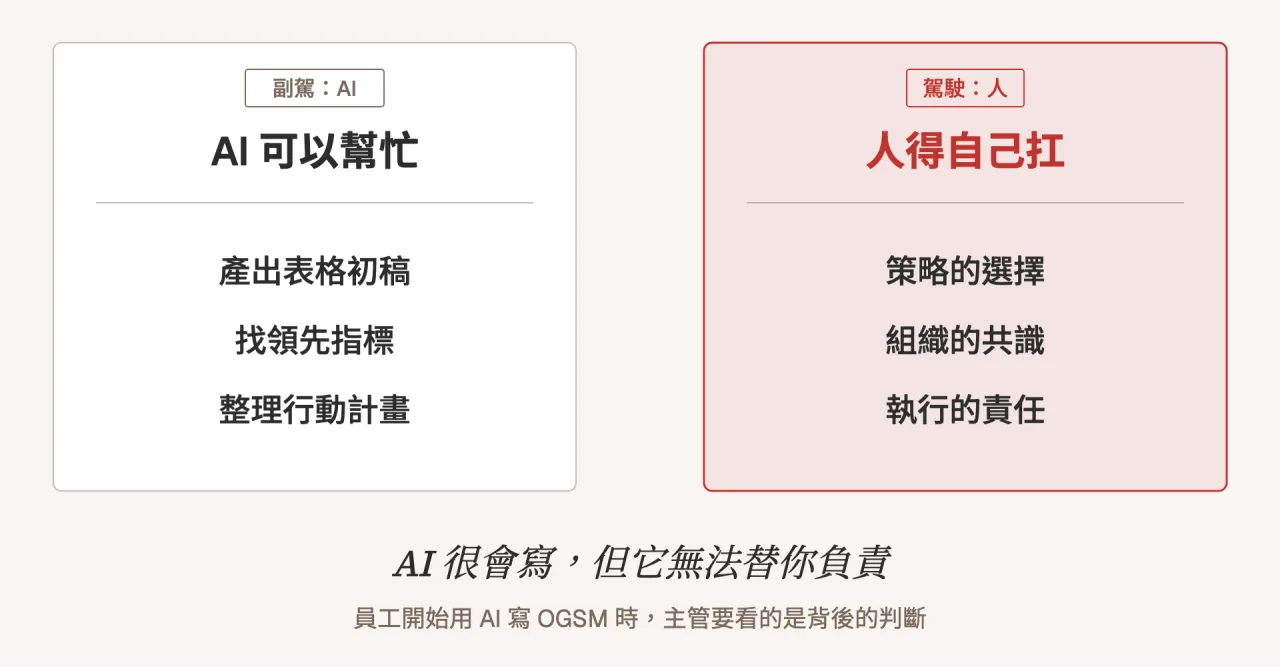
Chapter 14 talks about the cooperation between OGSM and AI. The title uses the word “Let AI be the co-pilot”. The book talks about the timing of AI intervention, two types of instructions, one-time generative and progressive. It also has a special section talking about the boundaries of AI’s capabilities, and what supervisors should pay attention to when employees start using AI to write OGSM.
I agree with this positioning. AI can help produce the first draft of forms, find leading indicators, and organize action plans, but the selection of strategies, organizational consensus, and execution responsibilities still have to be shouldered by humans. In the past few years, I have repeatedly reminded students in class of the same thing: AI is very good at writing, but it cannot take responsibility for you.
Read this book from someone who took on the goal
The main readers of this book are managers, middle and senior managers, and project leaders, but I think there is another group of people worth reading: workers who are undertaking the goals.
The third part of the book talks about running from top to bottom, setting the direction from the top and executing it from the bottom. Standing in the position of a grassroots colleague, the goal you get at the beginning of the year is the result of removing the G from a certain grid on the supervisor’s table. Everything you do this year should theoretically be worthy of that list.
So when I read this, the first thing that came to mind was year-end performance self-evaluation.
If the goal setting at the beginning of the year is that the company distributes OGSM to the next level, the self-evaluation at the end of the year means that you fill in the M and hand in the paper later. Many people find it painful to write self-evaluations because they start from a blank form and think about what they have done this year; but if you borrow the logic of reading from back to front in the book, things are much simpler: first find back the things you have done throughout the year, and then go back to the goals at the beginning of the year one by one, and finally ask, have these things added up, have they helped the supervisor to move forward on the list?
When you’re done, you’ll usually end up with two lists. One is a goal without results, and this is where you need to be prepared to explain it; the other is a result without goals, such as bringing in new people, cross-department support, and temporary projects. The latter is often missed the most, but it is most worth adding in the self-evaluation, because that is exactly the cross-department collaboration mentioned in the book, but it is not written on any table.
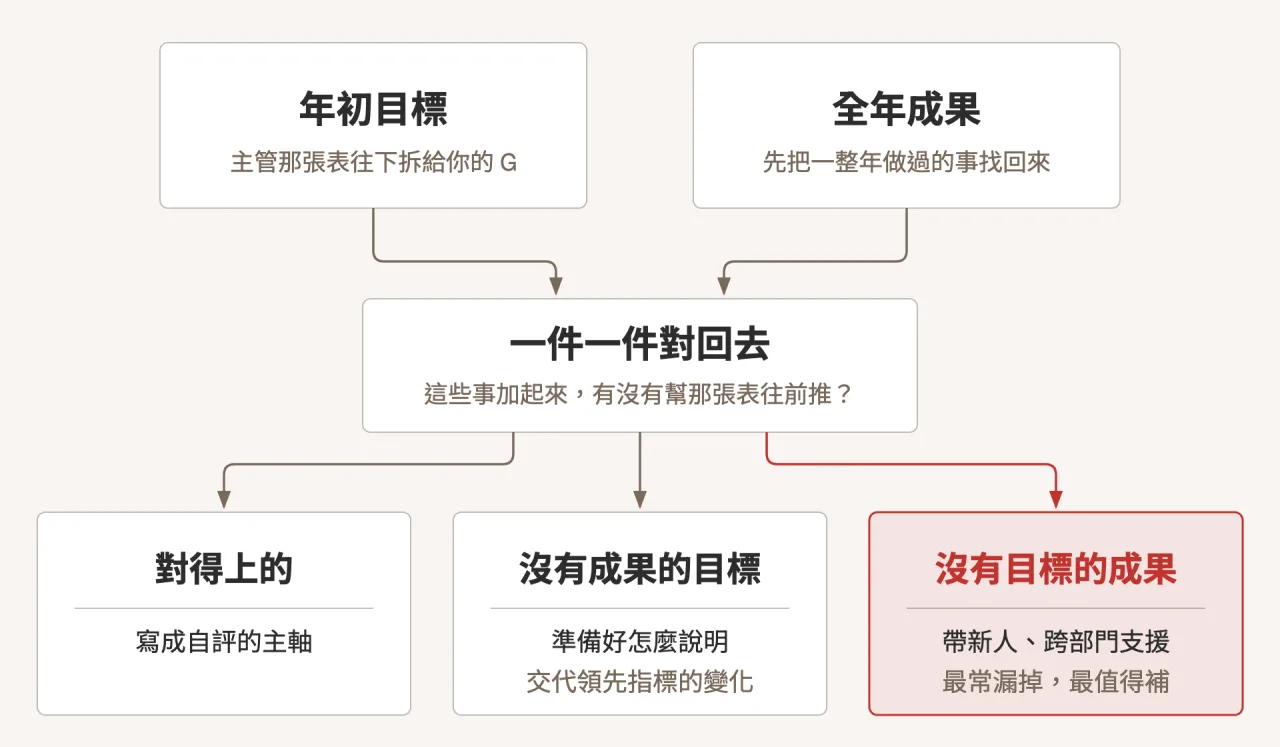
The concept of leading and lagging indicators also applies here. If the goal you are responsible for is a lagging indicator, such as annual revenue, but it was not achieved this year, instead of just writing down the results, it is better to explain what you did on the leading indicator and what changes there were. When your supervisor speaks for you in a calibration meeting, you have something to talk about.
Who to recommend to?
If you are an operator or senior executive thinking about next year’s strategy, the first and second parts of this book are worth reading in their entirety. They will help you translate your boss’s ideas into team practices.
If you are a mid-level supervisor or project leader, and you are often stuck in unclear explanations at the top and inability to get things done at the bottom, the third chapter is the most directly useful chapter on upstream and downstream undertakings and cross-department collaboration.
If you are a worker who is undertaking a goal, you may wish to read Chapters 4 to 8 first to familiarize yourself with what O, G, S, and M are asking. The next time you get the annual goals, you will know what questions to ask your supervisor; when you write a self-evaluation at the end of the year, you will also know how to match the results back to the goals.
Treat the year-end self-evaluation as a review
Finally, I would like to share with you a manual I just launched last week.
When reading “OGSM 2.0 Bringing Out High Collaboration Teams”, I kept thinking about what I have been doing recently. I saw that many of my friends in the workplace were struggling with the year-end assessment every year, so I designed the “Year-end Assessment Self-Assessment and Interview Package (opens in a new tab)” to break down the above-mentioned “take stock first, then set the goals, and write sentences that the supervisor can read” into a set of steps that can be followed throughout the entire assessment season.
The manual is divided into five modules and 19 steps, from understanding how performance appraisals are decided, arranging appraisal plans, taking stock of annual results, writing self-evaluations, making year-end report briefings, to how to talk before and after interviews, and how to track. Each step is taught how to do it, so you can follow it without using AI, and there is also a prompt, a total of 12 in the book. There are also 7 steps that deliberately do not use AI, such as scoring yourself and conducting interviews at the moment, because that is your judgment of yourself, and it is also a conversation between people. This is the same as the AI mentioned in the book that only serves as a co-pilot.
In addition to the PDF manual, it also comes with an annual achievement inventory form, a sample self-evaluation form, a sample year-end report presentation, a one-page summary and interview preparation card, and a sample document filled out by three fictional characters. If you want to take a look at the basic principles of writing a self-evaluation, you can first read “How to write your year-end performance self-evaluation”.
Let me make it clear first that this handbook does not guarantee any performance appraisal results. Ratings are judged by your company based on many aspects. What it can help you is to retrieve the results of the whole year, and write a self-evaluation with a source for each sentence of the goals set at the beginning of the year.
Further reading:
- How to write your year-end performance self-evaluation
- Make good use of OGSTM strategy tools and build an action blueprint
- Reflections on reading “The Supervisor’s Strongest Work Technique”: When AI can give answers, why do supervisors have to define their own questions
📚 Book purchase link: “OGSM 2.0 brings out high-collaboration teams: one table connects strategies and departments, aligns goals, takes precise actions, and creates profits!” 》 (opens in a new tab)
Next step
Bring this topic to your team
Vista Cheng speaks and runs workshops on AI workflows, writing and content systems for companies, schools and public agencies.