People management, making good use of AI Agent
This article was originally published in “Economic Daily (opens in a new tab)”.
When most professionals are managing contacts, they most often encounter the double dilemma of high friction in information input and low coverage of relationship maintenance: they are unable to sort out business cards and conversation details after a meeting, and they want to restart contact after a few months but cannot find a suitable entry point. To completely solve this pain point, the autonomous perception, planning and decision-making and tool calling architecture of AI Agent can be introduced to transform human network maintenance into a set of automated and systematic processes.
Practices of European and American consultants: division of labor among multiple agents to maintain relationships
Top business consultants in Europe and the United States have already introduced multi-agent workflow into personal relationship maintenance. For example, a common practice among senior managers in Silicon Valley is to configure three groups of agents with specific functions: the first group is responsible for monitoring public business updates and mailbox interactions, the second group is responsible for parsing conversation records and extracting key information, and the third group proactively drafts customized follow-up plans when specific trigger conditions are met.
Some senior mergers and acquisitions experts on Wall Street even use the Retrieval Enhanced Generation (RAG) (opens in a new tab) architecture to connect communication memos from the past few years. When news of supply chain transfers or mergers and acquisitions breaks out in an industry, the Agent can compare in a few seconds high-value lists with relevant backgrounds and who have not been contacted for half a year, upgrading occasional passive social interactions into precise strategic attacks.
If you are still “asking AI” instead of “letting AI do it for you”, you can first read “How can professionals make good use of AI Agents in the workplace?” The key transition from asking AI to letting AI do it for you〉, it will be more interesting to come back and look at this network system.
First Ring: Asynchronous Context Capture
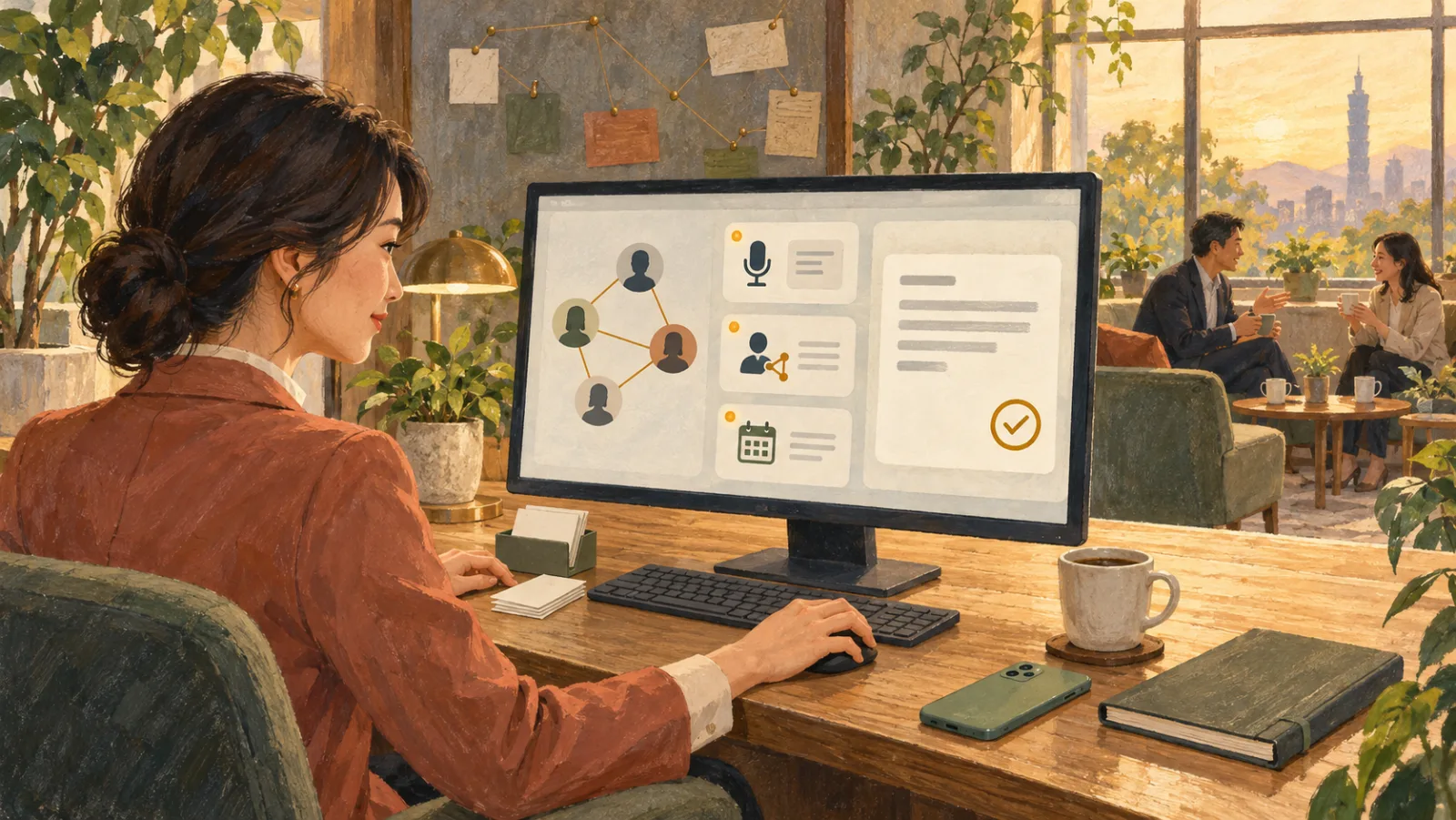
The first implementation step of this methodology is to establish an asynchronous context capture mechanism (Asynchronous Context Capture). During the walking time after leaving the scene after the meeting, various conversation fragments were recorded directly using the mobile phone’s voice to text, and the Agent responsible for semantic analysis automatically intervened and processed.
This Agent’s system prompts must contain a strict information extraction ontology, forcing the disorganization of disordered oral statements into core business propositions, informal life signals (such as the other party’s family situation, recent hobbies, planned travel) and promised delivery items. After the Agent parses, it automatically writes structured data into a personal relational database through Webhook (opens in a new tab) and synchronizes commitments to the calendar, completely eliminating the resistance of manual recording at the source.
In the past, I wrote “Please do this with me, simple management of business cards without worries”. At that time, scanning and manual classification were relied on; in the Agent era, even the “organizing” step can be handed over.
Second Ring: Event-driven correlation engine
The second step is to design an event-driven matching engine. The traditional business card library is static and isolated, but AI Agent can understand the human network in the form of Knowledge Graph (opens in a new tab). You can set up a resident scheduling agent to regularly perform two comparison tasks: The first is supply and demand complementary detection, which performs vector semantic retrieval between the external resources that A is looking for in the list and the new expertise that B has just demonstrated, and proactively prompts you for specific opportunities to promote understanding between the two parties.
The second is dynamic attenuation warning. When the system detects that the interaction frequency of a partner who belongs to the core circle is lower than the set health value, and there is a new position change or special speech in the public community, the Agent will actively trigger a reminder, turning the cold contact period into a warm communication opportunity.
Helping others get to know each other is the most valuable step in network management. This is also the concept I most want to take away from “Reading “High-Value Networking in the AI Era”: Live your life as a noble person of others, and the network will naturally come back to you”.
The third link: follow-up execution of human-machine collaboration
The third link is the follow-up execution of human-machine collaboration (Human-in-the-Loop Follow-up). Top-level network management is most taboo about sending canned messages completely automatically, so Agent is positioned as a high-level consultant rather than a spokesperson at this stage. When the trigger conditions are met, the agent responsible for writing the draft will automatically integrate previously captured personal life signals, the other party’s latest developments, and a high-value analysis you have recently produced or read to generate a draft of an icebreaking letter that includes the awakening of common memory points and the provision of stress-free value.
At this time, the system will only push the draft to your communication software to-do list, and you will spend 30 seconds to review it, add your own tone, and send it out manually. It not only has the precise layout of the algorithm, but also retains the true sincerity required for interpersonal trust.
If you want to extend this follow-up process to online communities, you can use the method of “Make good use of LinkedIn to turn connections into gold”; if you are a supervisor, you can also refer to “Make good use of AI Agent digital clones to upgrade middle and high-level supervisors to Agent Commander-in-Chief” to hand over more routine work to Agents.
Conclusion: Redistribution of cognitive resources
Introducing AI Agent into human network management is a redistribution of cognitive resources. The algorithm is responsible for handling energy-intensive data extraction, cycle monitoring, semantic association and draft pre-editing, turning the network from a scattered pile of business cards into an organic system with self-maintenance capabilities.
📰 This article was originally published in “Economic Daily”. For the original text, please see: Digital Marketing/People Management Make Good Use of AI Agent (opens in a new tab).
Next step
Bring this topic to your team
Vista Cheng speaks and runs workshops on AI workflows, writing and content systems for companies, schools and public agencies.