Even if something is ready, why can’t it be sold?

This article was originally published in “Vista Newsletter (opens in a new tab)” No.157
Hello, hello!
These two weeks have been very fulfilling for me. Researcher Manual (opens in a new tab) is being completed one after another, and the workplace series manuals are also completed one by one, which I introduced to you in the last issue of the e-newsletter. During the same period, I also gave lectures outside for several days in a row, from medical universities to youth career development centers. Some days I lectured from morning to evening.
Every night, I do a review and write down what I did that day, what I am thinking about, and what I will do tomorrow. Looking back at the records of the past two weeks this week, I found one thing that has appeared repeatedly: just because the product is ready, does not mean it can be sold.

In this newsletter, I want to talk to you about this discovery. If you are also selling your own work, whether it is a course, e-book, consulting service, or a gadget, the following pictures may help you avoid unnecessary mistakes.
The bottleneck has changed its position.
Well, let’s take a look at this picture first.
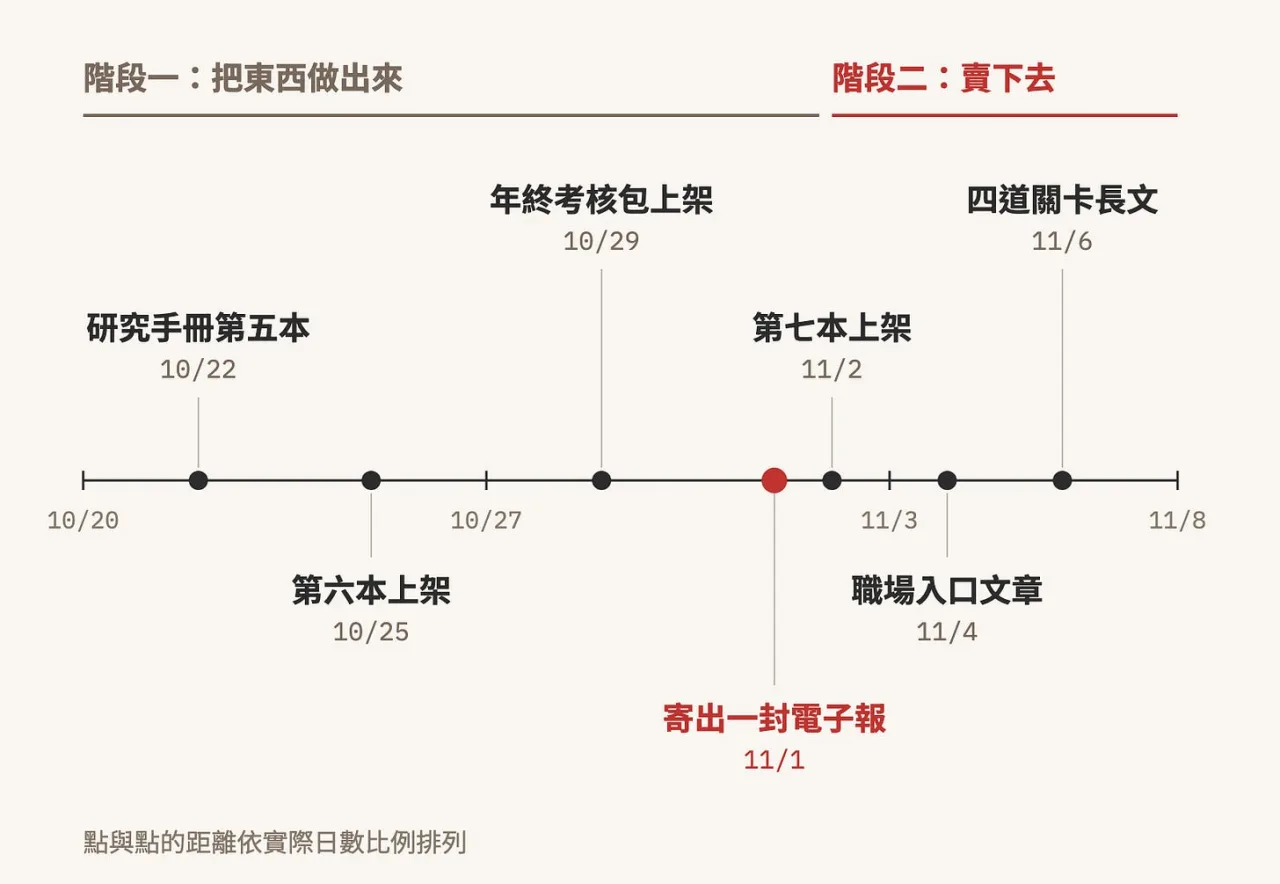
This is my timeline for the past three weeks. In late October, I put a manual on the shelves every few days, and by early November, the line of Researcher’s Manuals was finally complete.
Before that, all I thought about every day was “When will I finish the next book?” There are clear steps for making a manual: writing an outline, writing content, testing prompt words, making a sample, proofreading, and putting it on the shelf. As long as you take it step by step, you will move forward.
But the day the last book was put on the shelves, I wrote something in my review: “The next bottleneck is from making it to selling it.”
There are no clear steps for selling. You put something on the shelf and it doesn’t make its way to the customer. In the past two weeks, the word “promotion” has appeared in my intentions for tomorrow several times, but it has not yet turned into concrete actions.
Later I figured out that the problem was not not working hard enough, but that I was still using my “making things” head to deal with the “selling things” problem. When making something, the harder you work, the more progress you make; when selling something, if your efforts are in the wrong direction, it will be useless no matter how hard you work. So I started asking questions in a different way.
It can’t be sold, it’s probably because it hasn’t been seen.
Looking back on this period of time, I found a very simple rule: if readers can see something, someone will buy it; if readers cannot see something, no matter how good it is, it can only lie quietly on the shelf.
The research manual has a group of graduate students and teachers who regularly read this e-newsletter. They saw it as soon as the letter was sent. The readers of the Workplace Handbook are office workers, and at the beginning, I didn’t even have an article written for office workers. It’s not that they don’t need it, it’s that they don’t even know these manuals exist.
Later, I wrote an article about my reading experience, talking about the book “OGSM 2.0”, and by the way, I also talked about how to write a year-end self-evaluation. As soon as the article came out, the workplace line began to respond.
An article written for readers is more useful than waiting silently after it is published.
This incident led me to put together a diagnostic sequence. Next time you feel like something won’t sell, you can ask yourself three questions based on this picture:
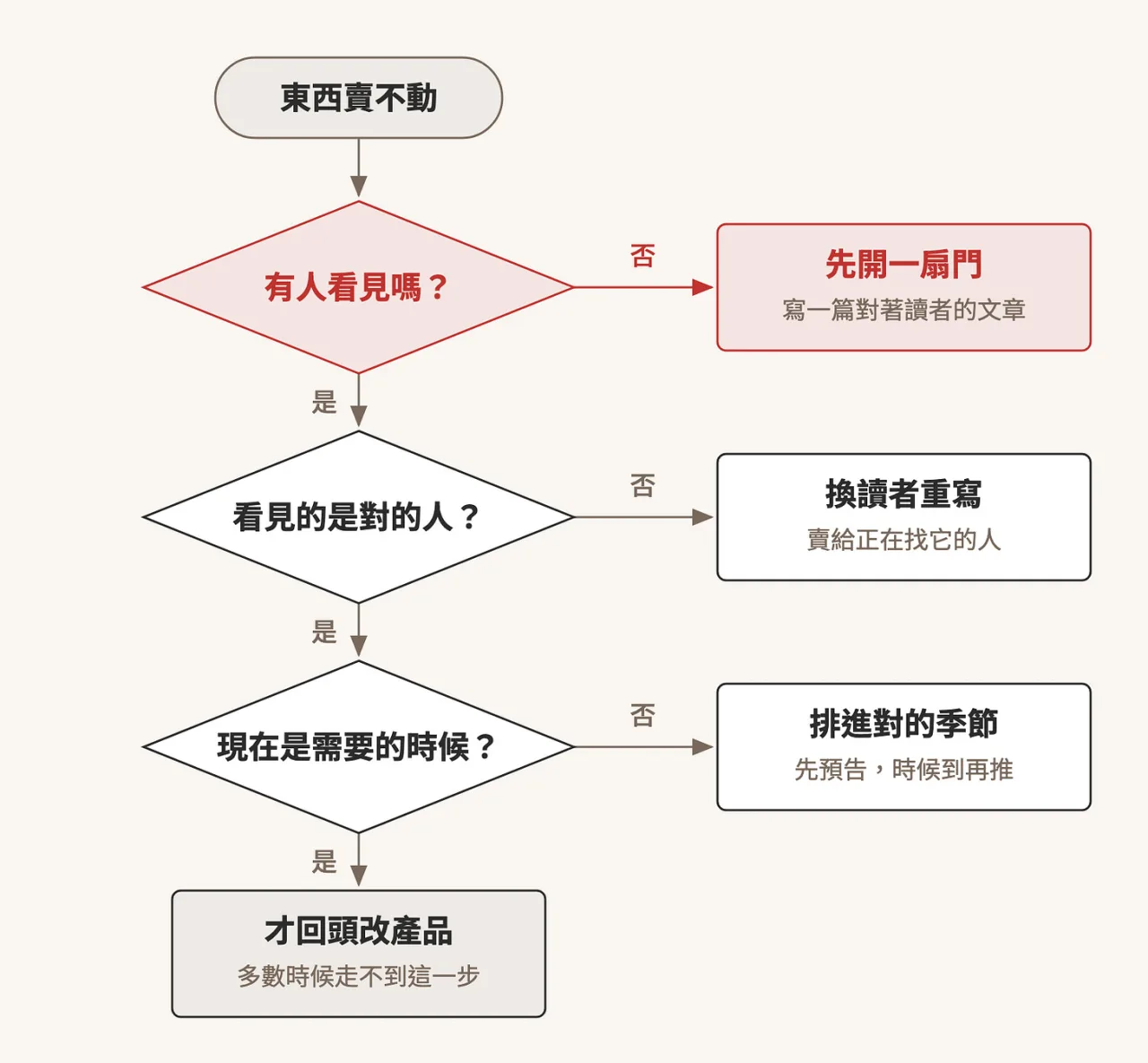
Question 1: Did anyone see it? Most of the time, the answer is “no.” You think everyone knows you have released something new, but in fact only you know. What you should do at this time is not to change the product, but to open a door first: write an article, send a letter, mention something in class, so that the right people have the opportunity to walk in.
Question 2: Did you see the right person? If the channel in your hand mainly comes into contact with another group of people, then no matter how hard you push it, it will be difficult to push it to the people who really need it. At this time, you need to change a group of readers and change your writing method.
Question 3: Is now the time of need? This question is most easily overlooked, and we will discuss it in detail in the next paragraph.
After passing all three questions and the item still can’t be sold, it’s time to go back and check the product itself. According to my experience, most of the time you can’t get to this step at all, and you get stuck on the first three questions.
Is the reader familiar with it? Is the timing right?
After the launch of the workplace series, I also wrote articles, sent e-newsletters, and made videos. But for a while, I wrote in my review: “I seem to be stuck, and I need to find a way to break out.”
Looking back the next day, I realize I missed one thing: timing.
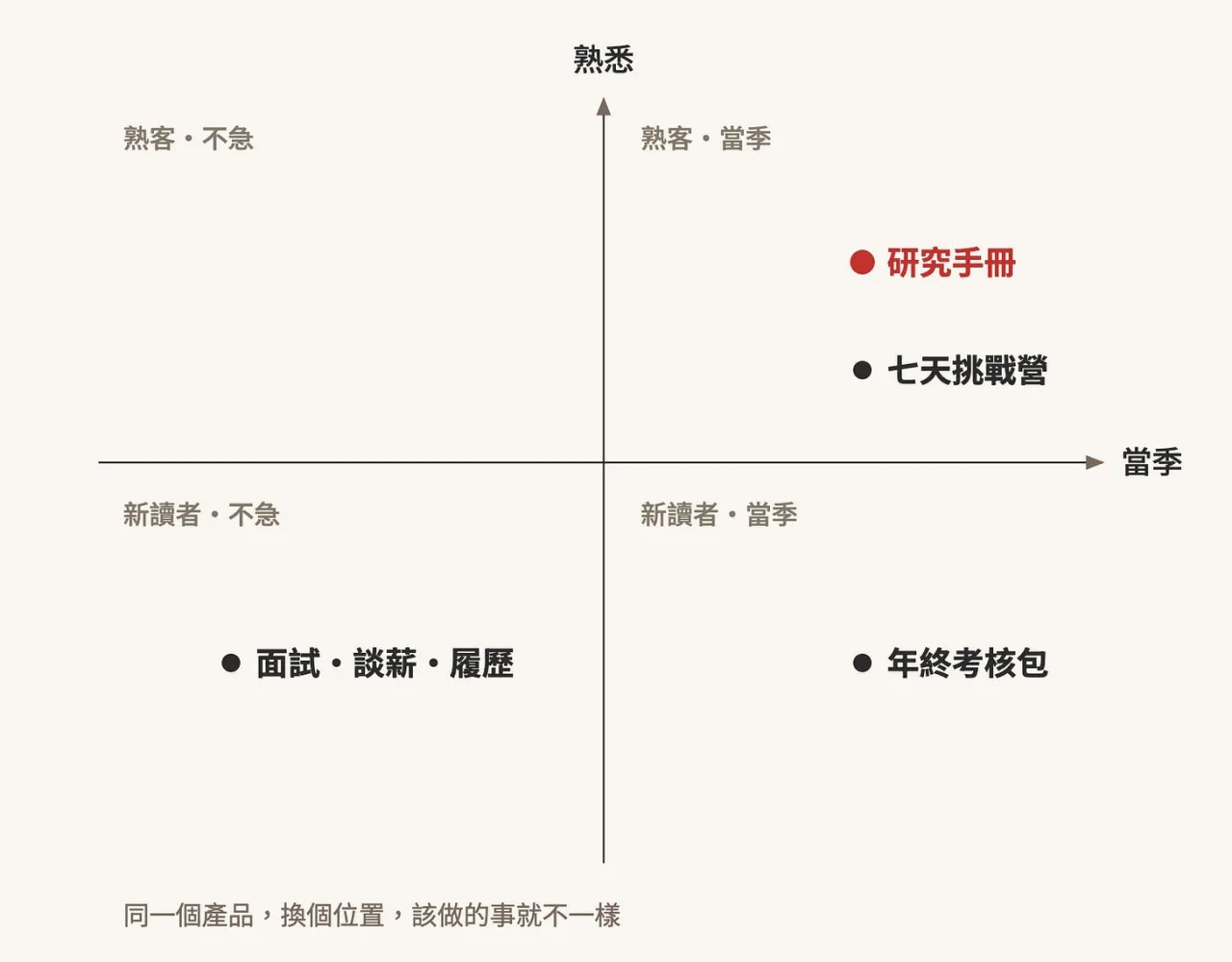
I put the product in my hand into this picture with two questions: Do readers recognize me? Do they need it now?
In the upper right corner is what readers who are familiar with me need. This area is the easiest, just let them know.
In the lower right corner is what readers are looking for answers to, but don’t know me about yet. Like the assessment season at the end of the year, many office workers are searching for how to write a year-end self-evaluation. The focus of this area is to allow people who are looking for answers to meet you while they are searching.
In the lower left corner, there is something that readers don’t know about me yet and don’t need in a hurry right now. Like interviews, salary negotiations, and resumes, most people will not change jobs at the end of the year. Pushing hard now is like selling down jackets in the summer. It’s not that down jackets are bad, but the time has not come yet.
This image can also be applied to your own products. Take a piece of paper, draw two lines and put what you are selling inside. You may find that some items are not unsaleable, but are just placed in the wrong season. For the same product, if you change the position, the things you should do are different.
The cheapest promoter is right by your side
When it comes to promotion, the first thing that many people think of is: running a community, making videos, and placing advertisements. These are useful, but also cost the most. Looking back on the past two weeks, the most effective promoter is actually the cheapest.
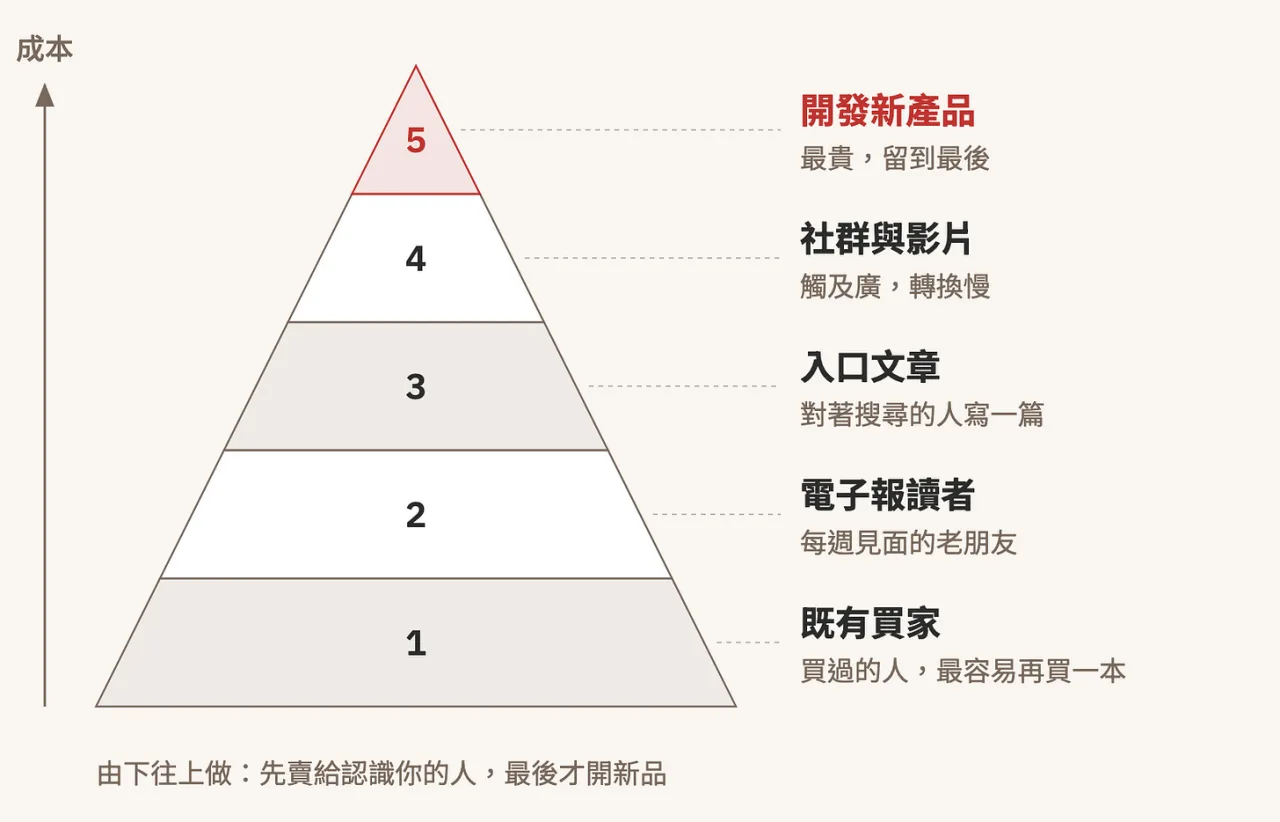
This pyramid, from bottom to top, represents the cost of promotion from low to high.
At the bottom are existing buyers. People who have bought your work already trust you and know your quality, and have the lowest threshold to buy again. Especially for something like a paper, when a person is stuck, he or she is often stuck in more than one place.
The second level is the e-newsletter readers. They may not have bought it before, but they receive your letters every week and are no stranger to you, just like an old friend who meets every week. E-newsletters are currently the cheapest and most effective promotion tool I think.
The third level is the entry article. Write a truly useful article for people who are looking for answers, so strangers can find you. It takes time to accumulate, but a good article can work for you every day during the season of need.
The fourth level is community and video. It reaches a lot of people, but the distance from “seeing” to “buying” is relatively long, and the conversion is relatively slow.
At the top is developing new products. This is the most expensive layer and requires several weeks of time and effort. In the past two weeks, I have also had the idea of “doing another book”, but I have held it down since then. The thing I have is not sold out yet, so opening another book will just postpone the problem.
Therefore, the order I give myself is: do it from bottom to top. Take care of people who know you first, then go to strangers, and finally open new products.
The podium is the most stable line
Looking back over the past two weeks, I can see that there is another line that has been growing silently, and it is growing more steadily than the manual, and that is on-site teaching.
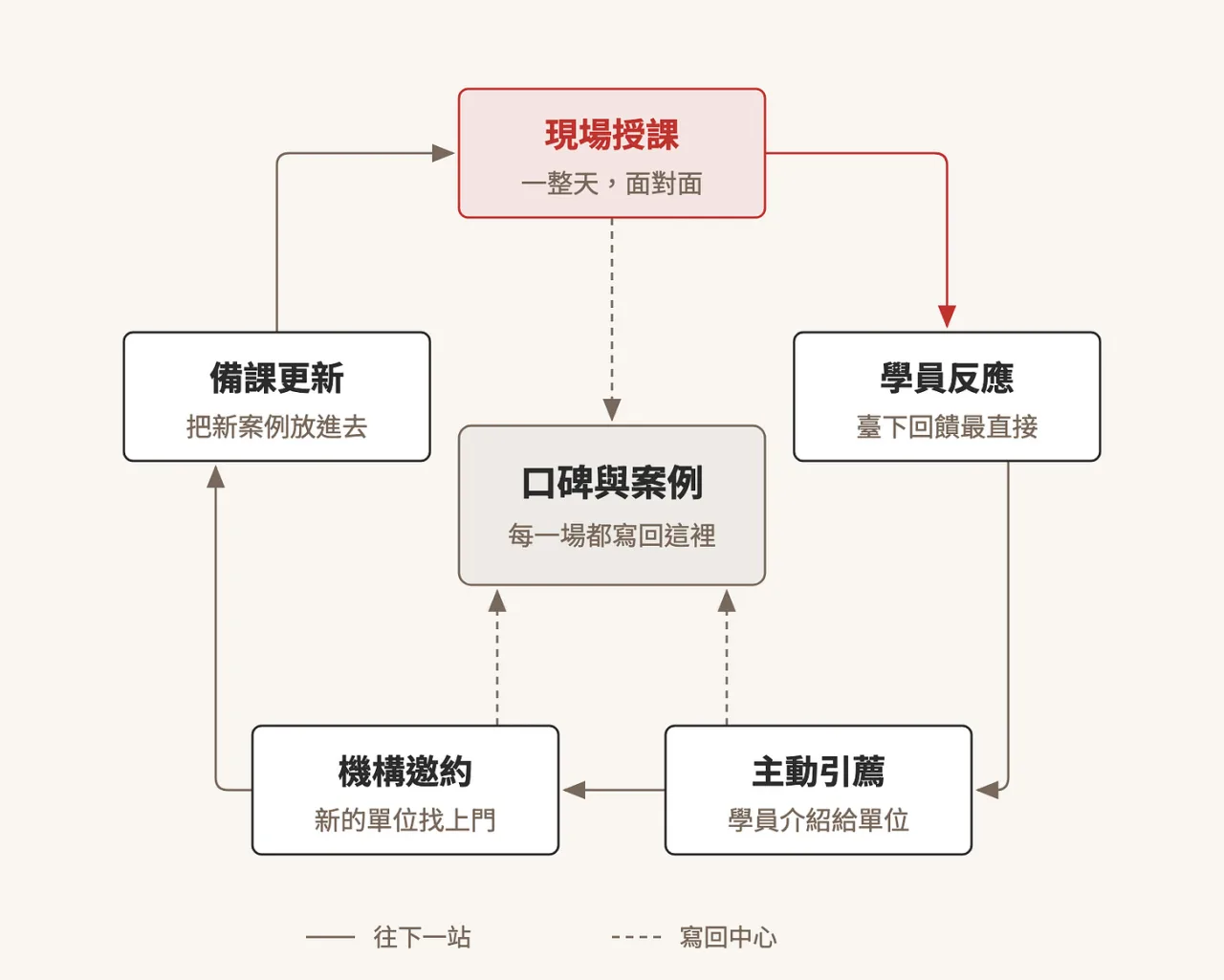
This is a cycle that rotates on its own: on-site teaching, students will respond; students who respond well will take the initiative to recommend; referrals will bring new units to the door; after receiving the invitation, I will put new cases into the teaching materials, and the next class will teach better. Every time you turn around, the “Reputation and Cases” in the middle will accumulate a little more.
In the past two weeks, several new units have come to us through introductions from students.
I also found a small detail in the review. I also lectured for a whole day. One day I wrote, “The students are more serious, so I won’t be too tired.” On the other day, I wrote, “It’s very tiring, but the response from the students and the organizer was very good, which is a small consolation.” Whether it takes effort or not depends largely on the people in the audience.
The podium is stable because it faces each other. Whether you speak well or not, the eyes in the audience will tell you right away; if students take it home and put it to use, they will naturally help you speak. This is something that is hard to replace with any post.
If you put off a to-do item that has been postponed too many times, just put it down.
Finally, I want to share a little thing with you.
For the past two weeks, I have had a simple task on my list that can be done in about ten minutes. As a result, it was postponed once, twice, three times, and all the way to the fifth time. Finally, I decided to officially put it down and cross it off the list.
If you haven’t done something that can be done in ten minutes for several days, it usually means two possibilities: it is not that important, or you simply don’t have time. I have done both in the past two weeks. All my physical strength during the day is devoted to the podium, and my time in the evening is reserved for products and lesson preparation.
One-person company The hardest limit is not ideas or technology, but physical strength. Everything on the list is competing for your power. Instead of letting a thing idle on the list and reminding you that “you didn’t do it again” every day, it is better to simply decide: Either do it now, or officially let it go.
After letting it go, I felt much more relaxed.
Three things you can take away from this issue
Let’s summarize the key points of this newsletter:
- When you can’t sell it, don’t rush to change the product. Ask three questions in sequence: Did anyone see it? Is it the right person? Is it the right time?
- Promotion is done from the bottom up: first take care of existing buyers and e-newsletter readers, then write imported articles, and finally develop new products.
- If something has been postponed too many times, either do it or let it go. Don’t let it idle on the list.
Come and practice with me on December 20th
Since the platform is the most stable line, I would like to preview a class that I am looking forward to.
The fourth session of “AI Empowered Academic Research and Writing Practical Workshop” will be held in Taipei from 9:00 am to 12:00 am on December 20 (Sunday). This is a three-hour practical course for graduate students, university teachers and researchers.
This class does not teach AI ghostwriting, but teaches you to use AI Agent (Claude Code or Codex) as a research co-pilot: let it help you read faster, think more clearly, and revise better, but the core thinking of the research is still your own. In three hours, we will go through three modules:
- Mentality and methods: Establish principles and boundaries for AI collaboration, and get started with Agent’s questioning and iteration.
- Read quickly: Use AI Agent to search, filter, and summarize literature, organize it into a literature review matrix, and identify research gaps.
- Able to make changes: from building the structure to revising the manuscript, and adhering to academic ethics and disclosure of AI use.
Please come with your own topics and drafts, and when you leave, you will take away six sets of templates and checklists that can be used directly on your next paper. The quota is limited to 20 people, and you can enjoy the early bird price by registering before November 29th.
See the complete introduction and registration of the workshop
If you are still considering it, there are also six free online mini-classes on the course page. You can take them first and then decide whether to come to the site.
A recent little thing
The countdown to registration for the seven-day challenge camp at the end of November is down to the last minute. The camp will start on November 30th. You will receive a task letter every day. In seven days, you will make a small tool that you can use every day. You can put it on the Internet and get the URL without having to write a program. Registration closes on November 28th.
See the introduction to the seven-day challenge camp (opens in a new tab)
In addition, if you are preparing for the year-end self-evaluation, the researcher’s handbook and the workplace series handbook are all organized on the same page, so you can choose according to your current needs.
Finally, I would like to hear your experience
Have you ever encountered a time when “something is ready but cannot be sold”? How did you break through later? Or, is there something on your list that you’ve put off many times but haven’t done yet?
Feel free to reply to me directly. Your experience will also become nutrients that encourage each other to grow.
If you have friends around you who are running their own brand and selling their own works, you are also welcome to share this e-newsletter with them.
See you next time!
Vista
Next step
Bring this topic to your team
Vista Cheng speaks and runs workshops on AI workflows, writing and content systems for companies, schools and public agencies.