The content dividend is not over yet, but the admission price has become higher: the copywriting power, content power and brand power of creators in the AI era

This afternoon, I wrote a post (opens in a new tab) on Facebook while revising the presentation I was going to give tonight. I said that Taiwan’s content dividend is not over yet. But if your imagination about writing is still limited to “as long as you write well, you will be seen,” then that romance is probably over.
Within a few hours of writing that post, I chatted online with more than a hundred friends all night. The topic is called “Can it be written? Can someone read it? Can it be sold”. These three sentences are not just made up by me. They correspond to the three places where I have encountered the most stuck creators over the years: some people can’t write at all; some people write for a long time, fearing that no one will read; some people write very hard and hard, but they just can’t be realized.
To be honest, I myself stumbled along the way. How many detours have you gone through, five? Maybe five hundred of them. So in tonight’s sharing, what I want to give you is a map: Let every listener know which level they are stuck on and where to go next?
This article is the highlight of tonight’s lecture.
In two years, the rules of the game have changed
Well, let’s talk about why now.
If you could go back two years and you were a budding creator, how would you fight this battle? You may be thinking: I have to work hard to write articles and do SEO marketing; I have to rely on a popular post to attract fans; I have to post every day to let the algorithm remember me.
In just two years, this gameplay has become completely different. Below are three structural shifts I have observed.
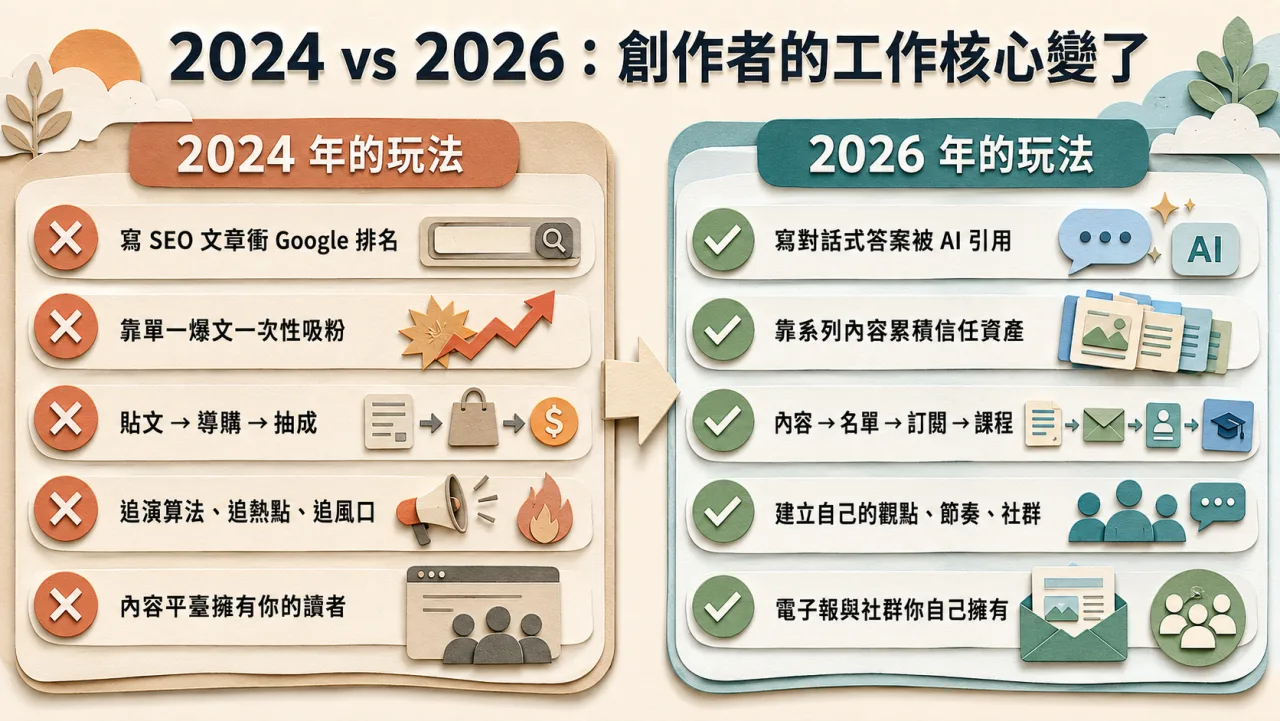
First, search changed from keywords to conversations. In the past, we opened Google and entered three or five keywords to search for information. What now? You might just type a whole sentence to ask the AI, or even bother typing and just turn on voice input. This incident is both a source of joy and a source of worry for the creators: The joy is that the content has the opportunity to be referenced in more scenes, but the worry is that the era of “you get traffic if you rank on the first page” is loosening. I talked about this turning point in <The key to the survival of personal brands in 2026 is not to be seen, but to be cited by AI>, and now it seems that it is coming faster than I expected.
Second, the platform began to pay attention to the relationship between people. Media that require time to spend time with, such as Threads (opens in a new tab), e-newsletter (opens in a new tab) or podcasts, are replacing pure traffic-oriented content. Losing links in one direction and driving people to other places is getting worse and worse. The value of a community has long since changed from what you post to what relationships you create.
Third, monetization relies on trust. Everyone will say the word trust, but how to cultivate trust, how to accumulate it, and how to be seen is the real knowledge. Regarding this point, I have a more complete deduction in <Traffic will return to zero, trust will not>.
Putting these three things together, the creator’s homework changes from “production” to “management”. Therefore, I put a set of comparisons in the briefing: two years ago, we were thinking about how to be indexed by search engines, and now we want to think about how to be cited by AI; two years ago, we relied on the luck of a single post, and now we rely on series of content to accumulate trust assets; two years ago, we wrote one article after another, and now we need to turn the content into a continuous product.
Here, I want to emphasize one thing: you must have your own home court. For example, the official website is the home field, and the e-newsletter is also the home field. Fan pages, IG, and Threads are all away games. The away game is very lively and there are many people, but you don’t make the rules and you don’t open the door. It is very dangerous to rely too much on the platform.
AI doesn’t destroy content creation, it destroys mediocrity
Every time I talk about AI, someone always asks me: Is this a good thing or a bad thing for creators?
My answer is: AI doesn’t destroy content creation, it destroys mediocrity.
It’s too easy and too fast to produce content these days. You give AI a question, and it can give you an article with a complete structure and smooth sentences in thirty seconds. The problem is, something like that is of a very average, mediocre level. When everyone can produce “okay” content in thirty seconds, “okay” is completely worthless.
Therefore, the creator’s topic has changed. In the past, it was considered as passing the test after finishing the article or filming the video. Now the question is: can I write something that will make people’s eyes light up, be really emotional after watching it, and be really helpful? It depends on your own perspective, your past experiences and your unique flavor.
I often say something to students: As large language models become more and more powerful, human experience, judgment and taste become more and more important. These are not words of comfort, but a redrawing of the division of labor. I once wrote that taste is the last moat for creators, and I also talked about when perfection becomes cheap, imperfect you are the most expensive asset, all of which are talking about the same thing.
Next, I broke this matter into three abilities that can be practiced: copywriting power, content power and brand power.
The first strength: Copywriting ability, translating value into sentences that can be understood in three seconds
When it comes to copywriting, many people’s first reaction is “I’m not good at writing.”
I want to help you loosen up a bit: Copywriting ability is a kind of translation ability. What you have to do is to translate the value in your head into sentences that readers can feel in three seconds. The quality of writing is never the absolute key, but whether it can convey value is.
And the difficulty has indeed increased now. In the past, you only had to please readers, but now you have to deal with three kinds of objects: readers, algorithms, and AI. Every sentence you write must not only impress people, but also be read by machines, and it must be quoted by AI. Next time you hit the keyboard, think about this.
Therefore, there is only one acceptance criterion for good copywriting: whether it can get the right people to make the right decisions at the right time. Whether the writing is beautiful or not is secondary.
Hooks, structures, and endings each guard an indicator.
The copywriting has a three-layer structure, and each layer corresponds to a very realistic indicator.
The hook is about the retention rate. Threads is very popular among Taiwanese netizens. The average scrolling speed is 1.8 seconds. 1.8 seconds can determine life or death. When the hook is not strong enough, the person will slip away.
The middle structure focuses on the reading rate. A smooth hook at the beginning is not enough. Every turn and rhythm in the middle determines whether the reader should continue reading.
The ending is about action rate, which is the familiar call to action. The principle of CTA is not difficult to understand, but the difficult part is the design. Modern readers are smart and have their own judgments. The rigid “buy now” appeal has long been ineffective.
How to write hook? I usually try from five directions: counter-intuition, giving specific information, using rhetorical questions, matching timing and telling stories (opens in a new tab). By the way, hooks are not only useful when writing copywriting. If you want to shoot short videos, you also need to design hooks.
It is certainly a good way to observe how others write and shoot. But I would like to remind you: you must incorporate your own experience and characteristics. Otherwise, all the products produced will be Me Too works, and no one will be impressed.
The classic framework will not be outdated, it just needs to be changed.
I have taught copywriting for so many years, and I still talk about frameworks with everyone. Some frameworks are really timeless, like PASTOR, AIDA, 4U and SCQA.
Among them, I particularly prefer PASTOR, which is problem-oriented. Why? Because every reader comes with questions. You first point out his problem, enlarge the problem, tell a story, describe the scene after solving it, and finally give a clear next step. After going through it this way, the copywriting will naturally look like it.
But the frame is dead. You still have to make changes based on your own experience and opinions, and you cannot fill in the blanks by copying formulas. If you want to see a more complete operation demonstration, you can refer to the 〈Four-step methodology for AI copywriting〉 that I wrote.
AI writing and AI-assisted writing are two different things.
Nowadays, almost no one does not use AI assistance. But I want to ask you to think about something.
If you just give an AI a question to write, it will certainly be able to write it, and it may not be bad at it. But is that article yours? Can I put your name on it? Does it have your taste in it? I think these three questions are worthy of every creator to face honestly.
A better way is collaboration: AI is responsible for drafting, and you are responsible for refining ideas, rhetoric, and adjusting the taste.
My own collaboration SOP is this: diverge first and then focus, don’t ask AI to write it for you at the beginning; think about it for a round first, and then let AI help expand it; pick an idea from it and go deeper; wait for the draft to grow, then strengthen the structure and slowly polish it.
There are three things I don’t outsource to AI.
The first is the hook. The hook is the starting point for people. If you ask AI to create ten hooks, it can write them, but those ten will probably not have your perspective or flavor.
The second is a true story. It’s true that everyone loves to read stories, but what everyone loves to read are true stories. Once the fabricated story is exposed, what you lose is trust, not traffic.
Third is the CTA. Calls to action written by AI are often smooth and have no problem reading, but they don’t have the power to sell. Do this part yourself.
After you’ve polished your draft, there’s another step worth your time: picking out the sentences that appear the same to everyone. I compiled my own practices into “Checklist for removing AI flavor in Chinese writing”, which is available for free, and you can also use it to check your own manuscripts.
From SEO to AEO: Being cited by AI may be more important than Google rankings
The rules of the search game have changed. In the past, we focused on SEO, but now SEO alone is no longer enough, we also need to understand AEO.
My judgment is: starting from this year, whether content can be cited by AI may be more important than Google ranking.
Of course, you can verify this yourself. Find a few questions or keywords that you are familiar with, and ask each AI to see what it replies to you, who it cites, and whether it leads to the content of your own website. This little experiment is interesting and cruel.
On the same topic, the way of writing SEO is indeed different from the way of writing AEO. In the title, you can only write descriptive words in the SEO era, but it is best to have a point of view in the AEO era. At the beginning, you could slowly lay out your answer in the past, but now it is recommended that you directly give the conclusion in the first one or two hundred words, because readers are impatient, and AI wants to know your answer directly. In terms of evidence, you must provide specific information that can be extracted and cited.
As for how to monetize your copywriting skills, there are actually many ways: taking on projects, working as a writing coach, running copywriting courses, or working as a content consultant are all possible outlets.
The second force: content power, turning every article into an asset
Many people ask me: If I want to build a personal brand, do I have to update it every day? Is weekly update okay?
The point is really not here. What matters is whether you can sustain it.
Continuity is more important than continuity. I would rather you write well, it doesn’t matter if you update weekly or bi-weekly, rather than happily writing three articles in one go today and then completely disappearing in the next three months.
Instead of pursuing posting every day, it is better to pursue that every article and video you post has its value and can continue to accumulate. The content should not be scattered here and there, it should grow into a system and become a continuous asset.
Pillar content: write once, use many times
Next, let’s talk about pillar content.
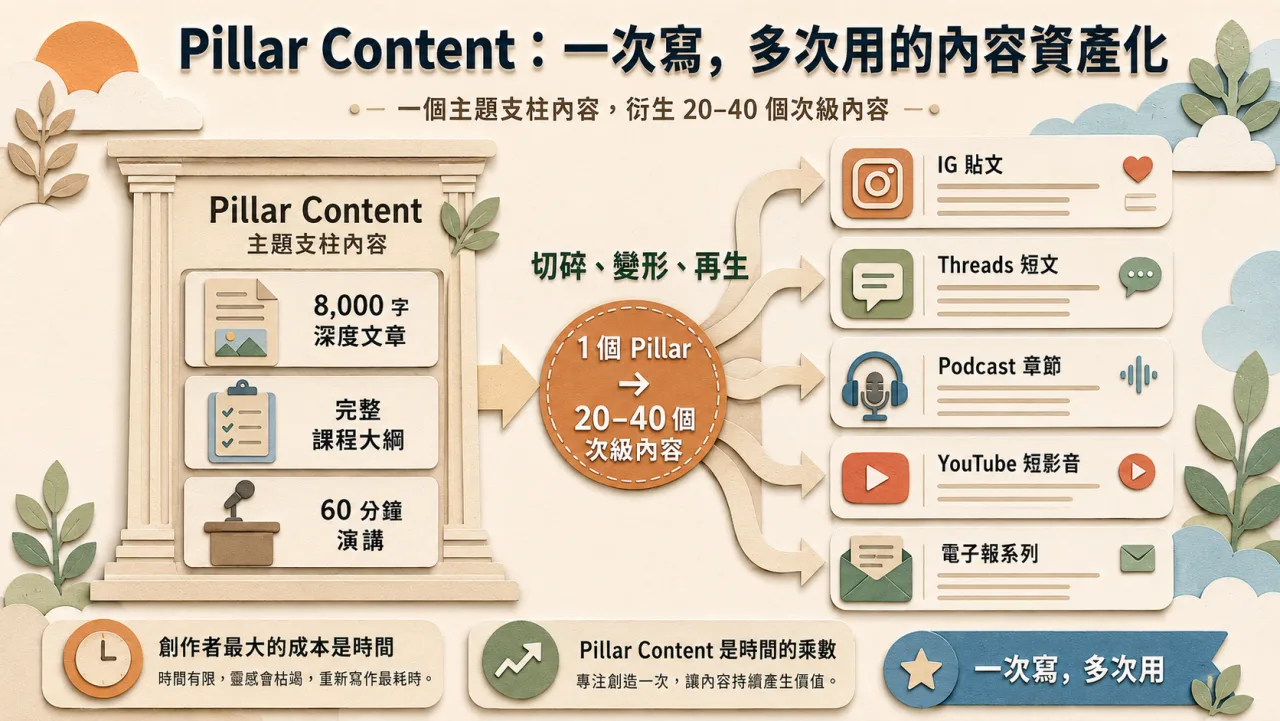
Whether you write an article, give a course, or give a speech, it can be chopped, transformed, and regenerated into different forms of content. A good pillar can generate in-depth long articles, podcasts, short videos, IG graphics, Threads posts, and e-newsletters. Creation takes time and effort. When time is limited, every creator should think clearly about how to effectively use the assets at hand.
The approach I recommend has four steps.
The first step is to find your theme. Here’s the key: don’t pick a topic you already know, pick a topic you’ve always been curious about, always passionate about, and never get tired of talking about. You can finish it by writing only two articles on the topics you know how to solve, but you can dig into the topics you are curious about for ten years. I have broken down this step in more detail in 〈Content pillars: the first thing personal brand operators should think about clearly〉, which is worth reading together.
The second step is to choose one pillar per season, four per year is enough. Don’t be greedy and say I want to choose ten or a hundred. Even if you choose, you won’t be able to take care of them. It takes time and effort to take root.
The third step is to write a long article, treat it as the headquarters of this season, and then connect all related derivative content back. The fourth step is to treat this long article as the mothership, split it into secondary content, and regularly review, review, and add new cases and information. As for how to automatically grow a long article into six types of output, you can refer to my Content Production Line Implementation Record.
For the same theme, the deeper it is, the more valuable it is. Many things are like this, just like wine, the darker it becomes, the more fragrant it becomes. By the way, the longer a website is, the more valuable it becomes, provided it is an active website and it is your own. Those hanging on the platform do not count: for example, I also have an account in Fanggezi, but the URL is Fanggezi’s, not mine. Therefore, I always encourage creators to have their own domain and website as early as possible.
By the way, there is one more thing I want to remind everyone: the value of content assets is a function of time multiplied by the number of rewrites. Many people come to me to learn how to write, and they immediately ask how many articles and words they need to write. Remember, it’s never about word count.
I have several themes that I want to delve into in the long term, such as: content creation methodology, AI and writing, personal brand and one-person company, instructional design and knowledge realization, and the second curve of middle-aged career. The corresponding channels include blogs, e-newsletters, podcasts, online courses, workshops, IG and Threads.
Select the battlefield and configure it with 121
My observation about Taiwan’s current platform ecology is this.
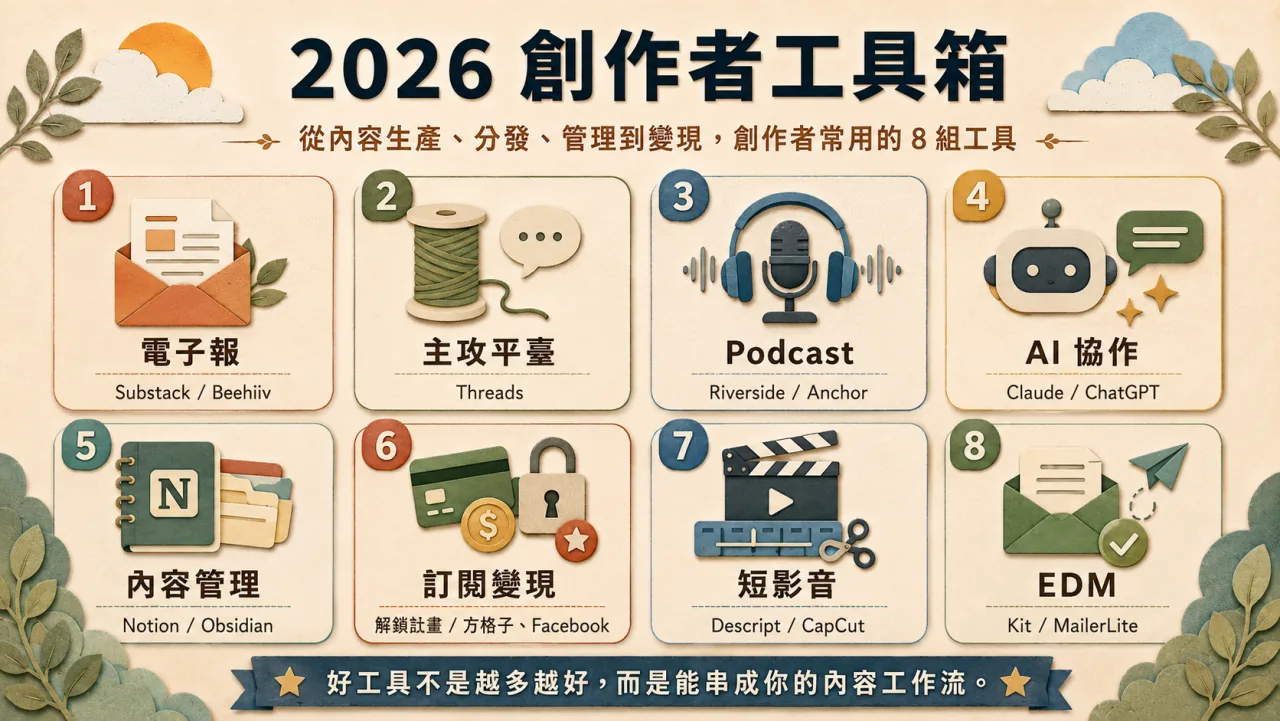
Threads is currently a profitable platform for text creators and is worth trying. Podcasts are a great place to build deep trust. YouTube Shorts’ short video bonus isn’t over yet either. Electronic newspapers are the media that many people ignore but are the most proactive. In addition, don’t forget the Private Community option, which often has a much higher density of relationships than the public forum.
However, you don’t have to register and participate in the popular platforms now. What you have to think about is: which platform is most suitable for your characteristics and content format. After all, our time, energy, resources and funds are limited.
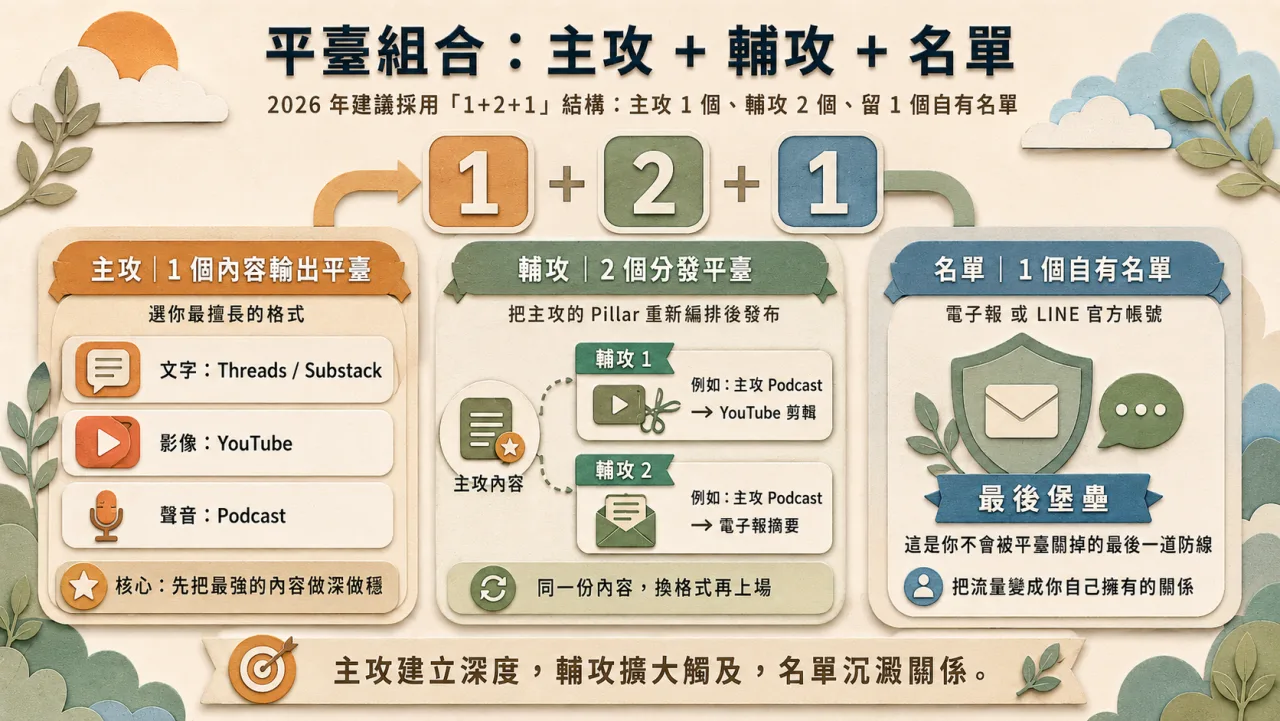
I suggest adopting a 121 structure: one as the main attacker, two as auxiliary attackers, and one free spot is left to wait and see. The proportion of investment can be 60%, 25%, or 15%. You can adjust this proportion according to your actual situation.
The rhythm can also be arranged first. For example: write an in-depth Threads article on Monday, post it on IG on Wednesday, send an email on Thursday, and record a podcast on the weekend. The more content you produce, the better, but it is important to have a clear hierarchy so that readers can develop the habit of watching and listening.
Traffic is the result, assets are the focus
I know everyone cares about traffic. But traffic is the result, and what you should really take stock of are the assets.
I have three sentences for everyone: search brings traffic, lists build relationships, and products are monetized.
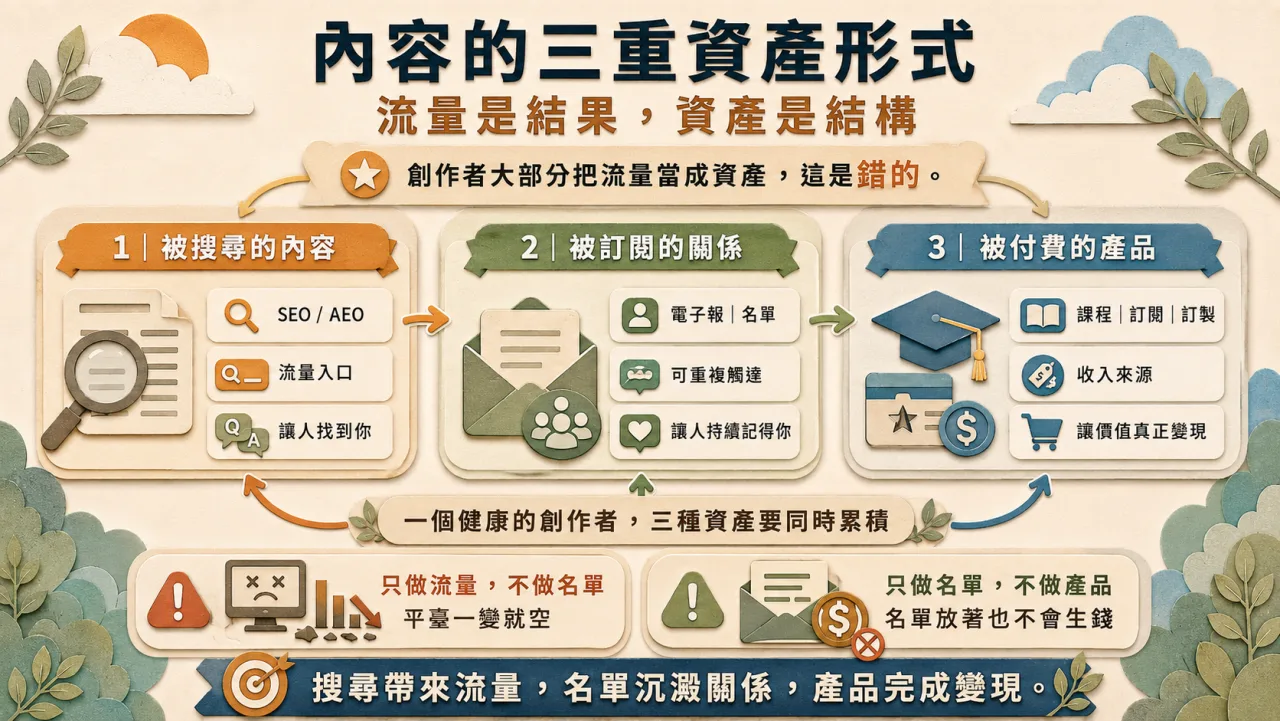
The corresponding are three assets: content assets that can be searched, list assets that can precipitate relationships, and product assets that can complete transactions. You can ask yourself now: I have my own official website or blog, can people find me? I have my own e-newsletter, can I create links with my readers? Do I have a product that people can pay for?
There is another calculation that I like very much: the expected income of a creator is roughly proportional to the number of lists, the quality of the lists, product suitability, and the thickness of trust. Note that these four terms are multiplicative. If any one of them is zero, the multiplication is zero.
From content to revenue, there is a funnel in the middle: cold traffic goes to warm traffic, warm traffic goes to hot traffic, then comes payment, and finally there are high-priced customers. What you have to do in each section is different. If you want to see actual numbers, I once reviewed How to accumulate 2,400 lists in one day.
Writing and revising can be done separately
Finally, let’s talk about workflow. From inspiration to publication, from publication to release to review, I suggest you design your own set of SOPs.
Here’s a helpful reminder: Don’t rush to write and revise in one go. Many times we think about too many things at the same time, thinking about arguments, sentences, and typos at the same time, and the quality is naturally unstable. Doing them separately is more stable.
Since I know how to Vibe Coding, I simply turned the entire pipeline into a set of skills: establishing a personal writing style, collecting inspiration, in-depth research, drafting, removing AI flavor, until the final release. It’s relatively easy for me to do these things now. Recently, I also built an AI editing system. I can record a video with my mobile phone and leave the rest of the editing and adding cards to it, which is very convenient.
I mention this to say one thing: Workflows can be designed, and the cost of designing workflows has dropped to an unprecedented low in the past two years.
If you also want to bring this process into your daily work, I have compiled the complete method into “AI Content Creation” online course: from establishing personal style files, inspiration collection, in-depth research, to drafting and removing AI flavor, I will take you step by step to grow your workflow.
The third force: brand power, how others describe you when they are not in front of you
Let’s first clarify a common confusion: personal brand and personal image are two different things.
Personal image is how you package yourself. Personal brand is how others describe you when you are not in that boardroom.
Positioning in one sentence: clarity is more important than completeness
The human brain is very lazy and cannot remember so many things. When it comes to Apple, everyone immediately thinks of simple technology; when it comes to Eslite, what comes to mind is a humanistic and bookish bookstore.

So you need to have one sentence to position yourself and make three things clear: who you are, who you do for whom, and what problems you solve. If you need to spend ten sentences introducing yourself, others will not be able to remember a single sentence.
Clarity is more important than completeness.
After Positioning (opens in a new tab) is written, there is a very simple verification method: show it to a few unfamiliar friends and see if they can directly say “So you are doing OO, right?” If they still need to ask, it means your positioning is not clear enough, so please go back and refine it again.
Positioning requires constant polishing, and you can also ask AI to help you think of several versions before choosing one yourself. Having said that, the reason why most people get stuck is often not because they can’t think of it, but because they are reluctant to let go of other options. I have a deep understanding of this in 〈It’s not that you can’t choose a position, you just can’t let it go〉. If you want to condense your positioning into one word, you can also take a look at A complete tutorial on personal brand tags.
Triangle of Trust: Professionalism, Sincerity, Continuity
Professionalism alone is not enough. Trust is supported by three corners: professionalism, sincerity and continuity.
I believe that you who will read this will have no problem with your major. But has your sincerity been shown? Has your persistence been seen by everyone? If one corner of the triangle is missing, the entire structure will collapse.
Here’s a little exercise for you: honestly assess which corner of your body is weakest, and then start working on it from that corner.
From writer to operator: the path to IP
A common path goes like this: writer → speaker → coach → author → operator.
This is not the only way, but it has reference value. The main tasks and issues to be faced at each stage are different. You can first determine which stage you are at now: just started trying to write? Great, that’s a great starting point. Already on the podium? Already want to write a book? All great too. Only when you know where you are can you know what to practice next.
If you have several interests at the same time and don’t know which path to focus on, 〈Multiple interests are not distractions, but careers you haven’t assembled yet〉 may be able to give you some clues.
E-newsletter, the most underrated tool
Every time I recommend e-newsletters, someone will ask: Do people still read e-newsletters in this day and age?
My answer is yes, for four reasons.
It is a proactive medium, unaffected by algorithms, and what you write goes into your inbox. You receive a bunch of emails and EDMs every day, but do you take the initiative to delete them one by one? Not really. As long as you don’t delete it, it will be seen one day, maybe you clicked on it while searching for other information one day. If the open rate can reach 30%, 50% or even higher, that would be a great thing. The reach rate of social platforms is far from catching up. The most important thing is the list: when you run a fan page or a Facebook group, there is no list, and those digital assets are not in your hands.
If you want to start a newsletter from scratch, here’s my advice.
In terms of platform choice, Kit (formerly ConvertKit) is great, but it is really expensive, and the cost of sending a report is higher than most people think. For those who are just starting out, I recommend Substack because it’s free and I use it myself.
Then design your list magnet (opens in a new tab): e-books, PDFs, teaching files, templates, any valuable, downloadable free resources, and use them in exchange for readers’ emails. At the same time, we divert traffic from the community and bring people from the away game back to the home court.
After you have a certain number of subscribers, you will start to strengthen: a fixed rhythm of sending emails, content worthy of being forwarded, and a recommendation mechanism. The Substack platform itself has a built-in recommendation mechanism. Many of my subscribers are referred by other people’s e-newsletters.
And a bloody reminder: Never use Gmail to send newsletters. Gmail is for writing letters, one-to-one, one-to-two, not one-to-many. If you try to send it to hundreds of people at once, it will soon be judged as advertising spam by Google, and your account may be suspended directly. To submit a report, please find a dedicated e-newsletter platform.
(opens in a new tab)
There are six types of brand assets, and the number of fans is not among them.
Building a brand is important, but what matters is not how many fans you have, but how much money you have accumulated that can be monetized.
I divide these assets into six major brand assets: content assets, list assets, product assets, methodology assets, network assets, and word-of-mouth certification assets.
From another perspective, there are four “cans”: content that can be searched, products that can be purchased, methodologies that can be authorized, and connections that can be collaborated with.
Take stock of what kind of products you have on hand, and you will know how strong your financial resources are, and you will also know what will be left if a certain platform collapses tomorrow.
Pricing: Don’t let cheapness become your differentiation
Pricing is a very deep science. There are three common logics: cost-plus pricing, value pricing and anchor pricing.
In the past, the simplest method was cost plus, calculating the cost and adding a percentage. But you can slowly adjust in the direction of value pricing and anchor points, and the operating space will be much larger. Many courses and products on the market actually use these two types.
As for whether to go the low-price or high-price route, there is no absolute right or wrong. You have to consider the market conditions, your own characteristics and the attributes of the content. But there is one principle I want you to remember: don’t let cheapness become your differentiation. Because there is always someone cheaper than you.
By the way, if you want to know which direction the market is heading, the high-price monetization signals mentioned in <The Zero-Click Era, Three Decisive Trends in Knowledge IP> are exactly the same as what I observed in the lecture tonight: there are more and more high-priced courses and high-priced escorts, and the whole thing is moving towards sophistication.
Superposition of three forces: nine paths to realization
At this point, all three forces have been dismantled. Next is the most critical combination question.
In the past, the monetization path for creators was very single, almost a one-to-one relationship: I can write articles, so I help others write articles; I can write, so I submit articles; I have some traffic, so I do affiliate marketing.
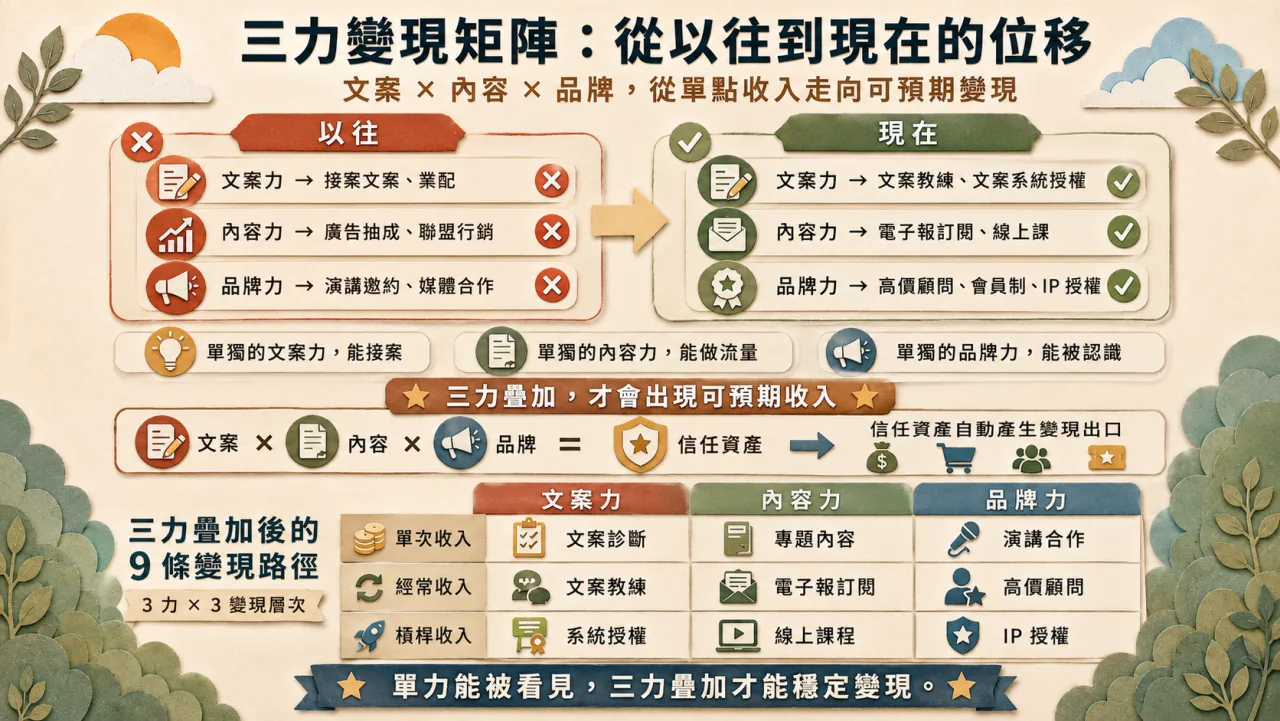 Now you can superimpose copywriting power, content power, and brand power, and then multiply them by three income dimensions: single income, recurring income, and leveraged income. Multiply three times three and you have nine paths to monetization.
You can be seen by relying on a certain force alone, but the superposition of three forces can achieve stable realization.
Everyone loves to talk about passive income and after-sleep income. If you want to earn after-sleep income, you need leverage. In addition to single-time income from writing, ghostwriting, and teaching courses, IP licensing, system licensing, and high-priced course products are the levers. If you want to know what people who are really making money are doing now, you can read what I wrote 〈The First Year of AI Monetization〉.
What about the order? My advice is clear.
First build your trust assets, whether it is a newsletter or a website. If you have just embarked on the path of creation, don’t be in a hurry to cash in. Write your own flavor first, build trust first, then launch the first paid product when the time is right, then slowly optimize and scale it up, and then start building the second product line.
The timetable roughly looks like this: in the first three months, clarify your positioning, optimize existing content, and start building a list; then design your first paid product; then move on to product optimization and traffic acceleration; and finally the second product line and IP.
Taken apart, each paragraph actually contains very complicated knowledge. But it doesn’t matter. We all learn by doing. We make mistakes while doing it. In the process of making mistakes, we review, improve and observe others, and the direction will slowly emerge.
The four most common landmines
After seeing so many creators, I have sorted out the four most common pitfalls.
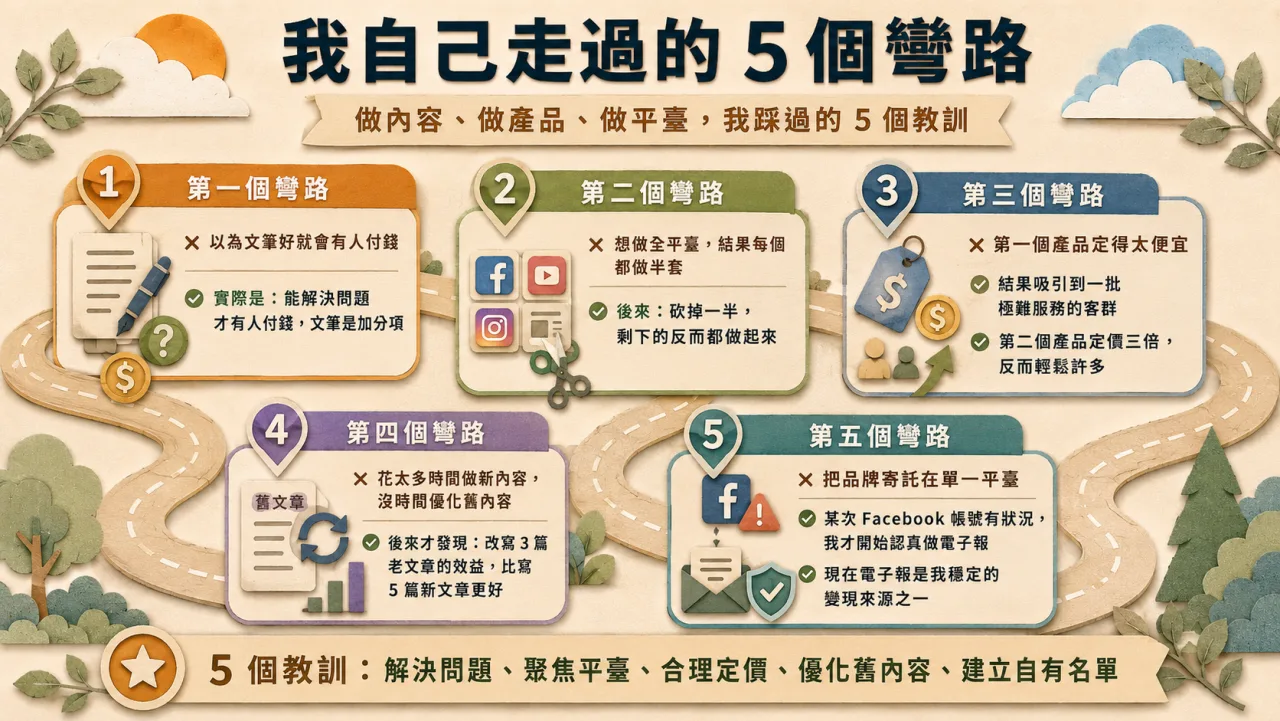
Rushing to sell a product: Selling before trust is established usually results in disappointment.
Too greedy: Operating several platforms at the same time results in failure in each one. Looking back at the 121 configuration, let’s make the first one.
Pricing is too cheap: Being cheap is not a strategy, it is giving up competition.
Just ignore the money: after the product is launched and the money is credited, there will be no follow-up. This is the fastest way to consume trust.
There is another question. A friend asked me in the comment area that night: How can I write content that the most people are willing to buy?
My answer is to put yourself in someone else’s shoes. Of course it’s fine if I write it by hand, but if you want to monetize it, you still have to start from the perspective of readers and potential customers: what do they really need? What are they worried about now? Many people write things entirely from themselves and write very seriously, but they never reach the other person’s heart.
People who write for a long time will eventually be seen.
Back to my Facebook post this afternoon.
The dividends from content monetization are really not over yet, but the admission price has become higher. When AI becomes more and more powerful, it means that the level of work that can be easily replaced is devaluing, and it also means that your judgment and taste are appreciating.
I want to remind you one thing: don’t be fooled by temporary bonuses. Just rush to whichever platform is popular. After two years of chasing, you may not have anything left on your hands. What is truly worth investing in are the assets that will accumulate.
Copywriting power, content power, and brand power cannot be developed overnight. But precisely because of this, once you practice it, it is something that is difficult for others to copy.
Tonight I put a sentence at the end to end, and now I give it to you:
The focus of a creator is not to write quickly, but to write for a long time. Because those who write for a long time will eventually be seen.
If you could only take away one action tonight, I would suggest you open your calendar, find a time slot, and answer those five positioning questions. Only when the positioning is clear can we move forward on the road ahead.
If you want someone to accompany you to complete this task, “Positioning Convergence Workshop” (opens in a new tab) is designed for this purpose: use one day to consolidate your scattered multiple identities into one sentence that others will remember. If you want to start from the content side, “AI Content Creation” online course will take you to build the entire writing pipeline.
Let’s do our best together.
This article compiles the contents of the online lecture “[2026 Creator Guide] Can be written, read, and sold: Breaking through the AI Content Red Sea” on July 27, 2026, and supplements the on-site Q&A discussion.
Several small tools mentioned in the article, including the writing discipline system designer, the Chinese writing AI flavor removal checklist, and about forty other creator tools I developed myself, are all located at lab.vista.tw (opens in a new tab). These tools run on your own device, and every word you type stays on your phone or computer and I can’t see it.
Next step
Bring this topic to your team
Vista Cheng speaks and runs workshops on AI workflows, writing and content systems for companies, schools and public agencies.