Creators are no longer the advertising space you rent: Three directions for brand marketers from the "2026 Creator Economy Report"
This article was originally published in Economic Daily (opens in a new tab), here is the full version.
Looking back on the history of digital marketing in the past ten years, Internet celebrities (opens in a new tab) and content creators are mostly regarded as short-term rentals by brands: they will be put on the shelves when the schedule is up, and they will be replaced when the case is closed. The unit of measurement is exposure and cost.
However, according to the newly released “2026 Creator Economy Report (opens in a new tab)”, this market worth hundreds of billions of dollars has officially bid farewell to a pure attention carnival and entered an era of highly specialized sovereignty and resonance. If brands still hold on to the old logic of spending money to buy traffic, they will be quickly marginalized in the subsequent market reshuffle.
The American influencer marketing agency The Influencer Marketing Factory (opens in a new tab) revealed the structural changes in the creator ecosystem in 2026 through an in-depth investigation of millions of creator accounts and consumers around the world. To formulate a correct digital marketing layout, corporate decision-makers must first clearly understand these three irreversible waves.
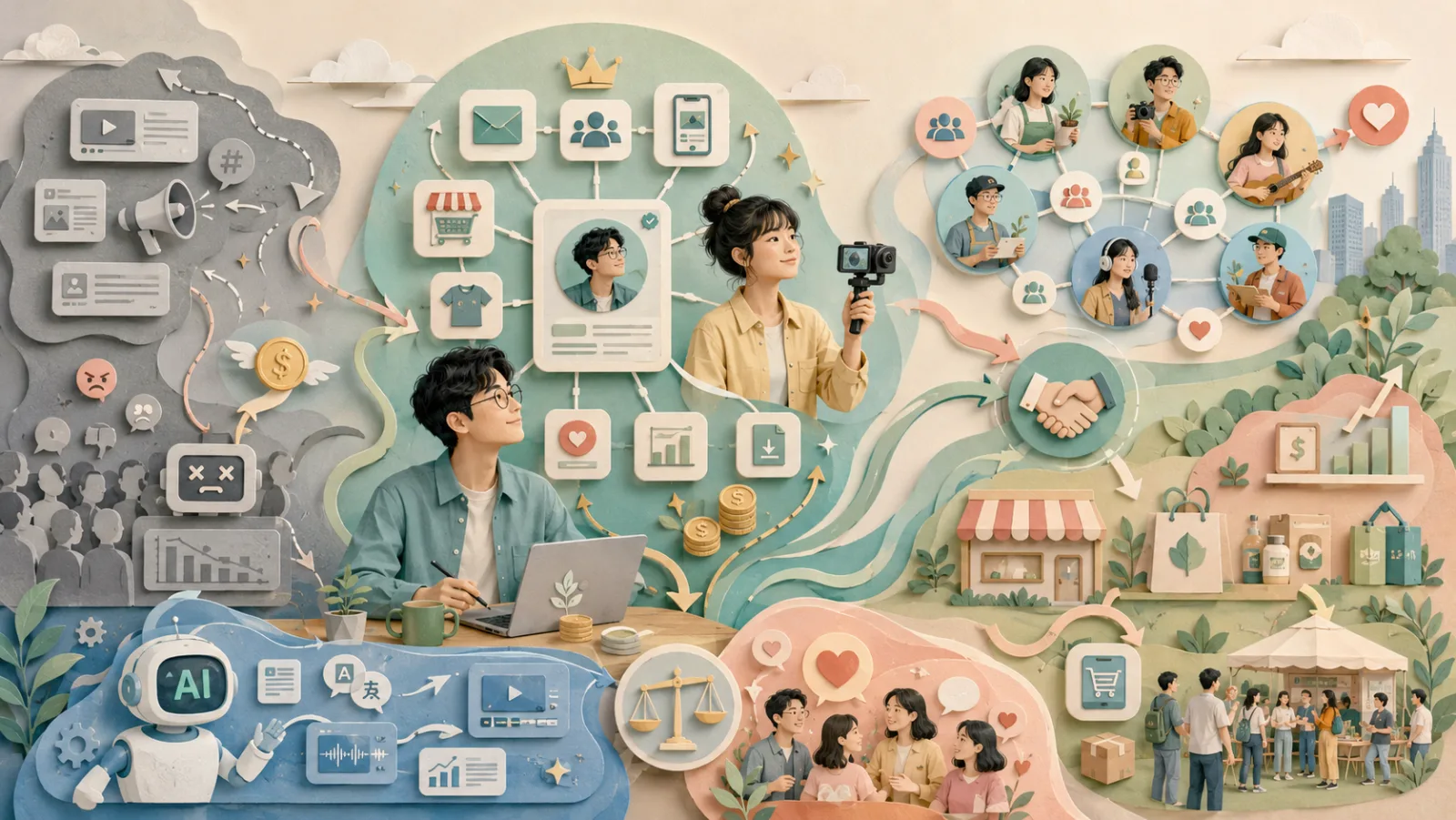
1. The rise of creator entrepreneurs: from platform workers to own channels
The report points out that the most significant watershed in the creator economy in 2026 will be the comprehensive upgrade of content creators to creator entrepreneurs.
In the past, creators relied heavily on the algorithms of a single social platform, and most of their income came from one-off brand placement cases. As soon as the algorithm was revised, the entire quarter’s revenue evaporated. In 2026, as many as 72% of creators are actively directing their fan base to private traffic or their own independent channels, such as paid newsletters, Discord communities and personal independent apps.
Creators are no longer content to just be part-time workers on the platform. They have established diversified revenue through their own IP, peripheral products, digital downloads and subscription (opens in a new tab), and their passive income ratio has exceeded 20%. This means that creators’ bargaining power and autonomy over brands have reached unprecedented heights.
I talked about this in “What creators are really selling is not words”: There are levels of realization, selling services, selling works, and selling systems, and the ceilings of the three are completely different. The reported figures provide evidence for this judgment on a global scale.
For the brand, this means a different person is at the negotiating table. What you are facing is no longer a self-employed person waiting to take a case, but a micro-media company with its own list, its own channel, and its own product line.
2. The middle class of creators supports the market: the golden age of micro-influencers and waist-level internet celebrities
For a long time, the creator economy has shown an extreme M-shape: the head eats all, and the long tail has difficulty making a living.
But the 2026 data shows a healthier ecology. Nearly half (about 48%) of professional creators earn a stable annual income between $10,000 and $100,000. This group of middle-class creators may not necessarily have millions of fans, but they have extremely high stickiness and voice in niche markets.
At the same time, the 25 to 34-year-old group has become the most important audience and main consumer across major social platforms. The tastes of this generation are more mature and rational. They have very little tolerance for hard sales, but they are willing to pay for people they trust. The two things stacked together provide very fertile soil for brands to carry out precise micro-influencer and waist-influencer marketing.
In other words, the best place to put your budget may not be the name with the highest offer and the most beautiful followers, but the ten people who are truly trusted in your target niche.
(opens in a new tab)
3. AI is a double-edged sword: the tug-of-war between technological dividends and humanistic value
AI tools will be fully integrated into creators’ daily workflows in 2026, used for script optimization, multilingual translation, video editing, and data prediction. Efficiency has indeed improved, but it has also triggered a crisis of homogenization of content.
When the public is inundated with a large amount of perfect but soulless AI-generated content, the market has a strong hunger for unmodified reality. The report shows that more than 75% of the audience believes that purely human creations are becoming a scarce resource with a high premium. The audience’s trust remains in the real and warm community, not in the cold algorithm optimization code.
This is exactly the same thing I said repeatedly in “Refining the Human Premium” and “Using Humanity to Fight Algorithms”: when perfection becomes cheap, imperfection becomes the most expensive asset.
Therefore, within the marketing team, AI should not be used to produce a large number of shoddy marketing manuscripts, but should play the role of marketing co-pilot (Co-pilot).
Leave the tedious administrative and data processing to AI, and leave precious budget and energy to creators for human-centered creative ideas. This is the right place for human-machine collaboration. It is worth mentioning that the search behavior itself is also changing, and consumers are increasingly accustomed to asking AI directly instead of Google. I talked about this more completely in “Customers no longer use Google, but instead ask AI before placing orders”.
How to adjust the brand: from buying space to operating relationships
The “2026 Creator Economy Report” has sounded the alarm to all brands: consumers no longer believe in perfect official advertisements, they believe in people they trust.
This transformation, which extends from the screen to real life (IRL), and from online e-commerce connections to physical experiences, is completely subverting traditional business rules. Creators are no longer just a marketing channel, they themselves are a new type of media and channel.
If I had to condense the three pivots into actions that brands can take immediately, I would say this:
-
Treat cooperation partners as partners rather than placements. Rather than buying out the slot at once, it is better to design a long-term co-creation relationship so that the other party’s own channels can also become your touch points.
-
Move the budget from the head to the middle. Ten trustworthy people in a niche can often bring about more actual conversions than one million followers.
-
Put the AI back into the passenger seat. Let it handle the research, translation, editing, and scheduling, leaving human time for what only humans can do: judge, feel, and tell a true experience to another person.
None of these three things requires a larger budget, but each requires a reallocation of attention.
When the creator economy reaches 2026, it is not only the marketing ecosystem that has been truly rewritten, but also the relationship between brands and people. In the past, we bought space, but now we have to manage relationships. In the past, we were competing to see whose voice was louder, but now we are competing to see whose words others are willing to believe.
Extended reading: “Uncovering the mystery of 163,000 subscriptions in two years” dismantling the compound interest model of content entrepreneurship, “Using AI Recommended Preface for Building Amateur Influence” talks about how amateurs can grow influence from scratch. “A Brief Discussion on the Creator Economy” is my first systematic review of this topic a few years ago. You can compare it to see what has changed in the past few years and what has remained the same.
Next step
Bring this topic to your team
Vista Cheng speaks and runs workshops on AI workflows, writing and content systems for companies, schools and public agencies.