The four hurdles for office workers, from resume submission, interview, salary negotiation to promotion

This article was originally published in “Vista Newsletter (opens in a new tab)” No.156
Hello, hello!
A while ago I wrote “How to write your year-end performance self-evaluation”. Recently, I have completed three other manuals in the workplace series and put them on the shelves: “Job Interview Preparation Package (opens in a new tab)”, “Sary Negotiation and Offer Assessment Package (opens in a new tab)” and “Resume and Technical Interview Package (opens in a new tab)”, plus the previously introduced “Year-End Assessment Self-Evaluation and Interview Package (opens in a new tab)”, a total of four books.
In the process of making these four manuals, I discovered something very interesting. Submitting a resume, interviewing, negotiating salary, and year-end appraisal may seem like four unrelated things that happen at different points in your career, but they actually involve the same skill: organizing what you have really done into evidence that others can recount and question.
So in this article, I want to break down this set of kung fu and share it with you. What are the specific methods for each level, how can AI help, and where should AI not intervene? Finally, I will briefly introduce these four manuals. Even if you don’t want to change jobs now, the material list and annual cycle mentioned later can be directly used for next year’s promotion.
At each level, someone will take what you wrote and ask questions.
Let’s take a look at this picture first.
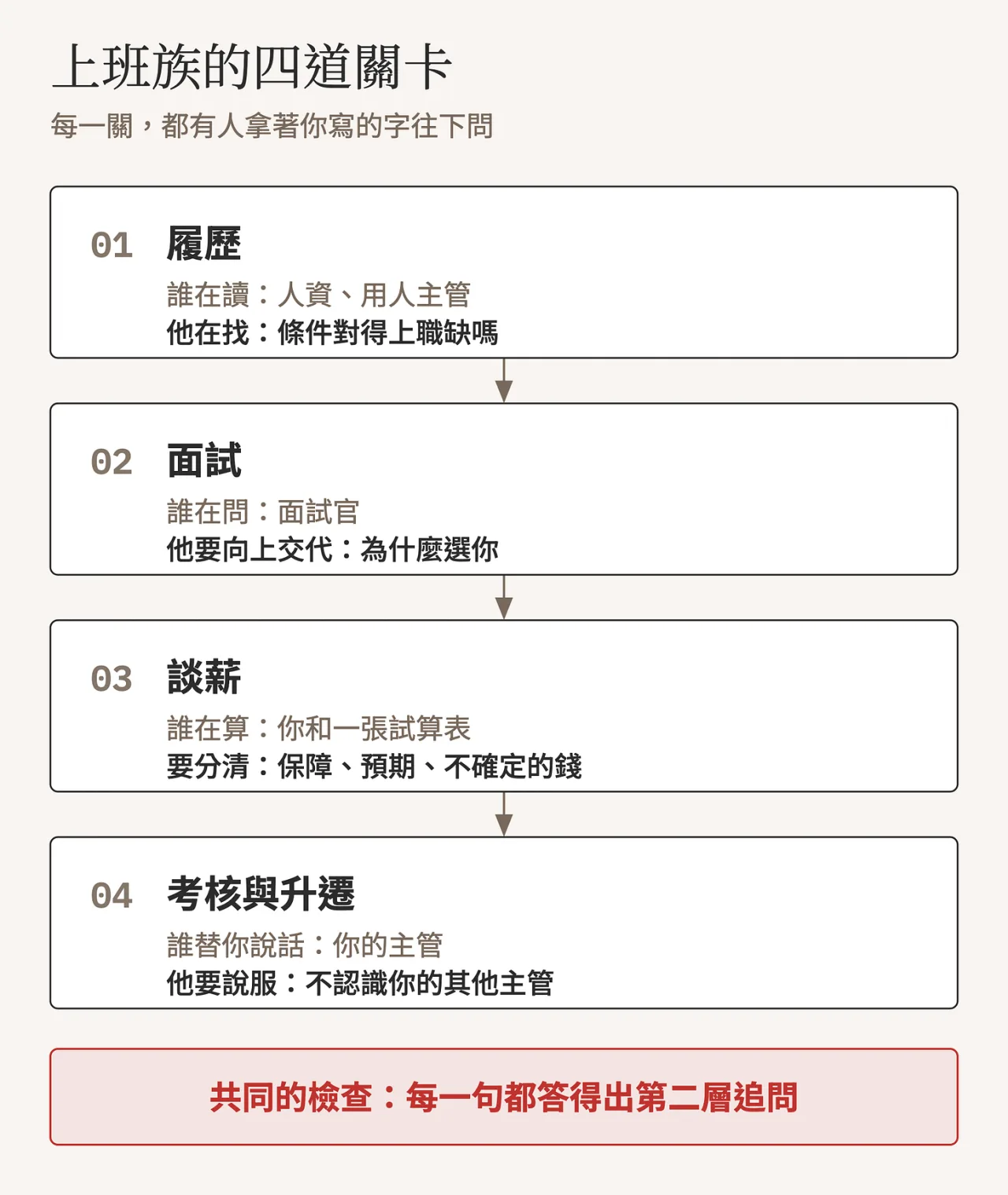
The readers of your resume are human resources and hiring managers, who are confirming whether your qualifications are suitable for the position. After the interviewer listens to your answer, he will explain to his supervisor why he chose you. When negotiating salary, the real person you are calculating is yourself. You need to clearly distinguish which money is guaranteed, which is expected, and which is not certain at all. When it comes to the year-end appraisal, the person who speaks for you is your supervisor, and what he has to convince is a group of other supervisors who don’t know you.
The four readers are different, but they all do the same thing: take what you have written and ask one more layer.
“Which area are you responsible for?” “Where did this number come from?” “How do you know the result is effective?”
So I ended up with the same check in all four manuals: whether every sentence you write can answer the second level of questioning. Sentences that cannot be answered, no matter how beautifully written, are risky.
An experience material table can be used four times
Many people start from scratch every time they reach a level. When it’s time to submit a resume, look through old files; when it’s time for an interview, think about it again; when it’s time to submit a self-evaluation at the end of the year, look through your calendar again. Every time I am tired, and every time I think about it, it is different.
My suggestion is to prepare a list of experience materials every day. Every time you complete something worth remembering, jot down a column.
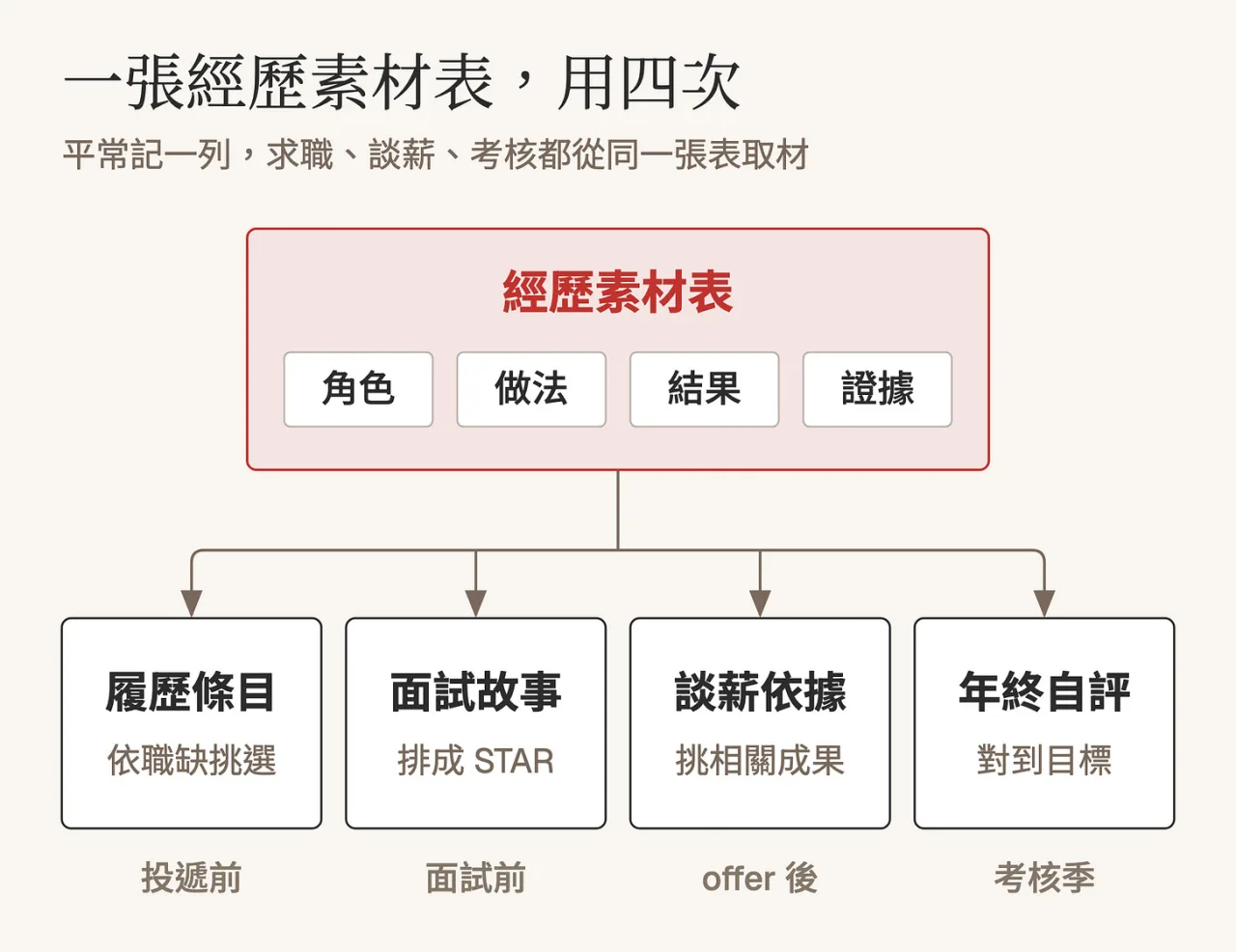
Each column only has four fields:
-
Role: Are you leading, responsible, assisting, or participating in this matter? Who else is on the team?
-
Practice: What decisions did you make and what actions did you take?
-
Result: What changed? Are there numbers, or verifiable facts?
-
Evidence: In which report, which letter, and which system can the numbers be found?
Give an example to illustrate. Suppose you are assisting the company in introducing electronic sign-off this year. The column can be recorded as follows: the role is “Assist, and the main responsibility is the information department colleagues”; the method is “organize the sign-off process of 12 forms in the administrative department, and accompany 3 departments on a two-week trial”; the result is “the average number of days for approval of the administrative department’s requisition forms has dropped from 5 days to 2 days”; the evidence is “system backend report, third quarter”.
This column can be turned into a resume item when submitting a resume; it can be expanded into a complete story during an interview; it can be used as one of the basis for you to be worthy of the salary when negotiating salary; writing a self-evaluation at the end of the year can directly address the goals at the beginning of the year. The same thing, the same source, is used in all four levels, and the explanation is consistent every time.
The matter of consistent statements is more important than imagined. The interviewer will use your resume to ask questions; the supervisor will use your self-evaluation to ask questions. If the resume says “leading” but the interview says “I mainly help”, the other person will have a question mark in their mind.
Resume: Write sentences that you can answer
After the material list is prepared, writing a resume becomes a relatively simple matter: pick out the columns that match the job vacancies from the materials and rewrite them into entries. Here are three practices that I feel are most often overlooked.
First, the verb must match the role. Participation, assistance, responsibility, and leadership are very different words in the eyes of the interviewer. Write “assistance” on the material list and “assistance” on the resume. Writing assistance as responsible may help you pass one more test, but if the interviewer just asks, “Who made the decision on this matter?”, the credibility of the entire interview will be compromised.
Second, the seniority should be written according to the starting and ending months, and the professional title should be written according to the official professional title of the company. If two years and ten months are used, just write the starting and ending years, and don’t make it “the past three years.” If the company calls it “specialist,” don’t translate it into “manager.” These things are easy to verify. Once they are found to be inconsistent with the facts, the trust of the entire resume will be lost.
Third, prepare a master version, plus customized versions for each position. Put all your experience in the master board. Every time you apply for a job vacancy, first break the job description into several competency requirements, then select the matching items from the master board and adjust the order. Finally, write down which version you used for this delivery. You won’t know what the other person wrote on the copy before the interview.
Having said that, let’s talk about using AI to modify resumes.
When making this series of manuals, I put each prompt word to the test to see what mistakes the AI makes most often when sorting out experiences. The results are very interesting: the most common problem is not grammar or format, but adding materials. You give it the sentence “Assist in organizing forms”, and it thoughtfully writes “Leading process optimization and improving efficiency”; you give it two numbers, and it subtracts them easily, resulting in a growth rate that you have not mentioned. The sentence becomes more beautiful, but every extra word is your responsibility at the interview site.
Therefore, if you want to ask AI to help you revise your resume, I suggest adding these rules: only use the content I provided; do not upgrade verbs, seniority or professional titles; do not add any new numbers, including estimates such as “about”, “nearly” and “exceed”; do not add, subtract and convert the numbers I gave; after rewriting each sentence, mark which sentence it corresponds to in my original text. The last one is the most useful. Whether the rewritten sentence is correct to the original text is because the AI has added information.
Interview: Prepare 8 to 12 stories that will stand up to questioning
After receiving the interview notice, the first action of many people is to search for “common interview questions” online and then write down the answers to each question. This kind of preparation may seem fine at first glance, but it can easily fail the second level of questioning.
What I recommend is to pick 8 to 12 things from the material list and write each one into a STAR story: Situation, Task, Action, and Result. Then, in turn, match these stories to common question types. A good story can usually answer several questions. For example, about the same cross-department cooperation experience, it can answer “How do you deal with conflicts” or “Tell me an example of how you influenced others.”
When writing a story, there are three things that are the most difficult to write about, but also the most commonly asked questions: failure, conflict, and weakness. The focus of these three types of stories is on what you did and what you learned later, rather than how miserable things were or how difficult others were. Tell a story of failure, and end with a specific change, such as “From now on, I will do one more thing every time before going online.” Tell a story of conflict, and don’t criticize your former colleagues in front of the interviewer. Tell a story of weakness, and choose an area that really exists and that you are improving.
In addition, there are two required questions, which are worth thinking about in advance.
When asked about expected salary, if you don’t understand the complete conditions of this position, you can ask the question back first: “I would like to know more about the job content and overall benefits of this position first, and then come up with specific figures. I would like to ask you about the salary range for this level in your company?” This is not avoidance, but the information you have is not enough, and the reported figures may not be good for you.
When asking questions at the end of the interview, don’t just ask, “When will the results be announced?” You can ask: “What results do you most want to see within three months of taking this position?” The answer to this question will also be very helpful for you to decide whether to take this job.
After preparing the story, you can ask the AI to act as an interviewer and practice with you. Here I have set several restrictions in the manual, which you can borrow directly: only ask one question at a time, and wait until you have answered before asking the next question; each question can be asked up to three levels; the whole session can have a maximum of six questions; do not give model answers, and do not rewrite them into standard answers for you.
The last one is very important. The model answers given by AI are very tempting, but the memorized answers will get stuck as soon as you are questioned on the spot. What I hope you can practice is to use your own words to explain your real experience clearly, instead of memorizing a manuscript written by AI.
Negotiating salary: Leave the money to the spreadsheet, AI does not touch the numbers
After getting an offer, the first thing many people do is compare their monthly salary. This intuition is natural, but often wrong.
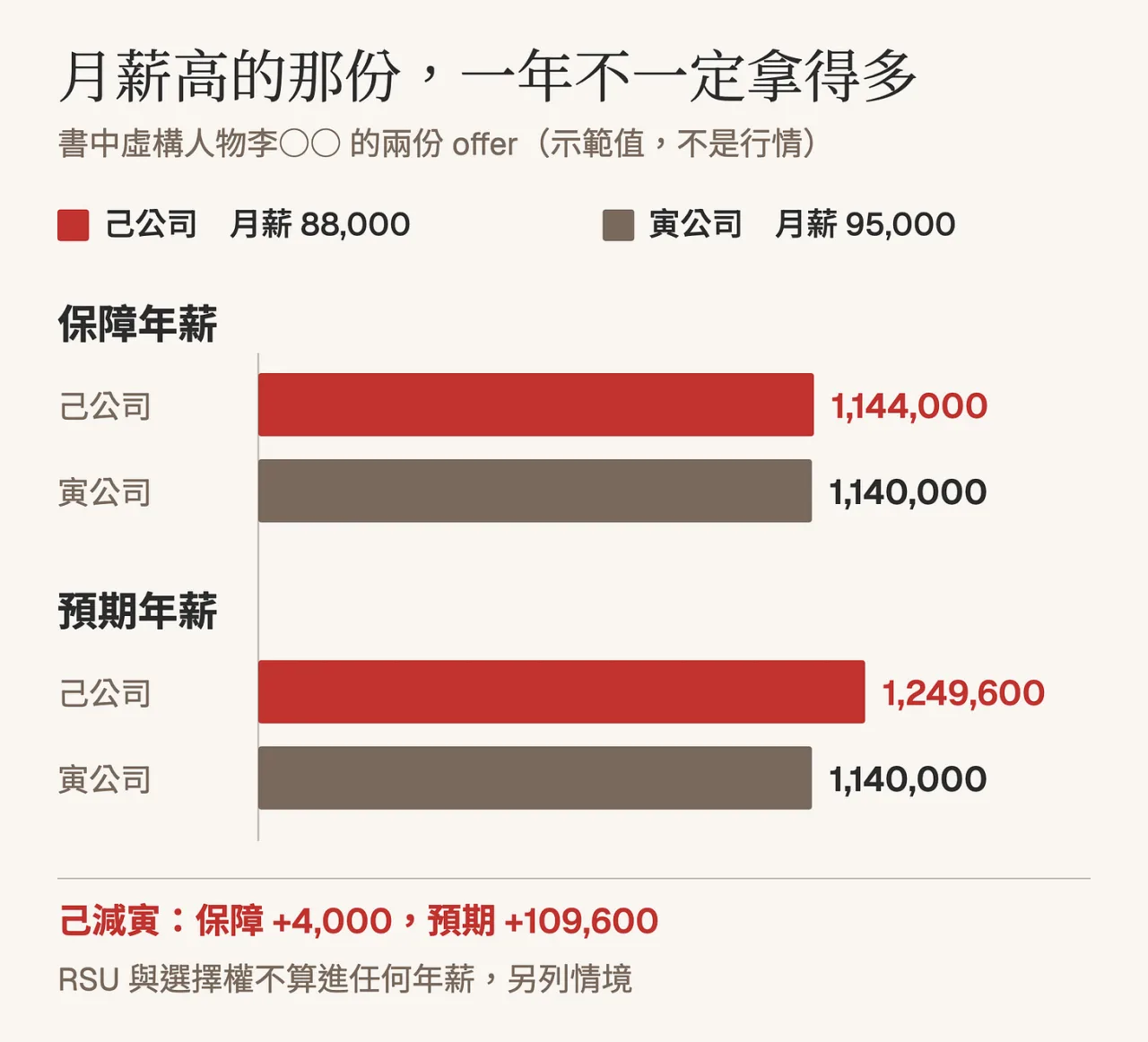
This is a demonstration in “Salary Negotiation and Offer Evaluation Package (opens in a new tab)”. The fictional character Li ○○ in the book has two offers in his hands (the characters and amounts are fictional demonstration values, not real market prices): the monthly salary of Yin Company is 95,000 yuan, and the monthly salary of Ji Company is 88,000 yuan. Looking only at monthly salary, Company Yin earns 7,000 yuan more per month.
However, after putting the two offers into the same spreadsheet and dividing the guaranteed money and the expected money, the results are very different: the guaranteed annual salary of my company is 1,144,000 yuan, and the guaranteed annual salary of Yin company is 1,140,000 yuan, but my company is 4,000 yuan more; the expected annual salary is 1,249,600 yuan for my company and 1,140,000 for Yin company. yuan, a difference of 109,600 yuan. As for RSUs and options, they are not included in any annual salary and are separately listed as scenarios.
What this picture wants to say is: when comparing offers, please first divide each amount of money into three categories.
-
Guaranteed money: It is written in the appointment letter and will be paid regardless of the company’s performance, such as monthly salary and fixed number of months at the end of the year.
-
Expected money: something that is documented but subject to change based on company or individual performance, such as performance bonuses.
-
Uncertain money: stocks, options, and anything with only verbal terms.
Be especially careful with verbal terms. What HR said on the phone was, “Our department probably received it last year” and “it can be considered.” Please don’t include it in your expected annual salary, list it in a separate column, and then ask the other party to change it in writing. Before signing, make sure everything you said verbally is included in the appointment letter or contract.
So, can AI be used to count the money?
My advice is don’t. AI will make mistakes when calculating money, and its mistakes will be very confident; if you use a wrong number to discuss with human resources, you have to bear the consequences yourself. Therefore, in this manual, all totals, labor and health insurance deductibles, income taxes and differences are all calculated by the formulas of the spreadsheet, and you can see how to calculate each cell. The AI’s job is to do several other things: organize the offer letter into a list with one condition and one column, list the things you haven’t confirmed yet against the must-ask items, check the counteroffer letter you wrote, and pretend to be a human resource to practice speaking with you.
During the test, I also deliberately asked the AI to directly help me calculate, or gave it a number that I deliberately miscalculated to see if it would help me check the calculation smoothly. In the round of testing after the prompt word was modified, the number of times the AI calculated the amount, ratio or difference on its own was 0; when it encountered a number calculated by the user, it would only reply “This number is confirmed by you and the spreadsheet.”
When it comes to salary negotiation itself, I just want to remind you of one principle: speak with evidence. The basis can be the results in your material list that are most relevant to this position, or it can be public salary information (remember to write the source), but it should not be another fictitious offer, and do not falsely report your current salary. The outcome of the negotiation is determined by both parties. What you can control is whether your own statement stands up.
Promotion: accumulated in one year, not won in an interview.
The last hurdle is the promotion that many people care about the most but are least prepared for.
I mentioned in “How to write your year-end performance self-evaluation” that the critical moments for performance appraisal and promotion often occur in the conference room where you are not present. The person who speaks for you is your supervisor, and the most useful thing in his hand is the evidence you give him. Therefore, the matter of promotion is not so much fought for on the day of the interview, but rather accumulated slowly throughout the year.
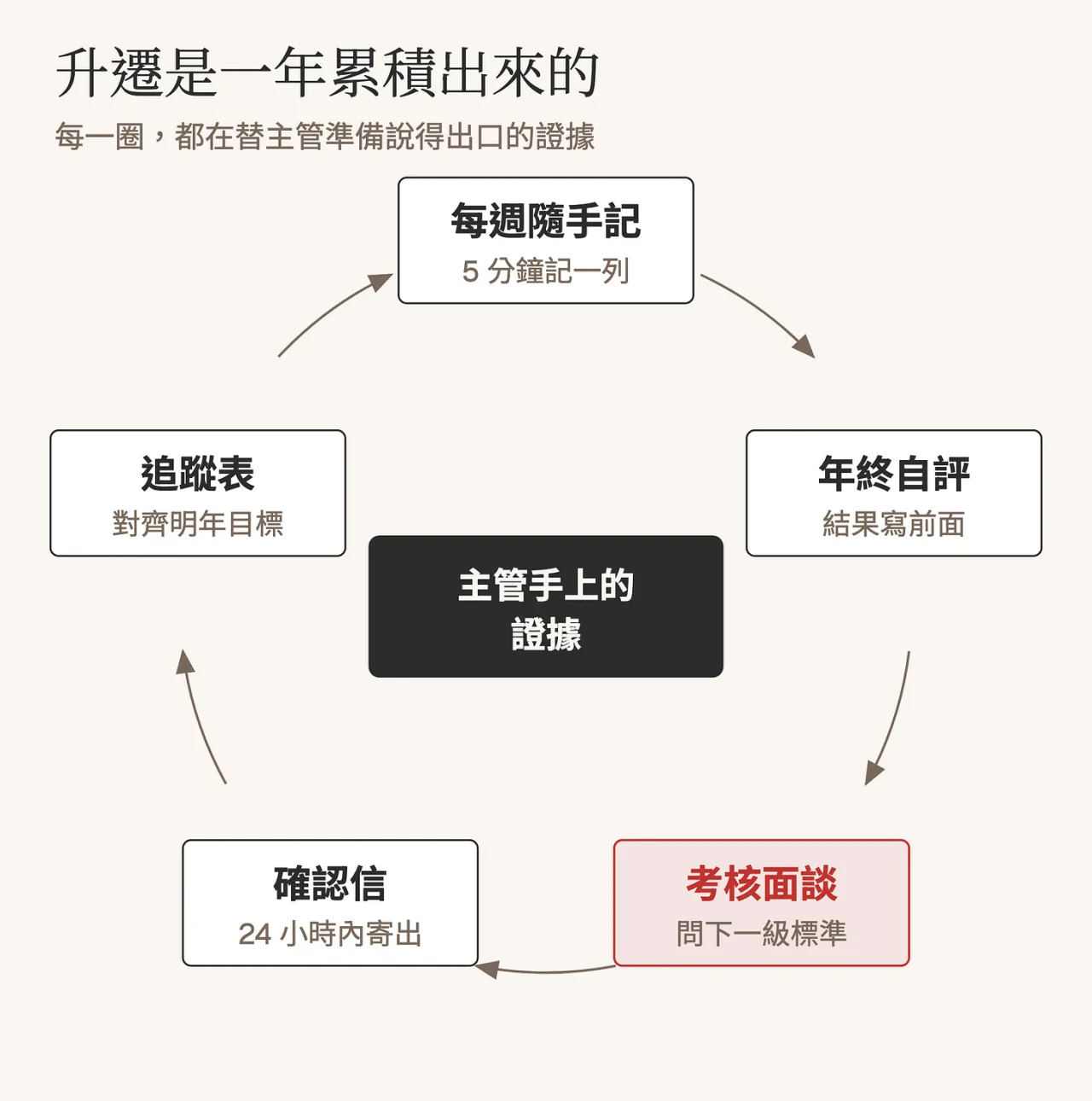
This cycle has five steps:
-
Weekly Notes: Spend 5 minutes every Friday to write down a column in the material table. This is the most inconspicuous but most critical step in the entire cycle. Next year you will thank you now.
-
Year-end self-evaluation: Draw materials from the material list, write the results at the front, have the source of the numbers, and explain the roles clearly.
-
Appraisal interview: First listen to the supervisor’s evaluation and reasons, and then ask two questions: “What’s the difference?” “What do you need to see to get to the next level?”
-
Confirmation letter: Within 24 hours after the interview, write a letter with the upgrade conditions stated by the supervisor and send it to him for confirmation.
-
Tracking sheet: Divide the conditions in the letter into goals for next year, go back to the weekly notebook, and record your progress on these goals.
The third and fourth steps are where promotion most often breaks down. Many people hear their supervisor say during the interview, “If you perform well next year, you will have a chance,” and they just nod and end it. But what does “behaving well” mean? To what extent is it considered good? Will the supervisor remember saying this next year?
Ask these questions clearly and write them down. During next year’s assessment season, you will not only have a self-evaluation, but also a letter from your supervisor confirming the promotion conditions last year, as well as your record of comparing these conditions throughout the year. At this time, if your supervisor wants to speak for you, you will have something to say.
The common boundary among the four levels: AI only organizes, you are responsible for judgment
As I write this, you may have noticed that I mention AI in every level, but every time I draw a line. This was my biggest concern when creating these four manuals.
AI is very suitable for these things: organizing the information you posted into tables, asking questions one at a time to find out details, acting as an interviewer or human resource to practice with you, and checking sentence by sentence for where you have gone too far. But there are a few things I think it shouldn’t do: it shouldn’t make up experience and numbers you don’t have, it shouldn’t write verbs and seniority upwards, it shouldn’t calculate money for you, it shouldn’t decide which offer to accept for you, and it shouldn’t rate your self-assessment for you.
The reasons are the same: someone will ask questions at every level, and the person being questioned is you.
In addition, before posting your work information into AI, please do four things: first check the company’s AI usage regulations and confidentiality terms; change customer, manufacturer, and project codes to code names, and colleagues to professional titles; keep the numbers only your own, and be able to tell others; use your own personal account to handle job-related information, and do not use the account or computer of your current company. Read it again after de-identification, because when several details are combined, it is still possible to identify which company it is.
These four manuals can be selected according to your current position.
The above mentioned are all part of the Four Workplace Series Handbooks (opens in a new tab). Each book adopts the same design logic: each step is taught the method first, and you can follow it without AI; a prompt word is given where needed. The prompt words have all been tested on Claude, and the limitations of the test and the areas that have not been fixed are also written in the manual. In addition, Excel and Word templates that can be filled in directly are attached, as well as sample files filled out by fictional characters.
Depending on your current location, you can choose as follows:
- Prepare your resume: “Resume and Technical Interview Package”. Five modules and 19 steps, from organizing experience materials, writing resume entries, customizing according to job vacancies, to autobiography, cover letters, LinkedIn and English resumes, there are demonstrations for administration, manufacturing, and marketing. There is a special chapter for software engineers, using AI as an interviewer to practice programming questions, system design and resume project questioning.
See the complete introduction of “Resume and Technical Interview Package” (opens in a new tab)
- Receive an interview notification: “Job Interview Preparation Pack”. Six modules, 23 steps, from job openings, inventory of experience, writing STAR story library, required test questions, AI interviewer simulation, to thank you letters and review on the day of the interview and after the interview. If there are only two days left, there is a condensed version.
See the complete introduction of “Job Interview Preparation Pack” (opens in a new tab)
- I have an offer in hand: “Salary Negotiation and Offer Evaluation Package”. Five modules, 20 steps, with an offer comparison spreadsheet, convert each offer and current position into after-tax annual total compensation, then prepare salary negotiation basis, counter-offer letter, all the way to resignation notice and pre-employment confirmation. The spreadsheet currently uses the rates and intervals of 2015. It will be updated after the announcement of 2016. You can get the new version with the same download link.
- To submit year-end self-evaluation and strive for promotion: “Year-end Assessment Self-evaluation and Interview Package”. Five modules and 19 steps, from planning the assessment season, taking stock of the annual results, writing self-evaluations, making year-end report briefings, to how to talk before and after interviews and how to track.
The official price of the four copies is 1,599 yuan, the initial price is 1,199 yuan, and each is limited to the first 50 copies.
To be clear up front, none of these four manuals guarantee any results. Interviews, admissions, salary and performance appraisals are all judged by the company or both parties based on many aspects, and no one can guarantee it. What they can help you with is retrieving your true experiences, writing them into statements that have a source for each sentence, and being able to answer them when asked.
A recent little thing
The countdown to the seven-day challenge camp at the end of November has begun. The camp will start on November 30th. You will receive a task letter every day. In seven days, you will make a small tool that you can use every day. You can put it on the Internet and get the URL without having to write a program. Registration closes on November 28th.
See the introduction of the seven-day challenge camp (opens in a new tab)
Finally, I would like to hear your experience
Among the four stages of resume, interview, salary negotiation and promotion, which stage makes you stuck the longest? Have you ever been asked a question that you couldn’t answer, or have you encountered an interview question that left a deep impression on you?
Feel free to tell me. Your experience will help me revise the next edition of these manuals better. If you have friends who are looking for a job, preparing to negotiate salary, or waiting for the year-end assessment, you are welcome to share this article with them.
See you next time!
Vista
Next step
Bring this topic to your team
Vista Cheng speaks and runs workshops on AI workflows, writing and content systems for companies, schools and public agencies.