The next step for one-person companies: AI unmanned companies that can operate like a team without employees

Every morning when I turn on my computer, the first thing I do is say good morning to AI.
After typing these two words, my virtual butler Sebastian will pop up and wake up the entire team. I have seven or eight virtual secretaries, each with their own responsibilities: one checks Gmail, one checks Google Calendar, and one takes inventory of to-do items. By the time I made the coffee, the morning report had already been written into the note-taking software. Which things needed to be done today and which letters needed to be glanced at first. It would take three to five minutes to count. In the evening, I switch to the evening newspaper, and the AI asks me in turn: What have I been busy with today? What are the most interesting and frustrating things?
Recently, I was invited by Zhong Ting (opens in a new tab), the manager of AILeader Hub, to talk to you about the content of the new book “AI Unmanned Company” before it is published. I start by kicking off my work every morning. Because this is how I run the company every day now: I don’t hire any real employees, but I do the same things that four or five people did before.
In the unmanned company, there is at least one person
I call this business model an AI unmanned company. When they hear the word “unmanned”, many people will think of cold automatics, or people with their legs crossed waiting to send others to do things. Well, actually none of them are right. The so-called unmanned company just has no employees. There is still one person in the company, and that person is yourself.
Coming to this point is related to two things. First, there is a shortage of jobs, a declining birthrate and an aging population. I think this structure cannot go back. 98% of Taiwan’s enterprises are small and medium-sized enterprises. It’s easy to say just add more people if there are not enough people. However, salaries and labor and health insurance are considerable costs, and people may not be retained. The second is the cost of AI. Even if you subscribe to a monthly subscription of US$200, it only costs more than NT$6,000.
Looking back, human work has been loosened three times: the Industrial Revolution allowed machines to take over physical work, the Internet has saved us from being trapped in the office, and now AI agents can get things done directly. Each time the threshold is lower and more can be done. Now I want to make a small game or edit a video, and I can do it at any time, but the question becomes: What exactly should I do?
So what I want to say in the book is that companies in the future will not compete with others because they have more people, but rather their systems will be smarter. In the future, when looking at a company, instead of counting how many people it has, it is better to look at what kind of systems, methods and logic it has.
From giving instructions to assigning goals
In the past two or three years, I have been giving lectures in enterprises, public sectors and universities, and I have found that many people still use AI in a question-and-answer manner: help me write an article, help me organize meeting minutes. This certainly saves time, but it’s a bit overkill.
In the book, I used the analogy of sweeping the floor:
- The AI assistant is like a vacuum cleaner, you still have to carry it around.
- The AI workflow is like a sweeping robot that goes out at a scheduled time and sweeps by itself when the time is up.
- The AI agent will plan its own route and know how to avoid it if there are pets at home.
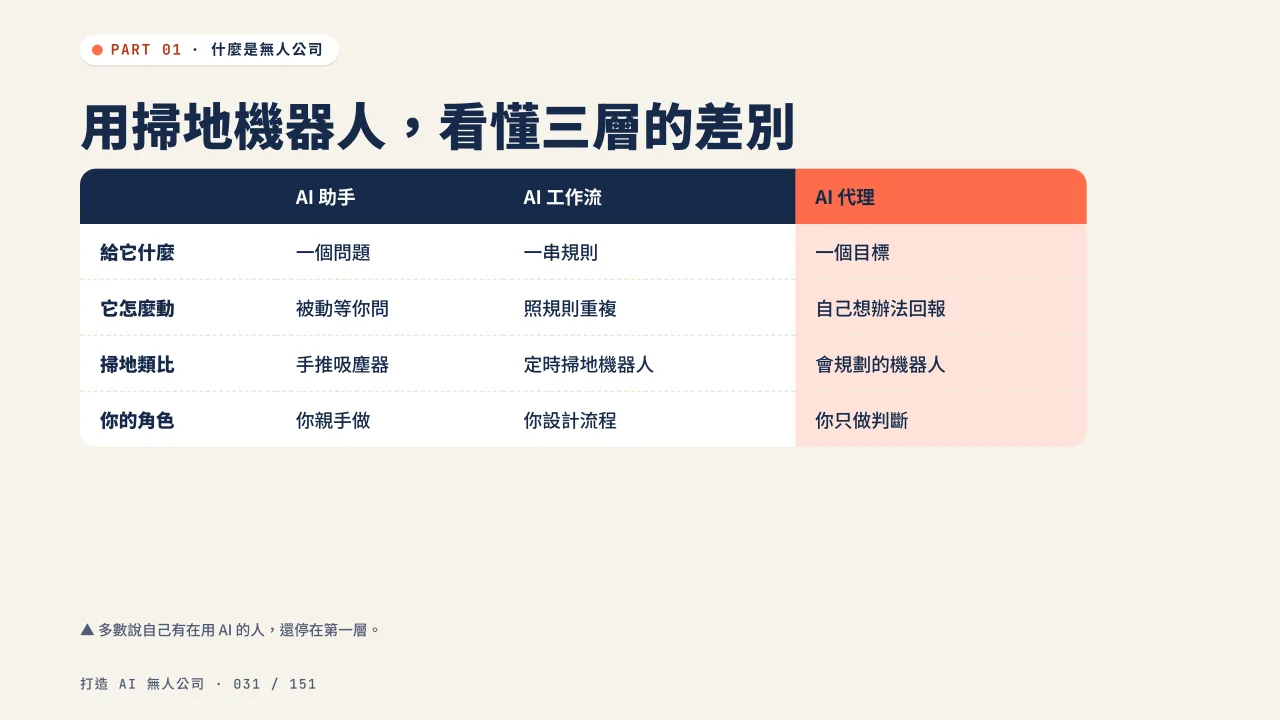
With an AI agent, you give it a clear assigned goal, and it will find a way to complete it on its own. You only need to accept it. For example, because of my need to write and produce content, I developed a set of content production skills, from style files, finding inspiration, writing drafts, in-depth research, removing AI flavor, all the way to distribution on multiple platforms. A blog can be extended into short articles, threads, newsletters, graphics, and videos.
However, I do not recommend that everyone blindly pursue “press one button and do it all.” A more practical approach is to figure out which steps to let AI do and which ones to leave to your own judgment, and ask it to repay you.
Thirty-seven points between man and machine: which 30% should be kept in hand
The main theme of this book is called “Three to Seven Points between Man and Machine”. The 70% that is repeatable, standardized, and similar to anyone else can be left to AI; the 30% of judgment, decision-making, taste, and trust should be firmly grasped by you.
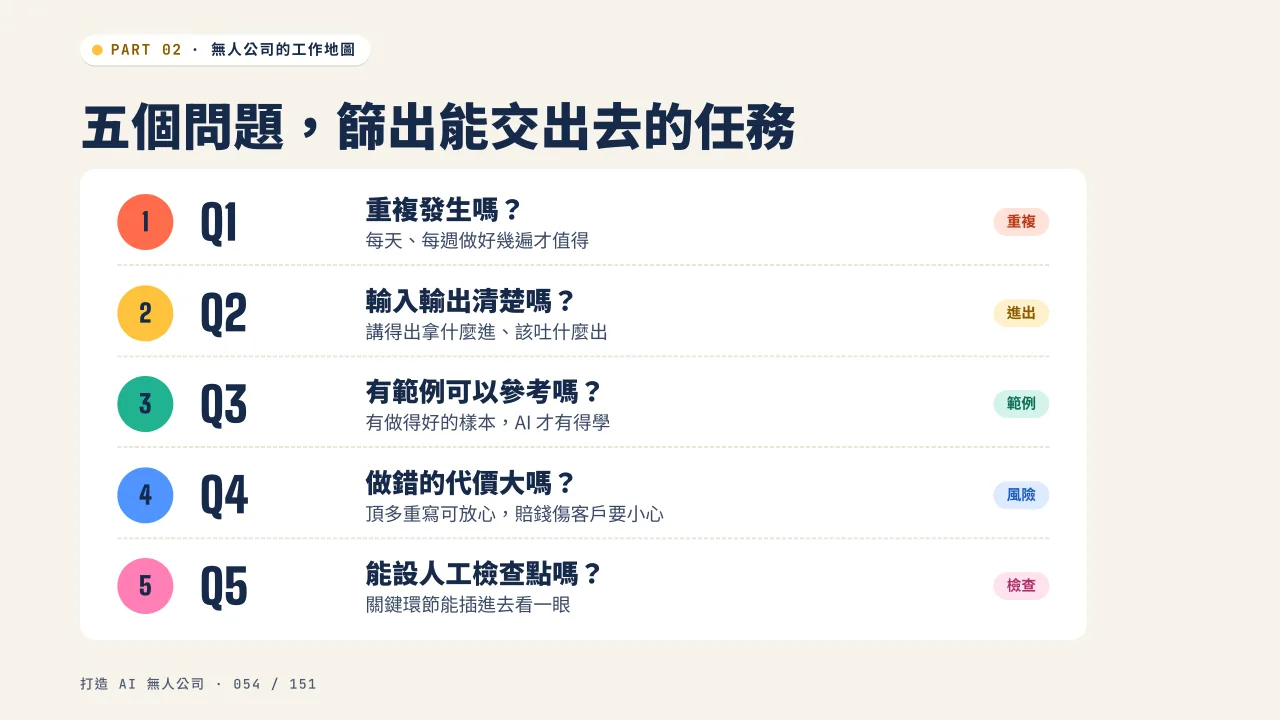
As for how to judge whether something can be handed over? I would start by asking five questions: Is it recurring? Are inputs and outputs clear? Are there any examples that I can refer to? Is the cost of making a mistake high? Can we set up manual inspection points?
Next is the dismantling of duties. Many people say that they lack a marketing manager or a social editor, but they only focus on the job title and cannot see where AI can help. If we expand the responsibilities one by one, we will often find that out of eight or ten items, AI can take over six or seven. For example, when tracking results, AI can help you analyze the data, but whether it is good or not and how to adjust it in the next step is still up to you to interpret.
Taste sounds mysterious, but it can actually be written into rules. For example, when I write articles, I always use “台” instead of “台”, except for the trademarks of companies such as TSMC. Write this rule down and the AI will follow it. The same is true for consultants. Which cases should be accepted and which cases should not be accepted? The consideration is definitely not only the amount of money but the lack of money. Only by writing it down clearly can AI help.
When everyone uses AI, everyone can easily get 60 points. From 60 points to 80 or 90 points, it depends on the 30% you left.
There are five levels of delegation, the most dangerous one is L3
Delegation is more like autonomous driving, divided into five gears from L1 to L5. Trust is not given all at once. You can ask AI to draft quotations and letters to customers. I think you will still take a second look before sending them out. Wait until its performance is stable enough, then slowly adjust it upwards.
Interestingly, the most dangerous of the five gears is L3 in the middle. Usually the AI is driving, but if you are asked to take over temporarily, you will hesitate and be nervous, and the car may skid at that moment. You think AI is watching, AI thinks you are watching, and both sides let go. Therefore, the further the gear is placed in the middle, the more checkpoints must be guarded.
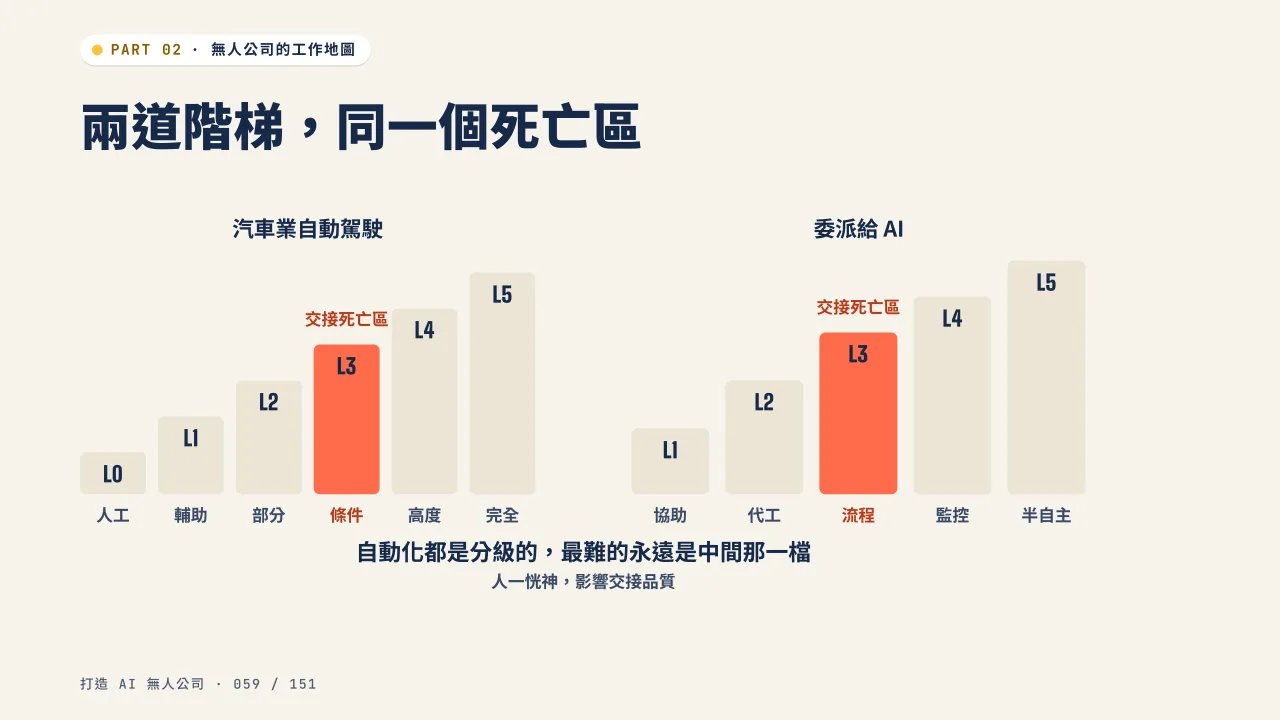
AI can take your hand away, but be careful not to let it take away your vision as well.
Use the method of bringing new people to lead AI
Since AI is treated as an employee, we should use human resources methods to manage it: give it a job description and write down clearly the scope of tasks, what materials can be used, what should be done, and what should not be done; then give it on-the-job training, and then continue to evaluate it. If it does well, it will be reported, and if it does not do well, it will be clearly pointed out. AI is a very smart newcomer, but it doesn’t understand you or the unspoken rules of your company.
I often use McDonald’s as an example. Whether in Taipei or Kuala Lumpur, burgers taste the same. Different employees are hired from all over the world and speak different languages. New employees can make standard burgers within two days of work, relying on an instruction manual that can be followed correctly. McDonald’s intelligence lies in its system.
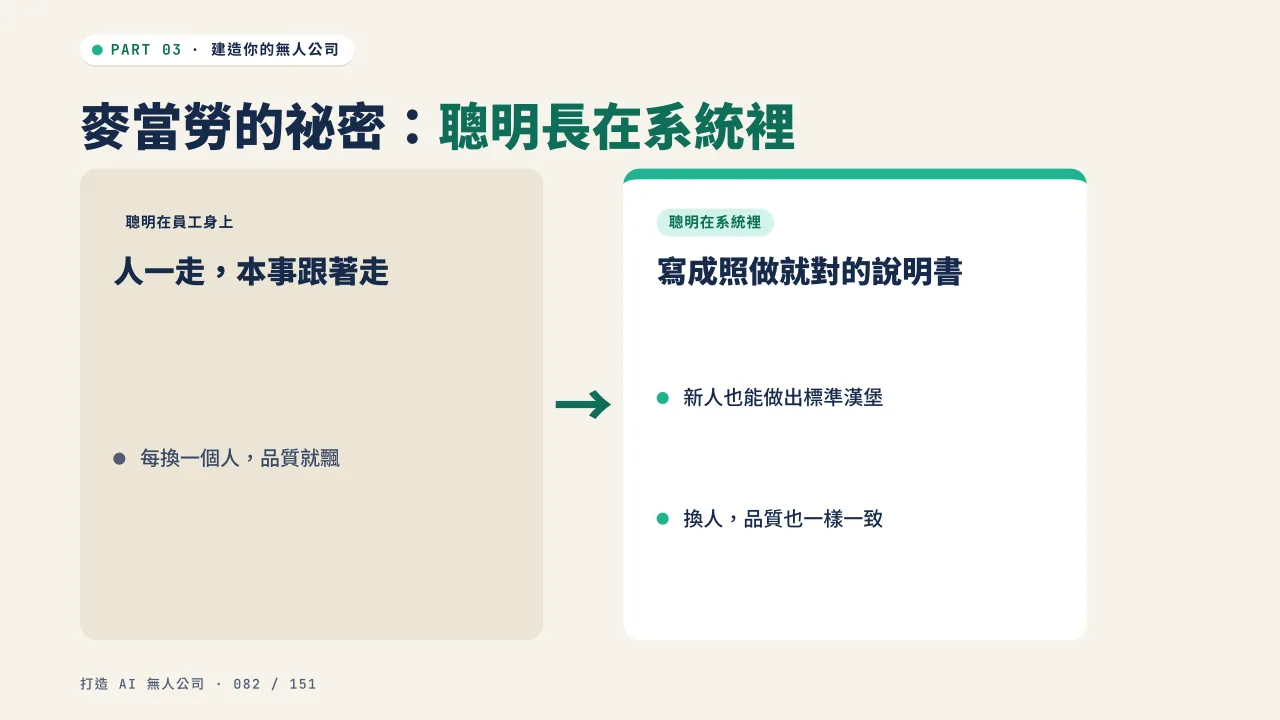
I call this method AOP, which is the AI version of standard operating procedures: manage AI the same way you manage employees, so that things can run as usual when you are not present. The order of establishment is first to rigidify, then to optimize, and finally to solidify. Just do it the same way at first, then adjust it as it goes smoothly, and finally fix it. Many people try their best to optimize from the beginning and spend a lot of effort, but the results are not necessarily good.
Guardrails: Don’t let the AI doing the work check you
AI works well, but it makes mistakes. Now everyone knows that AI can have hallucinations, but what I want to remind you more is the leak. For the sake of convenience, many people will throw reports and Word files into AI, but ignore whether there is any personal information or business secrets in it? You know, once the information is thrown in, it cannot be taken back. Therefore, it is recommended that you delete sensitive information first, block certain sensitive information, or replace it with A, B, or C numbers.
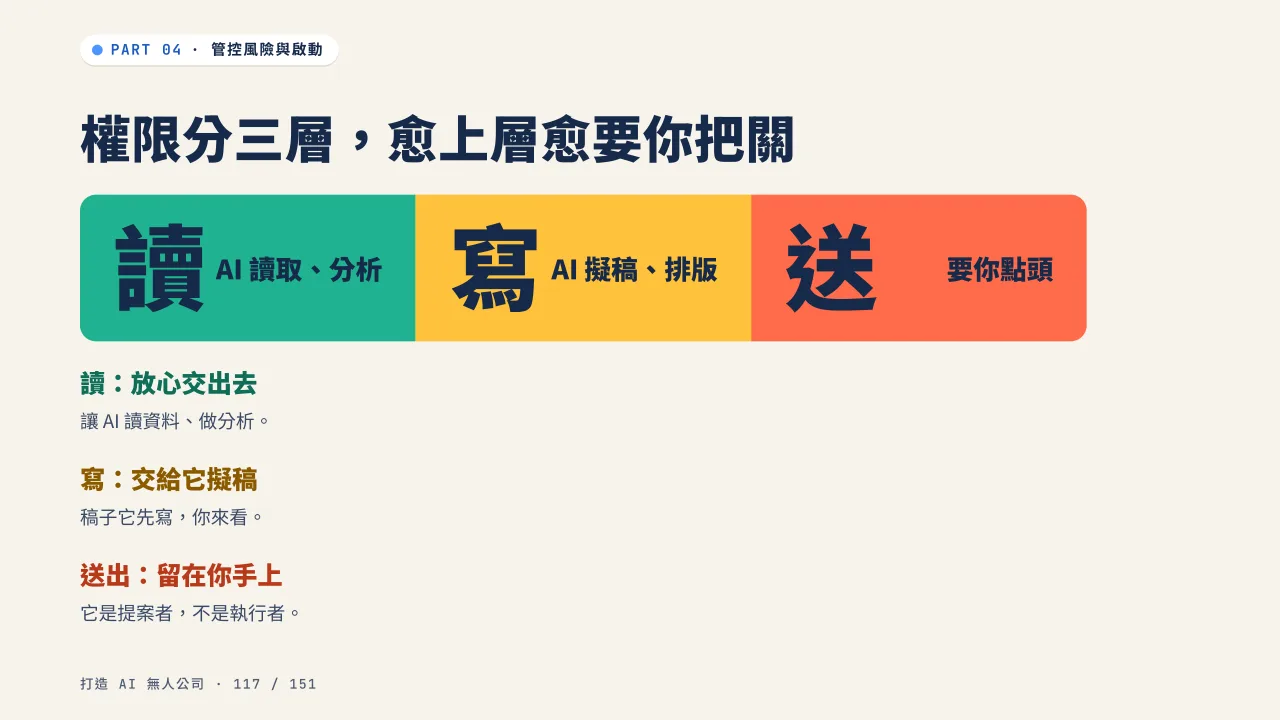
Permissions must also be hierarchical, including reading, writing, and sending. The higher you go, the more you have to control yourself. Another important point: don’t let the AI doing the work check itself. Of course it thinks it’s okay. When I work on a relatively large website project, I will use Claude to write the program and then submit it to Codex for review. I can often identify many blind spots.
Finally, remember that the person responsible is you. AI will reply to your letter and quote for you. If the price is missing a 0, you will still be held accountable. In addition, you should pay attention to things like copyright, personal information protection, and consumer rights; if you really have legal needs, please consult a lawyer or a professional legal person, don’t just ask ChatGPT. AI can certainly save us time, but it cannot save us responsibility.
90 days, start with a process
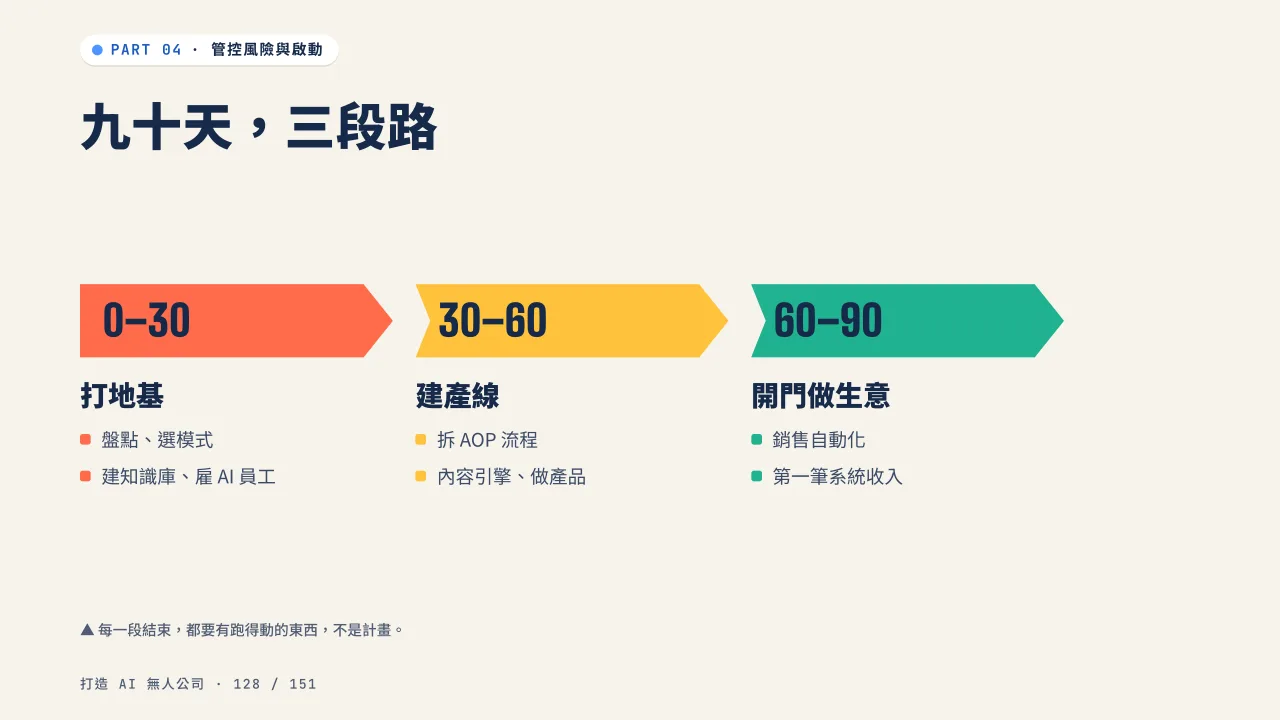
If you also want to build your own unmanned company, I recommend doing it in three stages: lay the foundation in the first 30 days, take stock of the work at hand, and select a model; build a production line in the second 30 days, which may be a service line or a content production line; and open the door for business in the third 30 days.
I started doing it in February or March of this year, from the sales page, cash flow, and website to the complete system now. Now as soon as the article is written, the system will automatically produce English and Japanese versions and put them on the website, which has also brought many foreign cooperation inquiries and inquiries. These were not made in a month, and it took a lot of time to get stuck and debug.
Therefore, I suggest that you don’t want to pull ten lines at the same time from the beginning. You know, TSMC didn’t do it well on the first day. First pick a process, take inventory, write down the setting card, and start running, one by one. You will become more comfortable with it as you do it, and the time for exploration will become shorter and shorter. It’s normal to get stuck on levels. If you talk to the AI more, it won’t laugh at you anyway.
The first step you can do today: take out your notebook, list the tasks you spend the most time on this week, screen them with those five questions, and pick one to let the AI try.
A more complete framework and diagrams are included in the book, “AI Unmanned Company”, which is expected to be published in December. Friends who are interested can first take a look at the Book Page I designed for this book.
Next step
Bring this topic to your team
Vista Cheng speaks and runs workshops on AI workflows, writing and content systems for companies, schools and public agencies.