Building an unmanned company: In the era of labor shortage, a company can be sustained no longer by relying on human sea tactics

This article was originally published in the expert argument column of “TechNice Technology Island (opens in a new tab).
An owner of a design studio told me that as long as one more person is hired, there will be tens of thousands more fixed costs every month, not counting labor and health insurance, education and training, and the risk of whether that person will be able to work for a long time. But if you don’t hire someone, the projects at hand can only be pushed out, and the income will be lost. He asked me: What should I do?
To be honest, this isn’t his problem alone. Small and medium-sized enterprises in Taiwan account for more than 98% of all enterprises. The declining birthrate and aging population have turned labor shortage into an irreversible structure. The road to joining is becoming increasingly difficult: expensive, slow and uncertain.
The answer I gave him was a term that sounded a bit harsh: unmanned company. Simply put, when the labor shortage issue becomes more and more serious, we can rely on AI to win back the victory.
Let’s start from an ordinary morning
Well, let me start with a very ordinary morning!
Every day when I turn on my computer, the first thing I do is say good morning to my AI. I have a butler whom I call Sebastian. After it replied to me early, it went to wake up the entire team of virtual secretaries: one to check the mailbox, one to check the calendar, and one to take stock of to-do items and project progress. By the time I made the coffee and sat down, the things I needed to do for the day were sorted out in front of me.
My company doesn’t have any real employees, but it operates like a whole team. I call this kind of company an unmanned company.
“Nobody” is often misunderstood. It means no employees: no one else you have to pay wages to, take care of attendance, and worry about whether or not you’ll be able to do it for as long as you want. The only person in the company is you, who designs the entire system, directs an AI team, and is ultimately responsible for all results. It’s not cold either. People who are squeezed dry by chores cannot squeeze out the warmth. After handing over the chores, the warmth can be refocused to the place where it should be warmest.
I often summarize this proposition in one sentence: The future of a company is not about having more people, but about being smarter than someone else’s system.
The third liberation of work
The reason why I say this is to talk about the third liberation of work.
Human work has been untied three times. The Industrial Revolution liberated physical power, the Internet liberated location, and this time AI liberated execution itself. The first two times did not touch the execution work that falls on people every day, but this time it just happened to be touched, so it is the one closest to your and my daily life among the three times.
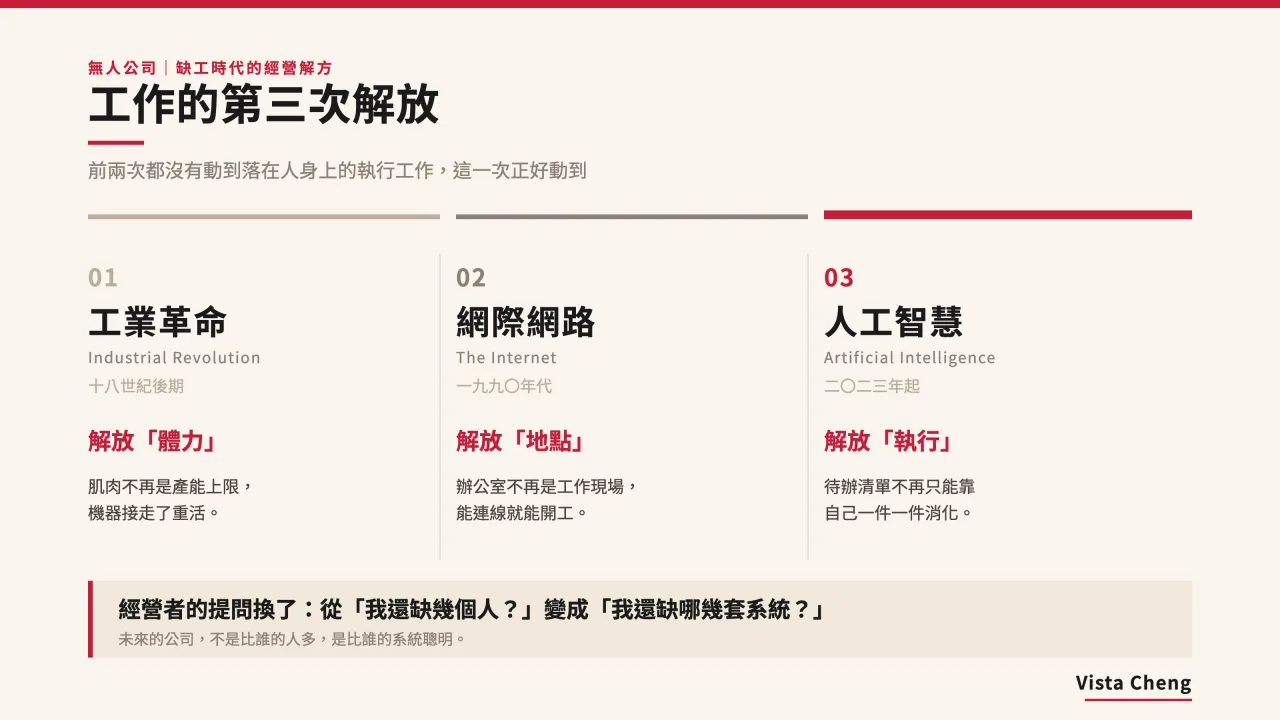
Therefore, the questions that operators should ask have changed. In the past, the question was “How many people do I still lack?”, but now I have to ask “How many systems do I still lack?”. The ability to build systems used to be the domain of large companies, but now it can be done by one person plus an AI team.
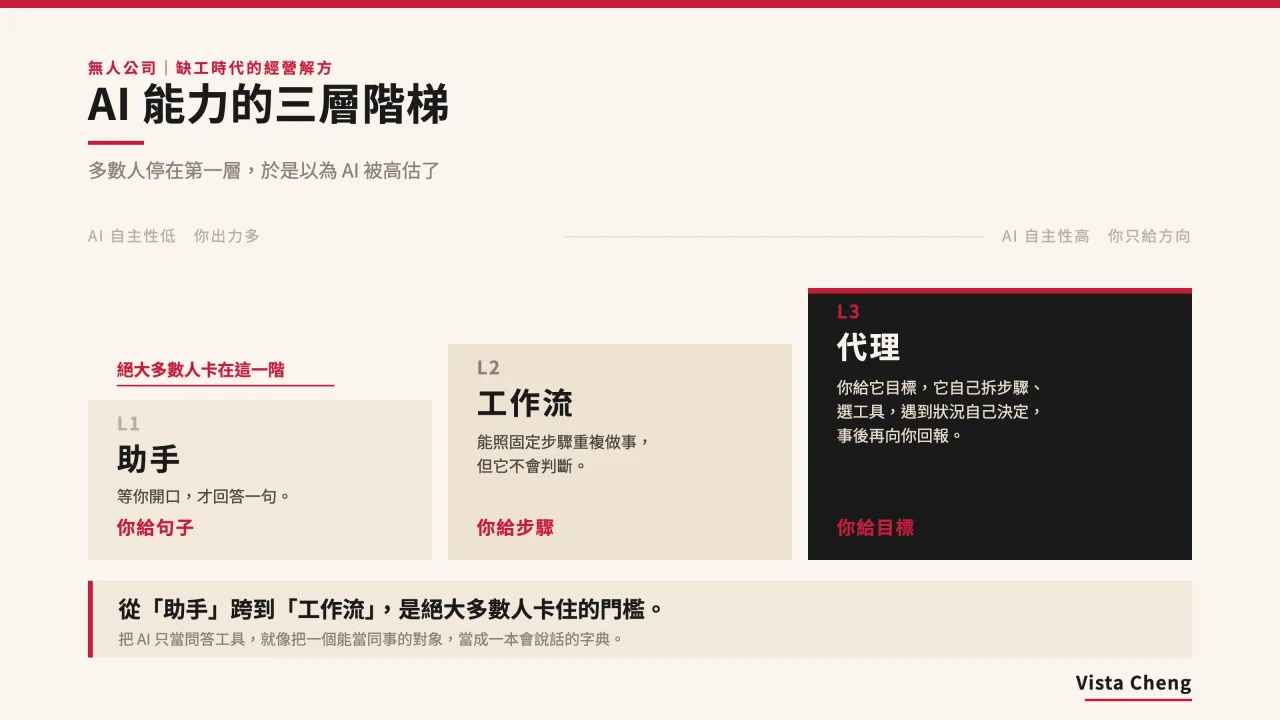
Many people say that they are using AI, but in fact, most of them stop at the first level. I divide AI capabilities into three layers: assistant, workflow, and agent. The assistant waits for you to speak before answering; the workflow can repeat things according to fixed steps, but it will not make judgments; the agent allows you to give it a goal, and it will break down the steps, select tools, make decisions on its own when encountering situations, and report back to you afterwards. Crossing from assistant to workflow is the threshold where most people get stuck. Treating AI as a question-and-answer tool is like treating an object that can be a colleague as a talking dictionary.
The cost is naturally worth estimating. The actual monthly burden of a real employee starts from 30,000 to 50,000 yuan; the cost of my entire AI team is mainly the monthly subscription fees for several tools, which ranges from a few thousand to 10,000 NT dollars.
Three myths about unmanned companies
To be honest, there are three myths surrounding unmanned companies.
The first one is the sweetest and most dangerous: fully automatic, making money while lying down. The truth is that you have to build the factory solidly in the early stage, and the system design is quite hard, but the sweat will accumulate.
The second one hides fear: AI will replace my profession. My opinion is that AI replaces execution and amplifies professionalism. Those who will be replaced are those who can only execute but do not develop judgment and taste.
The third pity is that only technical people can afford it. The most suitable person for an unmanned company is actually the person with the most domain knowledge, the most taste, and the most trustworthy assets. These three things are not in the program code.
First take stock of the process, then split the position into tasks
Most companies fail to introduce AI. The first reason is that the order is wrong. Buy tools first, learn prompt words first, but don’t ask first: What processes does my work consist of?
If you do something for a long time, it will sink into your intuition. In fact, you are not as clear as you think. After spreading it out on paper, you will probably find that a small boss has to go through ten links from beginning to end, which are divided into five departments: content, marketing, sales, customer service, and logistics. You will be tired because you are an employee of five departments at the same time.
Next, break the position into tasks. Many people ask “Can AI be used for my marketing?” After using it, they feel that it is possible but not very good, so they conclude that AI is overvalued. Actually it’s the wrong question. A job is a whole package of tasks. AI can probably take over 60 to 70% of the tasks that are repetitive and regular. The rest needs to be judged by you.
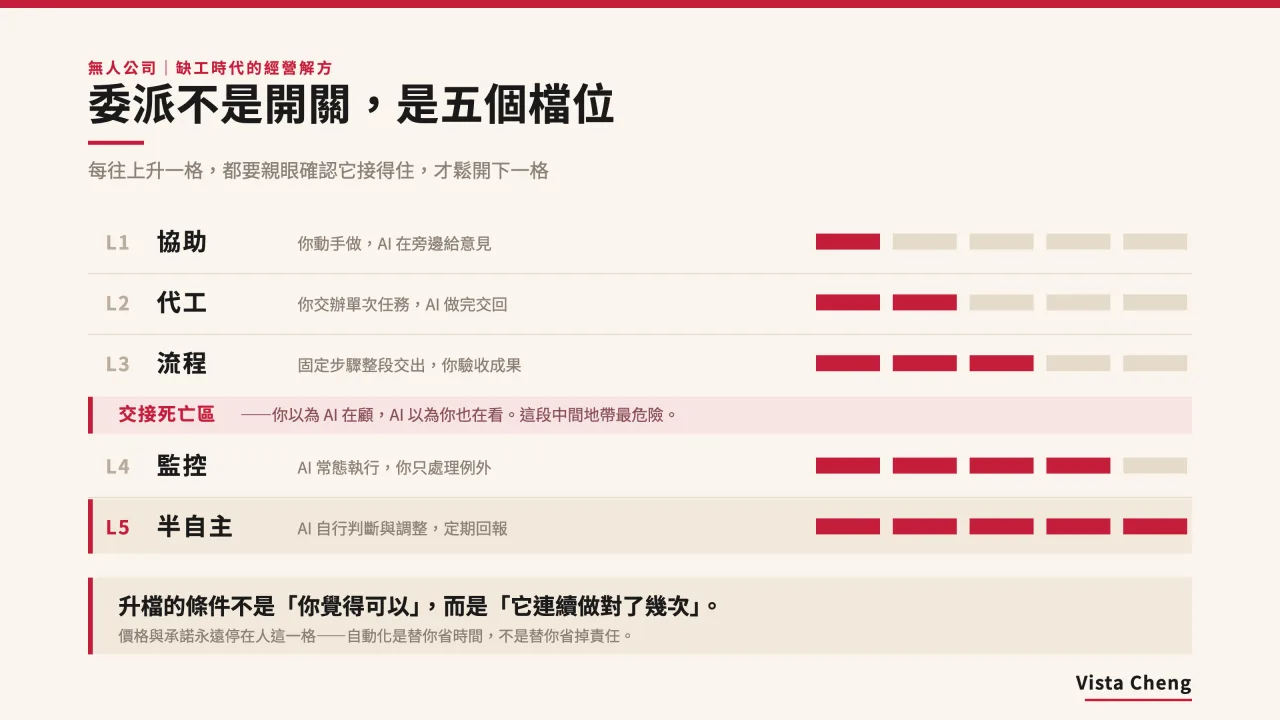
Delegation is not a switch, it is more like a gear lever with five gears: L1 assistance, L2 OEM, L3 process, L4 monitoring, and L5 semi-autonomous. Every time you go up a level, you have to confirm with your own eyes that you can catch it before letting go. The most dangerous part is the middle ground, which I call the handoff death zone: you think the AI is looking, and the AI thinks you are looking.
Seventy-three points between man and machine: hand over execution, leave judgment
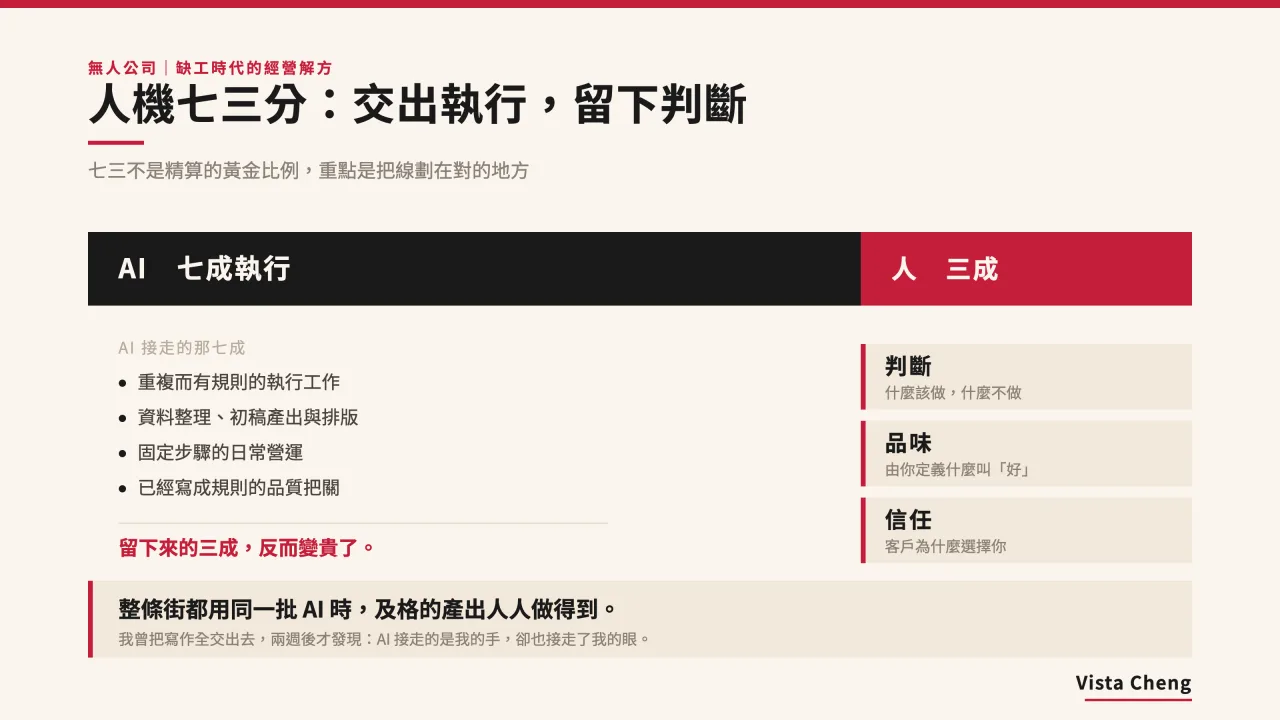
This is the principle I most hope everyone can remember: 70% of man and 30% of machine. About 70% is given to the AI and 30% is left to yourself. Seventy-three is not an actuarial golden ratio. It may be sixty-four or eighty-two. The key is to draw the line in the right place.
I myself have suffered the loss of crossing the wrong line. When generative AI first came out, I left almost all my writing to it. After two weeks, I felt something was wrong: the writing was smooth, clean, correct, and mediocre, not my style at all. I later figured it out: the AI took over my hand, but it also took over my eye, and I didn’t notice it at all.
The remaining 30% is judgment, taste, and trust. When 70% of the execution is handed over, the 30% not only does not become unimportant, but becomes more expensive. When the entire street uses the same batch of AI, everyone can achieve acceptable output; only 30% can make customers willing to pay more.
The comparative advantage of economics also illustrates the same thing: even if AI is better than you in everything, the most cost-effective division of labor is still that AI does 70% of the execution and you leave 30% of the judgment.
Even seemingly abstract tastes can be written down and handed over in rules. You are responsible for defining what is good, and the machine is responsible for guarding that good again and again.
Treat AI as an employee, not a tool
The way many people use AI is to turn it on, ask questions, and turn it off every time. This is using it as a tool. Tools are things that you have to pick up again every time and throw away after use; employees remember who they are and know what they should do, and you can continue to assign them and train them.
Since they are employees, they should be managed using the same set of standards for managing people: job descriptions, on-the-job training, and regular assessments. The secret of McDonald’s being able to replicate the same quality of hamburgers all over the world is not that the employees are particularly smart, but that the intelligence is embedded in the system. If you put intelligence into the system, the production capacity can be copied infinitely; if you put it in your own mind, it can only rely on you.
The job description for AI, I call it the setting card. It clearly states the role of the AI employee, what he is responsible for, what data can be used, what data cannot be touched, what format should be handed over, and what situations must be shown to you. Most of the time when the AI performs poorly, the problem is not with the AI, but with the settings card not being written clearly. My advice is to start by making a roster of the people you need, but hire one person at a time, and then bring on the next person once that person is up and running.
The next step is to write down how you do things. There is an inconspicuous folder in my computer, which contains dozens of files that are more than one page long. Each file is a record of taking something that had to be done by hand, taking it apart and writing it down step by step, and then officially handing it over. These profiles were the job description for my AI team, and the really smart thing about this company. Traditional SOP is written for humans to read; I rewrote it into AOP and wrote it for AI to execute with you. Every time an error occurs, go back and add an entry in the file, turning the error into a system upgrade.
In other words, the person who can give orders is the person who can lead the team. To write clearly is to think clearly.
Finally, the system must not only produce, but also return. Four systems are running at the same time. You don’t have to open several backends every day to make up the numbers. Instead, let them automatically send a page of dashboards to you: when everything is normal, you let go, and it will wake you up when something goes wrong.
Build four production lines first
After thinking clearly about the division of labor, you can build production lines one by one. I recommend that small companies start with four core systems: content, sales, customer service, and proposals.
The content production line allows one core point of view to derive a variety of finished products, and people only stand at the point where the point of view is generated. For list magnets and automatic sales, start by building the first two paragraphs: a free resource that solves specific pain points, plus a page to leave contact information. The customer service system first builds a knowledge base, because most of the customer service problems of small companies are the same ones. The proposal system lets AI handle the chores of sorting out information, finding cases, and typesetting. You only take action when deciding on strategy and price.
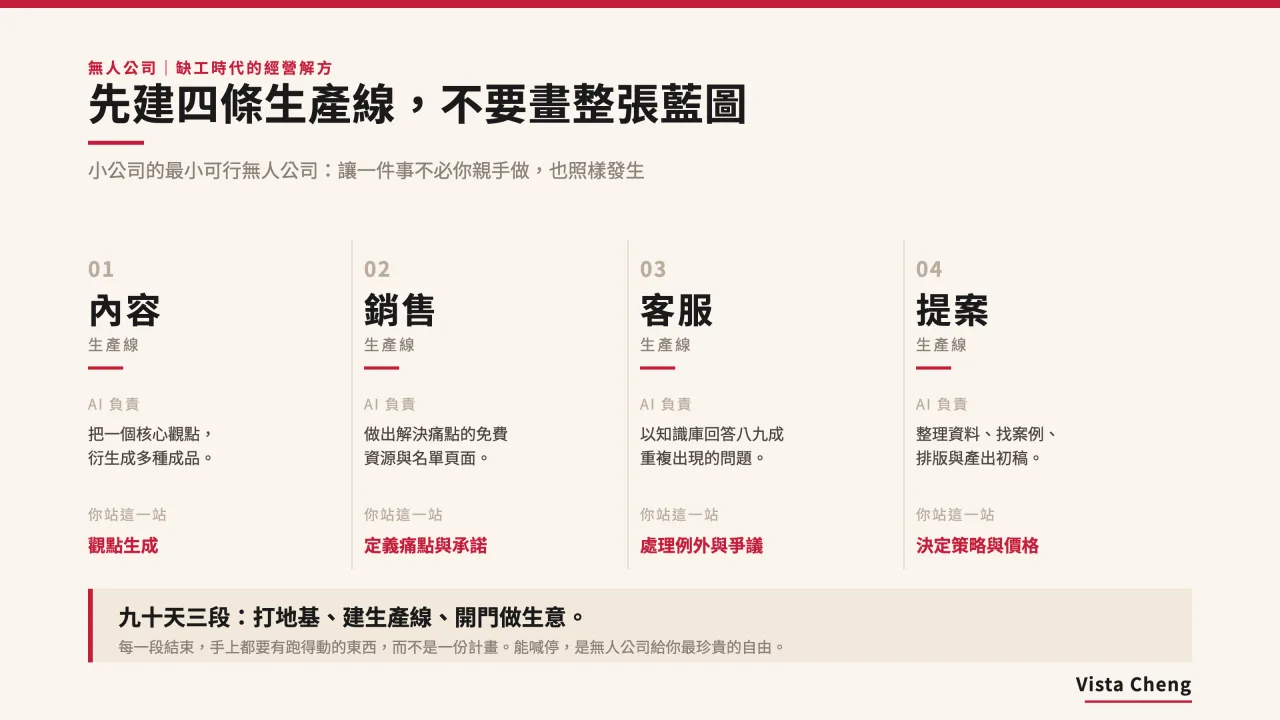
There is a line that must not be crossed: prices and promises are always decided by people. This is not a question of efficiency, but of responsibility. What AI says means what your company says; automation is used to save you time, not to save you responsibilities.
Therefore, I also want to talk about braking. The five most common risks of AI are hallucination, leakage, misjudgment, loss of control and unclear responsibility, which correspond to the three guardrails of data, authority and decision-making. There is also a very practical habit: don’t let the AI doing the work check its own work.
Ninety days, let the first thing happen automatically
Many people’s eyes lit up after reading the framework, and they spread out a blank sheet of paper and wanted to plan the entire company at once. The blueprint got bigger and bigger, and they became less and less afraid to start. Three months later, the piece of paper was still lying on the table.
I suggest asking a much smaller question: Can one thing be automated in the next three months so that I don’t have to do it myself? This is the minimum viable unmanned company, the first thing you can do without having to show up in person for it to happen.
The ninety days are divided into three stages: laying the foundation, building the production line, and opening the business. At the end of each period, you should have something to work with, not a plan. There will definitely be bumps in the middle. That is a process, not a failure.
Write at the end
Back to the boss we talked about at the beginning. The spirit of building an unmanned company does not tell him not to hire people. It gives another way: to make the system smarter without increasing the number of people.
When the first production line goes smoothly, you will stand at a fork in the road: vertical deepening, horizontal copying, selling and exiting, or not taking any of them and stopping at a just right scale. Being able to stop is the most precious freedom that an unmanned company gives you. Revenue is only a means, and choice is the end.
The true meaning of an unmanned company is to save people from chores, so that you can be yourself and do the most valuable things.
If you can only do one thing this week, take out a piece of paper and write down everything you did this week. Once the map is drawn, the road will naturally be visible.
If you want to take inventory of the process and plan the first AI production line for your company, you are also welcome to make an appointment for consultation (opens in a new tab), and we will draw the map together.
Next step
Bring this topic to your team
Vista Cheng speaks and runs workshops on AI workflows, writing and content systems for companies, schools and public agencies.