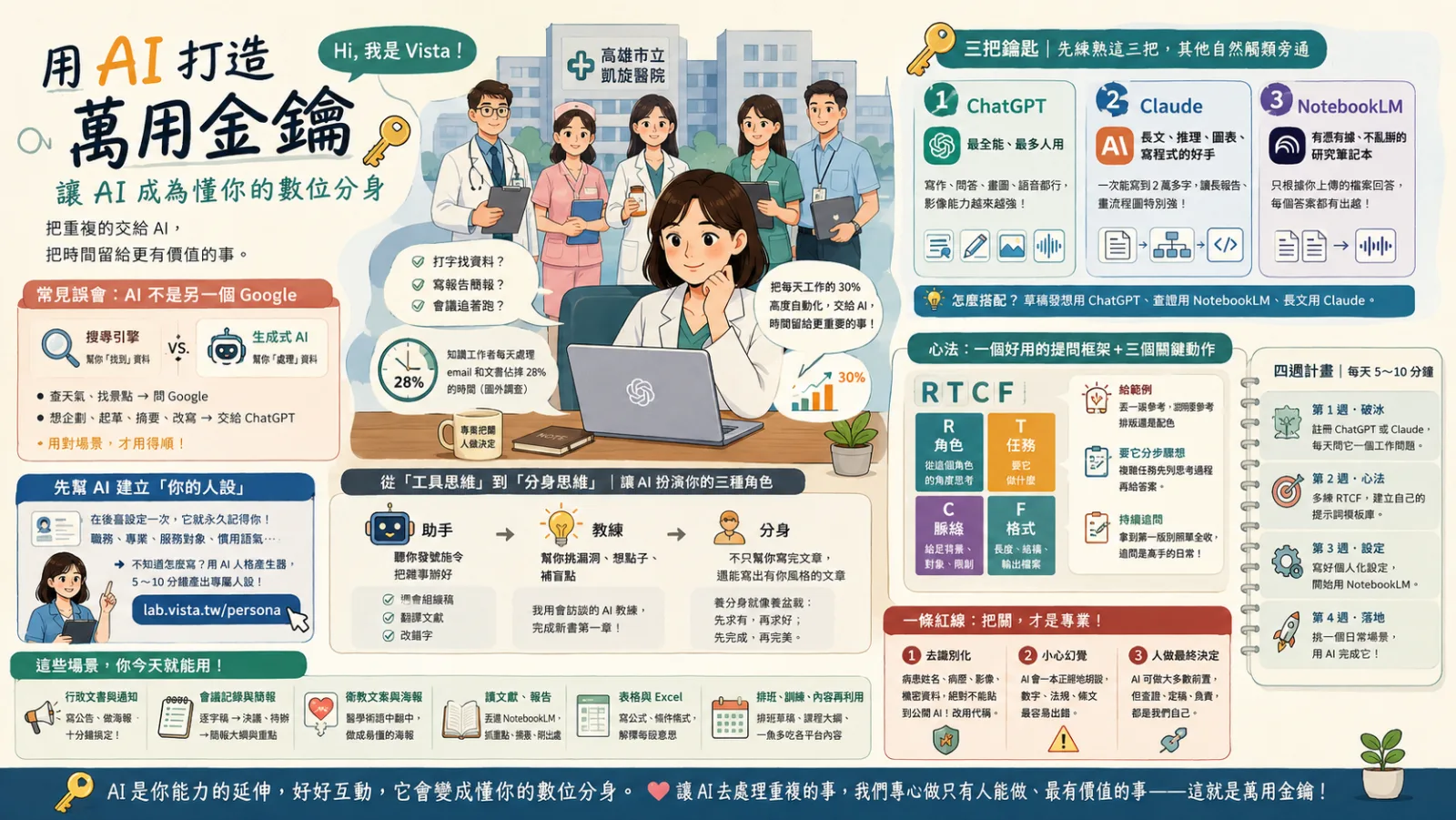
A key that can open many doors: the AI mentality I taught at Kaixuan Hospital
*This article was originally published in “Vista Newsletter” No. 118 (original link). *
Hi, I’m Vista.
A few days ago, I was invited by Kaohsiung Municipal Kaixuan Hospital to give a three-hour online sharing. The theme was “Using AI to create a universal key.” Most of the people in the audience are doctors, nurses, pharmacists, social workers and administrative colleagues - a group of people who are chased by paperwork, reports and meetings every day.
In this article, I condense the core part of that lecture for you. We won’t talk about advanced technology, but only one thing: How to make AI change from a tool to a digital clone that understands you better and better. **
How much time do you spend on typing and paperwork a day?
We usually don’t estimate deliberately, but it actually adds up to a considerable amount. According to a foreign survey, knowledge workers spend 28% of their time just processing emails and paperwork every day - in other words, almost a full day per week is spent on this.
Dr. Chien Lifeng, the former managing director of Google Taiwan, has a suggestion that I agree with: ** Highly automate 30% of daily work and leave it to AI to handle boring and repetitive processes, and free up time to do more important things. ** Please note that he is talking about everyone, not just AI talents; and it is not outsourcing all, but leaving the duplication to AI and leaving the judgment to yourself.
Search engines help you “find” data, and generative AI helps you “process” data.
I have been teaching AI from north to south in the past two or three years, and I have found that many people still use ChatGPT as another Google.
Well, that actually makes sense because we grew up with Google. But I want to remind everyone that the two are essentially different:
**Search engines can help you “find” data, and generative AI can help you “process” data. **
If you want to check tomorrow’s weather or where to visit, ask Google; if you want it to help you plan, draft, summarize or rewrite, then leave it to ChatGPT. Only when it is used in the right context can it be used smoothly.
By the way, a word of encouragement: It has only been more than three years since generative AI was launched at the end of 2022. If we look at it on the scale of human history, people starting to learn it now are still early adopters. ** Most people are still waiting and watching, or only use very simple prompt words - so learn it now, it is the time to reap the dividends, it is not too late at all.
Turn AI into a digital clone that understands you better and better
If you only use AI as a tool, you have to teach it from scratch every time; but if you develop it into a personal assistant, it will understand you better and better as you use it.
The term “digital clone” comes from the manufacturing industry - engineers will make an identical digital version of a machine and test it in the virtual world first. Borrowing this concept, each of us can also raise a digital version of ourselves: it understands your tone, remembers what you have explained, and knows the content of your work.
The same ChatGPT can play three roles:
- Assistant: Listen to your orders and get the chores done (weekly meeting organization draft, translation of documents, correction of typos).
- Coach: Help you find loopholes, come up with ideas, and fill blind spots. I recently used an “AI coach who will interview me” to complete the first chapter of a new book by asking and answering questions - and I have written more than 20 books.
- Clone: Not only helps you finish writing the article, but also writes an article with your style.
Nurturing your body is like raising a potted plant, you don’t have to do it all at once. Remember one sentence: **Seek something first, then seek perfection; first complete, then perfect. **
First master these three keys: ChatGPT, Claude, NotebookLM
There are more than 50,000 AI tools in the world, but you don’t have to learn them all. Master these three skills first, and the rest will follow naturally:
- ChatGPT|The most versatile and most popular choice for getting started. Writing, Q&A, drawing, and speech are all available, and the imaging ability is getting stronger and stronger (now there is almost no need for six fingers or garbled Chinese characters when drawing).
- Claude|A master of long articles, reasoning, diagrams, and programming. I can write more than 20,000 words at a time (almost one-third of a book), and I am particularly good at reading long reports and drawing flow charts.
- NotebookLM|A research notebook with solid evidence and no mess. It only answers based on the files you uploaded, and each answer is accompanied by a source, and you can return to the original text with one click. Throw ten papers into it, and it can also produce a 10-minute audio summary of a conversation between a man and a woman, so you can listen to it while commuting. This is a great tool for people who want to read a lot of literature.
How to match? I want to use ChatGPT for draft posting, NotebookLM for verification, and Claude for long articles. The tools are updated every day, but the mentality remains the same - learn how to ask questions, how to feed information, and how to check. No matter what tool you change, it will not be a problem for you.
The focus is not on the tools, but on how you ask: RTCF mentality
Why do some people use the same tool so well? **The focus is not on the tool, but on how you ask. ** Think of AI as a new colleague who has just arrived - the more carefully you explain it, the better it will do its job. If the question is careless, the answer will be perfunctory; if the question is clear, the answer will be beautiful.
Give you a framework that can be written down-RTCF:
- Role: Ask it to “think from the perspective of this role” (the point is not who you play, but what you care about from that standpoint)
- Task task: what to do with it
- Context: Provide sufficient background, objects, and restrictions
- Format format: length, structure, output file
Add three more key actions: give an example (throw a reference poster and explain whether to refer to its layout or color), ask it to think step by step (for complex tasks, list the thinking process first and then give the answer), continue to ask (don’t accept the first version after you get it, questioning is the daily routine of a master).
Write “Who are you” in one go: using AI personality generator
In the background settings of ChatGPT or Claude, you can write down “who you are” at once - job title, profession, service recipients, and usual tone. Once set, it will remember it forever, and you don’t have to type “I am a nurse at Triumph Hospital…” every time.
But many people will be stunned by the blank fields. So I made a small tool last week - AI Personality Generator, spend 5 to 10 minutes talking to it, and it will help you generate a personality, just copy and paste it back to the backend.
These 10 minutes are the most cost-effective investment for AI to truly understand you.
How can your work be used? A few scenes that will impress you once you try them
After sharing my thoughts, the most common question asked by colleagues at the site was, “How can my job be used?” I compiled a few scenarios that will make you feel the first time you try it. Although the example is a hospital, you will find that it is actually common to most workplace jobs:
- Administrative Documents and Notices: Do you want to write an announcement or make a poster about “Elevator in Building B is under maintenance and suspended from use”? Use RTCF to describe it. AI gives you a decent version in ten minutes, and you are responsible for checking it.
- Meeting Minutes and Briefings: Throw the verbatim draft (or recording MP3) to AI and ask it to organize it into resolution items and to-do items, then convert it into a briefing outline and add key points page by page. It originally took an afternoon to do, but now it’s done in an hour.
- Health Education Copywriting and Posters: Translate the medical term “中文中” into vernacular, and make a single poster saying “Sleep well, no need to hold on”. I made one using AI yesterday, with pictures and text, and it took two minutes to complete (please ask professional colleagues to confirm the content).
- Reading literature and reports: Long papers and incomprehensible English reports are thrown into NotebookLM, focusing on key points, writing summaries, attaching sources, and generating lazy packages.
- Table and Excel: “When column B is greater than 140, column C displays “high”. AI will directly help you write the formula, explain the meaning of each paragraph, and paste it back into Excel to use.
- Shift scheduling, education and training, and content reuse: AI has no human baggage and can prepare a draft schedule that everyone is convinced of; an article can also be converted into different formats such as Facebook, Instagram, or e-newsletters with one click (the so-called “one fish eats more”).
A small case: Nurse Xiaofang was assigned to make a sleep hygiene poster before leaving get off work. She used RTCF to ask AI to design it - the target was elders with long-term insomnia, little literacy, about 300 words in spoken language. If she thought it was too long, she asked “only three points per column”, and then asked it to “come with an illustration of an elder sleeping peacefully under dim light.” It took more than ten minutes to get it done, and finally I asked my senior to confirm the content before sending it out. The key point is: ** Clarify the roles and objects once, and ask for iterations if you are not satisfied, but there is no need to cut it off and practice again. ** This is the division of labor between humans and machines - AI does most of the work, and humans do the final check.
The stronger the tool, the more precious the control: three red lines
The more powerful the tool, the more valuable your control is. Especially in the medical field, a small oversight affects the rights of patients. Three things to remember:
- De-identification: Patient names, medical records, images, and hospital confidentiality must not be posted to public AI**. Use a proxy instead (“Case A, 45-year-old female”), and handle it manually if you have any concerns. Remember - you can’t get back what you throw to the AI. **
- Beware of Illusions: AI will “talk nonsense seriously”. It generates “text that is most like an answer” and is not checking facts. Numbers, regulations, and articles are the most prone to errors. Think of it as a “well-spoken intern”, not a textbook.
- Humans make the final decision: AI can do most of the preliminary work, but verification, finalization, and responsibility are all our own.
Four-week Getting Started Plan
It’s easy to listen, but it’s easy to do it. If you want to really turn AI into a clone, you can arrange your learning plan like this:
- Week 1・Icebreaker: Register a ChatGPT or Claude and ask it a work question every day.
- Week 2・Mind Method: Practice RTCF more and start saving useful prompt words into your own template library.
- Week 3・Settings: Go to the backend and write your “personalized settings” (use the AI personality generator if you don’t know how to write), and start using NotebookLM at the same time.
- Week 4·Landing: Pick an everyday scene and actually use AI to complete it - meeting reports, briefings, and health education posters.
Just five to ten minutes a day. Things that seem difficult are actually not that difficult.
If you only remember three things
- A concept: AI is an extension of your abilities. If you interact with it well, it will become a digital clone that understands you.
- A set of mental methods: RTCF - role, task, context, format.
- A red line: De-identification, content verification, and human decision-making.
Let AI handle those repetitive things, and let us concentrate on doing the most valuable things that only humans can do - this is the true meaning of “Universal Key”. It is difficult for us to become a master overnight, but as long as we make a little progress every day than yesterday, it will be great.
📖 深入探索相關主題