Entrepreneurial leadership in the AI era: Stop using numbers to define your company
Take 10 seconds to do a thought experiment.
Suppose that from tomorrow onwards, you are the only one left in your company, but you have a set of cutting-edge AI at your disposal. What things can you still do? What things will immediately break down?
The answer to this question will tell you one thing honestly: how much of your company is a real system, and how much is just you trying to hold it together.
A fact that keeps entrepreneurs awake
In 2023, an AI company called Midjourney used about 11 full-time employees to achieve annual revenue of nearly US$200 million without taking any venture capital. On average, each employee generates about $3 million in revenue. This ratio is almost unimaginable in an industrial-age organization.
Pieter Levels in the Netherlands is even more extreme: one person, no employees, no fundraising, operating a dozen products at the same time, and making about $3 million a year.
And just in June 2026, the AI program editor Cursor, with a team of hundreds of people and annualized revenue of US$2 billion in three years, was acquired by SpaceX for US$60 billion, writing the largest AI developer tool acquisition in history. A company that makes rockets bought an AI tool for programming, pushing the main axis of this era to the extreme.
The shapes of these stories are very different, but they have only one thing in common: in the era of AI, the value of a company is no longer directly proportional to the number of people.
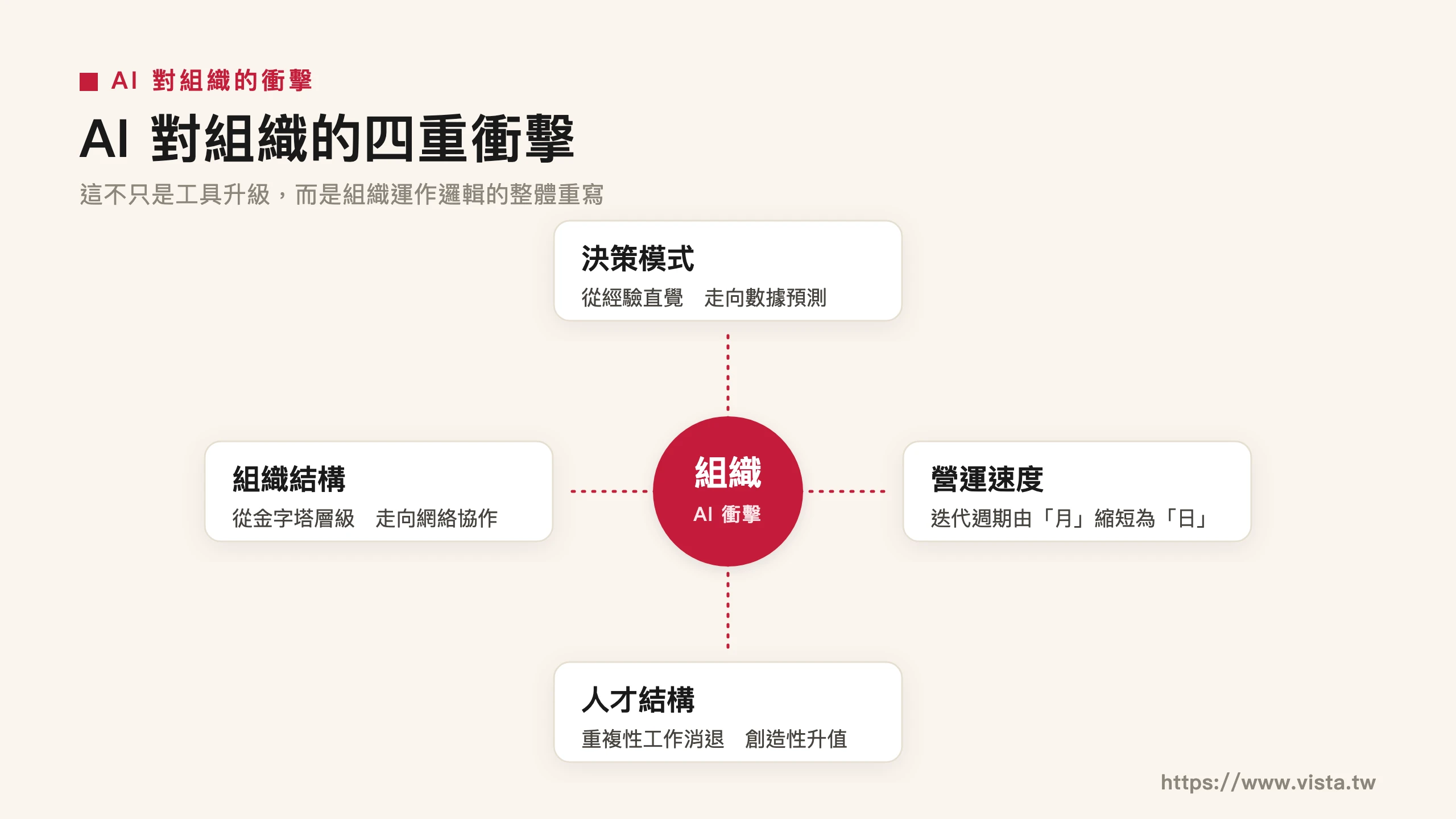 *▲ The fourfold impact of AI on organizations: This is not just a tool upgrade, but an overall rewriting of the organization’s operating logic. *
What really becomes cheaper is execution
Why is this happening? Because AI has made one of the most scarce things in the past cheaper: execution power.
The reason why organizations in the industrial era grew into pyramids was because execution power was scarce and information transmission was expensive. Organizing a group of people layer by layer to stabilize production was the greatest competitiveness. The pyramid is not stupid, it is a reasonable design under the technical conditions.
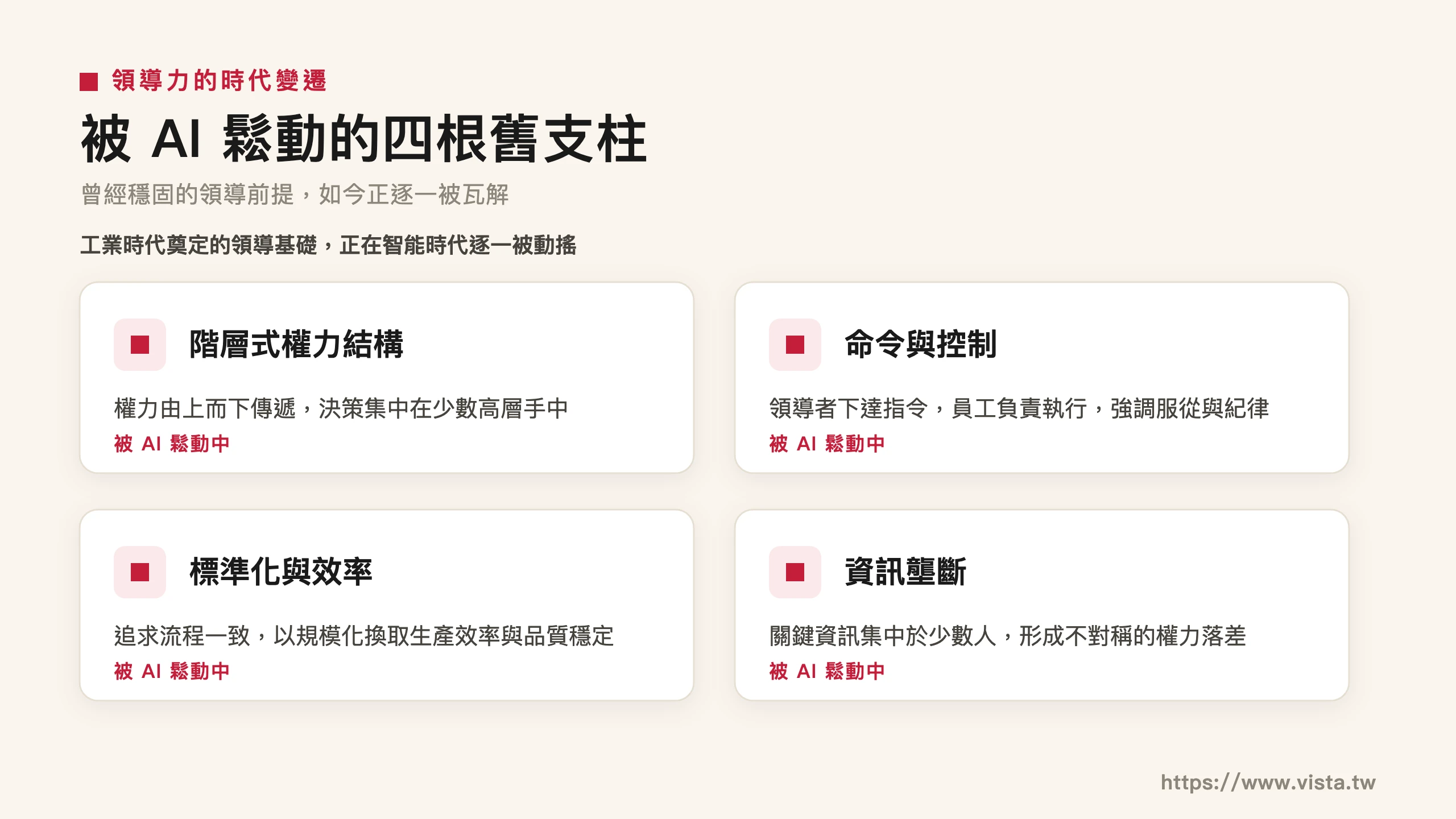 *▲ Four old pillars loosened by AI: The once solid leadership conditions are now being dismantled one by one. *
But the premise has changed. Today, when it comes to writing programs, designing, writing copy, and doing analysis, one person plus AI can do what used to take a small team to do. AI complements the four functions of organizations in one go: production, coordination, memory, and analysis. When execution is no longer scarce, the logic of stacking people up becomes loose.
What is even more alarming is a set of figures from McKinsey in 2025: 92% of companies plan to increase investment in AI, but only 1% of leaders believe that their company’s AI is truly in place; MIT found that 95% of generative AI trials did not bring measurable benefits.
What gets stuck is never whether the AI is strong enough. It’s about how the organization is designed and how the leaders lead it.
AI won’t replace leaders, but it will replace leaders who don’t transform
Therefore, the real entrepreneurial issues in the AI era become three questions:
- Shape question: Does my tissue still need to grow into a pyramid?
- Leadership question: When AI takes over execution, what should I, the leader, do?
- Action question: If I want to change, what is the first step I can take this week?
The answer lies in the three identity transformations of leaders:
Shift from commander to designer: You design the system, not issue every order. From a controller to an enabler: you give conditions instead of watching every action. From owner to co-creator: You work with your team and AI to make the pie bigger, rather than monopolizing it.
To put it bluntly, leadership in the AI era is not about managing more people, but about designing a system that can grow on its own.
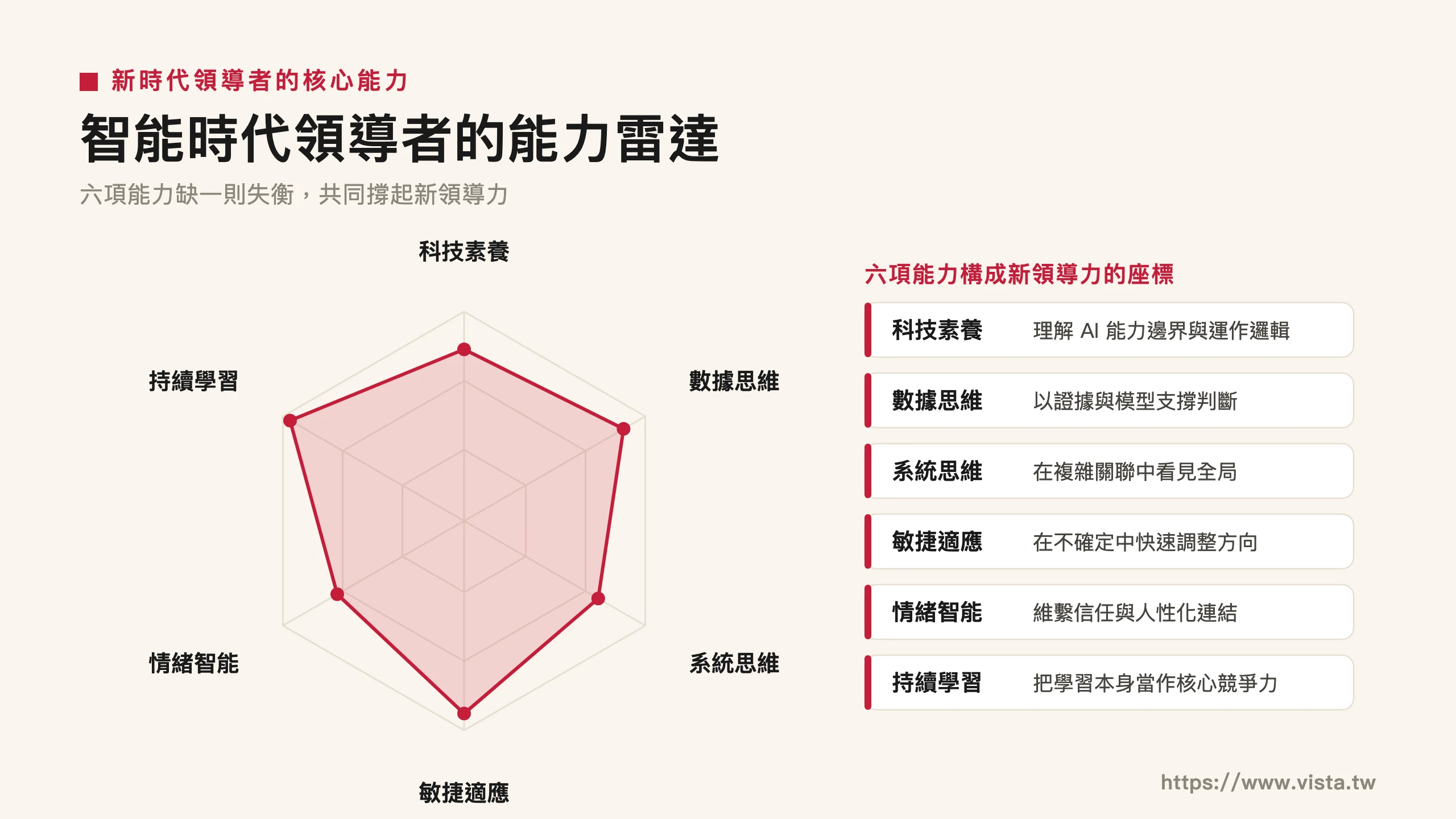 *▲ Six core competencies for leaders in the intelligent era: technological literacy, data thinking, systems thinking, agile adaptation, emotional intelligence, and continuous learning. *
I give you this complete set of blueprints
I compiled this set of thoughts into a 90-minute sharing, spanning more than ten real cases in Europe, the United States and Japan: from Midjourney and Levelsio in the United States, to Buurtzorg in the Netherlands, which has no managers, to Semco in Brazil, which allows employees to set their own salaries, to Japan’s Inamori Kazuo’s Amoeba Management, and China’s Haier’s Rendanheyi. Each case is accompanied by the year and source, which can be verified and cited.
I made it into a free e-book, which fully includes the four levels of shape, management, mentality, and methods, as well as a list of actions that can be done next week.
👉 Download the e-book “Entrepreneurship Leadership in the AI Era” for free: https://www.vista.tw/ai-startup-leadership
I hope it makes you reimagine: What should your company look like?
But there is a gap between understanding the blueprint and actually making it.
I have to be honest with you.
After reading that e-book, you will understand the trends, identify with the direction, and even excitedly list a bunch of things you want to do. But then, 90% of people will be stuck in the same place: back to daily life, and nothing happens.
Because e-books can give you directions and blueprints, but they cannot accompany you through the most difficult part: turning the major you already have into a knowledge product that someone is willing to pay for.
This is exactly what the most easily skipped but most critical card in the e-book is about: the future of professional services is to turn knowledge into systems, from selling time to selling products. And this matter, relying on one person to work hard, often requires one or two years of trial and error.
Therefore, I have made a plan to accompany you across this gap.
Concept realization running camp: 6 weeks, use AI to turn your major into a knowledge product that can be sold
This is not a video-watching class, but a small-scale live broadcast.
In 6 weeks, I will take you to turn the valuable professional knowledge in your mind into a knowledge product that can be put on the shelves, priced, and actually sold. What you take away is not a stack of notes, but a complete concept realization business blueprint: from positioning, product design, pricing, to the first batch of real market feedback.
This style of play is exactly the practical version of the organizational philosophy in the e-book: first find a narrow and deep wedge, use AI to maximize a person’s production capacity, and then decide whether to grow up.
- Format: Google Meet live broadcast + LINE group real-time discussion, Thursday evening 20:00–21:30, a total of 6 weeks
- Admission: You already have a major that you can excel in (this class will help you monetize it, not help you find questions from scratch)
- Quota: There are only 15 people in the founding tier, of which VIP one-on-one diagnosis is limited to 5 people
- Founder tier pricing: Standard 9,999/VIP diagnosis 16,800/Two people traveling together 18,000 (will be adjusted back to 16,800 after the official start of the class)
The quota and price for establishing a ladder are only available once. The entire course will be videotaped, and after the run is completed, it will be reorganized into a formal course, so the first batch of students will be able to exchange for the lowest tuition fees to the highest density of accompanying runners.
👉 Learn about Monetization Bootcamp and see the complete course design: https://www.solo.tw/courses/concept-monetization-bootcamp
Starting today, take the first step that is too small to fail.
The biggest opportunity in the AI era is not to bet on that one-person billion-dollar company that has not yet appeared, but to understand this trend line and then take the first step on yourself that is small enough not to fail.
Read that free e-book first to get your bearings. If after reading this, a voice pops up in your mind: “I also want to turn my major into a product that can be sold,” then let’s meet at the running camp.
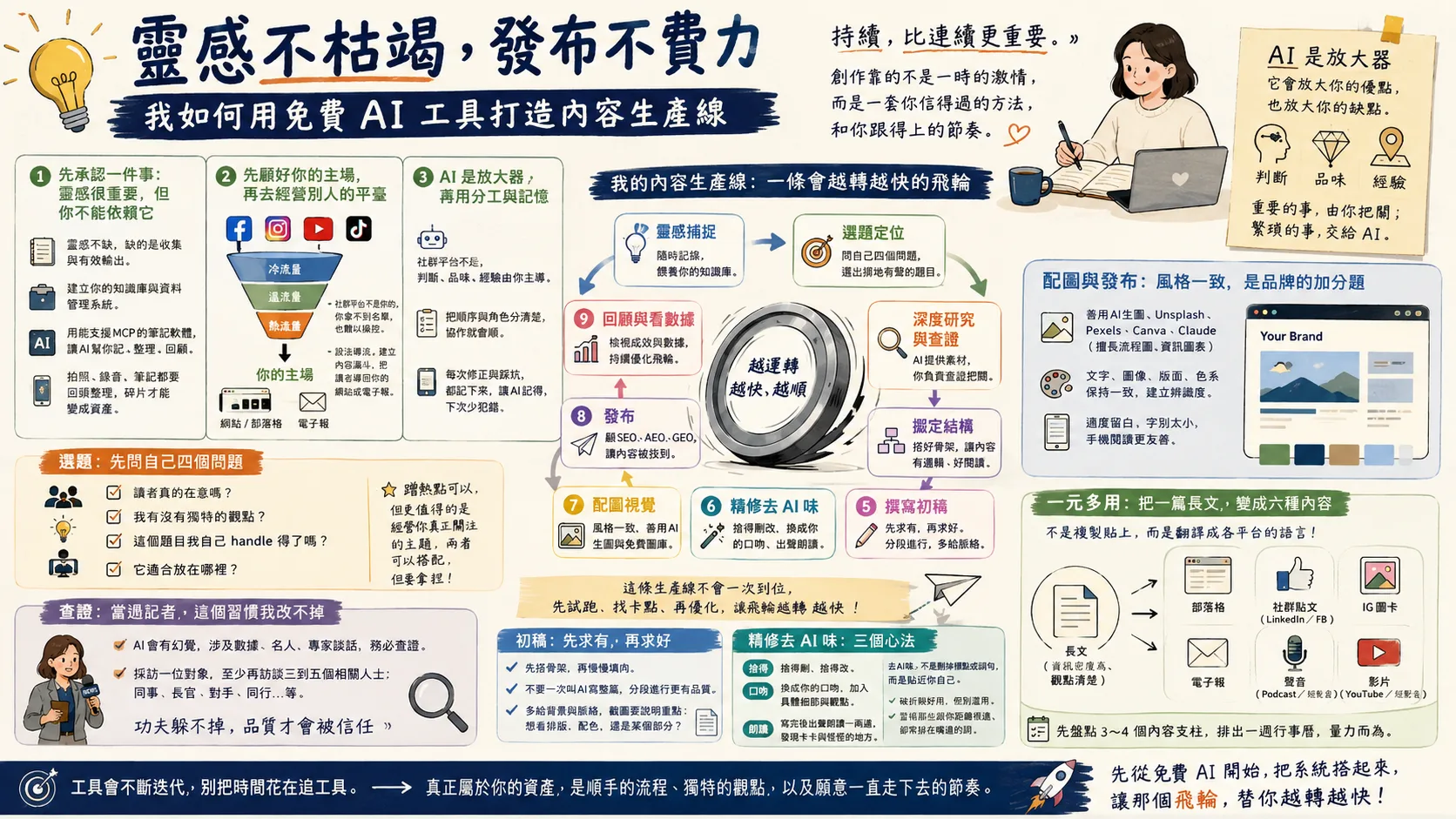
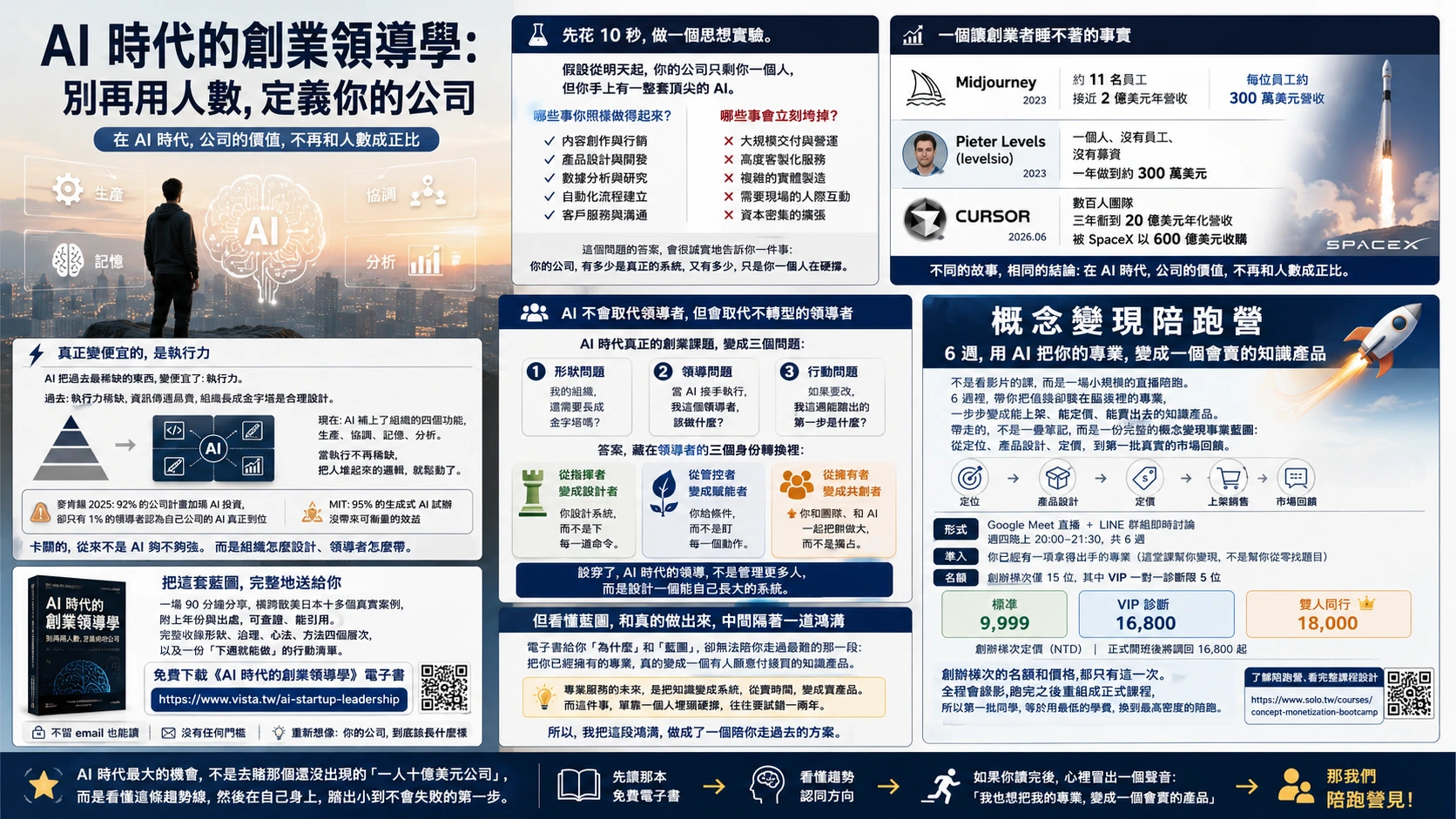 *▲ One picture to understand the entire article: from the shape of the company, the identity transformation of the leader, to the complete path to monetizing the profession. *