Never run out of inspiration, effortless publishing: Build your content flywheel with free AI tools
A while ago, I was invited by Nico, and I went to her community to chat with students for a guest live broadcast. The title is something I want to share with more people in the past few years: in the era of AI, what creators really lack is often not tools, but time, and a system that allows them to continue to produce.
I prepared a briefing of more than 200 pages that day, and I spoke very quickly, but in the end I didn’t finish it. So while my memory is still fresh, I want to put the core concepts of that sharing into words. If you are often troubled by the fact that “you are creating all day long but the output is not enough”, then this article is written for you.
Let’s admit one thing first: inspiration is important, but you can’t rely on it
I am a writer myself and have published twenty books. Someone asked me if inspiration is important. I would honestly say: “It is very important.” But more importantly, you must develop the ability to write without relying on inspiration.
Well, the reason is simple. What if you have to turn in a manuscript today and have no inspiration? Therefore, on the one hand, we must have methods to collect inspiration and use inspiration; on the other hand, we must also develop the habit of writing without relying on inspiration.
And let’s be honest, we’re not short of inspiration right now. The reason is simple, because we live in an era of information explosion, and inspiration can often be easily found. So the problem is not that there is too little inspiration, but that it is lost too quickly. We often don’t have time to write down the sudden idea in our mind, and lack effective output. In the end, it just disappears. It’s a pity.
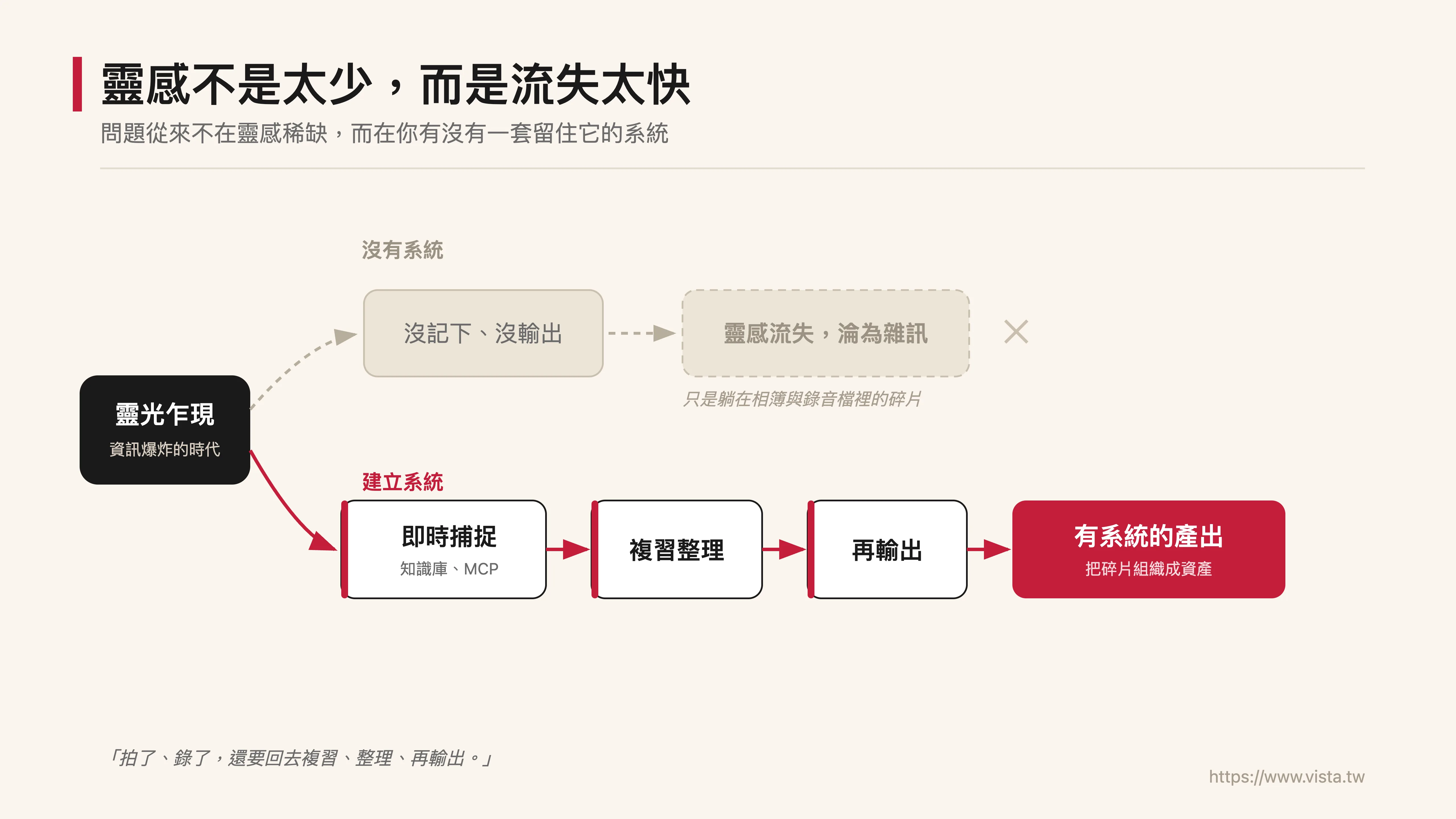 ▲The problem is not that there is too little inspiration, but that it is lost too quickly
Therefore, my first advice to every creator is: build your own knowledge base and use a data management system that you are used to. Whether you are a paper-and-pencil person or a digital person, it is actually fine. The key point is that you must have a fixed place to store inspiration.
Since I use AI every day, I choose a note-taking software that supports MCP, so that not only can I take notes, but AI can also help me remember and organize them. I ask it to help me make morning report every morning, evening report and review report every night. Even my recording software is connected to MCP: Sometimes when I see a very special picture or advertisement on the MRT, I will pick up the phone and talk to myself for a minute, and then directly throw the passage into the knowledge base after getting off the bus.
But I have to remind you: taking pictures is good, recording is good, but after taking pictures and recording, you still need to be able to keep going back to review, organize and output again. In this way, those fragments of inspiration can be organized and turned into systematic output. Otherwise they are just noise lying in photo albums and audio files.
AI is an amplifier, it will amplify your strengths and weaknesses.
When it comes to writing with AI, there are probably two schools of thought. One group advocates outsourcing almost all writing to AI, while the other group wants to do nothing for fear of being stained with AI flavor. Well, I think both extremes are bad.
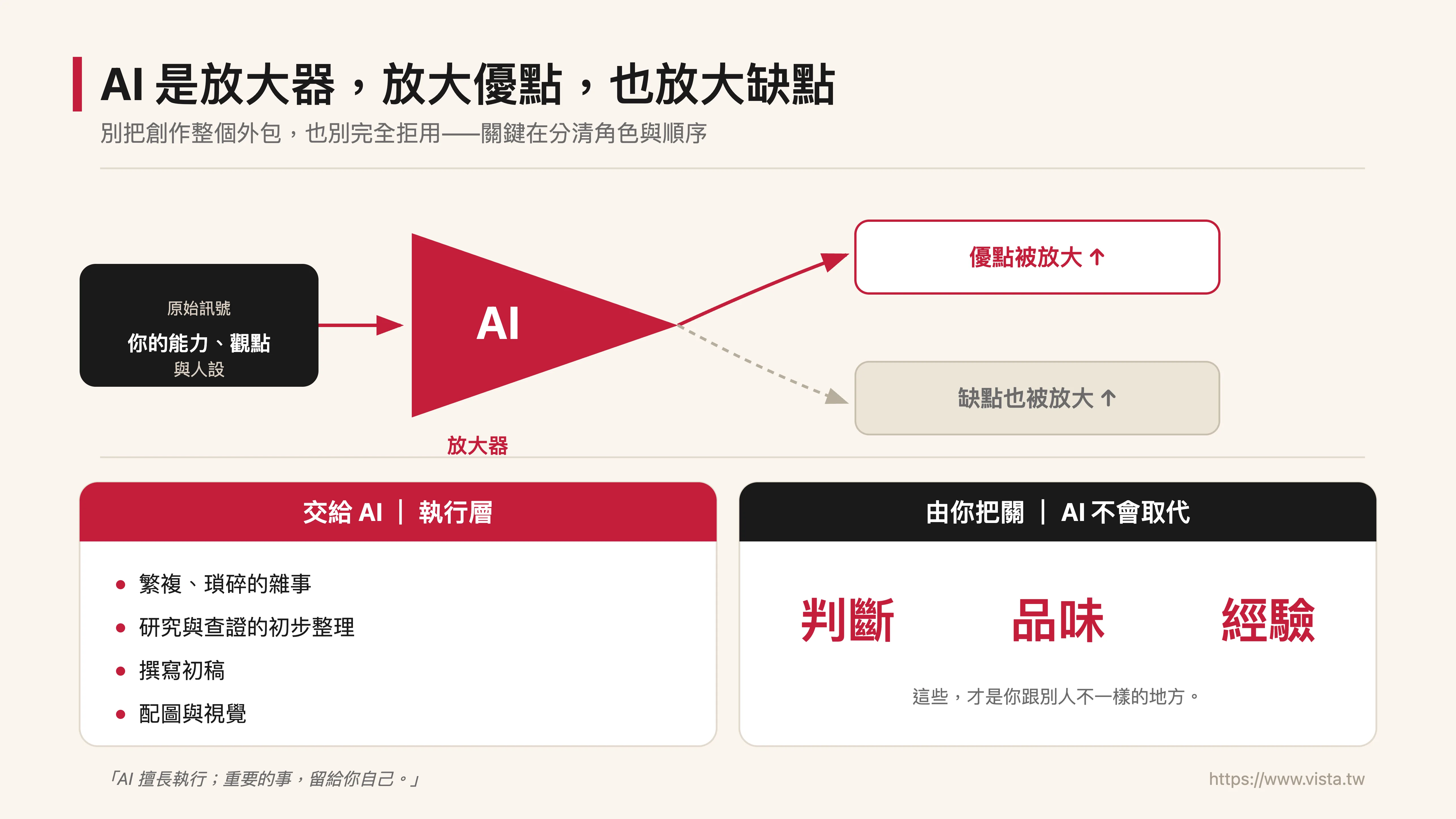 ▲ AI is an amplifier: it will amplify your strengths and, of course, your weaknesses
My own positioning is clear: AI is an amplifier. If you are a self-media operator or creator, do not outsource all creation to it. Firstly, it is not very responsible for yourself and the readers. Secondly, it is a pity because you will lose your own voice. And since it is an amplifier, it will amplify your strengths and, of course, your weaknesses.
I often say that AI will not replace three things that people have: judgment, taste and experience. So instead of asking “Will AI replace me?”, it’s better to think clearly: What makes you different from others? What’s your point? What is your persona?
Many people complain that things written by AI have no soul, but in fact the problem is often not with AI, but with us putting it in the wrong position. What AI is good at is execution, leaving those complicated and trivial matters to it; but important judgment, taste, and experience still have to be controlled by yourself. By clearly distinguishing the order and roles, your collaboration with the AI will be much smoother.
My own division of labor with AI is very detailed. Every time it makes a mistake or a new situation arises, I discuss it with it and write down the rules. Today’s models have a memory function. You can let it remember where you have stepped on a pitfall, so that you can make fewer mistakes next time.
Take care of your home court first, then run other people’s platforms
Well, this is something I want to remind everyone. Please run your own home page first, such as your website, blog or e-newsletter. Remember, these are the things you can control.
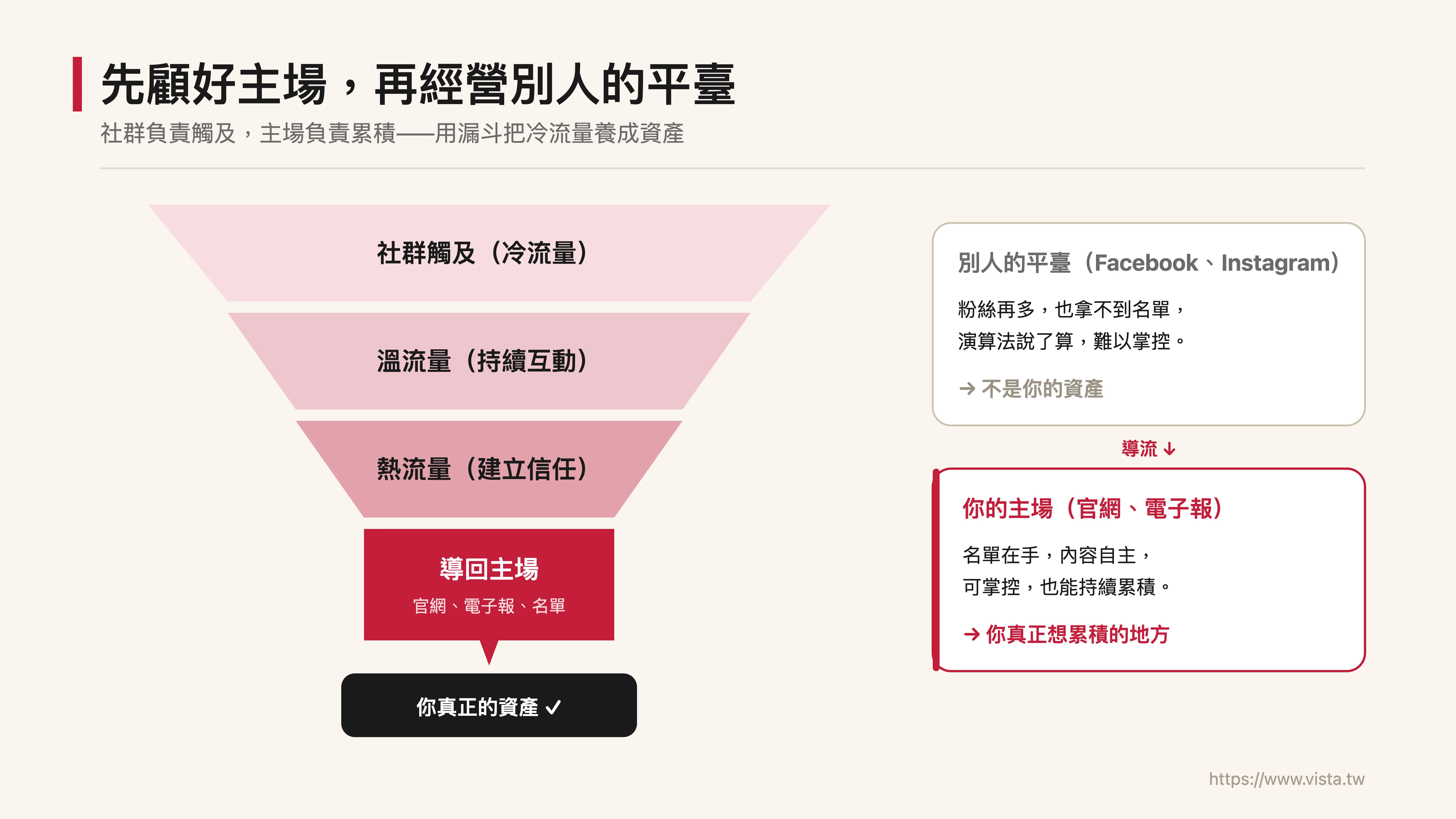 ▲ No matter how beautiful the social tracking number is, it is not your asset; take care of the home court that you can control first
As for social media such as Facebook and Instagram, even if you have 100,000 fans and 500,000 followers, they sound very impressive, but they are not your assets after all. Firstly, you can’t get the list, and secondly, it’s actually very difficult for you to control it. So if you are running these communities, it is recommended that you try to divert traffic and guide readers back to your own official website or e-newsletter step by step.
To put it bluntly, this is the concept of content funnel: start with reaching out to the community, slowly develop cold traffic into warm traffic, hot traffic, and then direct it to the place where you really want to accumulate. Graphics, texts, videos, and videos all have their own strengths. You have to think clearly about what form is suitable for the theme you are running, and then create this funnel.
My content production line: a flywheel that will turn faster and faster
Next is the part that everyone is most interested in: how to turn creation into a production line?
I have divided the creative process into nine links: inspiration capture, topic selection and positioning, in-depth research and verification, structure development, first draft writing, refinement to remove AI flavor, visual illustration, publishing (remember to consider SEO, AEO, GEO), and finally review and review of performance figures. I even developed a set of skills (skill) using Claude Code to systematize this series of processes. As long as I tell it the topic I want to write about, it can find materials from my notes, do research, and then run all the way down.
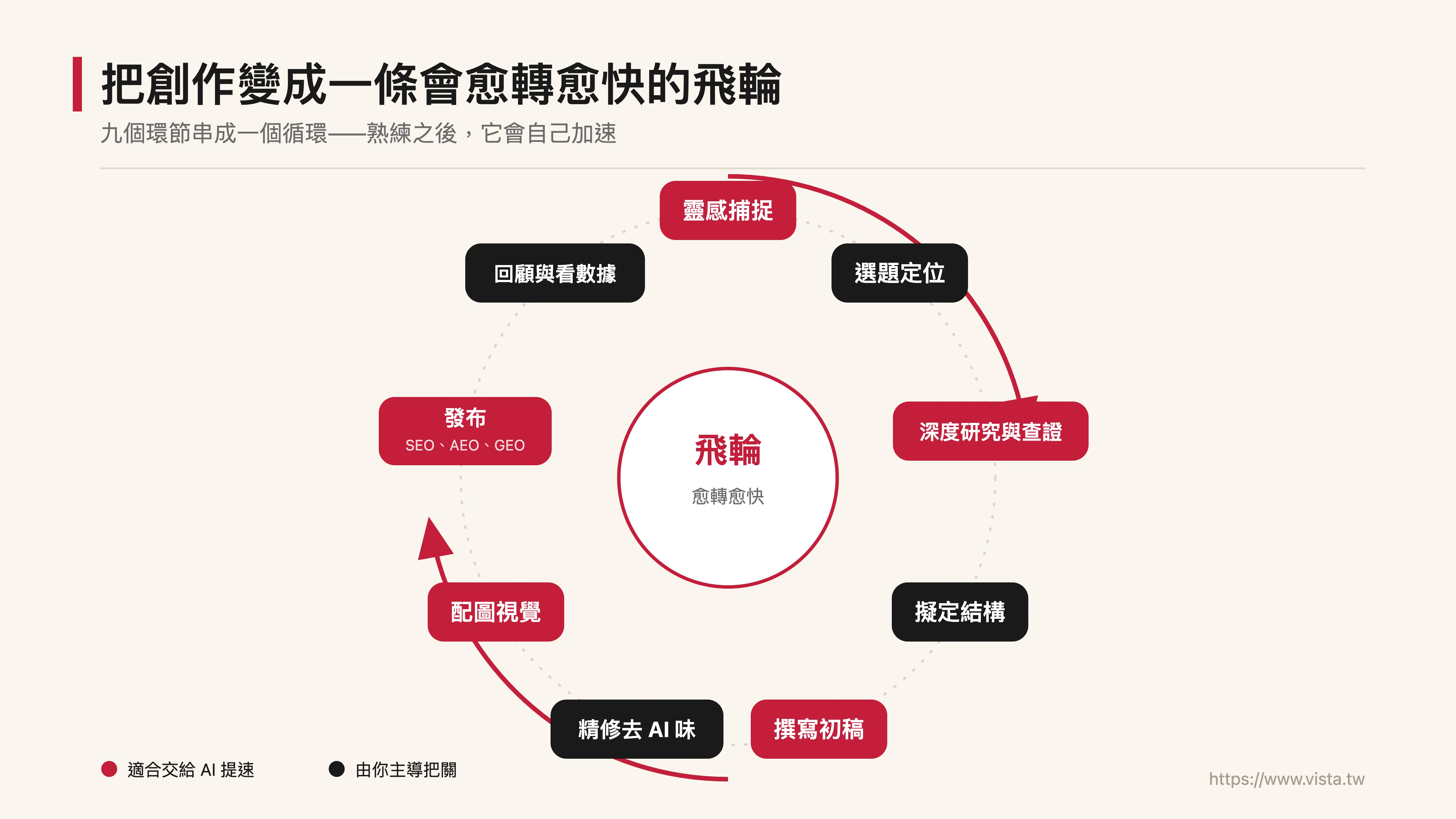 ▲ Don’t think of it as a straight line, but as a flywheel that will turn faster and smoother
But you don’t have to think that far just yet. Even if you only use the free version of AI Tool and run this set of logic in stages, you can still achieve similar effects. Instead, I hope you will spread out your process first and think carefully: Which sequences can be adjusted? Which aspects can be left to AI? Which ones still need to be done personally? This production line will not be ready in one go. You just need to do a test run first to see where it gets stuck, and then polish that link.
The key is: don’t think of it as a straight line. I wish it was a flywheel. As you become more and more familiar with your operation, this flywheel will spin faster and smoother.
The following links are the ones I think are most worthy of a few words.
Topic selection: Ask yourself four questions first
In this era where there is no shortage of articles, choosing a topic is crucial to how to write something convincing. Before I write, I ask myself four things: Do readers really care? Do I have a unique perspective? Can I handle this problem by myself? And, where does it fit in?
The third point is particularly important. I have seen too many people write about topics that they are not familiar with and are not good at in order to chase traffic. As a result, it was very painful to write. I didn’t like the finished product, and the readers were certainly less impressed. It’s not impossible to speculate on hot topics. Short-term traffic bursts also have their value, but more often than not, I want to go deeper into the topics I really care about. The two can be paired together, but you have to use discretion.
Verification: I have been a reporter and I can’t break this habit.
Everyone knows that AI can hallucinate. So as long as the article involves numbers, or the conversations of celebrities or experts, you must be particularly careful, because AI can easily fabricate it. If you are just writing a mood diary, this is not a big problem; but once it is a more formal article, verification is indispensable.
I used to work as a reporter in the media, so I couldn’t spare the time of verification. For example: when we interview a celebrity or expert, we will not finish listening to his opinions. We usually also interview three to five people around him, his colleagues, superiors, and even his opponents and peers. If you want to accumulate reputation and influence on the Internet, you cannot avoid this effort.
First draft: first seek something, then seek good
The only goal in writing a first draft is to get it right before you get it right. Build the skeleton first, and then slowly fill in the meat. Don’t think about perfection from the beginning.
If you use a free version of the AI tool, I suggest you write it paragraph by paragraph instead of asking it to write the entire article in one go, which will often only get mediocre answers. In addition, you need to give it more background information and context. I often use this method of capturing pictures, but I also want to remind you: many people just say “make one for me” after capturing a picture. This is not good. You should tell the AI, what is the focus of this picture that you want it to see? For example, is it layout, color matching, or which part? It can only help if it is explained clearly.
Refinement to get rid of the AI flavor: give up, change the tone, and read aloud
I have three mental methods to refine this step.
The first is willingness. Many people work hard to write it, but they are reluctant to delete or change it. But you have to be willing.
The second is to change your tone of voice. If it’s an AI draft, you’ll want to adjust it to your perspective and add specific details.
The third method I particularly want to share is: don’t rush to publish it after writing it, read it out loud first. With your eyes, you can’t even see the typos; but once you read it out loud, you will immediately notice where it is stuck or weird. As long as the environment and time permit, I recommend that you read it aloud once or twice.
As for removing the AI flavor, I would rather say: Don’t be too arbitrary. Many people shout that this smells like AI when they see the dash or “it’s not what, but what” appearing in the article. But I like to use dashes in the first place. Is it because I can’t use them? The point is not to delete all these words and sentences, but you have to consider every word. Dashes are still useful, but ten of them might be too many in one article. What deserves more vigilance are the words that are clearly distant from you but insist on being spoken. After all, writing should be close to yourself.
Illustration and publication: Consistent style is a bonus for personal branding
I believe everyone has heard the saying “a picture is worth a thousand words”. We absorb images faster than words. You can let AI generate the illustrations, you can dig into free libraries like Unsplash and Pexels, or you can use Canva to design them. If you want to make flowcharts, schematics or information charts, I would especially recommend Claude. Its charting capabilities are very good.
But what I want to emphasize more is the consistency of style. If you have your own website or blog, make the text, images, or layout unique to you. You can go to my vista.tw or solo.tw and it should be easy to see my preferred color system and main vision. It’s definitely a plus for your personal brand when others can recognize it as yours at a glance. In addition, given that modern people’s eyesight is not very good, especially when reading on mobile phones, please remember to leave the page appropriately blank and the fonts should not be too small.
One source for multiple uses: turn a long article into six types of content
I think every creator should internalize this last concept, that is, one source for multiple uses.
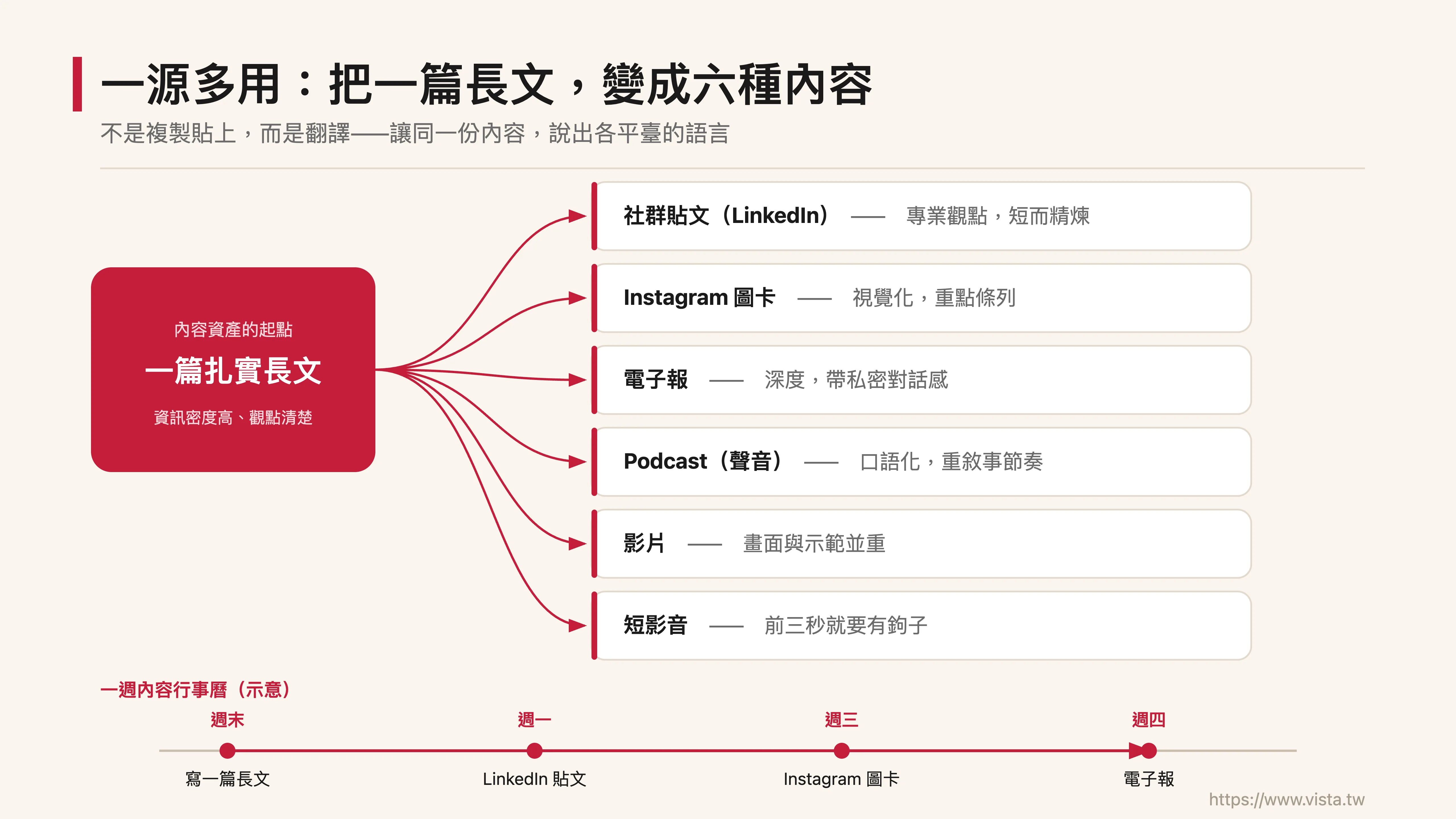 ▲ One source for multiple uses: From single article thinking to content asset thinking
A solid piece of content that you can turn into a blog, social post, newsletter, audio, or video. But please note, this is not a copy and paste. Each platform has its own attributes and language, different length, different focus, and even different calls to action (CTA). So what you have to do is translate, translate the same content into the languages of each platform.
As for what kind of content is best to disassemble? In my opinion, long articles with high information density and clear viewpoints are best broken down. For example, let’s say you have more free time on the weekend and write a long blog post. Then you can use it wisely: convert it into a LinkedIn post on Monday, post it as an Instagram card on Wednesday, and rewrite it as an email newsletter on Thursday. In this way, one article can be changed into six articles; in other words, this is moving from single article thinking to content asset thinking.
Of course, you don’t have to ask for daily updates from the beginning. First, take stock of three to four content pillars of your own (don’t be greedy, too many will make you lose focus), let everyone know clearly what expert you are, and then create a content calendar for the week, and just do what you can.
Do you want this flywheel to start turning from the website you made by yourself?
The bottom layer of this content system is, to put it bluntly, the digital assets you can control: the official website, tools, and knowledge base. If you want to have your own home court but don’t have a programming background, you might as well start with a practical implementation.
In the Vibe Coding Practical Workshop, you will learn to use natural language to describe your requirements, and let AI help you build professional websites and tools from scratch - no programming background is required to make the ideas in your mind come online.

Conclusion: Continuity is more important than continuity
At the end of the day, I left the students with a message that I also want to give to you: persistence is more important than continuity.
As a writing coach, I’m not asking you to write every day. Whether it is creation or building a personal brand, it all relies on accumulation, and accumulation never relies on temporary passion. It is not about happily writing three articles today and discontinuing updates in the next three months. What it requires is a method you can trust and a rhythm you can keep up with.
You know, tools will be constantly revised and iterated, so don’t spend too much time chasing tools. The assets that truly belong to you are that smooth process, those unique perspectives, and the rhythm that you are willing to keep going.
If you don’t have much budget just yet, don’t worry! You might as well start with free AI tools and set up the system. Then let that flywheel spin faster and faster for you. If you have any questions, you are welcome to contact me or make an appointment for consultation.