
Inspiration will not wait for you: Use MCP to connect Voicenotes and content production Skills, a complete method to turn voices into articles
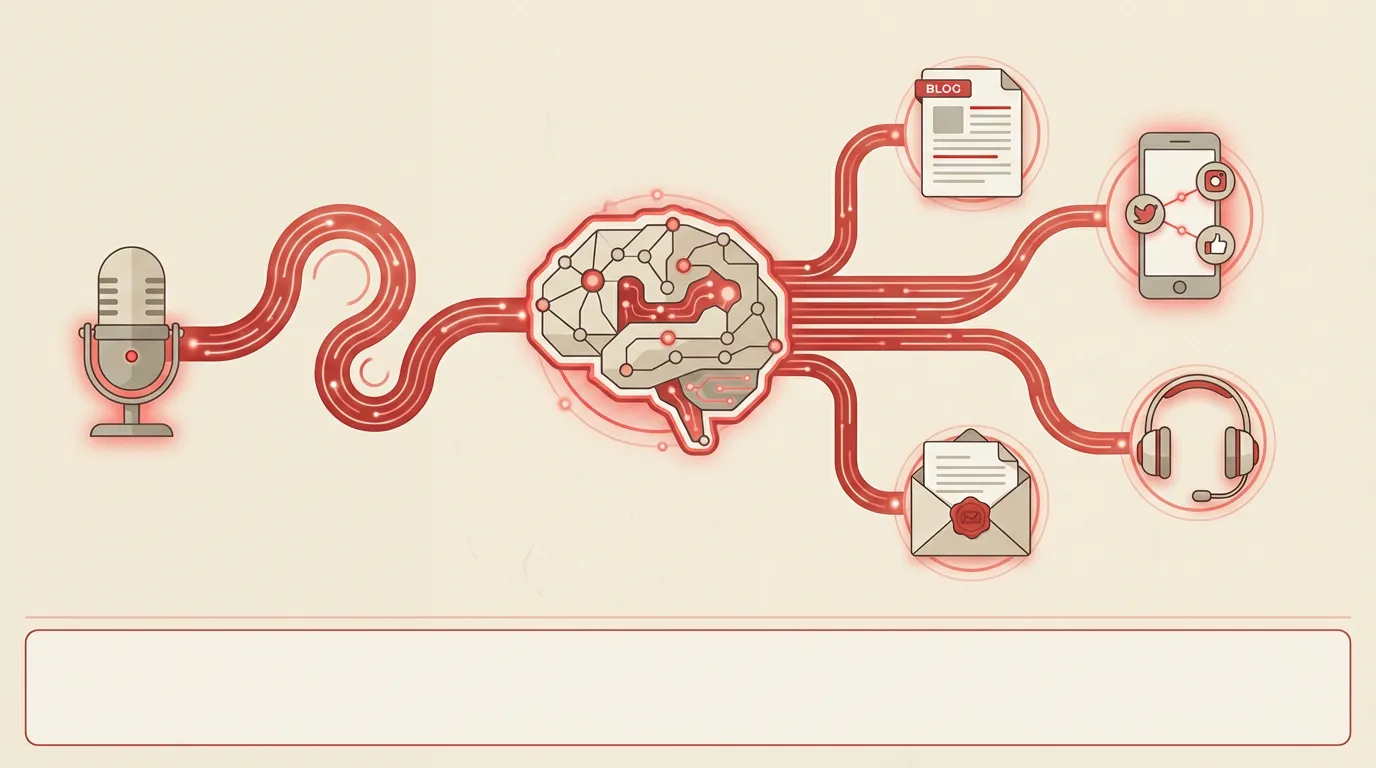
*▲ Voice notes from Voicenotes are connected to Claude Code through MCP, and then five content production Skills are relayed to produce a complete article. *
Open your phone and look at the Voice Memos or Notes App. There are many pieces of inspiration that you have recorded but never went back to listen to.
Quite a few, I guess. An idea came to my mind while commuting, a metaphor came up while I was taking a shower, I caught a corner during a meeting, and I immediately thought, “This must be written,” so I recorded it. Then what? Then it just sits there until you forget you even recorded it.
The biggest enemy of inspiration is never lack, but loss. Its shelf life is very short, and there is a distance between a piece of speech and a formed article that most people cannot cross: you need to listen again, convert it into text, organize the structure, check the data for support, polish the manuscript, add pictures, and publish it. Each step is not difficult, but the combined friction is enough to kill 90% of ideas.
This article is going to talk about how to use AI to make up for this distance.
Let’s talk about the results first: This is how this article was produced
The article you are reading now and my previous article “Using AI starts with dismantling the workflow” were all produced using the same method: I connected the voice notes recorded in Voicenotes to Claude Code through MCP, and then handed them over to a set of content production Skills I designed to relay, from inspiration, research, writing, refinement, all the way to release.
What I did in the middle was mainly judgment and decision-making: whether this angle was right, whether this paragraph should be retained, and whether this case was strong enough. Almost all the rest of the moving work was handed over.
I am not writing this article to make you marvel at how powerful AI is. What I want you to see is something more worth learning: when you can break down a complex job into a clear production line, advanced AI technology can have room to focus on it. Next, I will completely dismantle and show you how to build this line; and more importantly, how to use it in your own work.
What does this production line look like?
Let’s look at the whole picture first. The entire line can be condensed into one sentence: Voicenotes is responsible for capturing, MCP is responsible for concatenation, and Claude Code plus content production skills are responsible for processing.
The most critical link that most people get stuck on is the MCP.
The full name of MCP is Model Context Protocol, which is a set of standards that Anthropic will open source at the end of 2024. The problem it wants to solve is simple: in the past, AI was an isolated island. It was very smart, but could not touch your real working environment. Your notes, your files, and your tools are all invisible to it, and you can only keep copying and pasting them. MCP is like a universal socket that allows AI to connect to various external services safely and standardizedly.
For example: if AI is a powerful host, MCP is the USB specification. With this common specification, services such as Voicenotes only need to provide an MCP interface, and Claude Code can directly read your voice notes without the need for you to manually export, upload, and paste them.
This seemingly technical detail was actually the turning point of the whole thing. Because it changes inspiration from something that you have to laboriously carry to a source of data that AI can actively access.
Process dismantling: voice in, article out
After connecting to MCP, my content production skills can be relayed. I designed it into five links, corresponding to the five Skills you saw in the picture at the beginning of the article.
The first step is to learn and formulate the topic. I will ask Claude Code to use the MCP of Voicenotes to retrieve all the voice notes related to a certain topic, read the verbatim draft, sort out the recurring views, and determine the corners of this article. The value of this step is that it reads what I myself have said. Therefore, the seeds it compiles have my personal opinions from the beginning, and will not be a general content without soul.
The second step is research. After setting up the question, Skill will extend the verification: add data, find corresponding cases, and confirm trends. The Gartner and McKinsey data cited in my previous article were added in at this step.
The third step is writing. This step organizes the research materials and my voice perspectives into a first draft according to a narrative framework. Note that the skeleton of the first draft came from my voice notes, so it had me in it from the beginning, rather than being a soulless essay.
The fourth step is refinement. After the first draft comes out, Skill will do two things: first remove the traces of AI writing, those empty openings and mechanical connectives; and then calibrate it against my personal style file to make the text read like what I wrote.
The fifth step is publishing. Convert image formats, generate SEO descriptions, create blog post files, automatically translate into multilingual versions, and push them online. These are purely moving tasks, all automated.
As the entire line ran down, my role changed from executor to decision-maker. I no longer need to do those repetitive and time-consuming processes, I only need to make judgments in each link.
Commercial value: What you buy back is not just time
When many people see this, they will understand this method as a time-saving technique. The time saving is certainly true, but if you only see this layer, you’ll underestimate it.
Its real business value has three levels.
The first level is time leverage. From concept to launch, it used to take five or six hours for a long article, but now it takes about one hour. But the point is not about speed, but where the saved time goes. It flows to those things that AI cannot yet do and are the most valuable: thinking of opinions, telling stories, and putting your real experiences into words. You outsource the low-value moving and keep the high-value judgment to yourself.
The second level is that inspiration is no longer lost. When drawing inspiration becomes the first step in the production line, every paragraph you record has the opportunity to become a work. This is a kind of compound interest: every thought you have today is more likely to become an asset tomorrow. For a person who relies on his profession for a living, the long-term effects of this will be greater than you imagine.
The third layer, and the most overlooked, is scalability. The output of a person without a system depends on the state and mood of the day; the output of a person with a system depends on the process. Status will ebb and flow, processes will not. When your content output changes from being dependent on the weather to being predictable, you will have the confidence to accept greater cooperation, open courses, and implement subscription systems, because you know you can deliver.
This is also a concept I have been talking about in the past few years. What really allows you to stably monetize is not a certain hit article, but a production line that can stably produce opportunities. Regarding this point, I talked about this in depth in this article What really widens the gap in the AI era is the establishment of a content production system.
🎯 Do you want to actually incorporate this production line into your work?
This article talks about methods and mentality, but to make it run in your own scene, the fastest way is for someone to take you through it. The “AI Content Production System Workshop I designed is to break down the entire line of inspiration, research, writing, refinement and publishing into a system that you can operate and take with you: one piece of material, running in six formats, covering the complete funnel from e-newsletters, communities, podcasts to courses.
👉 Learn the course content now: solo.tw/courses/ai-content
Not all work should be automated: how to choose a scenario
The most common way advanced AI technology dies is when it is used in the wrong place.
I’ve seen too many people try to automate everything as soon as they get a new tool, and end up creating a bunch of gorgeous processes that no one uses. When introducing this type of technology, the first thought is: choosing the right scene is more important than learning the tools.
When I judge whether a job is suitable for this production line, I ask three questions.
One, is it repetitive? Automation has a low return on investment by doing a job that is done once and looks different every time. But work like converting speech into articles that is done every week and has stable steps is very worthwhile.
Second, can its success or failure be verified? Convert image formats and produce SEO descriptions. Right and wrong are clear at a glance, so you can hand them over with confidence. Work that requires careful judgment and mistakes that are difficult to detect should be left in your own hands.
Third, does it consume your physical strength or your judgment? Hand over the transporting process that consumes physical strength; carry out the decision-making process that consumes judgment by yourself. I draw this line very clearly.
You will find that these three questions actually point to the same thing: you must first understand your work well enough to know which section should be handed over. This is exactly the purpose of my previous article Using AI starts with dismantling the workflow: the starting point of AI introduction is never the tool, but the disassembly of your workflow.
Three tips to make the method come true
After picking the right scene, the real test is to make it run in your daily life. Here are my three thoughts.
The first idea is to dismantle the process first and then add the tools. Don’t immerse yourself in studying how to set up MCP from the beginning. First take a pen and paper and draw out the complete process of your certain content work. See each link clearly, and then decide which link should be connected to AI. If the process is clear, the tools will naturally find their place; if the process is unclear, the tools will just become a new burden for you.
Tip 2: Start from one link and don’t think about getting it right at once. You don’t need to automate all five aspects on day one. Pick the most annoying and repetitive link, which for many people is research, or typesetting and publishing. Hand over that section first, make sure it runs smoothly, and then extend it forward and backward. A production line is developed, not designed once and then finalized.
The third mental method is that people must stay on the judgment side. This method will help you produce more and faster, but it won’t help you decide what’s worth writing about. If you hand over judgment as well, you will produce a lot of correct but soulless content. The role of AI is to amplify your judgment, not replace it. Hold this line and your content will always be yours.

🛰️ Want someone to accompany you to see clearly in the wave of AI changes?
Almost all the public articles you see are finished products after repeated polishing. But what I cherish the most are the warm judgments made before the finished product - this is the reason why I created [Vista AI Inspiration Supply Station] (https://www.facebook.com/iamvista/subscribe/): a weekly thought note for fellow travelers in the AI era, sharing those rare, fleeting glimpses that will not appear in formal articles with you who are willing to get closer.
You don’t have to find the whole path yourself
This method took me a long time to perfect. The technology will change, but the mentality behind it remains stable: dismantle the process, choose the right scenario, and leave people on the judgment side.
If you’ve read this and are starting to think, “I want to put this into my job,” I want to give you two starting points.
One is to do it now. Open your voice memo, pick a piece of content that you most want to write into an article, and try to list the steps from this voice to the finished article. Just by listing them, you’ll know where you’re stuck better than you did yesterday.
Another thing is, if you want to avoid detours, I have broken down this entire production line, from inspiration, research, writing, refinement to release, into hands-on courses and workshops. I also continue to share my latest practices and tools through subscriptions. Advanced AI technology is actually not difficult, but what is difficult is having someone explain it clearly and walk you through it completely. I’m happy to accompany you on this matter.
Inspiration won’t wait for you. But as long as you have a production line that can catch it, it doesn’t have to be lost anymore. If you want to understand this line more deeply, you can continue to read [Use Claude Code to string together the entire content production line] (https://www.vista.tw/blog/claude-code-content-creation-workflow), and [Claude Code is not just a tool for engineers] (https://www.vista.tw/blog/claude-code-for-knowledge-workers).