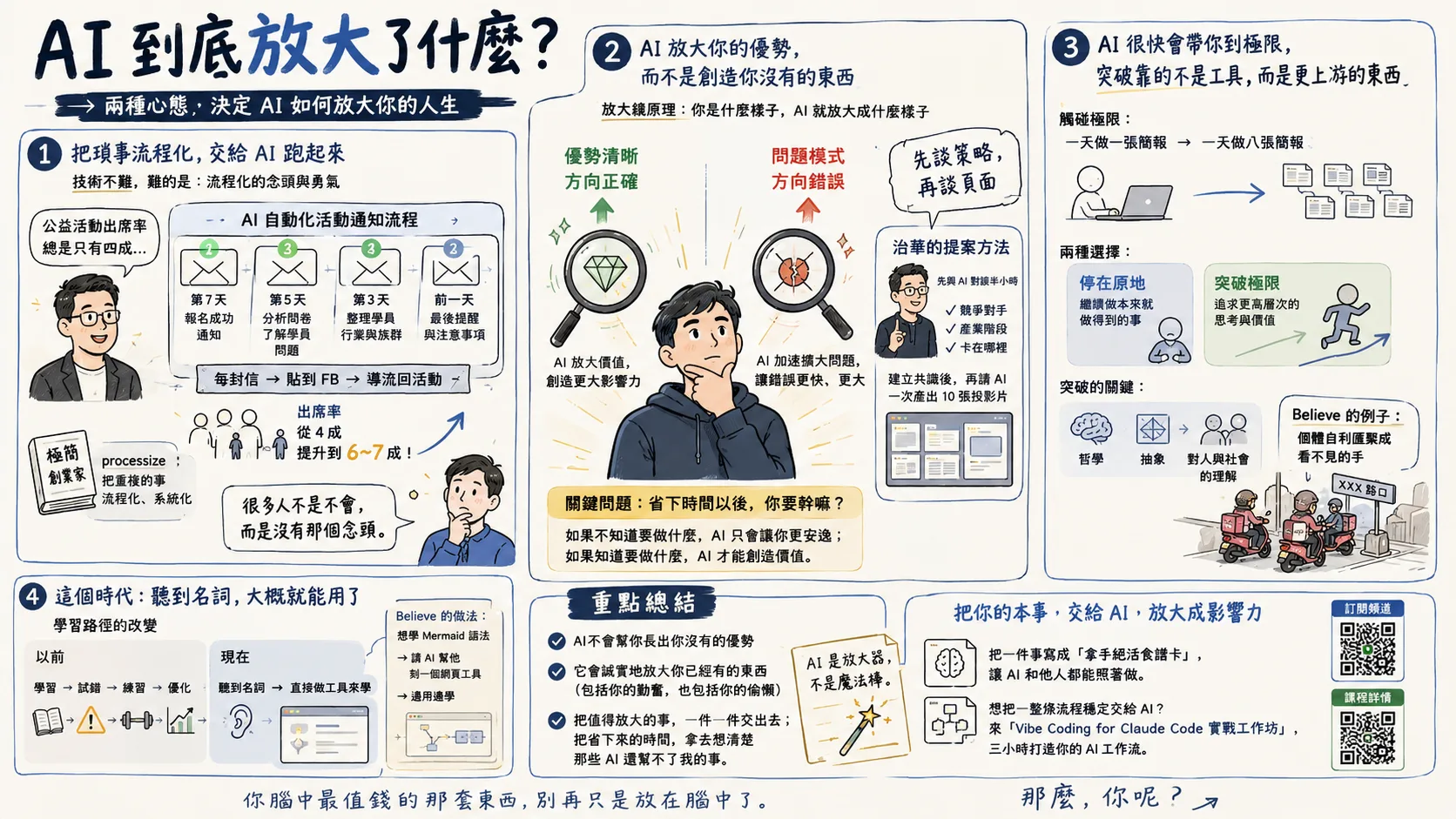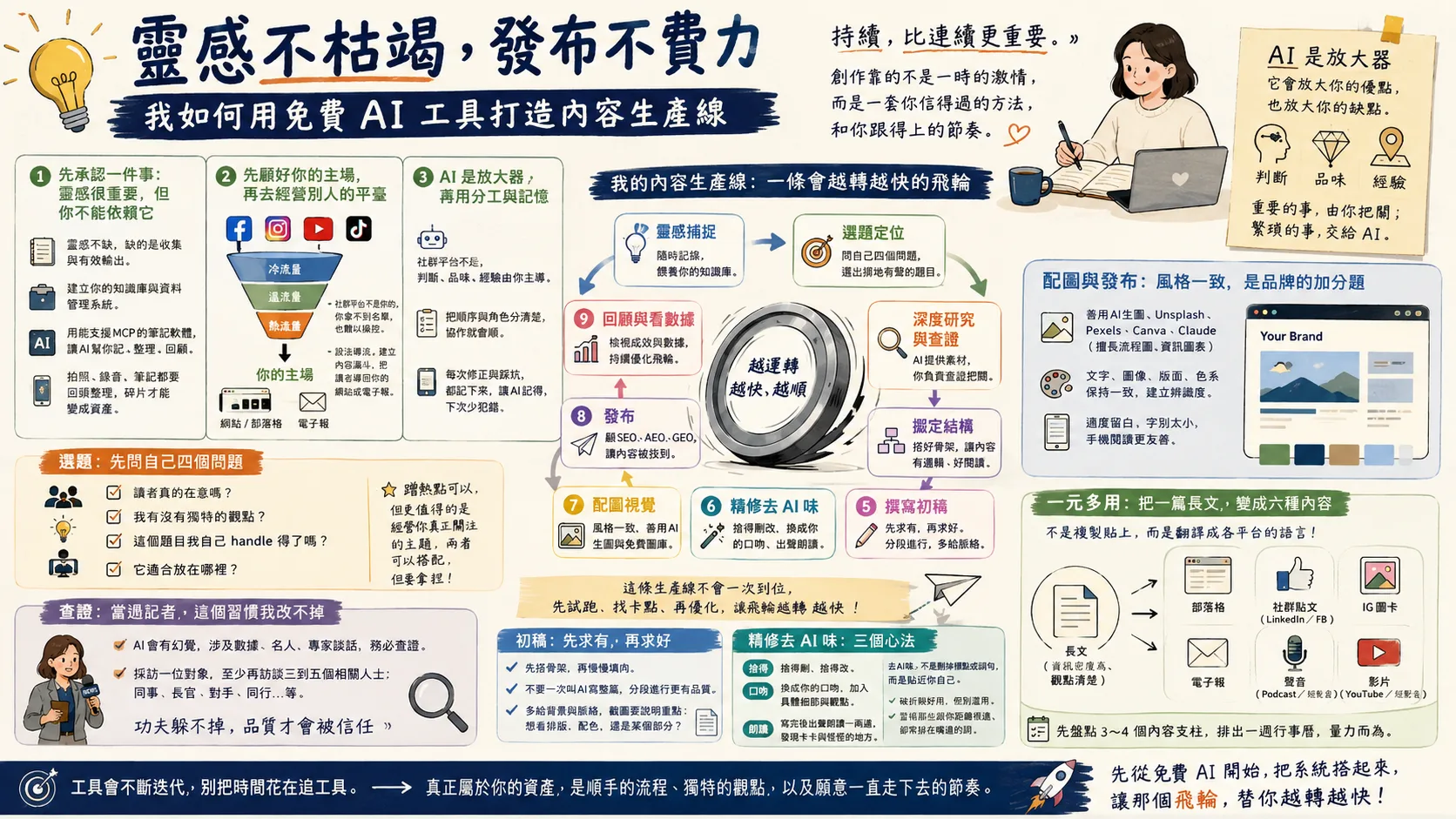
I wrote a content production line into a skill: give the AI a recipe card, so that you don’t have to re-enter the prompt every time.
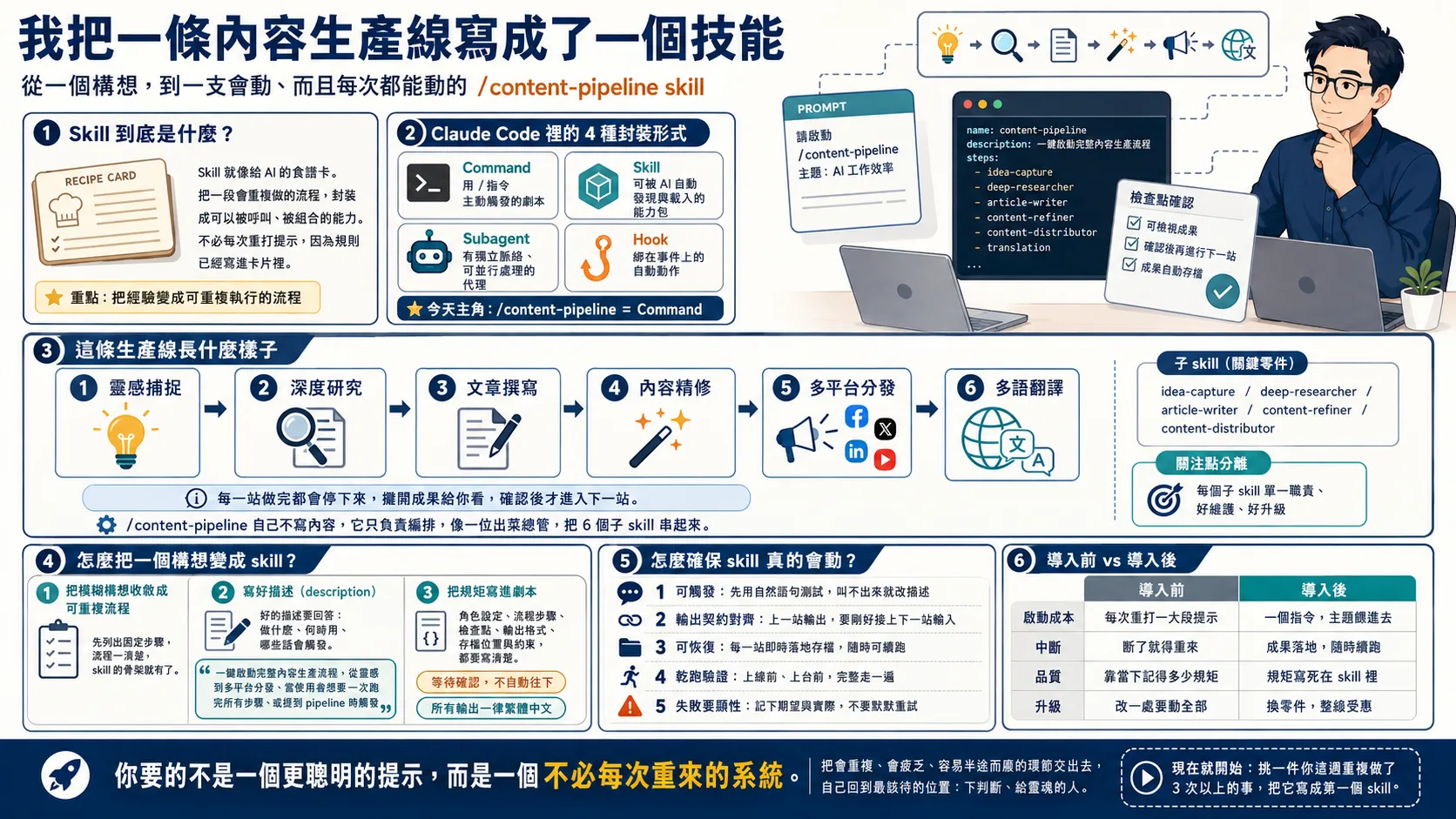
*▲ How does an idea turn into a skill that can move and be able to move every time? This article will show you the path. *
Not long ago, in a workshop specifically for creators, a student came over during the intermission and asked a little embarrassedly: “Teacher, every time I ask AI to help me write something, I have to retype a large section of prompts - from research direction, tone to format, etc., all over again. Is there a way to just give one command and it will understand what I want?”
I laughed, not because the question was basic, but because it was such a great question! Because this is the reason why I developed the content-pipeline skill half a year ago. If you want to first understand why I advocate upgrading AI from a question-and-answer tool to a production system, you can go back and read this prequel: [What really widens the gap in the AI era is never questions and answers, but the establishment of a content production system] (https://www.vista.tw/blog/ai-content-production-system).
I laughed and told him it was doable, and the method was more approachable than you might think. In today’s article, I want to dismantle the design logic of this system for you. I don’t plan to talk too much about technology, I just want to explain one thing clearly: how to turn an idea into a skill that can move and be able to move every time.
Let’s make it clear first: what exactly is skill?
For example, you can think of a skill as a recipe card.
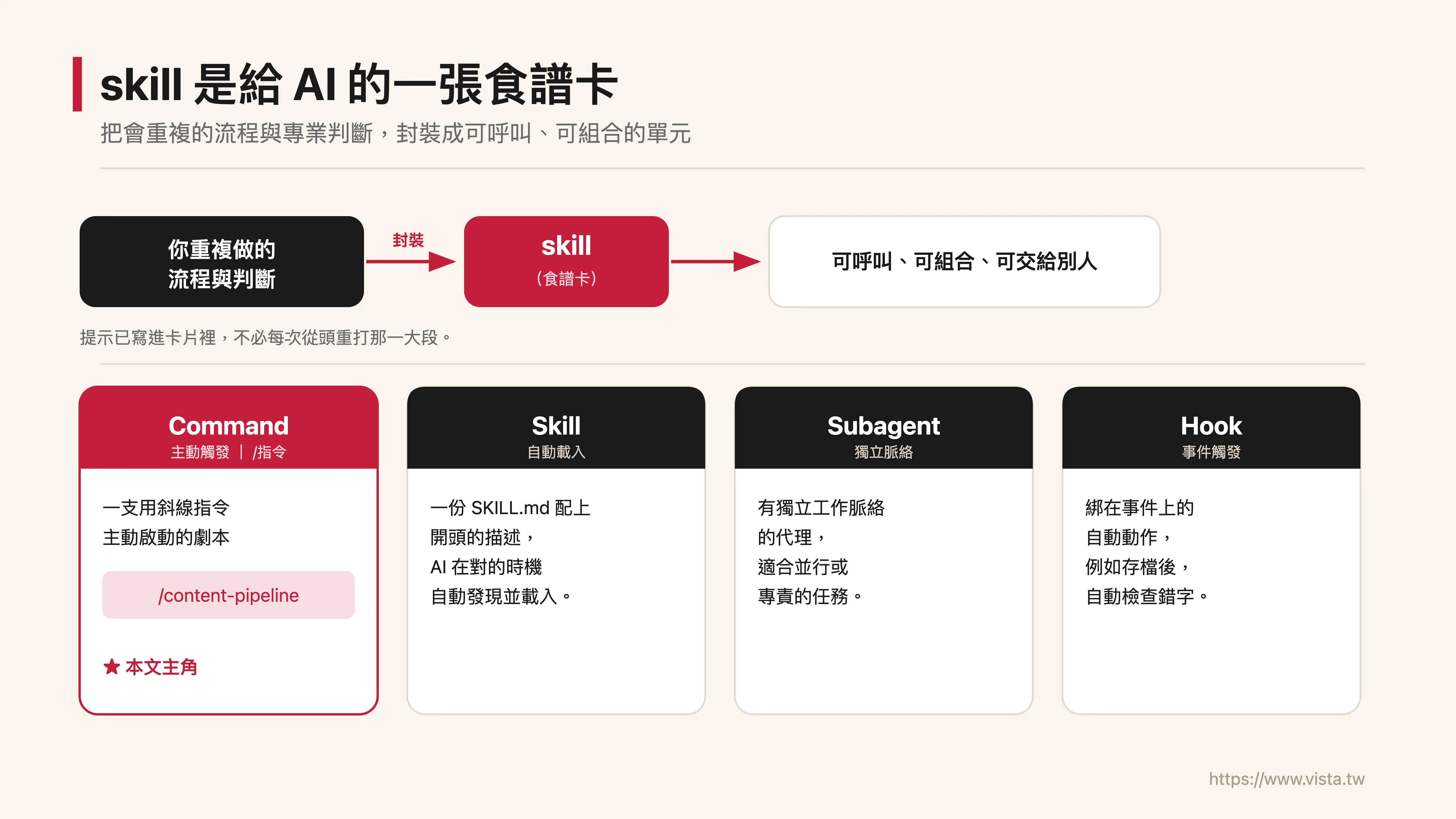 *▲ A skill is a recipe card for AI: encapsulate a process that you will do repeatedly, and take it out directly when needed. *
For example, you know how to cook braised pork, but you probably don’t want to have to remember from scratch every time you cook: first blanch, then stir-fry until browned, and how much heat to cook… If you take the time to write it down on a card, you can just take it out and follow it when needed. Even better, this card can also be given to others to execute.
Yes, skills are recipe cards for AI. To put it bluntly, it encapsulates a process that you will do repeatedly, or a set of professional judgments in your mind, into a unit that can be called and combined. You don’t have to retype that long section of prompts every time because the prompts are already written into the card.
In Claude Code, this kind of packaging has four forms, with different positioning:
- Command (placed in ~/.claude/commands/): a script that is automatically triggered by /command. /content-pipeline itself.
- Skill (a copy of SKILL.md with a description at the beginning): an ability package that can be automatically discovered by AI and automatically loaded at the right time.
- Subagent: An agent with an independent work context, suitable for parallel or dedicated tasks.
- Hook: Automatic actions tied to events, such as automatically checking for typos after each save.
I use all four, but today’s protagonist /content-pipeline is the first one, which can also be regarded as a script. Its plot is a six-station production line.
What does this production line look like?
Inspiration capture → In-depth research → Article writing → Content refinement → Multi-platform distribution → Multi-language translation
[1] [2] [3] [4] [5] [6]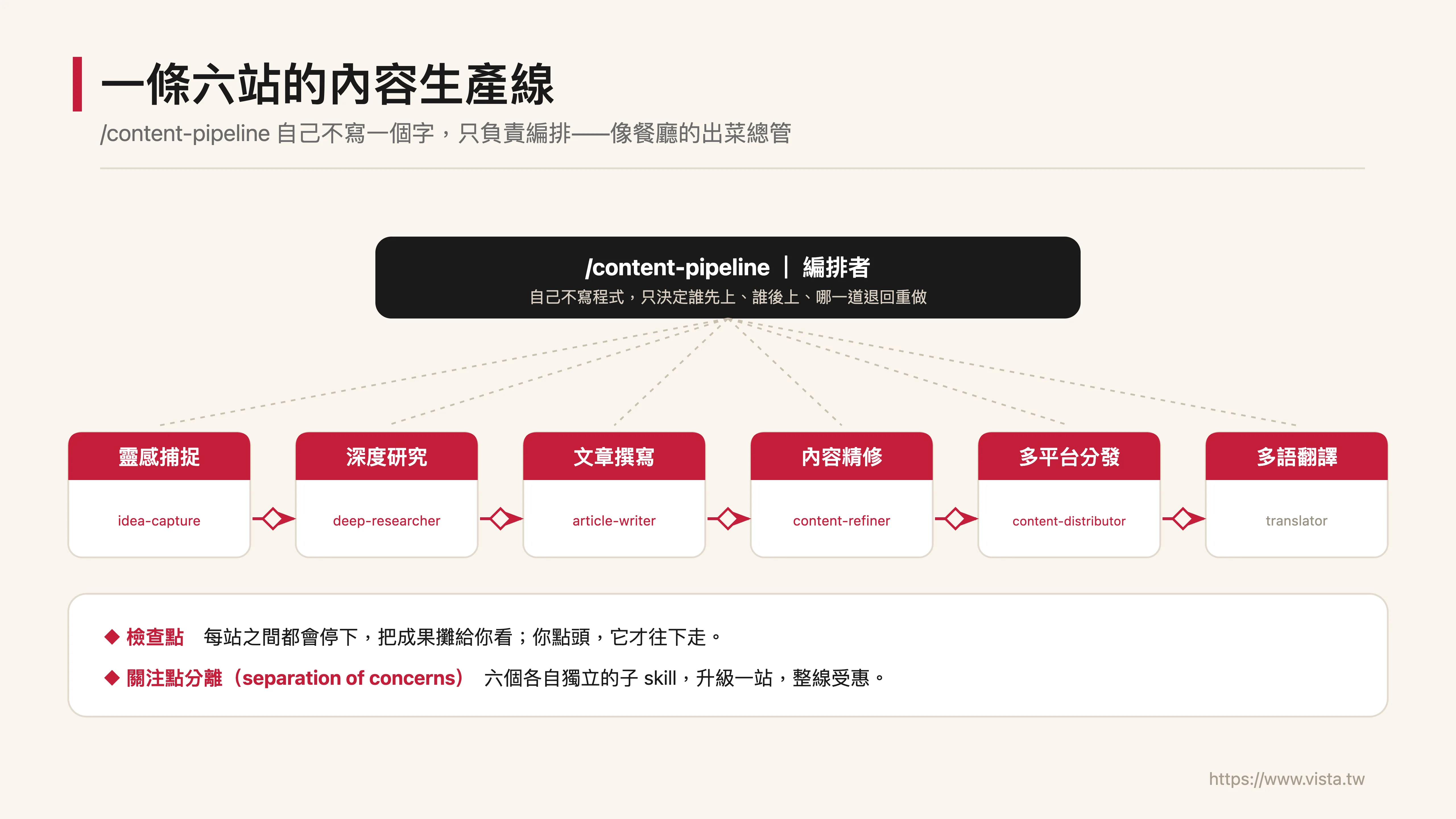 *▲ You feed a theme and it leads you from station to station, with a checkpoint between each station. *
You feed a topic, and it leads you from station to station, with a checkpoint between each station: Stop when you are done, show you the results, and ask you if you want to make adjustments and if you can move on. You nod and it moves forward.
There is a key technical design here that is worth mentioning: these six stations are not six pieces of code written in the same program, but six independent sub-skills, connected by this script. (If you want to see how this production line actually runs, I recorded the entire process in this article: When AI not only helps you write, but also helps you research, format and publish: the content production line I built with Claude Code.)
Idea capture is idea-capture, in-depth research is deep-researcher, writing is article-writer, refinement is content-refiner, and distribution is content-distributor. /content-pipeline itself does not write a word, it is only responsible for arrangement - like a restaurant manager, he does not cook the dishes, but decides who will be served first, who will be served last, and which dish will be returned and redone.
This is called separation of concerns (Separation of concerns, SoC) in engineering. There are two advantages: each sub-skill has a single responsibility and is easy to maintain; and when I upgrade the refined algorithm, the entire line will benefit immediately without having to change the program structure of the other five stations.
Here comes the key point: how to turn an idea into a skill
Suppose you also want to start your own production line from scratch, you can probably refer to the following three steps.
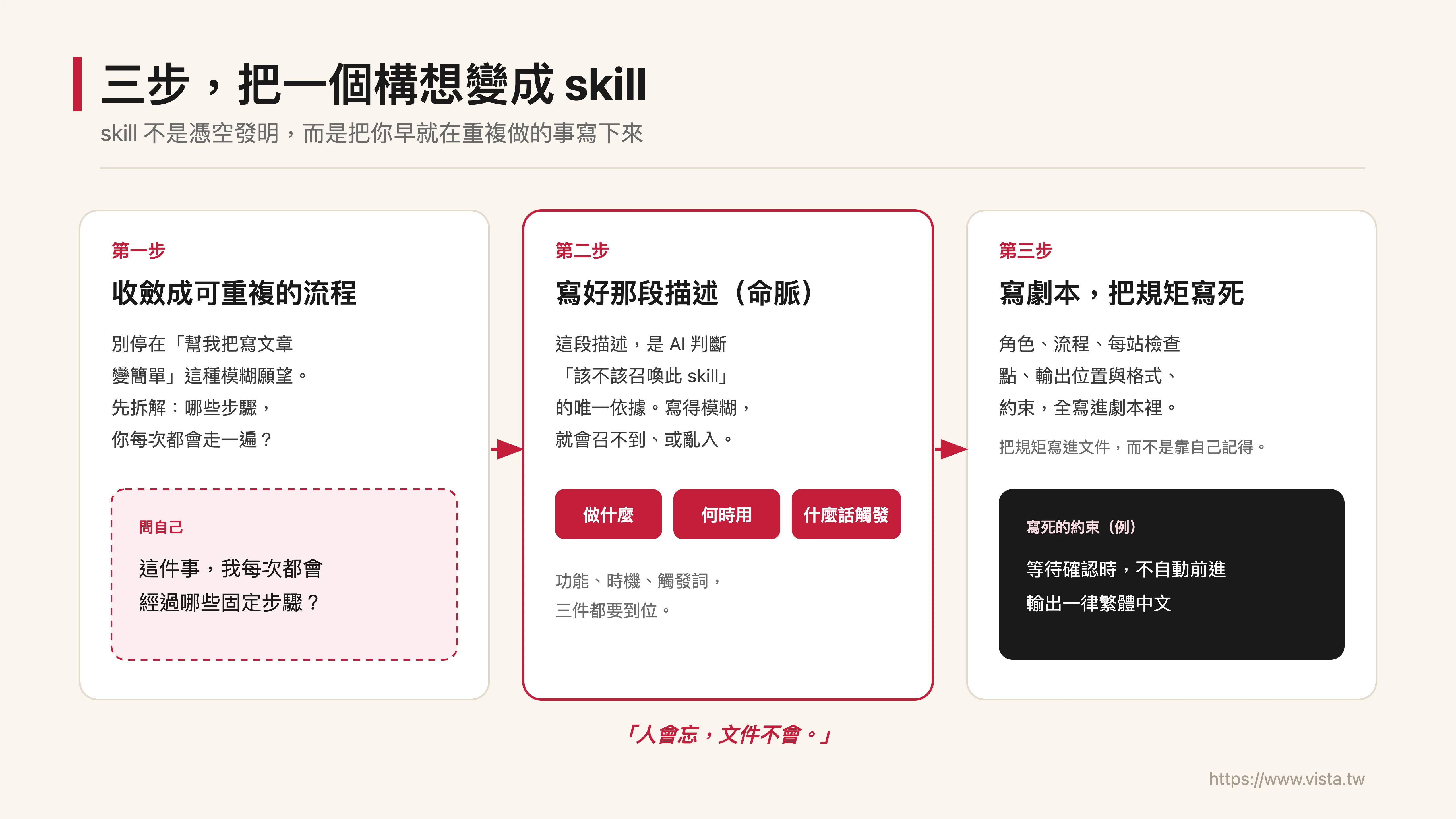 *▲ Converge the process, write a good description, and write down the rules - three steps to turn an idea into a moving skill. *
Step one: Convergence the vague idea into a repeatable process
The original idea usually looks like this: “I hope AI will help me make writing articles easier.” However, if you really say this, it may be a bit difficult for AI to understand and it will not be a skill.
So, you have to ask yourself first: What are the fixed steps I will go through every time in this matter? List it out. I’ll list those six stops. Once the process is clear, the skeleton of the skill is in place. To be honest, skills are not invented out of thin air, but just written down what you have been doing repeatedly. This also echoes the concept I have always emphasized: [The starting point for utilizing AI is not to pick tools, but to dismantle the workflow] (https://www.vista.tw/blog/ai-agent-era-decompose-your-workflow).
Step 2: Write that description, which is the lifeblood of the entire skill
Each skill begins with a description. Many people write casually, but this is actually the line that should be considered the most.
Why? Because this description is the only basis for AI to judge “should this skill be called out now?” The writing is vague, and it will either never be summoned, or it will come in at the wrong time.
A good description usually needs to answer three things: what to do, when to use it, and what words the user says will trigger it? The description I wrote for /content-pipeline is: “Start the complete content production process with one click, from inspiration to multi-platform distribution. Triggered when the user wants to run all the steps at once, or when the pipeline is mentioned.” You see - function, timing, trigger words, all three are there.
Step 3: Write a script and write the rules in
The rest is the text, which is the script of this skill: role setting, process steps, checkpoints at each station, where the output is saved, what the format is, and constraints.
By the way, constraints are especially important. I wrote two things in /content-pipeline: do not automatically enter the next stage when waiting for user confirmation; all output must be in Traditional Chinese. Writing the rules into the skill instead of remembering them by yourself every time is the key to stable quality. After all, people forget, but documents don’t.

*▲ If this kind of dismantling of “turning workflow into a system” is useful to you, please subscribe to Vista AI Inspiration Supply Station - I will regularly share with you first-hand the tested AI tools, processes and thinking. *
The more difficult level: how to ensure that the skill can really move
Writing is not enough, it is only half done. To be honest, I have suffered from hidden losses before.
I still remember one time when I wanted to give a real-time demonstration in a speech, and I wrote a function on the slide that I thought I had already done. I casually tested it the night before going on stage, only to find that the function only existed on the slide, and the actual skill was empty. Well, luckily I found it early and I had time to remedy it that night.
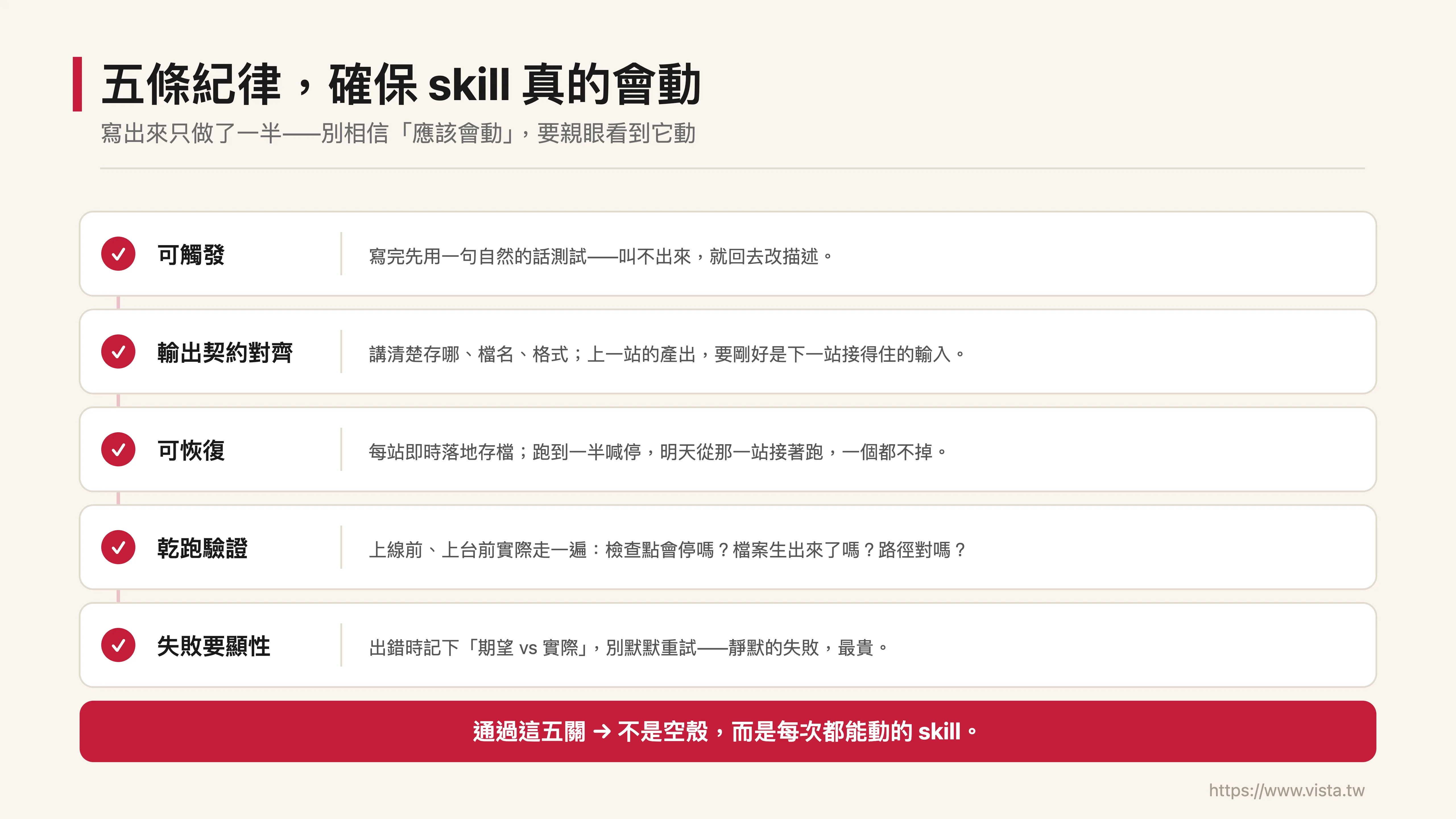 *▲ Triggerable, output contract alignment, recoverable, test run verification, failure should be explicit - five disciplines to ensure that the skill is not an empty shell. *
Since then, I have established five disciplines for myself to ensure that the skill is not an empty shell:
- Triggerable: test a sentence first after writing. I will deliberately use a natural way of saying it to see if this skill will be called correctly. If you can’t call it out, go back and change the description.
- Output contract alignment: Each station must clearly explain where the results are stored, how to get the file name, and what the format is. This is the premise for the production line to be established - the output of the previous station must be exactly the input that the next station can receive. If the interface fails, the pipeline is broken.
- Recoverable: The results of each station are archived immediately, with seed cards, research abstracts, and first drafts all in their own place. So if you run halfway and say, “Go here first and continue later,” and come back tomorrow and continue running from the fourth stop, no one in front will be lost. Life will not give you three hours without interruption, and you have to be able to withstand interruptions.
- Trial run verification: Before going online and before going on stage, actually walk through it. Confirm one by one - will the checkpoint really stop? Are files really created? Is the path really correct? Don’t believe “it should move”, see it move with your own eyes.
- Failure should be explicit: If something goes wrong at a certain site, write down what I expected to happen and compare it with what actually happened, rather than trying again silently. After all, those silent failures are often the most expensive failures.
Before import vs after import
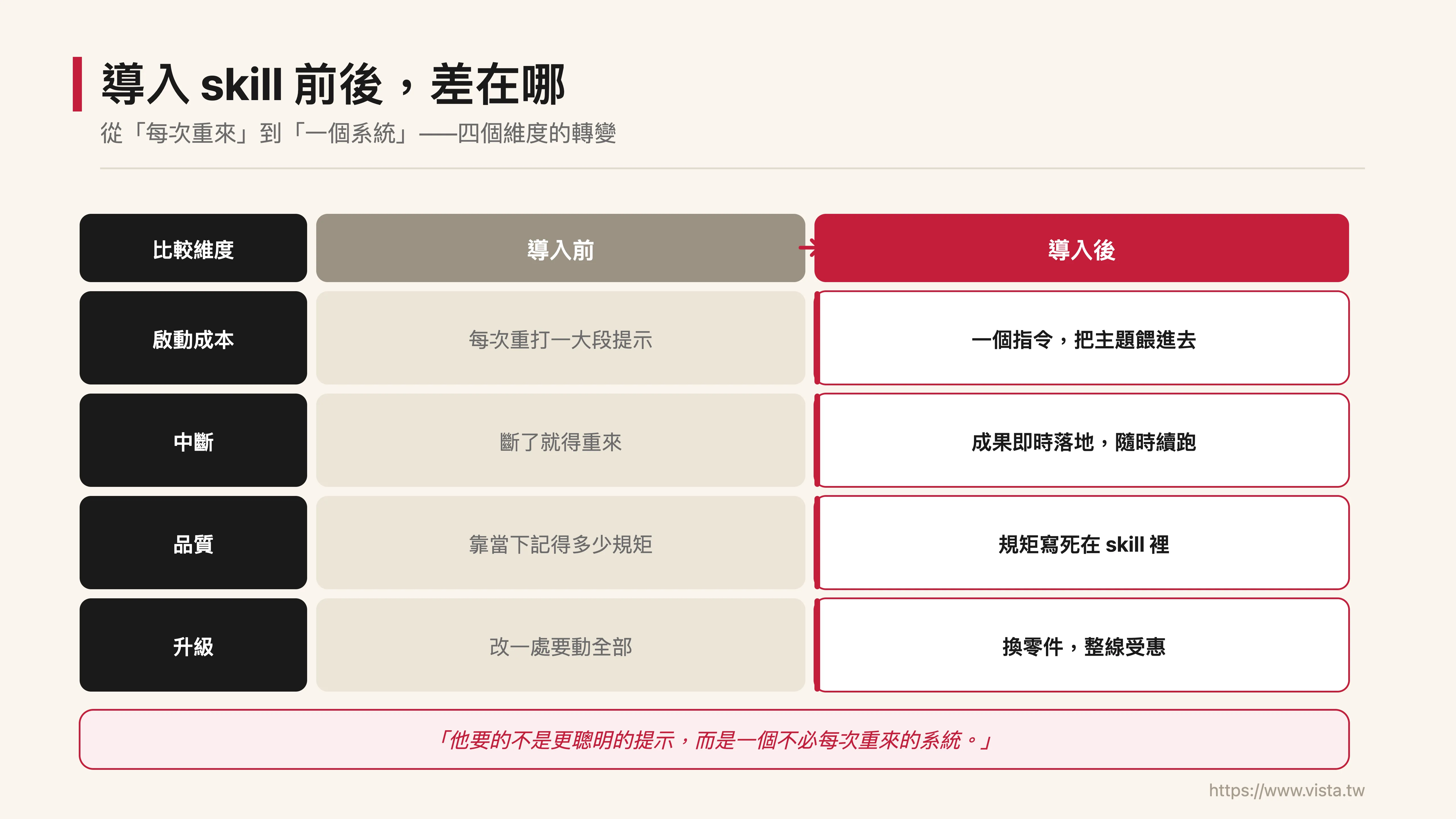 *▲ After writing the process as a skill, the four things of startup cost, interruption, quality, and upgrade have changed. *
| Before import | After import | |
|---|---|---|
| Start-up cost | Reprint a large section of prompts each time | One command, the theme is fed in |
| Interruption | If you break, you have to start again | The results are implemented, and you can continue running at any time |
| Quality | Rely on how many rules you remember at the moment | Rules are written down in skill |
| Upgrade | Change one part to change everything | Replace parts and benefit the entire line |
##Finally
Back to the question of the student in the workshop. What he wants is not a smarter reminder, but a system that doesn’t have to be repeated every time.
This is what skill gives you. It allows you to hand over those links that are repetitive, tiring, and easy to give up halfway, and return to the position where you should be the most: the person who makes judgments and gives souls. This is also what my ideal content flywheel should look like - never running out of inspiration and effortless publishing.
If you want to start, my suggestion is simple: pick something you have done more than three times this week, write down the steps, give it a clear description, and then try it out. Your first skill is born.
Yes, start now. If you want someone to help you build your own content production line step by step, welcome to sign up for my online course - I will turn the design logic discussed in this article into practical capabilities that you can take with you.
👉 Understand and register for the “AI Content Production System Workshop”
Dear friends, let’s meet in class.
📖 深入探索相關主題