Why can’t the person with the best performance be promoted to a supervisor? After listening to Chen Zongxian, I made three key points for knowledge workers that no one reminded them of.
That day, I listened to the episode where Chen Xiuping interviewed Professor Chen Zongxian twice from beginning to end. The first time, I was hooked by the title - “The person with the best performance can’t be promoted to a supervisor?” This sounds like irony, like a hook for traffic. But after listening to it, I realized that this was not a sensationalism, but a sentence condensed into one sentence by an old man who had led 71 companies and trained nearly 200 professional managers in Taiwan.
To put it bluntly, we are too accustomed to treating two completely different abilities as one; taking two completely different paths as one.
I am a person who makes content, teaches and provides consulting services. At first glance, Mr. Chen’s world seems far away from me - he talks about manufacturing, chain systems, ERP and responsibility centers, while what I face every day is content, courses, communities and personal brands. But the more I listened, the more I couldn’t sit still, because the diseases he talked about in enterprises, put on new clothes, are actually happening to knowledge workers like you and me one by one. I would like to use my own perspective to add three important points that no one has noticed in this episode.
*▲ Master Business School EP47 | Chen Xiuping interviews Professor Chen Zongxian, known as the “Peter Drucker of Asia”. I listened to this episode twice. *
Peter Principle - Don’t force the soldier who knows how to fight to become a general who can’t fight.
The first key point that Teacher Chen talks about is the Peter Principle (Peter Principle): A person performs outstandingly in his original position, so he is pushed up to a position where he is incompetent. Teacher Chen mentioned that as many as 90% of companies in Taiwan promote whoever has the best performance to a supervisor. As a result, a good business manager is lost and a miserable supervisor is added.
He put it very bluntly: The salesperson is a professional worker, and the supervisor is an integrator. These are two abilities, not an extension of the same line. More importantly, he flipped the definition of promotion - in a formal company, promotion can last a lifetime without having to recruit anyone. You can be promoted all the way from engineer to chief engineer, chief engineer, and your salary can be increased several times, but you never care about anyone. Because in his system, supervisor is a part-time job, another function, not the only outlet for promotion.
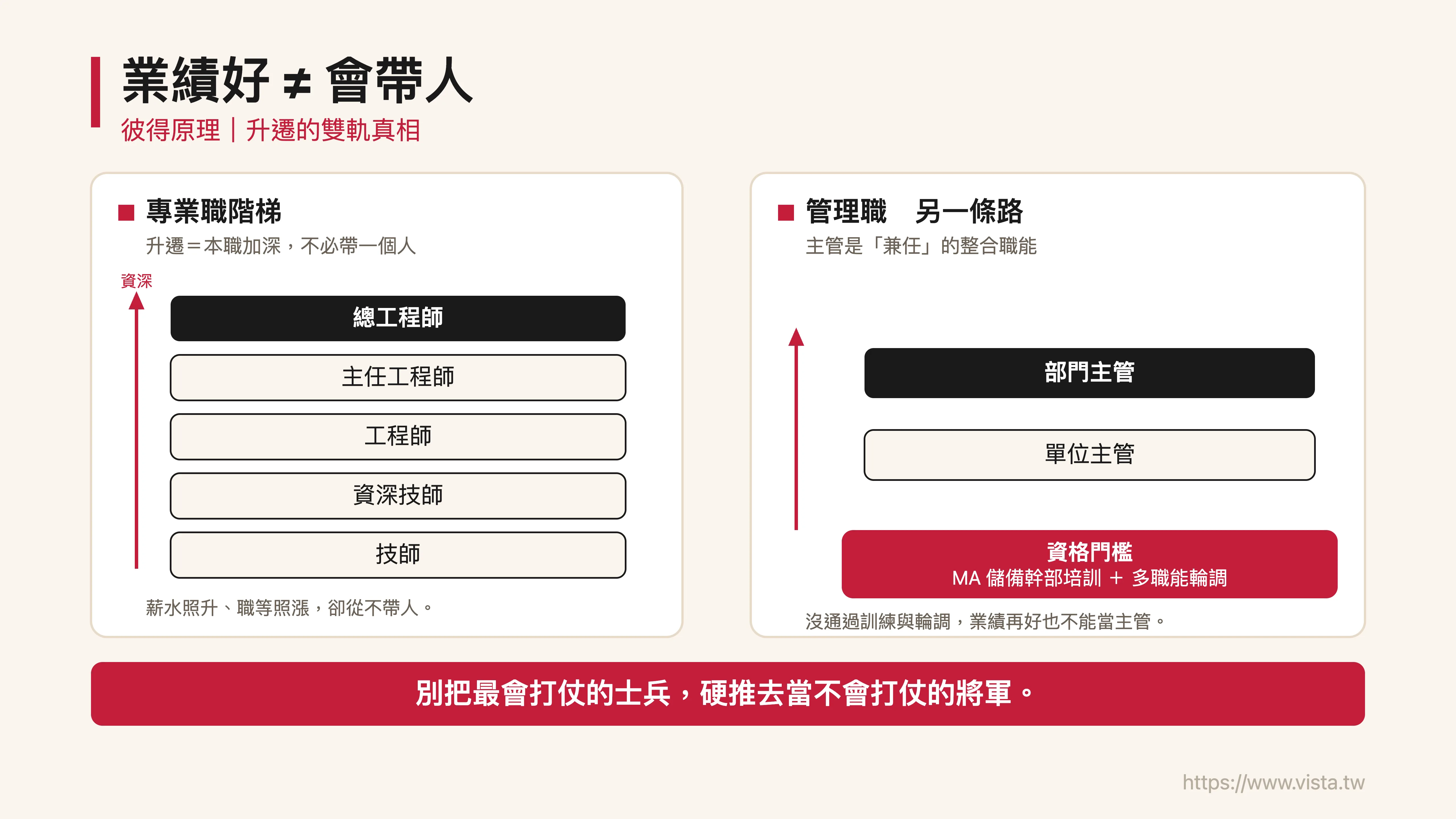 *▲ There is one ladder for professional jobs and another for management jobs - don’t push the soldiers who are best at fighting to become generals who don’t know how to fight. *
I was particularly touched by this passage. Because in our industry, the same misunderstanding happens every day: a creator who writes good content thinks that he should be able to run a community, lead a team, and start a company; a lecturer who teaches well is pushed to become a consultant or chief operating officer. However, producing good content and leading people well are two different abilities, just like what Mr. Chen said about business and supervisory work. I have seen too many people who are good at creating being pushed by their own talents into a position that makes them suffer every day. In the end, even the creations they are best at are wasted. Mr. Chen’s saying “over-professionalism will lead to poverty” is certainly sharp, but it also holds true in reverse - if a professional is mistakenly placed in an unsuitable management position, it will be a double waste.
System comes before goal - build the car first, then tell him where to drive it
The most counterintuitive thing in this episode, and the one that made me stop and think for a long time, was the sequence in which Teacher Chen talked about systems and goals.
Those of us trained in strategy are taught to “begin with the end in mind”: think clearly about the goal first, and then work backwards on the path. But Mr. Chen said that when he joins a company, the first thing he does is not to set goals, but to establish a good system - rules and regulations plus SOPs. He first spends two or three months completing the rules of the game, then does education and training, and finally talks about business goals. His reason is very simple and ruthless: the system first solves 60-70% of a company’s problems, and the remaining 30-40% is the turn of strategy and direction; the system has not been established well, no matter how beautiful the goals are, everyone will just go around in circles. He made an analogy that I like very much: You have to build the car first, teach him how to drive it, and then tell him where to drive it? If the order is reversed, no matter how good the destination is, you will not reach it.
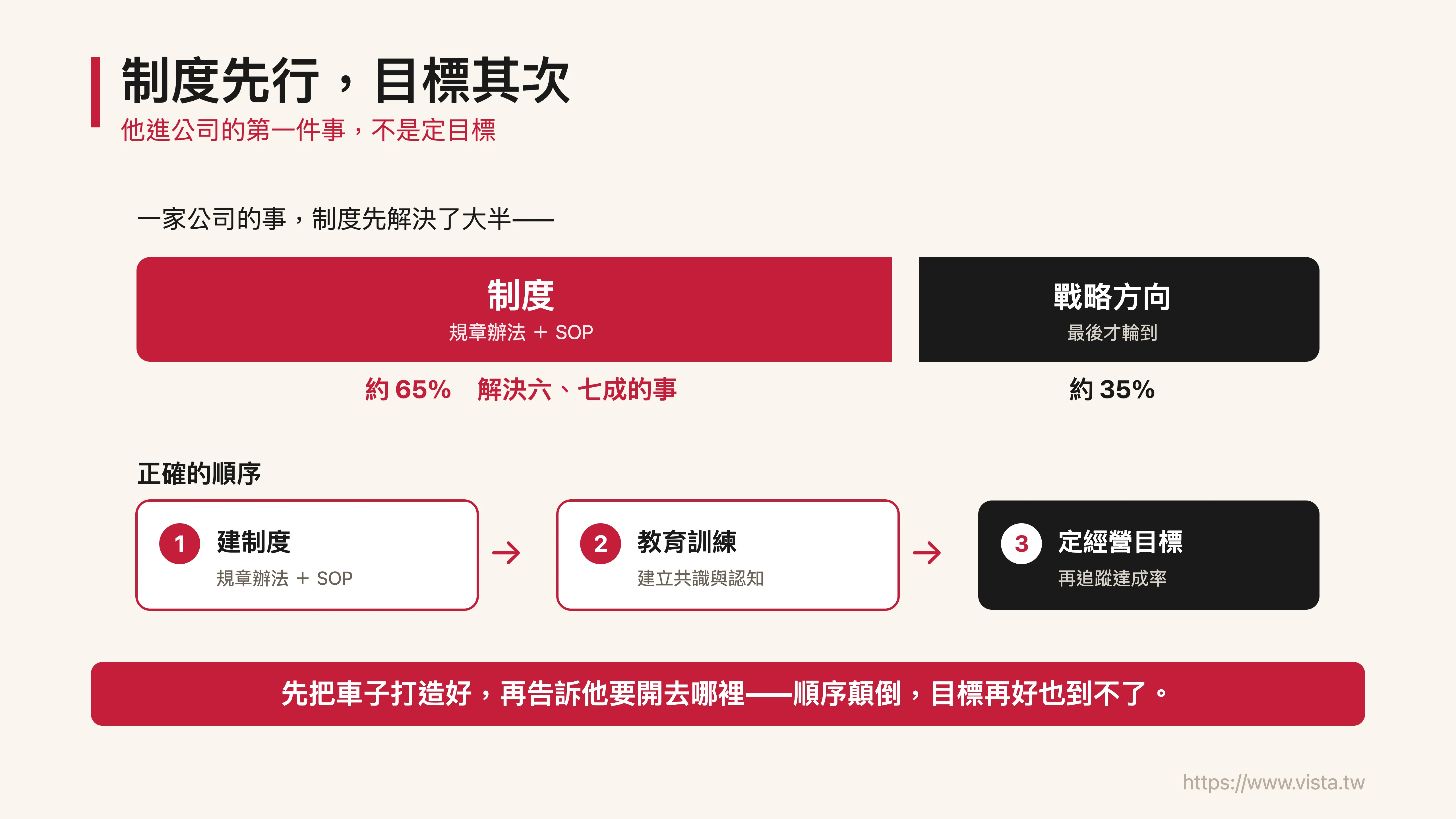 *▲ Build the system first, then educate and train, and finally set business goals - if the order is reversed, no matter how good the destination is, you will not reach it. *
I originally thought that the advanced logic of this system was a luxury product for large companies, and had nothing to do with workers in small teams like me, or even often in one-man companies. But after hearing about it, I came up with an idea: the more individual workers are, the more they need systems. Because we don’t have the human resources to help fill positions, and we don’t have supervisors to finish things off for us, every link that breaks down is our own responsibility. The reason why I can run several communities, write columns, teach courses, and promote doctoral research at the same time has never been based on willpower, but on the set of [processes and systems] I established for myself (https://www.vista.tw/blog/ai-content-production-system).
This also coincides with the “73% human-computer” law that I have been talking about: the 60% to 70% that can be regularized and taken over by the system should be generously handed over - to SOP, to tools, and to AI; the 30% that really requires human judgment, direction and temperature should be kept in your own hands. Teacher Chen said that the system can handle 60-70%, and I said that machines can handle 30%. What they are actually talking about is the same kind of wisdom - first distinguish what should be handed over, so that you can have spare energy to focus on things that really cannot be done by others.
Leadership guides people, management manages numbers - two things, don’t confuse them
Teacher Chen’s separation of leadership and management is so clean and almost cold: leadership is to lead people and care about people, while management is to manage things and numbers. Only what can be quantified can be managed; what cannot be quantified is not management. The daily report he designed was all numbers. You had to ask for instructions to fill in the text. It also stipulated that each sentence should not exceed 30 words and that a day should not exceed 100 words - forcing you to turn the abstract “I work hard” into concrete numbers.
But he doesn’t just have a cold side. He also taught supervisors to do good deeds every day: take the initiative to greet colleagues when entering the office every day, occasionally send small gifts, and buy afternoon tea. These extremely small actions are caring; while forms and numbers are stewardship. One is cold and the other is hot, one is right for things and the other is right for people. Without either side, the team will go astray.
I used this tool to review the way I run communities and design courses, and I found it to be of great use. In the past, I tended to be biased - focusing on relationships, warmth, and companionship. This is my nature, and it was also my original intention for the words “Writing Companion”. But Teacher Chen reminded me: without the relationship between numbers, sooner or later I will lose focus. The retention rate of the community, the completion rate of the course, and the renewal rate of the subscription, these cold indicators are not to replace the temperature, but to protect the temperature - let me know whether my company is really helping people?

🛰️ Want someone to accompany you to see clearly in the wave of AI changes?
Almost all the public articles you see are finished products after repeated polishing. But what I cherish the most is the warm judgment before the finished product - this is the reason why I created [Vista AI Inspiration Supply Station] (https://www.facebook.com/iamvista/subscribe/): a weekly thought note for fellow travelers in the AI era, sharing those Yoshimitsu Kataha that will not appear in formal articles with you who are willing to get closer.
A place worth pondering
I learned a lot when I heard the section about the responsibility center, and I couldn’t help but want to think more about it. Teacher Chen said that the profit center (Amoeba system is mostly unaccustomed to Taiwan, and what is suitable for Taiwanese companies is “profit center plus cost center” because few bosses are willing to delegate purchasing and sales rights as a whole package, leaving one department to be responsible for its own profits and losses.
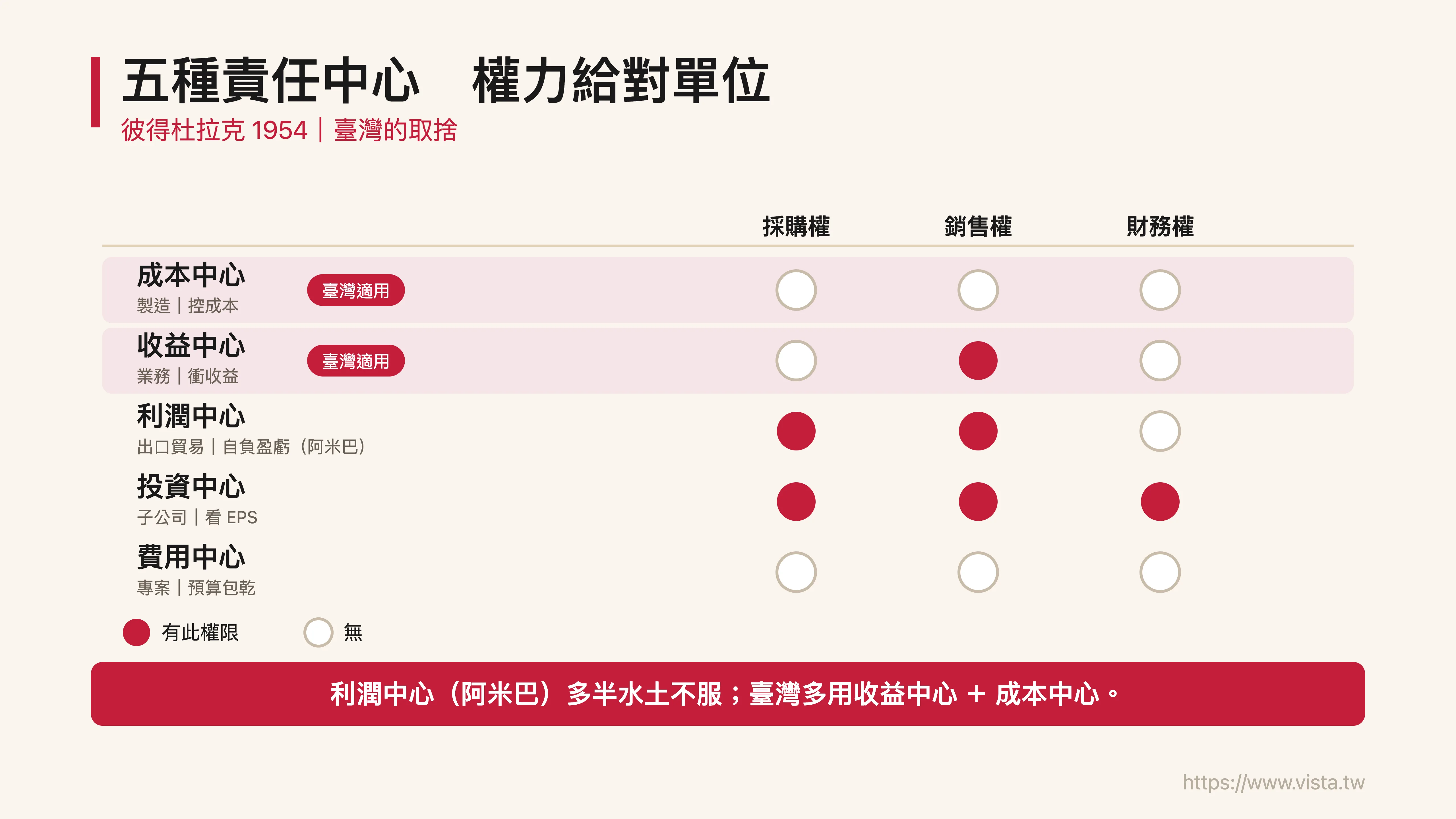 *▲Dulak The concept of responsibility center proposed in 1954 fell into Taiwan’s choice: multi-purpose revenue center plus cost center. *
I completely agree with this judgment when it comes to traditional companies. But I would like to add a new trend that I have seen: in the era of personal branding and self-media, every creator is actually being pushed to become his own profit center. We purchase by ourselves (topic selection, purchase knowledge), sell by ourselves (manage the audience), and handle profits and losses by ourselves. Teacher Chen said that Taiwan’s organizations cannot tolerate profit centers, but the platform economy has created thousands of one-person profit centers outside the organization. This is not to refute the teacher, but his framework allowed me to see one thing - when large organizations cannot provide a stage, individuals will set up their own. This is what I have been doing and teaching over the years.
Closing: Three things I want to bring back to work
After listening to this episode, I left three specific reminders for myself.
First, distinguish between doing well and being able to lead. Whether it is a role that I take over or a position that I recommend others to take on, I always ask: Does this require professionalism or integration? Don’t let anyone (including myself) be pushed into a painful position by talent.
Second, build the system first and then pursue the goals. I will re-examine my own content production and community management process, and try to condense the links that still rely on “memory” and “feeling” into replicable SOPs, and hand over what can be handed over to the system and AI.
Third, give the temperature a number. I will not let go of companionship and relationship, which is what I care about most, but I will install a dashboard for it so that my good intentions can be seen, measured, and continued.
An eighty-year-old gentleman who lectures six times a week and sleeps only four hours a day is very moving in his seriousness. To be honest, we don’t have to imitate him to sleep less, but his enthusiasm of “telling you things that you have thought about clearly throughout your life until you can figure it out” is indeed worth learning from everyone.
📖 深入探索相關主題