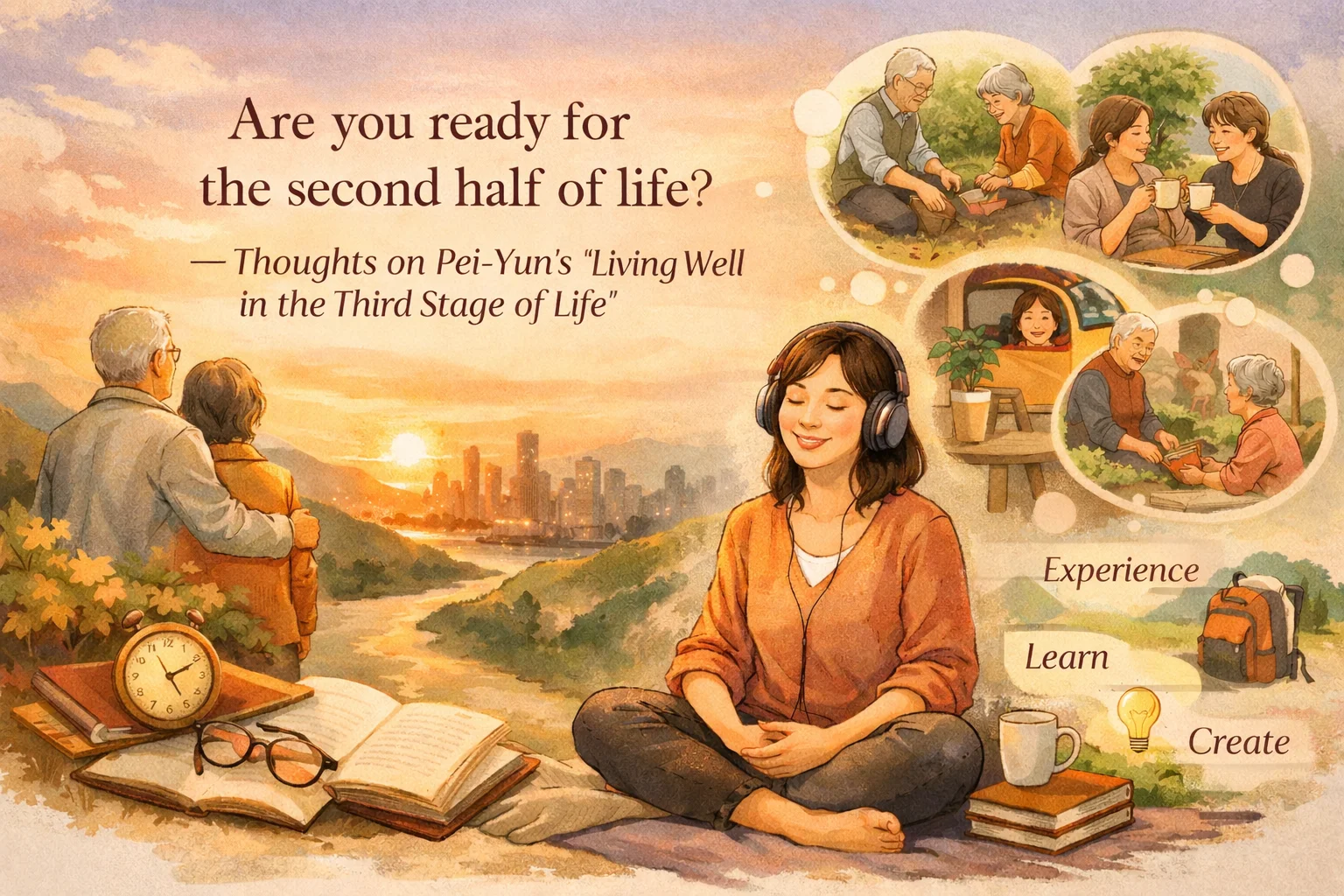
Are you ready for the second half of your life? ——Five profound insights from listening to Hong Peiyun's "Live Well in the Third Life"
Some lessons, after listening to the first episode, I want to pass them on to my friends.
There are some books that you can’t put down after turning the first page; there are some classes that you want to tell your friends immediately after listening to the first episode.
For me, Peiyun’s “Live the Third Life: Clinical Psychologist Hong Peiyun’s Maturity Preparation Course” is the latter.
Some things must be heard with the ears to truly enter the heart. Words are powerful, but sounds have a kind of warmth that words cannot give.
An old friend’s new work makes people unable to stop listening to it
I have known Peiyun for many years. When we were both still young, we talked a lot about the second half of life - of course, at that time it was more just words, and the real sense of urgency had not yet arrived. But in the past few years, watching the elders around me getting older, watching my own physical strength and energy no longer being an inexhaustible resource, watching friends of the same age starting to seriously plan for retirement, the feeling that “time has begun to speed up” is real.
So, when Peiyun told me that she was creating this audio course, I was really looking forward to it.
Peiyun is a clinical psychologist, but she has never been the kind of professional who lets you sit in the clinic chair and be analyzed coldly. She has a rare quality: she can express difficult psychology concepts in a language that you and I can understand, and she can say it in a way that makes you feel, “Yes, that’s how I am” and “So this can be seen this way.” Chatting with her, you won’t feel like you’re being taught, you’ll feel like you’re just two old friends opening up to each other in a coffee shop.
This course has such a temperament.
Why do I like audio lessons more and more?
Before talking about the course content, I want to talk about audio first.
As someone who has been producing content for a long time, I have observed the effects of various learning media. Video courses have their advantages: visual impact, graphic animations, demonstration operations… But I found that for those topics about “life”, “soul”, and “relationship”, audio has something that videos cannot give - that is intimacy.
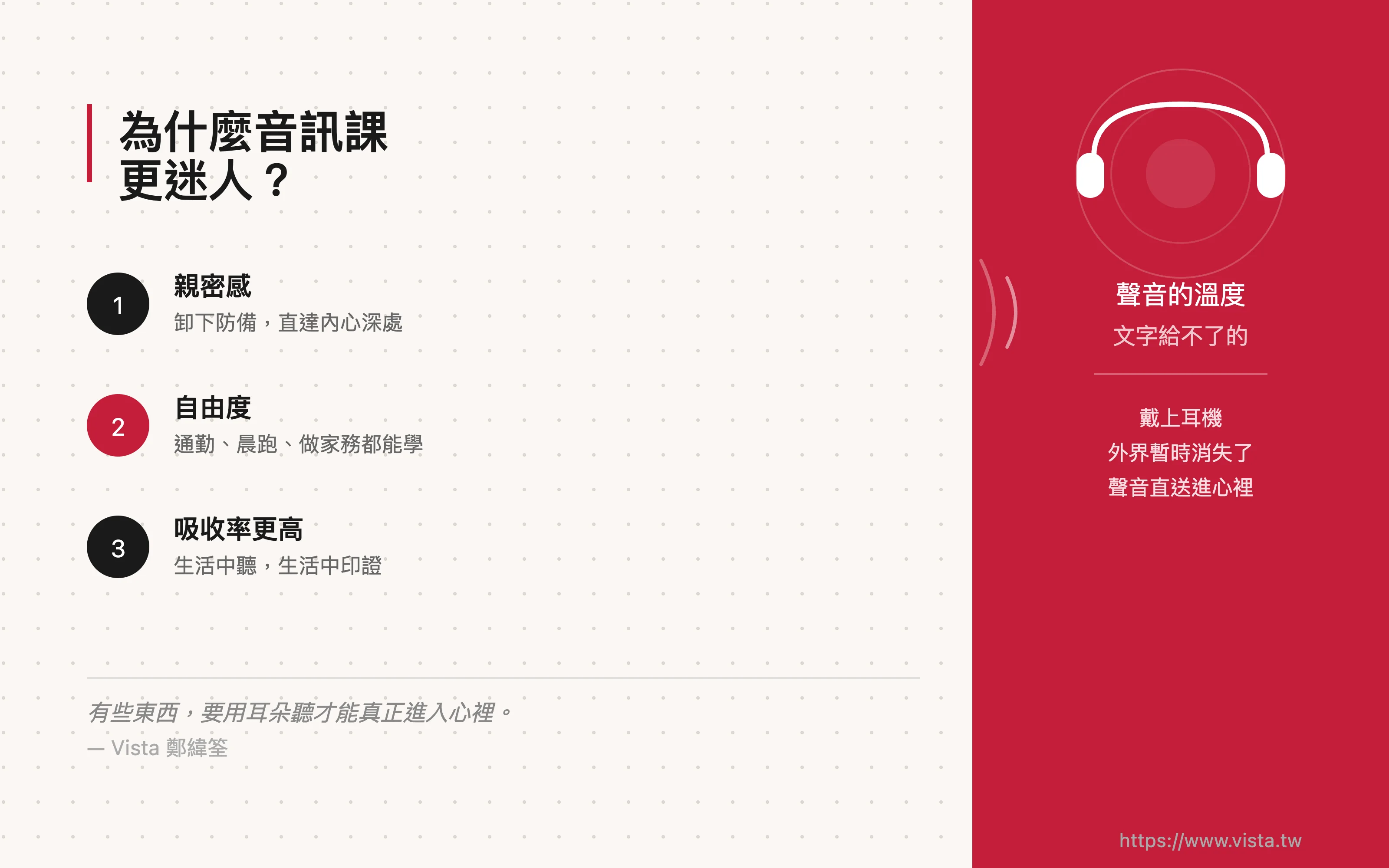 ▲ Sound has a kind of warmth that words cannot give
When you put on headphones, the outside world disappears temporarily. The voice that speaks is sent directly into your ears. There are no lights, no cameras, no carefully arranged backgrounds, just a person’s voice and the moment when you are walking, washing dishes, or lying down to sleep.
This kind of intimacy makes people take off their guard.
When I was listening to Peiyun’s class, I walked on the road several times and suddenly stopped, not because there was a car in front of me, but because something she said made me stunned. For example, when she talked about the three stages of observation, awareness and insight, I suddenly realized that I used to think that I was aware, but in fact, many times I only stopped at the level of observation - I knew that emotions appeared, but I did not go deeper to see clearly what made it appear.
Such a wake-up call, happening in quiet headphones, is more powerful than sitting in a classroom and listening to lectures.
Another thing I like about audio class: it’s freeing. You don’t have to sit upright, hold a laptop, or stare at a screen. You can listen to it on your commute, during your morning run, or while doing housework. Every episode of this course is a companion that you can pick up at any time and press pause at any time. For people like me who have a busy schedule, this kind of learning method that exploits every opportunity makes the absorption rate higher, because you are listening in the flow of life, and after listening you can immediately compare and confirm it in life.
Taking good care of your own heart is the starting point of everything
At the beginning of the course, Peiyun’s first priority is not what plans you want to make, but what you need to take care of your heart first.
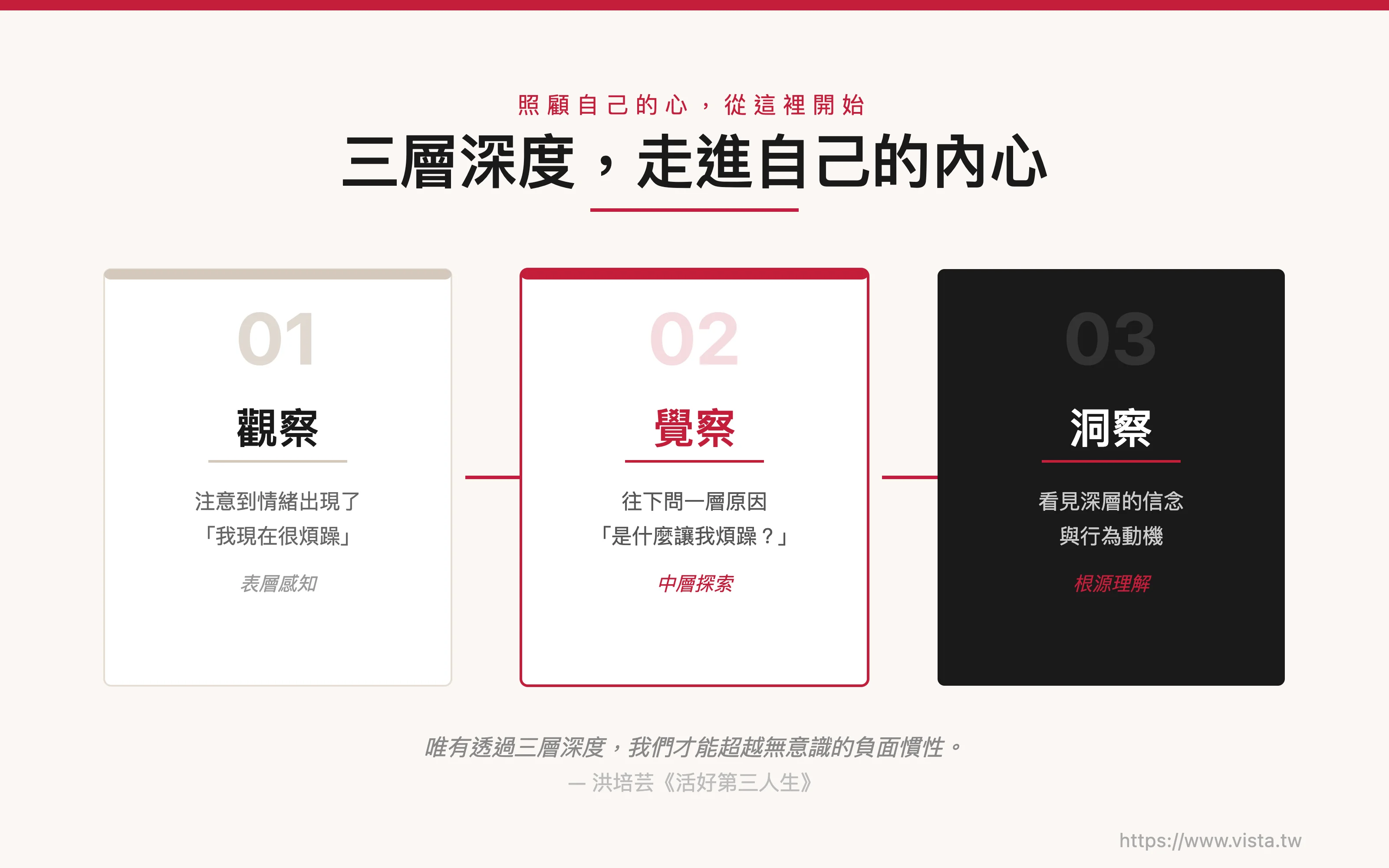 ▲ Taking good care of your own heart is the starting point of everything
This entry point impressed me deeply. Many life planning courses start with financial spreadsheets, pension planning, and health management checklists—of course these are all important, but it makes sense for Peiyun to choose to start with the “heart.”
She gave a very everyday example: You have been busy all day and bought delicious snacks to share with you at home. As a result, your family ate slowly and dispersed without saying anything. You are suddenly very angry and look ugly. After taking a shower, you still feel annoyed.
I believe many people have experienced this scene. Not just family members, it can happen to colleagues, friends or partners. Peiyun asked: Is it really the slowness of their movements that you care about?
No. What you care about is that your thoughts are not seen and your efforts are not appreciated.
But the problem is that we usually don’t have the time or the habit to see this layer clearly. We only see superficial behavior—they’re slow to act, they don’t say thank you—and then the emotions explode.
The three steps of observation → awareness → insight proposed by Peiyun are the first very specific tools I got in this course.
- Observation is when you notice the fact that “I am very irritable now”
- Awareness is when you go down a level and ask “What makes me irritated?”
- Insight is the deepest level - behind my irritability, I am actually worried that my efforts will not be valued, because I have been accustomed to using efforts to prove my worth since I was a child.
This third level is where the real homework lies. But many people always only stop at the first level, or even the first level - when emotions come, they act directly, and then wait for the emotions to subside, then continue with the original life, waiting for the next explosion.
Peiyun said that to break this cycle, you need to set aside thirty minutes for yourself every day.
Thirty minutes is a gift to yourself
She quoted what Teacher Jiang Xun said, “Eighteen minutes for yourself every day.” Then she said with a smile that Teacher Jiang Xun is a person with a high level of cultivation. For her, eighteen minutes may not be enough, so she ordered thirty minutes for herself.
Well, this passage resonated with me and was interesting.
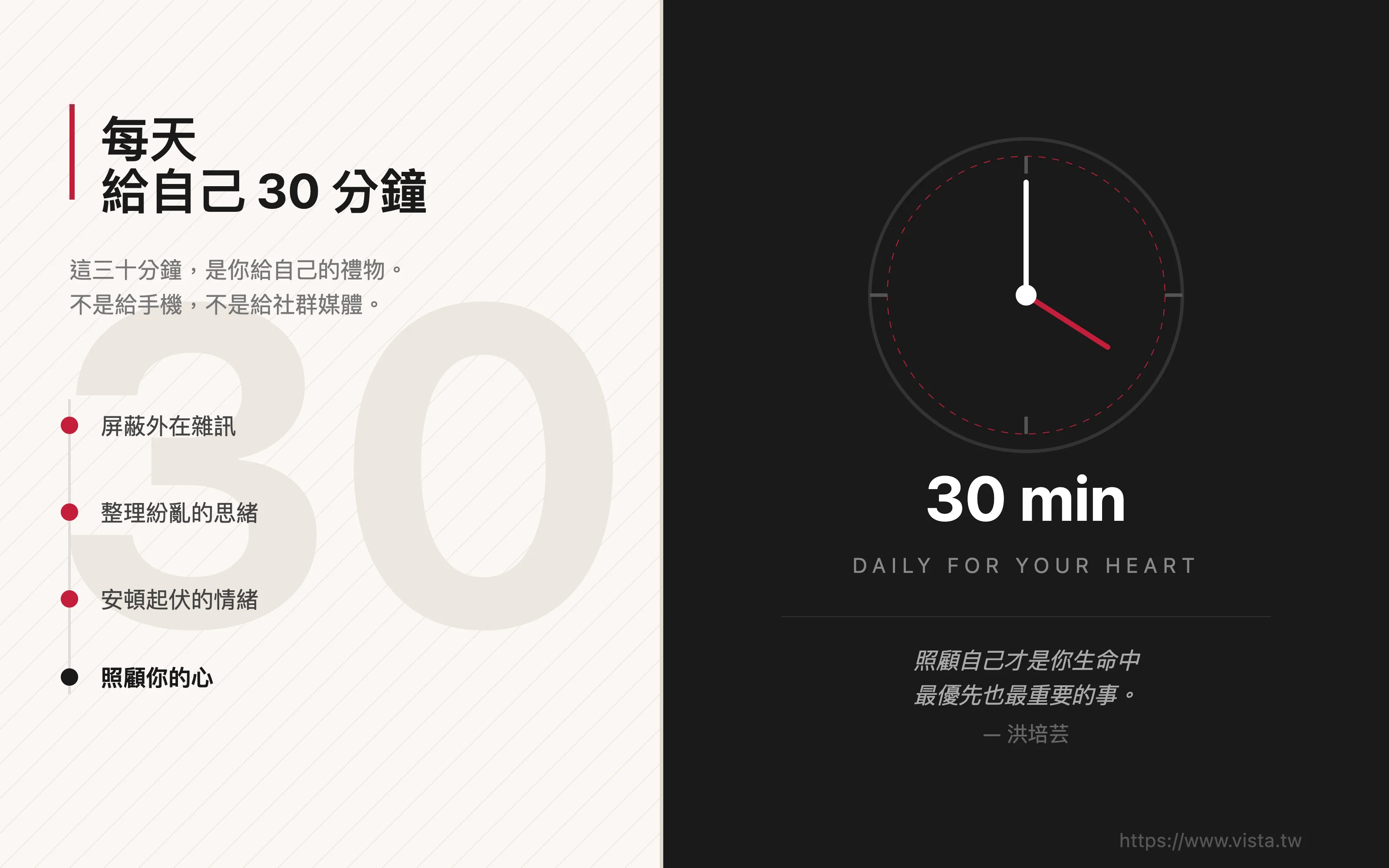 ▲ Thirty minutes a day is the best gift you can give yourself
We often hear some experts say, “Five minutes of meditation a day is enough,” or “Just doing this one small thing every day can change your life.” Then we give up after trying for three days. The reason is not that we are lazy, but that our starting point is different from that of the experts. Experts have been practicing for 20 or 30 years. Their five minutes can go deep into places that we cannot reach in two hours.
Peiyun said that we must learn these wisdoms, but we must also know how to adjust. For ordinary people, thirty minutes is a more practical time and a time that allows the soul to truly settle.
She also said that these thirty minutes are not for you to sit there and meditate (of course you can), but for doing anything that can nourish your soul: reading good books, talking to yourself, practicing gratitude, and meditating. The important thing is that these thirty minutes are for yourself, not for your mobile phone, not for social media, and not for news that makes you feel anxious.
Four ways to take care of your soul
She mentioned four methods in particular that she found helpful:
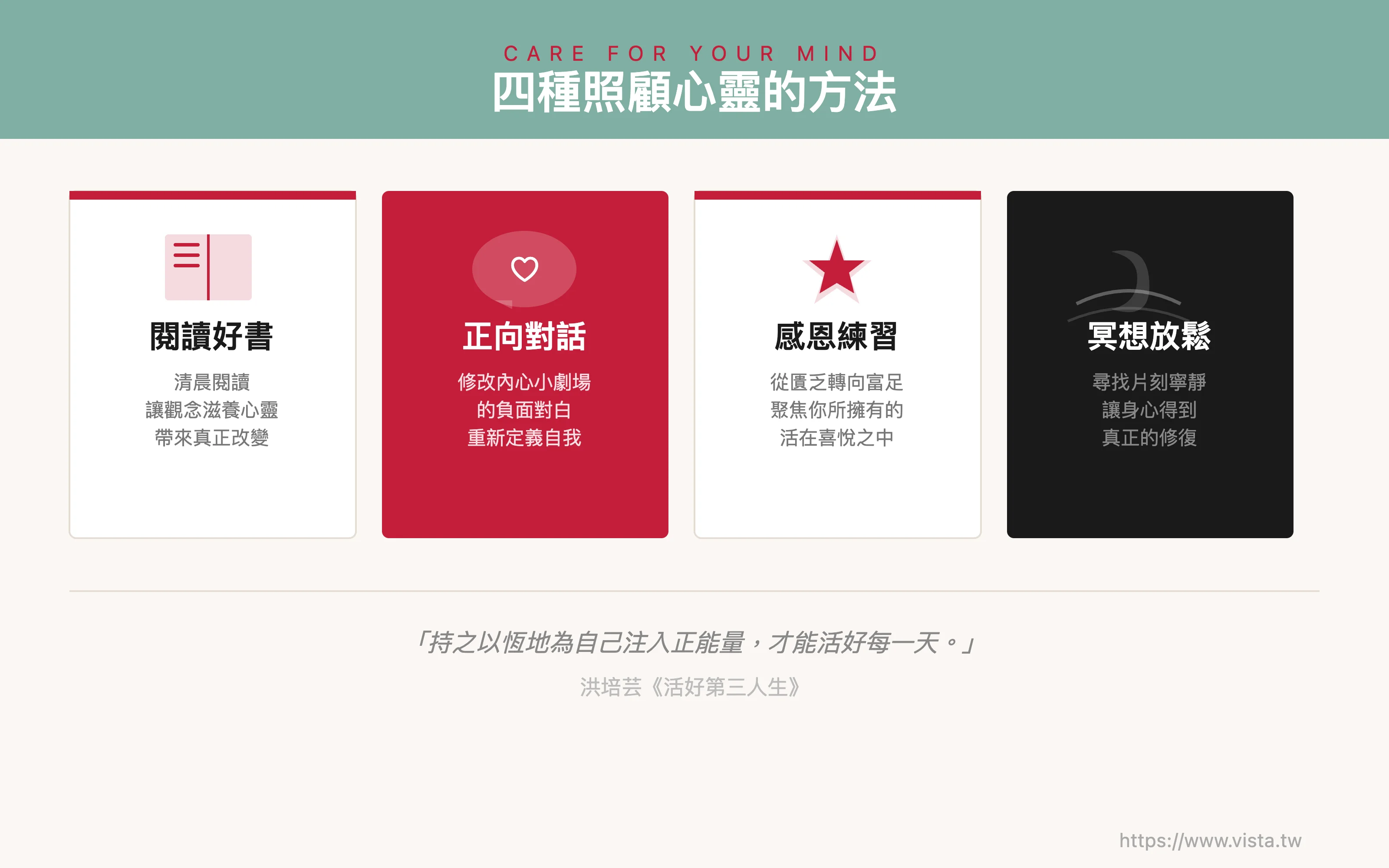 ▲ Peiyun shared four ways to take care of the soul
The first is to read good books. Peiyun said that she gets up at four o’clock every morning, and the first thing she does after getting up is to read. Early morning is the quietest time. That kind of silence allows you to truly absorb the concepts in the book instead of just reading them. What can really change you in a good book is often the one or two concepts that subvert your old thinking. As long as this concept enters your heart, it will begin to quietly change the way you see the world.
The second is positive self-talk. The little theater in our minds is often attacking itself. “I just can’t do it”, “My conditions are so bad”, “I really failed”. Peiyun said that you can practice replacing these voices - not pretending that the problem does not exist, but changing a more constructive perspective: “I just haven’t succeeded yet”, “This thing is difficult, but I can start to learn”, “My existence itself is value.”
Third is a gratitude practice. She said that most people’s pain comes from not seeing what they have, but only seeing what others have and what they don’t have. Gratitude practice allows you to draw your attention back to the things you have: feet that can walk, eyes that can see the scenery, and an appetite that allows you to eat delicious food… These may sound ordinary, but when you really appreciate them seriously, you will find that you actually have a lot.
Fourth is meditation and relaxation. Find a way to calm yourself down. It doesn’t have to be sitting cross-legged and meditating. It can be walking, listening to music, or taking a bath. As long as it can temporarily withdraw you from external stimulation and return your mind to a relatively calm state, it is enough.
Most people’s pain comes from not seeing what they have, but only seeing what others have and what they don’t have.
The essence of life: experience, learn, create
In the second half of the course, Peiyun talked about what I think is the most core concept in this course, which is her interpretation of the essence of life - experience, learning and creation.
I have studied AI and knowledge creation for many years, and I also teach at universities. I often think about questions such as “Why do people learn?” and “What is the nature of knowledge?” Peiyun’s three-stage framework allowed me to look at this matter from another perspective.
She said that no matter what happens to us in this world - good, bad, big or small - the first step is to experience it. You can’t not experience it, you can’t skip it. When your clothes are splashed with dirty water, you experience embarrassment and annoyance; when you take care of your elderly parents, you experience fatigue, distress, and complicated family entanglements.
Then comeslearning. The learning mentioned here is not to learn a technology or take a certificate, but to see things you have not seen before from the events you experience. When your clothes are stained, you can learn that “when encountering an emergency, it is more useful to solve the problem first rather than blaming someone first.” In the process of taking care of your parents, you may learn that “it turns out that my father actually loved me back then, but he just couldn’t express it.” Then the knot in your heart that has been in your heart for decades will be quietly loosened in an ordinary afternoon.
Finally, there isCreation. Peiyun said that this is a stage that many people have never thought about. She gave an example of an older sister she met in a taxi: she did beauty and manicure work before she was 50, then changed careers, learned to drive from scratch, and finally became a taxi driver. Well, that’s what creation is - creating a self that didn’t exist before, creating a service that didn’t exist before.
Creation means “making something that has not existed before”. There is no difference in size, as long as it is given out sincerely, it counts.
Creation doesn’t have to be great, she said. You can share the good concepts you learned from the course with your friends; you can sort out your life story so that future generations will avoid detours; you can go to oil painting classes and still paint works that make young people feel inferior when you are 70 or 80 years old. When I heard this, I thought of what I have been doing over the years - writing, teaching, producing course content and running communities - in fact, this is exactly what Peiyun said he created. I organize the things I have learned, the detours I have taken, or the pitfalls I have stepped into, into a form that others can use, so that they do not have to walk the same path again. To me, the thing itself is meaningful, no matter how many people see it.
Want to use new skills to create your own digital works? No programming knowledge required, just your ideas. In Vibe Coding Practical Workshop, you will learn to use natural language to collaborate with AI to create a work of your own. Just like what Pei Yun said about “creation” - making something that didn’t exist before, you can start from now on.
 ▲Vibe Coding practical workshop, use natural language and AI to collaborate to create your own digital works
Before entering the second half of life, first enter your own heart
In the course, Peiyun quoted Ram Dass Dass said: “Most of the pain of old age comes from thinking about the past.”
 ▲ It’s easy for us to get stuck between the past and the future, forgetting to live in the present
I thought about this sentence over and over for a long time.
It’s easy for us to get stuck in two times: one is the past (regrets, regrets, things we didn’t do), and the other is the future (worries, anxieties, bad things that haven’t happened yet). The only thing that can truly make us dwell is the present moment. But many people say the words “live in the moment”, but few practice it, because our hearts have never been properly trained.
Peiyun’s course is all about training this.
It not only tells you what you should pay attention to in the second half of your life (work, family, financial management, health…), but more importantly, it tells you what kind of heart you should face these with.
A calm heart, a heart that knows how to be grateful, a heart that can learn from setbacks, and a heart that is still willing to create at any age.
With such a heart, the second half of life is not a question of whether it is too late or not, but a question of whether you are willing to start.
Written at the end: For those of you who are still hesitating
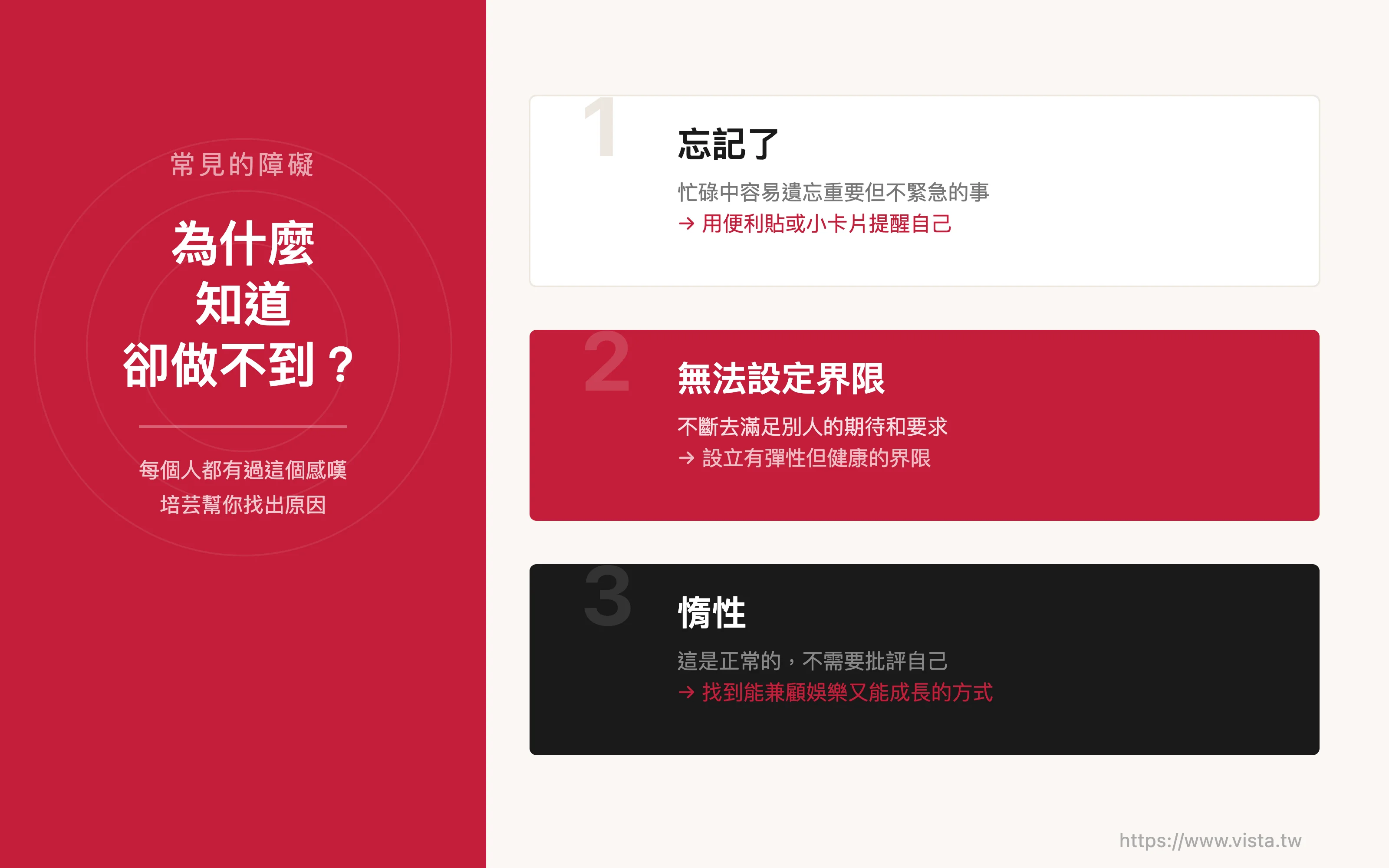
I know that when many people face this kind of course, the first voice in their mind is: “I know all these principles.”
Yes, maybe you do. But there is a long road between knowing and doing. Peiyun herself admitted this with a smile during the course: “I understand all these principles, but I just can’t do it.” This is a sigh that almost everyone has had.
The value of this course is not just to tell you the truths that you “should already know”, but to accompany you on the road of “from knowing to doing it”. Peiyun uses her clinical experience, her own life story, and a tone that makes you feel “she really understands me” to take you step by step into your own heart.
And, it’s with voice.
When Peiyun’s voice directly enters your ears, and when she talks about those vulnerable moments that we all have experienced, you will find that you are not alone.
This is the most fascinating part of audio lessons.
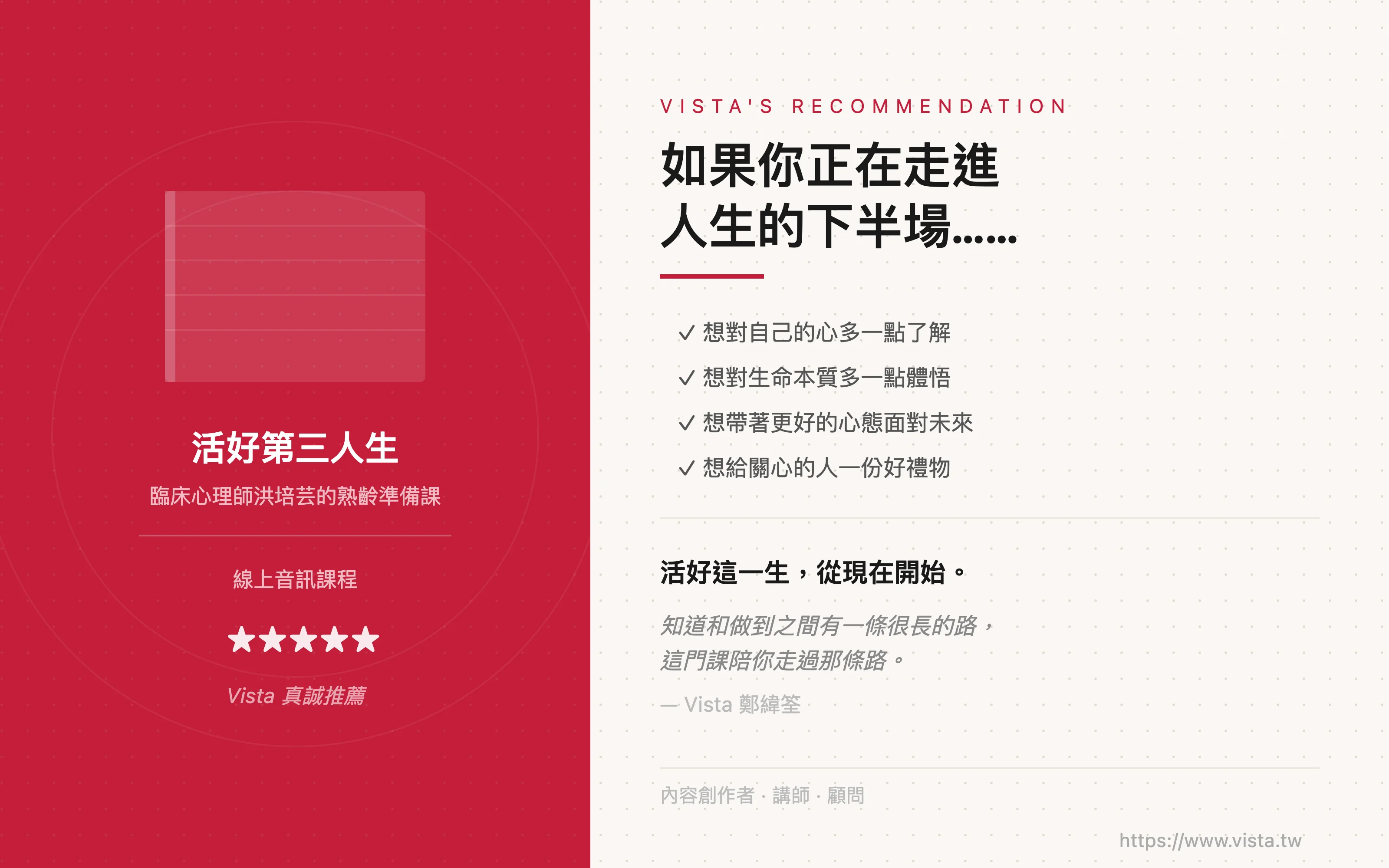 ▲ Live this life well from now on
If you are entering the second half of your life, or you haven’t gotten there yet but you already feel that the road is approaching; if you want to know more about your heart and appreciate the nature of life; if you have a good friend who is trapped by these problems, you want to give him a meaningful gift——
So, recommending this course to your friends and yourself is a good start.
Live this life well, starting now.
Further reading
- Action Guide to Learning and Application in the AI Era
- AI collaboration for knowledge workers
- Content power advanced writing course
External resources
- Live the Third Life well: Clinical Psychologist Hong Peiyun’s Maturity Preparation Course
- Ram Dass - Wikipedia