Re-read "Sun Yun-suan Biography": The man who used the spirit of an engineer to lift Taiwan up
There is a book on my bookshelf. The back of the book has turned yellow and the edges of the pages are even a little brittle. It is “Sun Yun-suan Biography” published by World Magazine in 1989.
I clearly remember that year, when this book first came on the shelves, I immediately ran to buy a copy and take it home. I was still very young at the time, but I was already deeply impressed by the contributions that Mr. Sun Yun-suan, the former Executive President, made to Taiwan. Later, while studying, working, and creating content, I would pull this book out of the bookshelf and read it from time to time.
After many years, I read this book carefully again because the new edition was recently released. When I read it more than thirty years ago, I looked up to a legendary figure who rose from an engineer to an executive president; when I read it again more than thirty years later, I saw something else - the most simple and least fancy engineering spirit in him, which is something that is increasingly scarce in this era.
How can an engineer lift an island?
Friends who are not familiar with this period of history may be a little unfamiliar with the name Sun Yun-suan, so let me give a brief background introduction first.
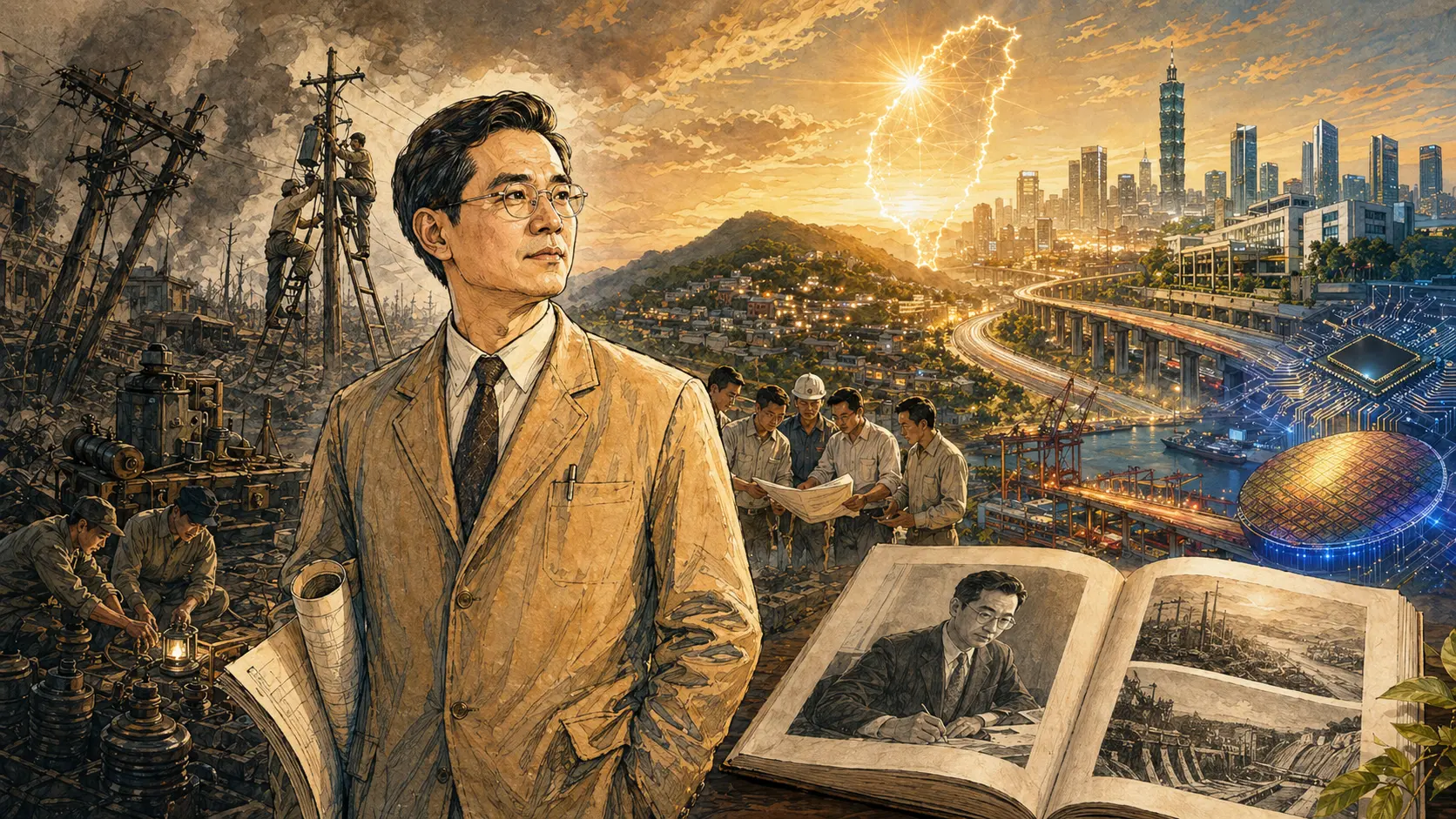
Sun Yun-suan is from Shandong. He graduated from the Department of Electrical Engineering of Harbin Institute of Technology in 1934 and came to Taiwan after the war to receive Taiwan Power Company. At that time, Taiwan’s power system was nearly paralyzed due to the war. He led a group of young engineers to restore more than 80% of Taiwan’s power within six months.
This is just the prologue. Later, he served successively as Minister of Transportation, Minister of Economy, and finally President of the Executive Council. Each of the undertakings he led changed Taiwan’s destiny in the next half century:
- Promote the [Ten Major Constructions] (https://zh.wikipedia.org/zh-tw/%E5%8D%81%E5%A4%A7%E5%BB%BA%E8%A8%AD) to bring Taiwan’s infrastructure to the level of industrialized countries.
- ITRI (ITRI) was established in 1973 to concentrate Taiwan’s technological research and development energy.
- In 1980, Hsinchu Science Park was born, laying the foundation of Taiwan’s semiconductor industry.
- The introduction of integrated circuit technology from RCA in the United States allowed the seeds of TSMC and UMC, which later became world-class companies, to sprout.
Today, we are proud of Taiwan’s “Sacred Mountain that Protects the Nation,” but let’s not forget the original foundation. It was because when he was the Minister of Economic Affairs, he fought against all odds to introduce technology from the American RCA and established Industrial Technology Research Institute (ITRI), which promoted Taiwan’s technology industry from labor-intensive to technology-intensive development.
What exactly is the engineer spirit?
After reading this book, you will find that Sun Yun-suan has not changed from beginning to end. From a small engineer at a power company to the executive president of a country, he is still the same person at heart.
What does that person look like?
He ispragmatic. There is a short story recorded in the book: When he first joined the electric power company, he was the first to arrive and the last to leave every day. He went to the construction site by himself, read the drawings by himself, and ate with the workers by himself. He didn’t put it on display for others to see. He really felt that the best way to figure out the problem was to get involved personally.
He ishonest. In that era of complex official and business dealings, he adhered to a rule: he could not take a dime from the projects he handled. The book writes that when he was the Executive Dean, his family’s house was rented, and he did not even own any real estate after his retirement. This kind of thing sounds like a myth today, but he did it his whole life.
Heis focused. He doesn’t care about political calculations or rhetoric. He only cares about one thing: whether the problem has been solved. When building a power plant, we must build the power plant. When we introduce semiconductor technology, we must introduce technology. When we do the ten major projects, we must complete the construction. His philosophy of life can be condensed into a sentence that engineers would say: It just works.
These qualities appear repeatedly in the book. What impressed me most when I re-read it was that these things that should have been the duties of a leader have become luxuries today.
Re-reading it thirty years later, I saw three things that I had not seen before.
To be honest, when I watched “Sun Yun-suan” in 1989, what I saw was a legend - a young man from another province came to Taiwan, started from scratch, and finally became the Executive President.
Looking back more than thirty years later, I have done content creation and taught many students. When I read the same book again, I saw three things that I didn’t understand before.
The first thing: He knows how to “do things right first, and then make things bigger”
Sun Yun-suanThe years he spent at the electric power company were actually the foundation period of his career.
From an outsider’s perspective, they might wonder why he started to shine after he took the position of Executive President. But if you read the biography carefully, you will find that before the age of 30, he had already mastered how to bring a system back to life from a collapsed state. All the seemingly powerful decisions that follow are based on that period of hard work.
This is actually very useful for today’s creators, entrepreneurs, and workers in the AI era. The most common problem I see when doing Personal Branding consulting is that some people want to skip the stage of doing things right and rush to make things bigger. But Sun Yun-suan has spent his whole life proving that if the foundation is not laid properly, the higher the building, the more dangerous it will be.
The second thing: He is willing to do “things without seeing the harvest”
The establishment of ITRI, Hsinchu Science Park and the introduction of semiconductor technology were all questioned back then.
“What kind of semiconductors does Taiwan do? We can’t even make televisions.” This was the view of many people at the time.
But Sun Yun-suan was unmoved. He believes in the judgment of engineers: he is right about technological trends, but if he doesn’t act now, he will regret it thirty years later. The result? Thirty years later, TSMC’s market value exceeds everyone’s imagination.
There is a passage in the book that I read over and over several times: He personally made overseas phone calls to persuade overseas Chinese scientific and technological talents to return to Taiwan. At that time, many people thought Hsinchu was remote and the salary was not high, so he persuaded them one by one. That patience is the same as the patience of an engineer to debug a machine until it operates normally.
I reread this paragraph and thought about what I have been doing recently: writing long articles, publishing e-newsletters, teaching Vibe Coding and being a one-person company coach. At first glance, these are things with no immediate payoff. But Sun Yun-suan reminded me: most things worth doing are like this.
The third thing: Engineer spirit is the most scarce thing in the AI era
I admit, this was the biggest shock I had when I re-read this book.
We are now in an era where AI accelerates everything. AI can produce all standardized outputs such as writing articles, programming, presentations, and designs in a matter of seconds. Sounds wonderful, right?
But if you look carefully, what is most scarce today is the ability to figure things out without relying on AI. It is pragmatism, focus, willingness to get your hands dirty, and dismantling a complex system to its roots and then reassembling it piece by piece.
These are all the spirit of engineers.
To put it another way, AI makes execution cheaper, so judgment becomes more expensive. People who can judge are not those who can only use AI, but those who have engineer thinking in their bones - they know what a system looks like, where it will easily fail, and how to fix it?
Sun Yun-suanIn that generation, there was no AI, no Google, and no ChatGPT. They rely on breaking down problems, allocating resources, organizing people, and finally getting things done.
This set of capabilities is not outdated at all today. On the contrary, it is even more valuable because so many people want to use AI to take shortcuts.
Lessons from an engineer
While I was re-reading “Sun Yun-suan Biography”, I happened to have the opportunity to pass by Hsinchu Science Park. I stopped there specifically and looked at those high-rise buildings and factories, feeling a very complicated feeling in my heart.
Behind every seemingly natural building on this land, there is a decision made by someone who took risks. Many of these decisions were made by people like Sun Yun-suan. They did not wait until all conditions were mature before taking action; they used actions to achieve the conditions.
If I had to learn anything from this book, it would be:
The engineering spirit is not a professional attribute, but a way of looking at the world. It believes that problems can be dismantled, that complexity can be organized, and that as long as you are willing to keep doing it, there is no system that cannot be repaired.
To me, reading this book in 1989, it was a biography.
But reading it today in 2026, it is undoubtedly a solid reminder for everyone who is groping for the direction in the AI wave.
Who is suitable to read this book?
- People who want to understand why Taiwan’s post-war economic miracle happened.
- In the AI era, people who want to get back to the rhythm of solid reading and doing.
- Engineers, researchers, and educators who are developing technology, building products, and engaging in infrastructure construction and feel that their work is not easily visible to the outside world.
- People who want to see what it means to be a true leader - especially now, we need this model more than ever.
If you are like me and still have the old 1989 edition on your bookshelf, then having the opportunity to re-read the new edition of “Sun Yun-suan Biography” will be a very special comparison. If this is your first time coming into contact with this book, congratulations even more - because you are very lucky to be getting to know an engineer who still has a shadow on every semiconductor chip, every highway and every science park in Taiwan.
In the age of AI, I am happy to recommend everyone to read “[Sun Yun-suan Biography] (https://www.books.com.tw/exep/assp.php/vista/products/0011050626?utm_source=vista&utm_medium=ap-books&utm_content=recommend&utm_campaign=ap-202604)” (written by Aili Yang, published by Tianxia Magazine).
Further reading:
- After reading “Di Bono’s Horizontal Thinking Dialogue Method”, I re-understood what it means to be able to chat
- AI Reading Revolution: In the era of information explosion, how to read effectively
- Create a reading ritual for yourself
External resources:
- Wikipedia:Sun Yun-suan
- Industrial Technology Research Institute (ITRI)(ITRI)
- Hsinchu Science ParkAgency
- Published by Tianxia Magazine
📖 深入探索相關主題