Don’t wait until you are ready to start - re-understand the essence of growth from the roundtable conversation between Fan Deng, Ding Lingjuan, Zhang Xiuxiu and Hao Xulie
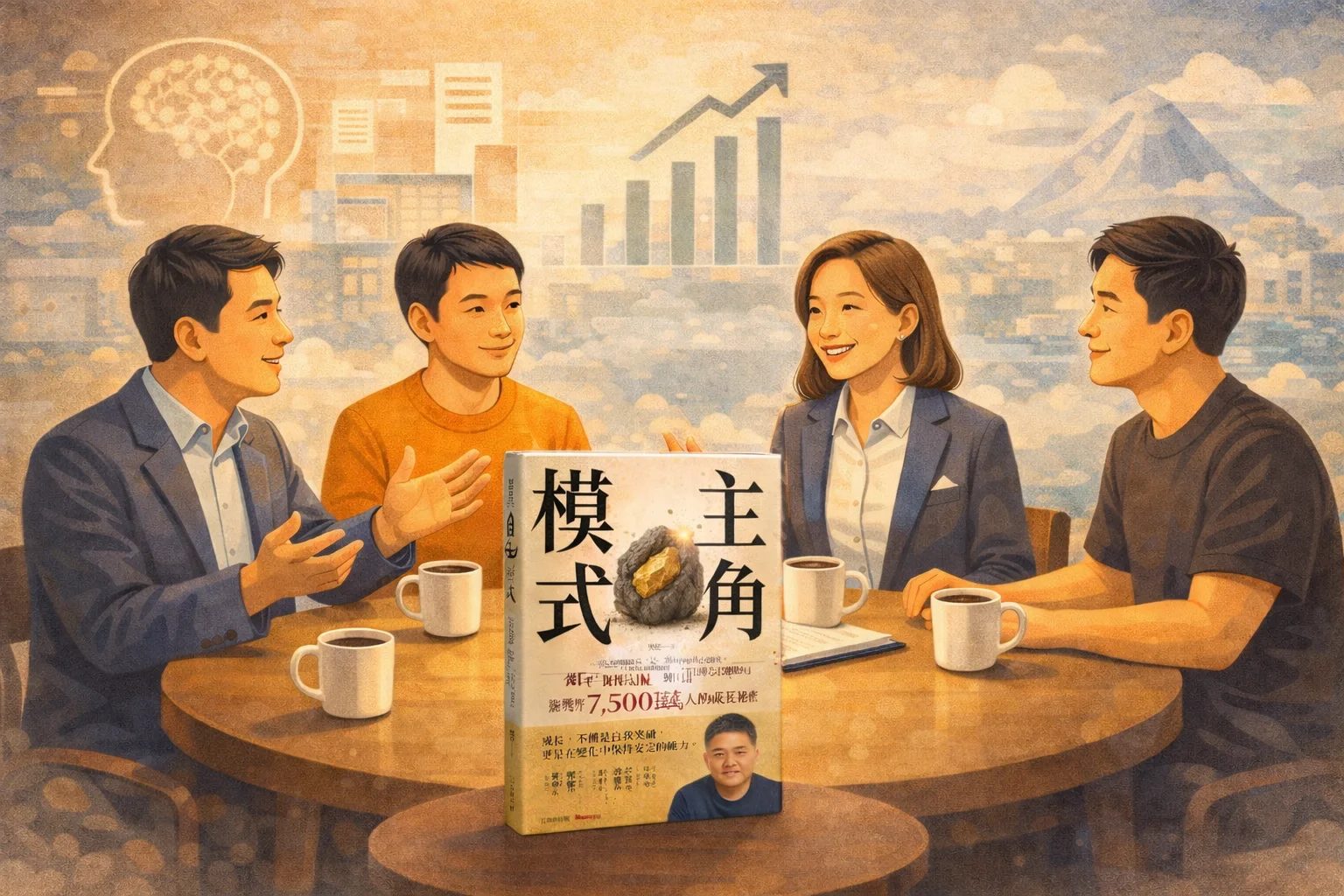
During the Chinese New Year, I watched a show hosted by Hao Xulie (Brother Hao), Fan Deng, Ding Lingjuan and Zhang Xiuxiu participated in a roundtable discussion. This conversation revolves around Teacher Fan Deng’s “Protagonist Mode” is about growth, but it goes far beyond the superficial meaning of these two words.
As someone who has been shuttling between content creation, corporate training and university teaching for a long time, I can honestly say that I am no stranger to the theme of “growth”. However, this conversation gave me some new touches. It’s not because they said any earth-shattering new ideas, but because the four speakers started from their own completely different life experiences, but invariably pointed to several common cores - and those cores are precisely the propositions that I have thought about repeatedly in teaching and writing in the past few years.
Below, I would like to use my own perspective to sort out some of the points that touched me most in this conversation, and also incorporate them into my personal thinking and extension.
Is growth painful or happy?
At the beginning, teacher Ding Lingjuan said something very real: the process of growing up must not be a comfortable thing. Going out of your comfort zone, facing pressure, doing things you are not good at - these are all against human nature. Therefore, many people prefer to lie flat because it is more comfortable.
But here comes the interesting thing. Teacher Fan Deng immediately put forward an interesting counterargument. He said that there is one person in mainland China who is particularly interesting: “I hear you all day long saying that I need to get out of my comfort zone. Who can tell me how to get in?” He believes that if you truly understand learning, you will know that learning and growing are joyful in themselves. When you can solve a question, it has nothing to do with your test scores, and you will be very happy - that is called understanding and understanding.
Don’t equate discomfort with something wrong. When you feel uncomfortable, you are probably on the threshold of growth.
These two seemingly contradictory views are actually not contradictory. My own understanding is this: the process of growth is indeed accompanied by discomfort, but the experience of growth itself is pleasant. As Teacher Ding and Zhang Xiuxiu later added, after passing that level, you will feel extremely excited and happy, just like the refreshing feeling of exercising muscles in the gym - the soreness is real, but the sense of accomplishment after the breakthrough is also real.
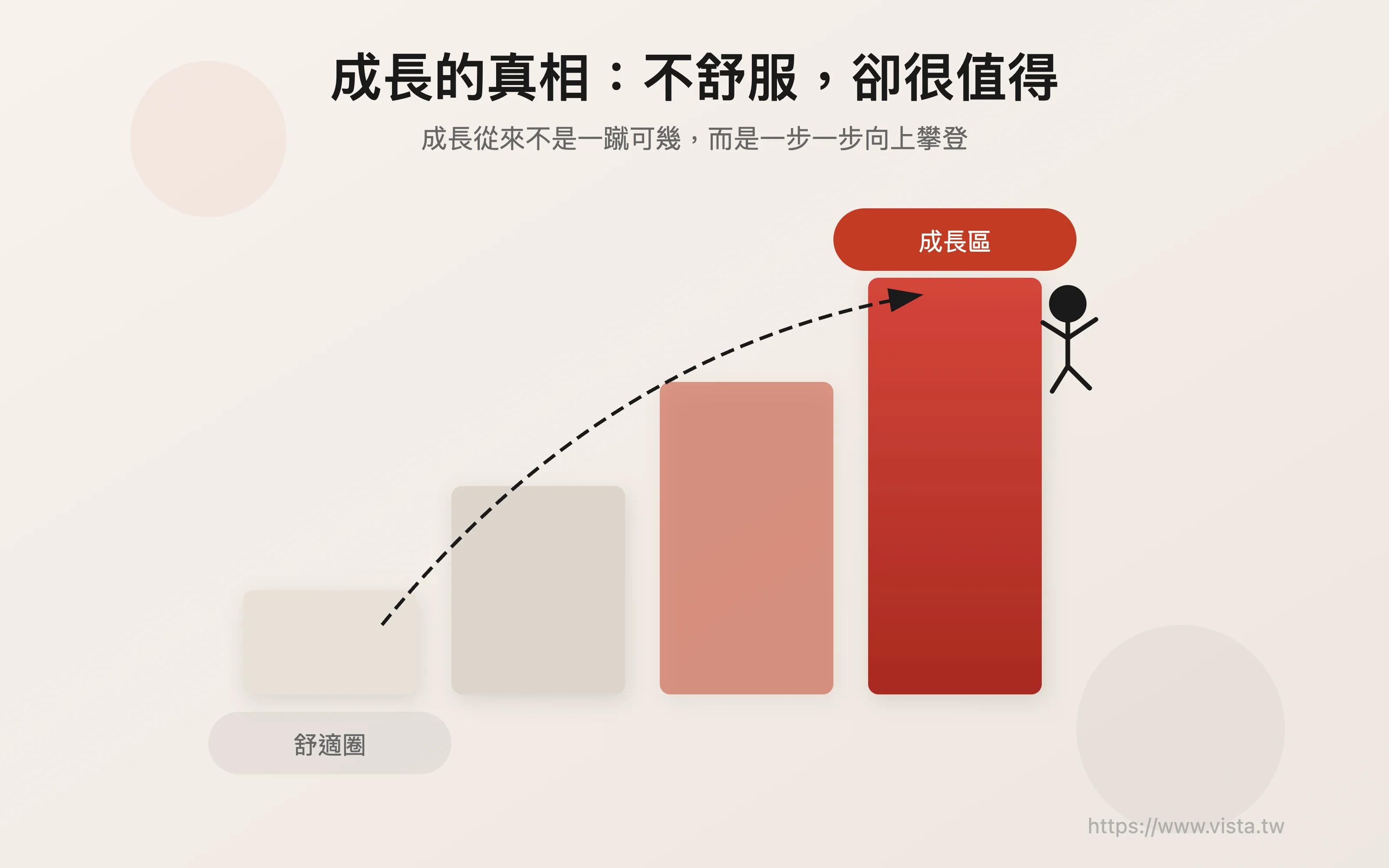 ▲The truth about growing up: uncomfortable, but worth it
Don’t equate discomfort with something wrong. When you feel uncomfortable, you are probably on the threshold of growth. The key is not to eliminate the discomfort, but are you willing to move forward with the discomfort?
Third Life: 50 years old is the best start
Teacher Ding Lingjuan recently published a book called “Life gradually understands: 50 is the best start” During the conversation, she put forward a framework that I very much agree with: life can be divided into three stages. The first life is the stage of studying, the second life is the stage of job hunting, and the third life is the stage of returning to yourself and wanting to be yourself.
She said that in Second Life, we spend too much time conforming to other people’s expectations, such as our parents’ expectations, our supervisor’s expectations or society’s expectations. We play too many roles and satisfy too many people, but in the third life, we can finally be ourselves.
One of the best things about life is that you can control your own time and decide your own destiny.
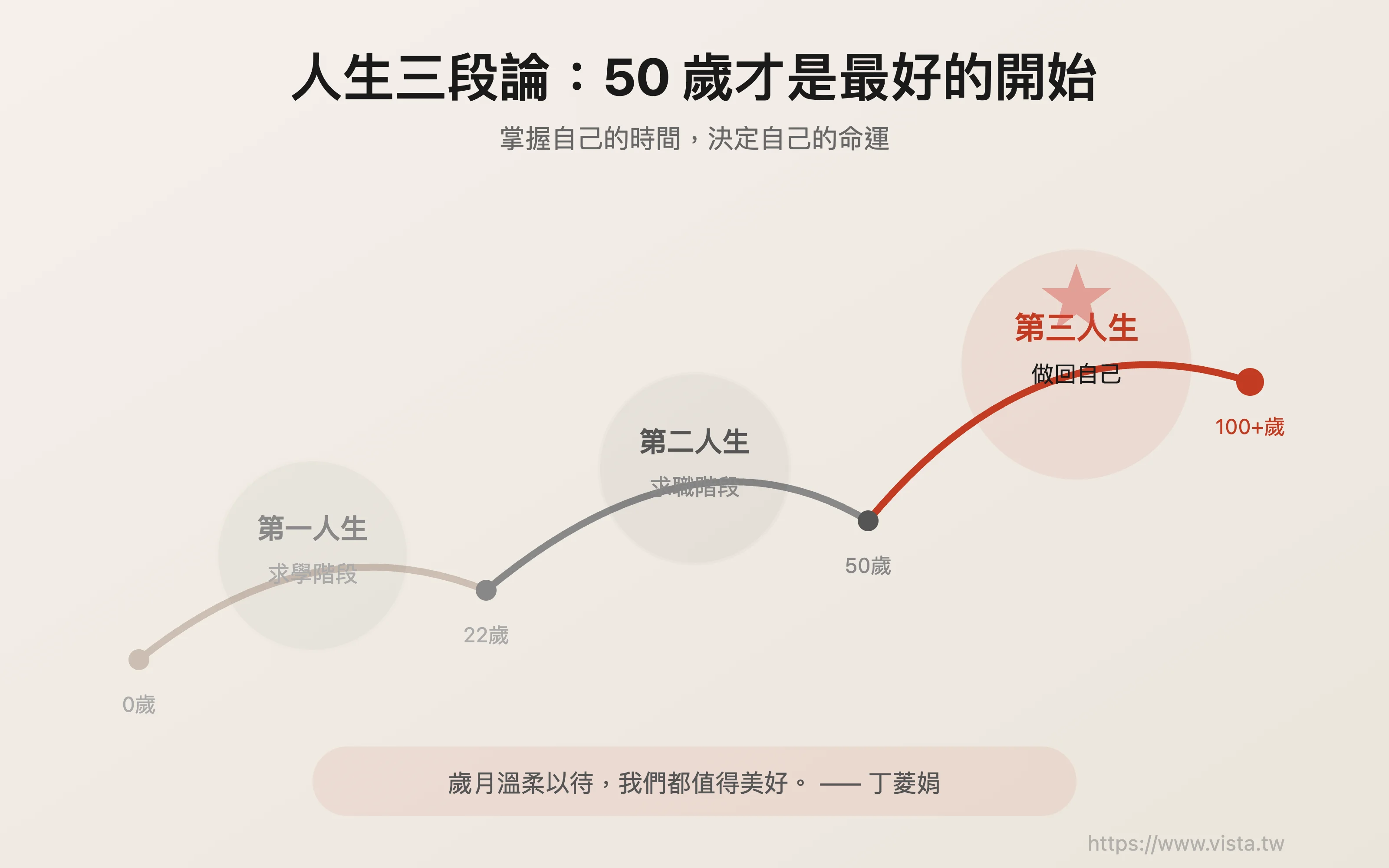 ▲ Life syllogism: 50 is the best start
Well, this passage particularly touched me. For myself, as a lecturer, columnist and consultant, and also involved in content creation, to some extent, I am at the junction of second life and third life. I know very well the feeling of wanting to be myself but being pulled away by various roles. Teacher Dante said something that particularly touched me: “One of the best things in life is that you can control your own time and decide your own destiny.”
She also mentioned a very wise realm: you will understand many things after experiencing them. You don’t need to run up to someone and point your nose in it and say, “You’re doing this wrong.” This is not indifference, but a gentleness tempered by years.
I think this is exactly what I have been pursuing in my writing and teaching - not rushing to give answers, but creating a space for people to understand on their own. The years are gentle and we all deserve good things.
Don’t look for it, do it instead
Well, this was one of the most shocking points in the entire conversation. Teacher Fan Deng said that many people always think that others are lucky and have found their destiny and what they like. But he said: “It’s not about looking, it’s about doing. Nothing is found by luck, but you work hard and make it fun.”
He quoted “<a href=“https://www.books.com.tw/exep/assp.php/vista/products/0010949100?utm_source=vista&utm_medium=ap-books&utm_content=recommend&utm_campaign=ap-202602” by Mihaly Csikszentmihalyi target=“_blank” rel=“noopener noreferrer”>Flow Theory: If you feel bored doing something, it must not be because of that thing, but because you are not doing it seriously enough. If you are serious enough, everything will be interesting.
It’s not about looking for it, it’s about doing it. Nothing is found by luck, but you work hard and have fun making it.
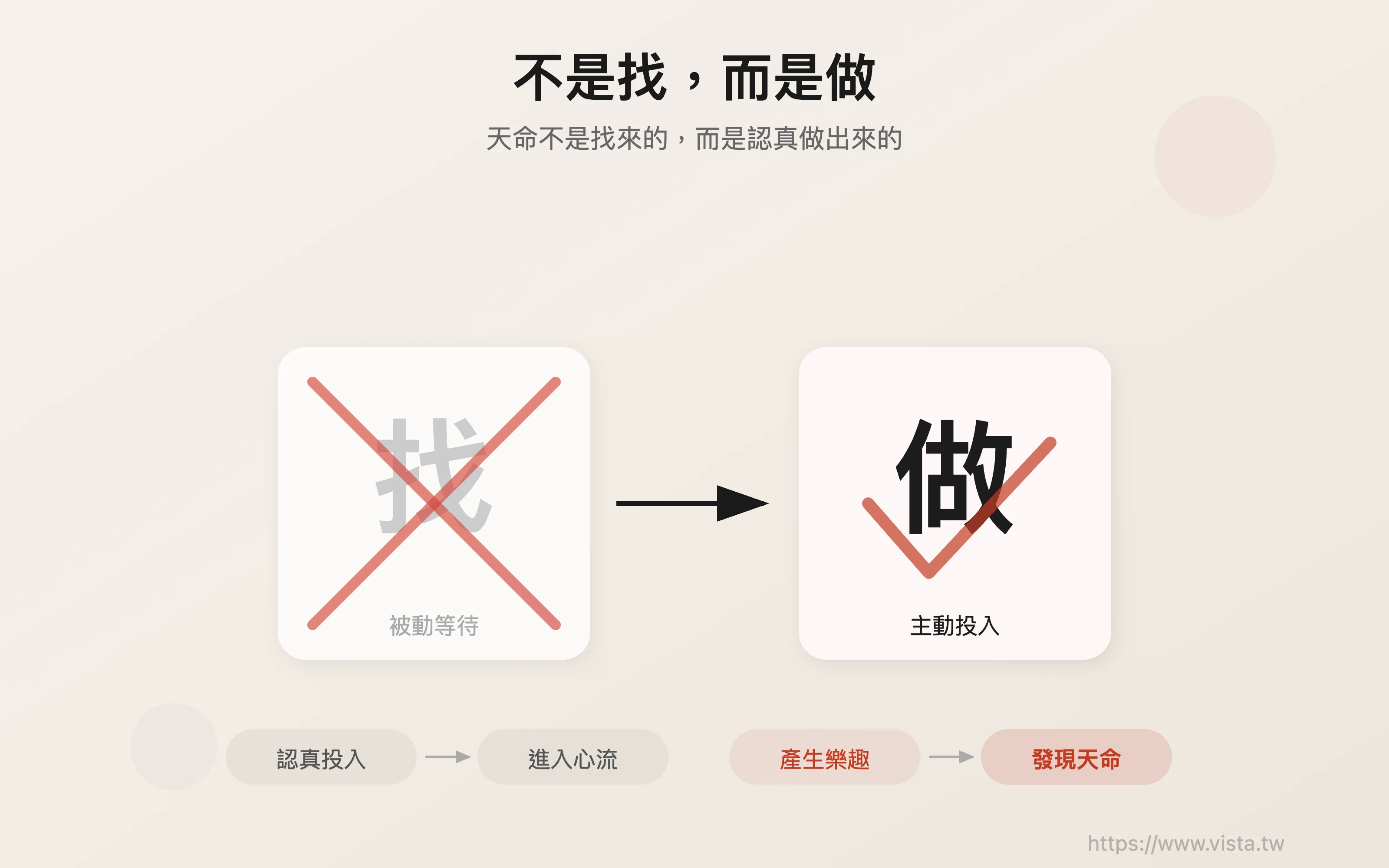 ▲ Not looking for it, but doing it
He gave a particularly vivid example: There is a theater in Beijing called Renyi (Beijing People’s Art Theater), there is an old man in it. His career is to pull the curtain - from the beginning to the end of the curtain, he has been doing it for fifty years. But the curtain of every scene he pulls is related to the emotion of that scene, and young people simply cannot replace him. Everyone in the troupe respects him.
This story reminds me of a question I often think about: In the era of AI, what should we pursue? Many people are anxious about whether to learn AI, whether to transform, and whether to find a new direction. But Teacher Fan Deng’s point of view reminded me: the point is not what you do, but how you do it. Being serious to the extreme can produce irreplaceable value in any field.
One word: sincerity
Teacher Fan Deng traces the matter of doing things seriously back to the core of classical Chinese philosophy - Yangming’s Theory of Mind which states that “disloyalty means nothing”. He said, if you don’t have the word “sincerity” here, you can’t do anything.
If you don’t have the word “sincerity” here, you can’t do anything.
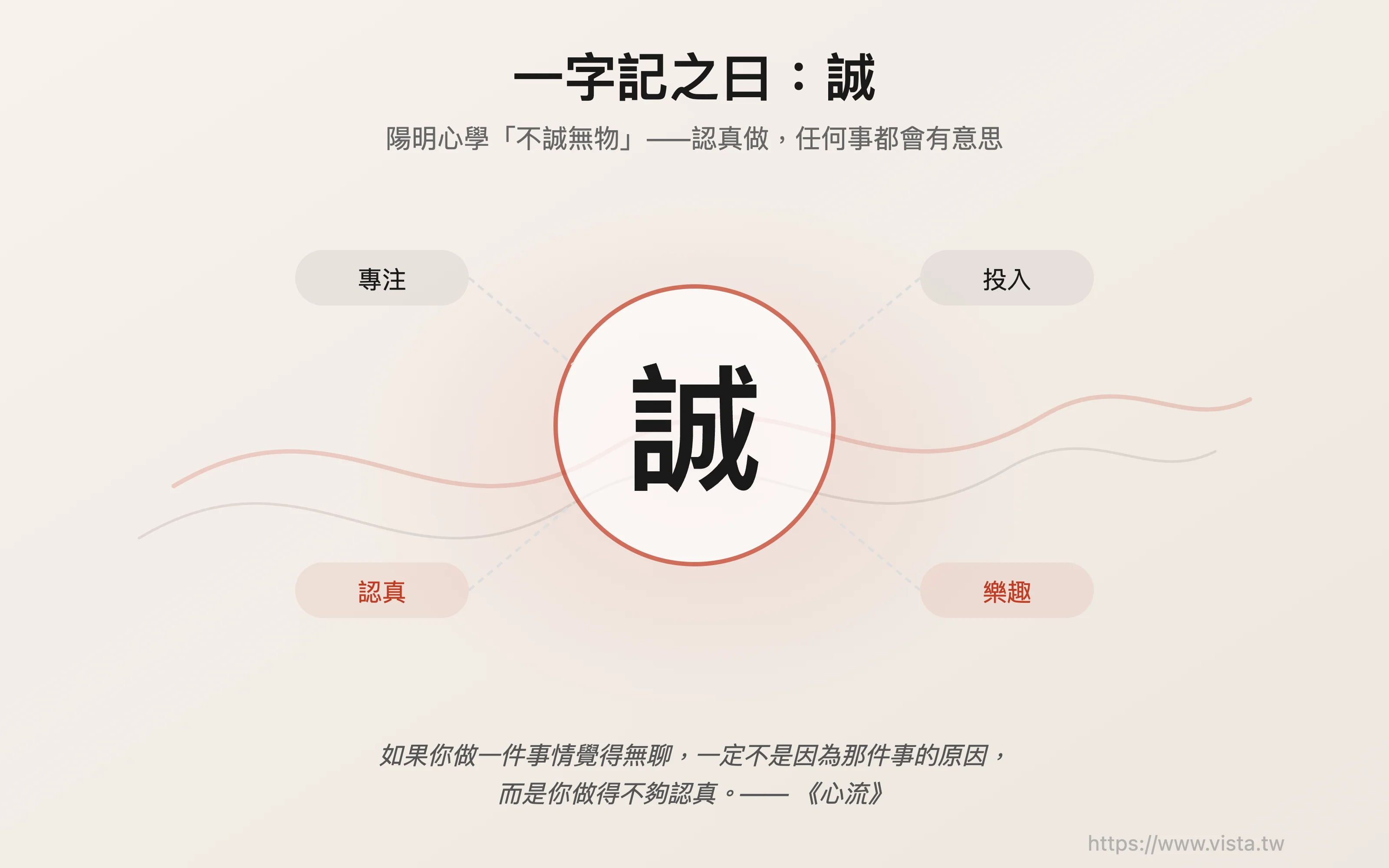 ▲ One word: sincerity
He even used a very everyday example: fried eggs. If you can carefully watch the white and yolk fighting when frying an egg, and look into it with great concentration, this is seriousness. Selling oyster omelette can be the best in Taiwan, cleaning toilets can also be a success Sweep the way.
“There is nothing without sincerity” comes from “The Doctrine of the Mean”, which means that if there is a lack of sincerity, all things and actions in the world will be vain and unachievable. This phrase emphasizes that “sincerity” is the foundation for being a person, doing things, and the existence of all things. If there is no real meaning, it is like vanity. In Confucianism, “sincerity” means “sincerity and truth”, while dishonesty means falsehood, so a gentleman values sincerity. As someone who has been deeply involved in the field of content creation for more than fifteen years, I have a deep understanding of this point of view. I have seen too many people chasing the trend, making short videos today, AI tools tomorrow, and social e-commerce the day after tomorrow. They always seem to be looking for opportunities, but never take anything seriously enough to get into flow.
There is no right or wrong in this, but rather than spending time looking for the right thing, it is better to do the right thing at hand. When you are serious enough, flow will come naturally and enthusiasm will naturally grow. This is not chicken soup for the soul, but an experience that I have proven over and over again in my career.
Substitutability determines your price
Teacher Fan Deng threw out an economic concept during the conversation and explained very accurately why it is so important to be serious? He asked: What determines our income? Not cognition, not value, but fungibility.
When others cannot replace you, you can make money. As long as you are better than 99% of people at one thing, you will definitely make money.
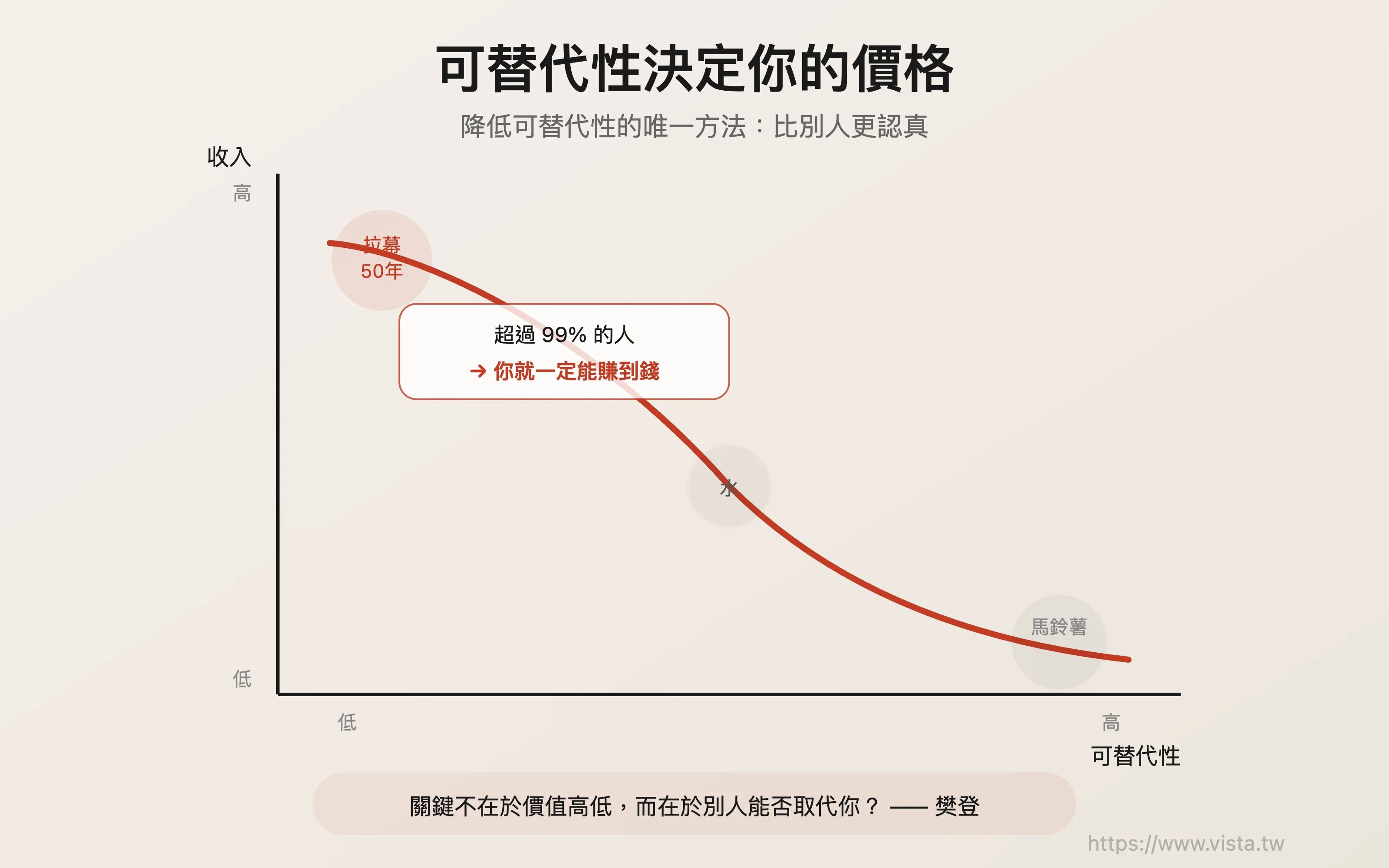 ▲ Substitutability determines your price
He used a wonderful metaphor: water is very valuable, but it is sold cheaply because there is so much water and it is highly replaceable. Potatoes are cheap all over the world because they can be substituted in any staple food. Therefore, as a person, if you want to have a foothold in society, you must have very low replaceability. In other words, when others cannot replace you, you can make money.
This idea is not difficult to understand, but it is particularly enlightening to me. When I was doing corporate training, I often encountered students asking me: “Teacher, what should I learn so that I will not be replaced by AI?” My usual answer is: Don’t think about what to learn, but think about how to do it to a degree that others can’t do? AI can write articles, draw pictures, and write programs, but AI cannot replace a professional who has been working in a specific field for decades and has accumulated unique insights and connections.
The way to reduce substitutability is ultimately what Teacher Fan Deng said: sincerity. As long as you are better than 99% of people at one thing, you will definitely make money. This is actually not difficult, because most people are unwilling to work hard and are just trying to get by. This is human nature.
Play life like an RPG
Zhang Xiuxiu’s sharing gave the entire conversation a very young and energetic perspective. He said that his life mentor is Luffy (the protagonist of “One Piece), and the way he views growth and failure is like playing an RPG (Role-Playing Game).
He said that every time he does something, whether he succeeds or fails, that picture will appear in front of his eyes: “The level has been improved! The experience value has increased! English skills +15! Physical value +20!” Just like ” target=“_blank” rel=“noopener noreferrer”>I Level Up Alone” is the same as the protagonist.
Regardless of whether things work out or not, the experience points will still be there. As long as life is not logged out, there will always be opportunities.
 ▲ Play life as an RPG
He also mentioned an interesting metaphor: If you fell into a hole while playing Super Mario, would you be sad there? Won’t. Because, you will press “Restart”. So why can’t we have the same mentality when faced with real life failures?
He quoted a player ” noreferrer”>Diablo” experience: After death, the equipment will fall to the ground, but you can still pick it up. Isn’t this the same in our lives? Regardless of whether things work out or not, the experience points will still be there. As long as life is not logged out, there will always be opportunities.
From a social science and psychology perspective, I really like this framework. As someone who has long studied content strategy and personal brand, I have found that the reason many people are afraid to take action is not because they don’t know what to do, but because they are too afraid of failure. But if you change your frame - think of life as a game, and failure as experience plus one - you will find that the threshold for action is suddenly lowered.
Thick skin is the best equipment for growth
Teacher Fan Deng shared a story of his own, which made the audience laugh and feel deeply inspired. He said that the biggest change in him around the age of 50 was that he became thicker-skinned.
Last year, Pennsylvania State University in the United States invited him to give a lecture, and all the people sitting there were foreign students. He joked that his English proficiency was average and he could only order food, so he had originally prepared for simultaneous interpretation. But on the way there, he read a book that said: “If you want to learn a language, the easiest way is to make 200 mistakes every day.”
So, he told the dean of the School of Education at the University of Pennsylvania that he wanted to speak in English. So he actually spoke in English for three hours. What was intriguing was that the foreigners actually understood him! How did he comfort himself? “I have also seen many foreigners speak Chinese very confusingly, and even we can understand it. After that, they still say how good your Chinese is.” As expected, those who listened to the lecture praised Teacher Fan Deng for speaking English very well.
As long as it’s fun, don’t be afraid of embarrassment! Living and trying new things is the fun part of growing up.
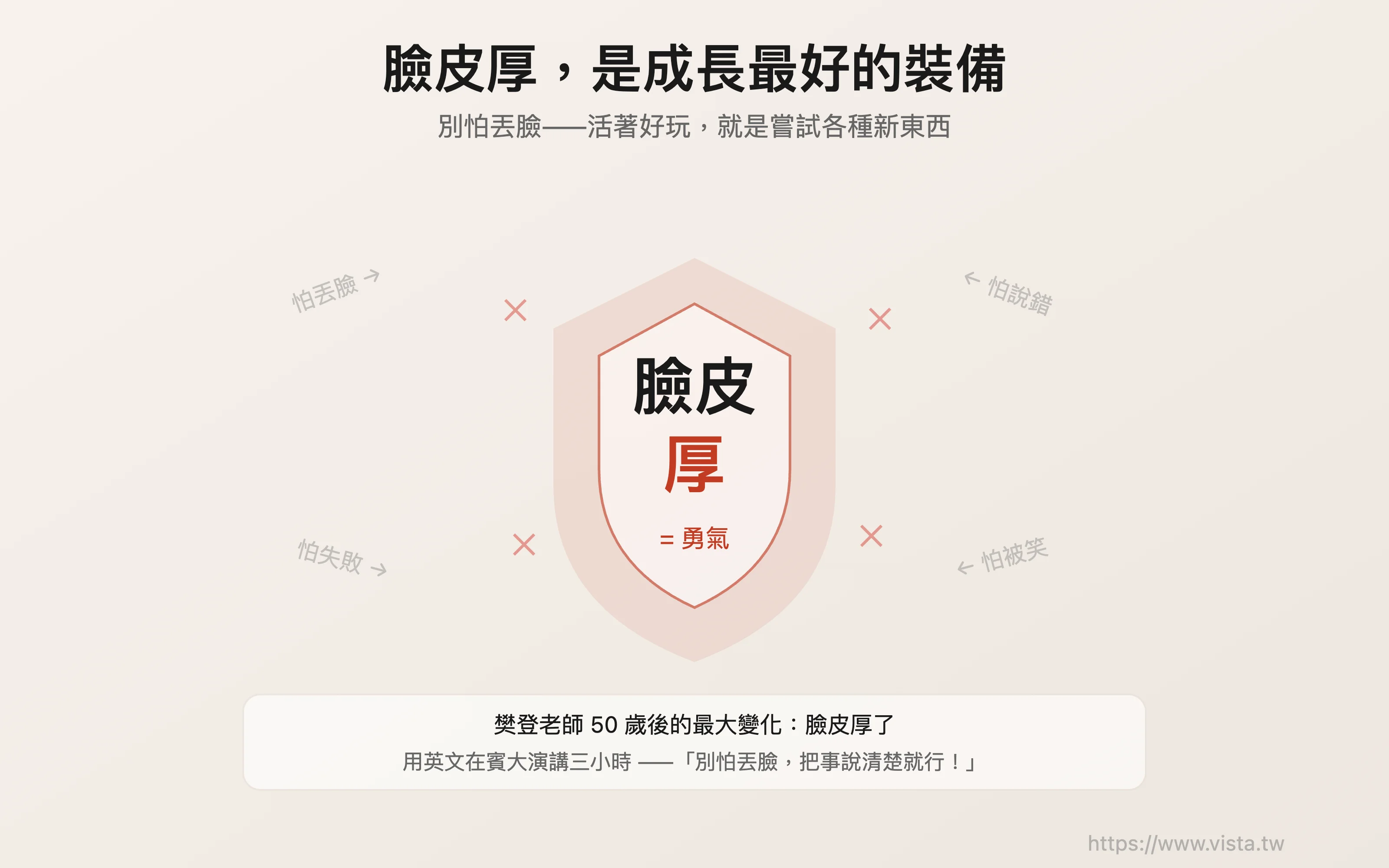 ▲Thick skin is the best equipment for growth
Teacher Fan Deng encouraged us, as long as it’s fun, don’t be afraid of embarrassment! Living and trying new things is the fun part of growing up.
Teacher Ding Lingjuan immediately echoed this point of view, sharing her first experience of giving an English briefing to a group of foreigners - she memorized the manuscript the day before and then went on stage to finish all the memorized content regardless of what the other party asked. As a result, the other party still nodded.
These two stories remind me of something I have learned in teaching: many times, what prevents us from growing is not lack of ability, but too little face. We are too afraid of saying something wrong, being embarrassed, or being made fun of. But in fact, when you are willing to let go of your perfection mentality and pursue completion first, you will find that the world is much more tolerant than you imagined.
 ▲ From scattered content to AI content production system, double your creative efficiency
🚀 Want to build your own AI content production system?
You don’t need to be an engineer or know coding. In the AI Content Production System Workshop, I will take you from scratch and learn to use AI to assist the complete process of conception, writing, editing and publishing, so that your content production efficiency can be doubled and the quality can be upgraded.
Whether you are a blogger, a self-media creator, a corporate marketer, or a professional who wants to build a personal brand - this class can help you create a replicable content production line.
Learn the same thing in one year, and do the decathlon in ten years
During the conversation, teacher Ding Lingjuan shared a very practical life strategy. She said that when she was 40 years old, she suddenly hated herself—every day was nothing but work, and the Ding Lingjuan who loved literature and art and creation when she was young was gone.
She wanted to become a multi-talented person, but felt she didn’t have the time. Later, she had a flash of inspiration: If she learned the same thing one year, wouldn’t she be able to do the decathlon in ten years?
We often overestimate what can be accomplished in one year, but underestimate what can be accomplished in ten years.
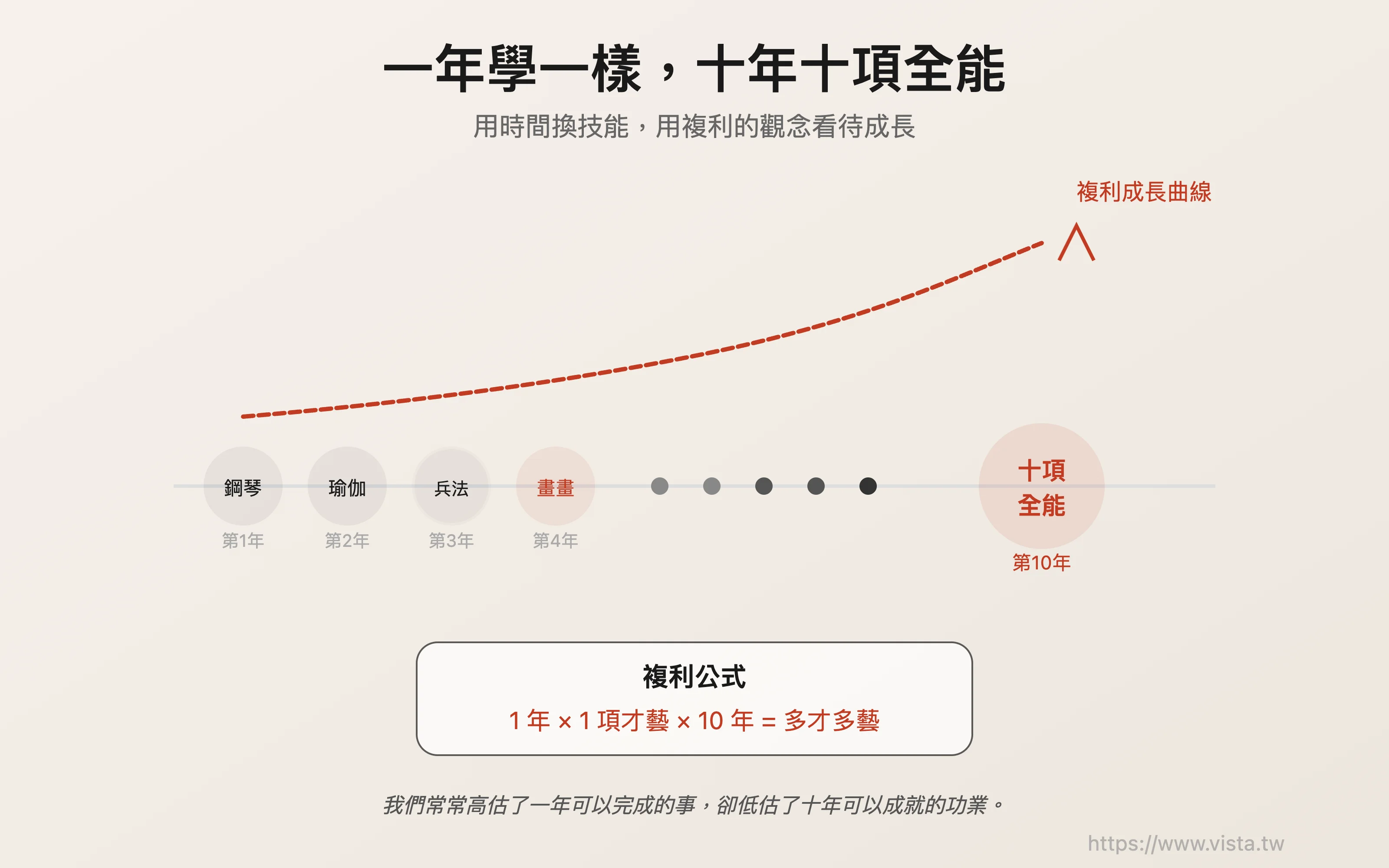 ▲ Learn the same thing in one year, and do the decathlon in ten years
So, she made a list - she originally thought there were only two or three things she wanted to learn, but there were more than a dozen or twenty in one list. She learned piano in the first year (because her family had no money to buy it when she was a child), yoga in the second year, and Sun Tzu’s Art of War in the third year… In the past ten years, although she was not proficient in everything, she made breakthroughs bit by bit in the process, and unexpectedly discovered her true passion - painting.
I think the essence of this strategy is to use the concept of compound interest to look at growth. Just like the sentence in the book: “We often overestimate what can be accomplished in one year, but underestimate what can be achieved in ten years.” Teacher Ding’s experience is the best proof.
We don’t need to do a lot of things at once, we just need to do one thing at a time and give it enough time. Time is the best compound interest engine.
Never change others
This is the theme of the entire conversation, and it is also the most profound discussion in my opinion.
Brother Hao asked a question: What would you think if someone said, “Teacher, I’m just fine this way and don’t want to change.” Teacher Fan Deng’s answer was very sharp. He first used “Nonviolent Communication” framework analyzed Brother Hao himself: “You ask this question, which reflects that you want to change others too much.”
The real influence is not to push others to go, but to go well enough that others will naturally want to follow.
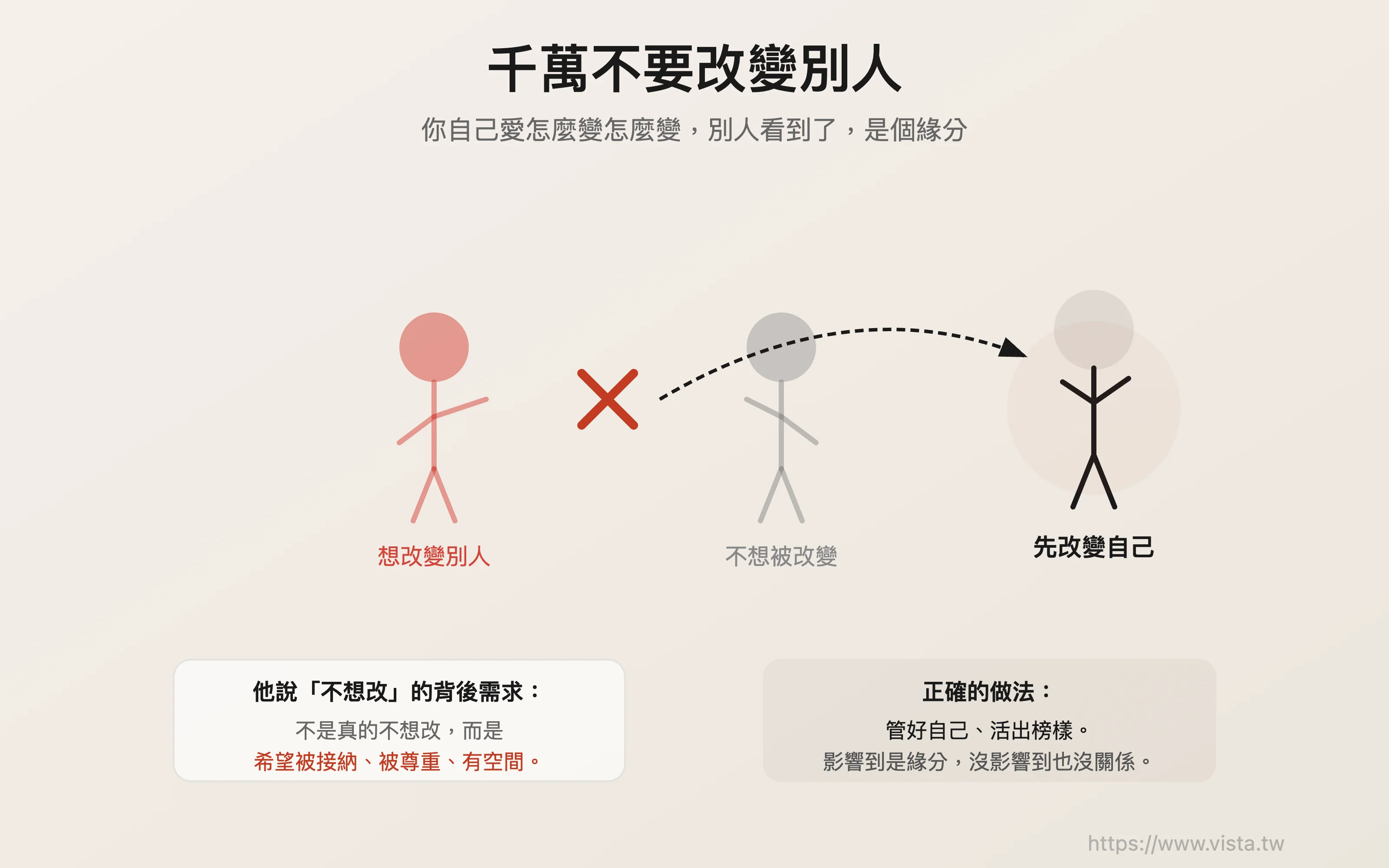 ▲ Never change others
Then, he said something that impressed me deeply: “We don’t have to worry about other people’s hearts. You can change however you want, and you should work hard to change, and then others will see it. If it affects you, it’s fate. If it doesn’t, it doesn’t matter.”
What’s more important is his interpretation of the phrase “don’t want to change”: When a person says in front of you, “I’ll be fine just like this,” his need is not that he really doesn’t want to change, but that he doesn’t want to be criticized. He wants to be accepted, respected, and given space. If you are more tolerant and nicer to him, he will suddenly want to move in the end - because people’s upward power is difficult to restrain.
Zhang Xiuxiu added this point of view from the perspective of brain neuroscience: Many people do not want to move because they have been under too much pressure since childhood, the cortisol concentration is too high, and the prefrontal cortex is damaged. They are not lazy, they are tired. So the first step is not to rush them into action, but to let them go first.
This discussion made me rethink my teaching methods. As a teacher and counselor, I do sometimes unconsciously want to push students forward. But this conversation reminded me: the real influence is not to push others away, but to move forward brilliantly so that others will naturally want to follow. Just like someone said in the conversation: Influence is to live your life to achieve three things - live very happily, continue to be happy, be happy all the time, and be happy to the point that others want to be the same as you.
Just read books - what you buy when buying books is probability
Teacher Fan Deng put forward a very unique book buying philosophy in the last concluding paragraph. He said: Don’t believe what we say, we are just giving you an incentive to pick up the book and read it from now on.
When buying a book, what you buy is not the content of the book at all, but the probability of reading the book. If you buy it, there is at least a 1% chance that it will be read; but if you don’t buy it, the probability is 0.
He explained why there is not enough information on the Internet: first, it is unsystematic; second, it is too pleasing to you; third, it is too fragmented. So you can’t bring yourself systematic progress.
Then, he threw out an argument that impressed me: What you buy when buying a book is not the content of the book at all, but the probability of reading the book. If you buy it, there is at least a 1% chance that you will read it, and it may even be a 10% chance; but if you don’t buy it, the probability is 0. Iterating between 0 and 1%, the final results are very different.
 ▲ Probability theory of reading: buying books means buying probabilities
He even said: It is better to buy it without reading it than not buying it at all. Because you don’t read, your son might read, and your grandson might. Put paper books at home, and they will annoy you every day. There is one in the bathroom, one on the bedside, and one on the bookcase. You can make progress just by looking at the spine of the book! Not only will your self-esteem levels increase, but your serotonin will also increase, which has an impact on your brain.
I couldn’t help laughing when I heard this. Because, I am the person who loves to buy books. Even if you buy it without reading it, or just read the cover, you will still be happy.
Finally, he quoted Mr. Yang Jiang’s reply to a troubled young woman: “All your problems are in href=“https://www.threads.com/@a_novel_13/post/C3aARpYvm5B” target=“_blank” rel=“noopener noreferrer”>Thinking too much and reading too little.”
As an author of twenty books, this passage makes me both moved and want to smile bitterly. What is touching is that in this era of short videos and fragmented information, there are still people who are willing to defend reading and paper books so firmly. The sad thing is that I know that everything he said is true - systematic deep learning is indeed what most people lack the most.
Postscript: Growth is original
Going back to the beginning of the conversation, Brother Hao quoted what Teacher Fan Deng said: Every life is original. You can learn, but you cannot teach, because in the process of teaching, you are just sharing your experience with others.
The reason why this conversation touched me is precisely because the four speakers are using their own unique life experiences to respond to the same ancient proposition-how do people grow? Teacher Ding Lingjuan responded with her 40-year-old awakening and the open-mindedness of the third life; Teacher Fan Deng responded with the philosophical depth of “There is nothing sincere” and the story of the old man who pulled the curtain; Zhang Xiuxiu responded with video game philosophy and neuroscience; and Brother Hao used his consistent “just do it” to connect everyone’s wisdom.
To grow, you don’t need to look for it, you just need to do it; you don’t need to suffer, you just need to be sincere; you don’t need to change others, you just need to change yourself.
As a listener, what I took away was this integrated belief: growth does not need to be looked for, only done; it does not need to be bitter, only sincerity is required; there is no need to change others, only to change yourself. When you are serious to a certain extent, you will naturally enter the flow, naturally reduce your replaceability, and naturally live your life as a person that others want to follow.
No matter how old you are now, no matter what you are doing, please remember what Teacher Fan Deng said - you are at least gaining weight and getting older. Since you can’t change these, why not make yourself happier, learn something new, and learn something fun while gaining weight and getting older?
Growth is actually such a simple thing.
Further reading:
- You don’t have to risk your life to start a business: Learn the seven keys to building an automatic profit system from two sacred books
- Stop chasing tools! Build your own “unbeatable system” in the AI era
- When AI not only helps you write, but also helps you research, format and publish: the content production line I created with Claude Code
- Refuse to be a digital tenant: Why do you need to use Vibe Coding to build a digital headquarters in 2026?
External resources:
- Fan Deng “Protagonist Mode” - Blog Coming
- Ding Lingjuan “Life gradually becomes clear: 50 is the best beginning” - Blog Coming
- Hao Xulie (Brother Hao) Facebook
📖 深入探索相關主題