If you hand over everything you can to AI, what will be left after a year? Thoughts after reading "Live a Year Without Relying on Humans"

During the years when I was a reporter and later editor-in-chief of “Digital Times”, I accepted and reviewed countless new products. At that time, I had seen countless products and services, and I developed an occupational disease: No matter how beautifully presented the manufacturer’s presentation was, there was only one question in my mind: Will this thing stay on the table after I take it home for a month?
So when I read the preface of “Live a Year Without Relying on Humans (opens in a new tab)”, I quickly felt a sense of familiarity with my peers.
Author Joanna. Joanna Stern has written a personal technology column for the Wall Street Journal for 12 years and won an Emmy Award. She said that her happiest job over the years has always been working with technology, rather than interviewing senior executives and taking notes on the sidelines. In order to test the metaverse, she spent a full twenty-four hours wearing a VR headset in a hotel room; in order to test whether the mobile phone was resistant to falling, she used a drone to drop the mobile phone from a height of thirty stories.
This time she played a bigger game: starting from midnight on January 1, 2025, for twelve consecutive months, she will insert AI into every corner of her life.
An experiment in real life
The picture of the ultimate AI life described in the book seems ridiculous. The AI robot dog lifts its legs on the neighbor’s azaleas, the AI sunglasses introduce the bugs on the roadside to her ears, and the AI bracelet on her wrist records the conversations along the way and organizes them into to-do lists; there is an AI lawnmower spinning in circles in the yard, a robot folding T-shirts in the basement, and a novel entirely written by AI is placed next to the bed.
Nor did she keep her experiments in a lab. The book will feature her real-life two sons, wife, pet dog, and her mother’s battle with cancer. Doctor’s appointments, taking kids to school, business trips, and deadlines are all part of the experiment.
The book progresses according to the four seasons: in winter, the body is handed over to AI to measure the gap between AI doctors and human doctors; in spring, the steering wheel is handed over and the whole family takes more than 30 Waymo self-driving trips; in summer, the most annoying drudgery in housework and work is outsourced; in autumn, AI is allowed to enter the mind and heart, acting as a counseling psychologist or even a companion.
I think this order is very smart. The things handed over are becoming more and more private, ranging from body, life safety, time, all the way to emotions. As readers follow the seasons, they will naturally feel where the line is crossed.
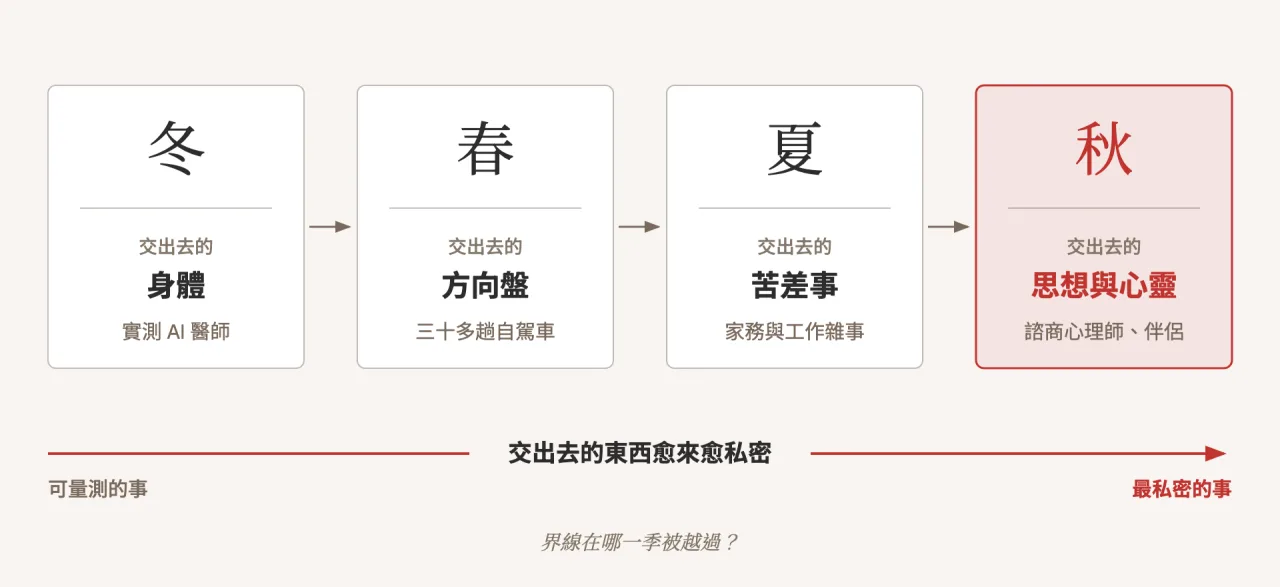 ▲ Stern’s AI progresses year by year, and the things handed over range from the measurable body to the most private emotions
What I want to take away most are her three principles
Frankly speaking, this kind of experiment of using AI to live for a period of time is not uncommon on the Internet. What makes this book stand up are the three principles of action she set out in the preface.
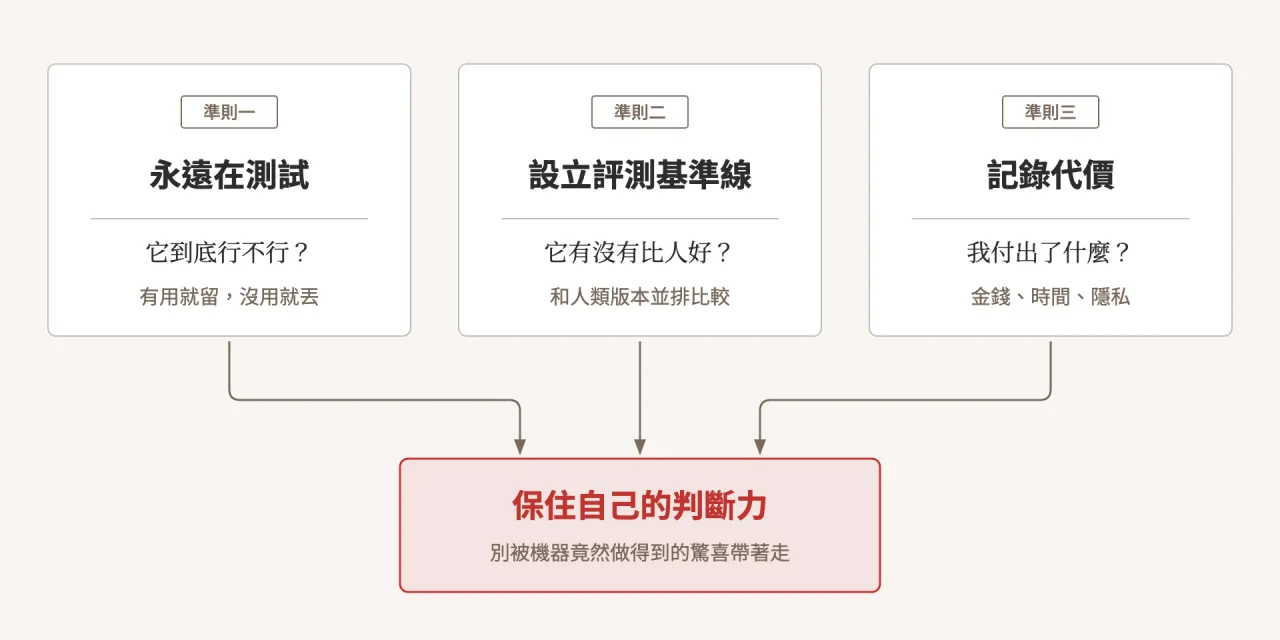 ▲ Each of the three principles answers a question, and together they are a set of disciplines to preserve judgment
Rule 1: Always test
She tested more than a hundred products, including chatbots, AI glasses, AI necklaces, home robots, AI toys, and AI personal trainers, and interviewed nearly two hundred people at the same time. There is only one rule: keep it if it is useful, throw it away if it is not.
She would also call stop at any time. For a while, she let the AI automatically reply to every text message and e-mail, but then she stopped after realizing that this was a shortcut to unemployment and divorce.
I laughed out loud after reading this sentence, but I felt a little guilty after laughing. I myself hand over many things to AI agents in my one-person company, and what I remind my students most of all is this: there are many things that can be automated, but there are far fewer things that should be automated. External communication is the most trouble-prone area, because what the other party receives is not only the content, but also your attitude of whether you are willing to reply in person.
Guideline 2: Establish an evaluation baseline
This principle is what I consider to be the most valuable methodology in the entire book. She said technology is only amazing when it surpasses the old thing it replaces. So every time she tested a tool, she asked: Is this really more helpful than the human version?
She hired a human research assistant and replaced her with an AI research assistant; she compared robot masseurs to human masseuses; and she watched an AI radiologist flag a lesion that a human physician judged to be benign.
This reminds me of the basic skills of product evaluation back then: evaluation without a control group, just writing down experiences.
When I take AI courses in companies and schools, what I see most often is exactly the opposite. Everyone exclaims when they see AI producing a briefing or an article, but few people ask: How is it better than the version you originally did yourself or asked your colleagues to do? Has the time saved been spent on checking and revising? Without this baseline, it is easy to be carried away by the surprise of what the machine can do.
Rule 3: Record the cost
The third one is most easily ignored. The price, she says, isn’t just subscription fees, but time, privacy, and more obscure things.
There is a detail in the preface that particularly impressed me: She asked ChatGPT to summarize an academic paper. The summary looked confident, but the content was completely wrong. In order to correct it, she had to spend four more steps, instead of reading the paper herself in the first place.
In the past few years, I have taught AI-assisted academic research in universities and research institutes. When designing the “AI Academic Research Prompt Manual (opens in a new tab)”, I ran 120 actual tests on seven papers. The most laborious part was to check: where AI would make sense but in fact have no basis. The situation she encountered is something graduate students encounter almost every day. The time saved by AI is often paid back in another form.
She also asked two more difficult questions. Did she really feel better after talking to the AI counselor, or was she just emotionally brushed off? Will letting AI help her edit and simplify the text all the time, will the book lose its original look? After all, part of the value of writing lies in the slower, more ample reflection process.
I often get stuck here when I write my own books. AI can help me change a paragraph to be smoother, but sometimes the days when I am stuck are when I want to figure out what I want to say.
The table of contents first reveals the direction of the answer.
The book’s table of contents itself is very nice. The first article in the preface is “How AI was used in the creation of this book”. In a book about AI, I first explain how I use AI. I appreciate this order. This is also the concept that I have been promoting in academic circles this year: if AI is used, explain it truthfully, explain clearly where it is used and how to verify it.
Scroll down further, and there are several titles that make me want to skip over and read them: “GPT Doctor: Transcript”, “Manipulated by GPT with Gaslighting Effect”, “AI Fake Learning”, “ChatGPT Asked Me to Resign”. Just by looking at the title, you can tell that she did not intend to write a book praising AI, nor did she intend to write a book denigrating AI. Freddy said in his recommendation that this book is a hangover cure, which I think is very appropriate.
The book also includes her and Bill. Gates, Sam. Ultraman, Anthropic CEO Dario. The interviews with Amodei and others do not talk about valuations and arms races, but only talk about how ordinary people can use AI to live their lives. The preface quotes a very honest statement from Gates: This technology will definitely undergo huge changes in the next five years, but after that time, no one knows what will happen.
Read this book from the perspective of an unmanned company
The “AI Unmanned Company” I am writing talks about how a person can run a company by relying on AI agents. What Stern is doing is, in a sense, a real-life version of the same thing: How much can a person do to a machine?
After reading the preface, I think we will all come to the same question in the end: after handing it over, what do you have left?
She listed four questions in the preface, hoping that readers can answer them after reading them. The last question is: How can I ensure that I will not become a robot?
My own answer is simple: hand over the execution and leave the judgment. AI can organize information, draft, schedule, and respond to routine inquiries for me, but once these judgments are handed over to me about what to do, what not to do, and whether the results are good enough, humans will really only have the function of pressing the confirm button. Stern’s three principles are, to put it bluntly, a set of disciplines to preserve judgment: Only by continuous testing can you know whether it works; only by setting a baseline can you know whether it is better than others; only by recording the cost can you know what you have paid.
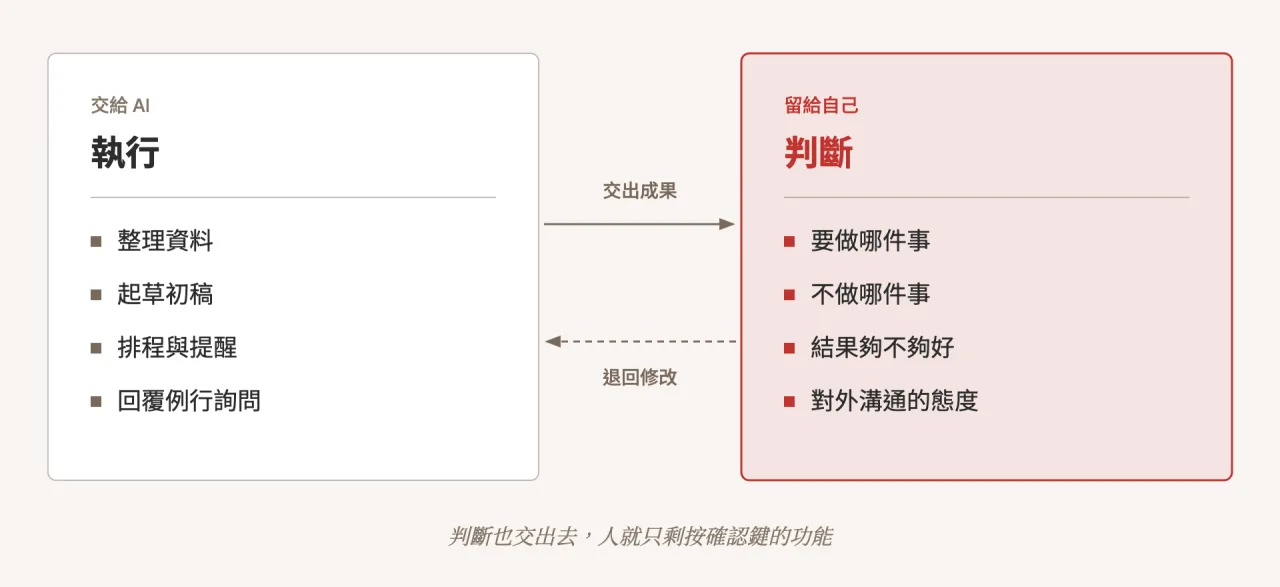 ▲ When AI hands over the results, people decide to accept or return them for modification; it is judged that this column is not outsourced
She also mentioned another observation that stuck with me. Her four-year-old son recently asked her for a photo of himself with a robot dog and wanted it framed. She said that when these children grow up, they are destined to miss the era when “the computers in the world were not as smart as humans.”
As an educator, I have read this sentence for a long time. Our generation is learning how to use AI, and the next generation has grown up with it from the beginning. What they should be taught may not be how to use which tool, but what Stern has been doing all year: stay curious, try it yourself, and then honestly note what works, what doesn’t, and what shouldn’t be handed over.
Who is this book suitable for?
Stern himself divides readers into two groups: one group is already familiar with AI and just wants to see her crazy adventures; the other group often hears people talk about AI and wants to know how it will affect their lives. I think both groups would have a great time reading it, plus three types of people:
- Supervisors and managers who are introducing AI: The three criteria can be used directly as a checklist for team assessment tools, especially the baseline one
- Teachers and parents: The book looks at AI through children’s eyes, which is a perspective I rarely see in other AI books.
- People who are anxious about AI: She neither flatters nor threatens, and uses humor to bring many exaggerated claims back to ground.
The book quotes a professor from the Wharton School of Business in the United States [Ethan. A quote from Ethan Mollick: “Please remember, this is already the worst AI you have ever used in your life.” Stern then added an attitude that I like very much: when a product simply cannot do what it boasts, she will never allow manufacturers to use this law as an excuse.
Tools will continue to get better, but the decision of whether to hand it over and how much to hand over is still up to us. Friends who are interested can start here to get “Live a Year Without Relying on Humans (opens in a new tab)”.
📖 Book information
- Book title: “Living without relying on humans for a year: Wall Street Journalist’s 365-day record of AI life (opens in a new tab)”
- Original title: I Am Not a Robot: My Year Using AI to Do (Almost) Everything
- Author: Joanna. Stern
- Translator: Pan Rongmei
- Publisher: Yuanliu
- Publication date: October 29, 2026
Extended reading: When talking about how to be an operator in the AI era, I also wrote “How many people do you need to run a company?” ](/blog/how-many-people-to-run-a-company)〉.
Next step
Bring this topic to your team
Vista Cheng speaks and runs workshops on AI workflows, writing and content systems for companies, schools and public agencies.