After 1000 days, I care more about what kind of people we will become: Reading "The Next 1000 Days", what AI actually changes is our patience and judgment.
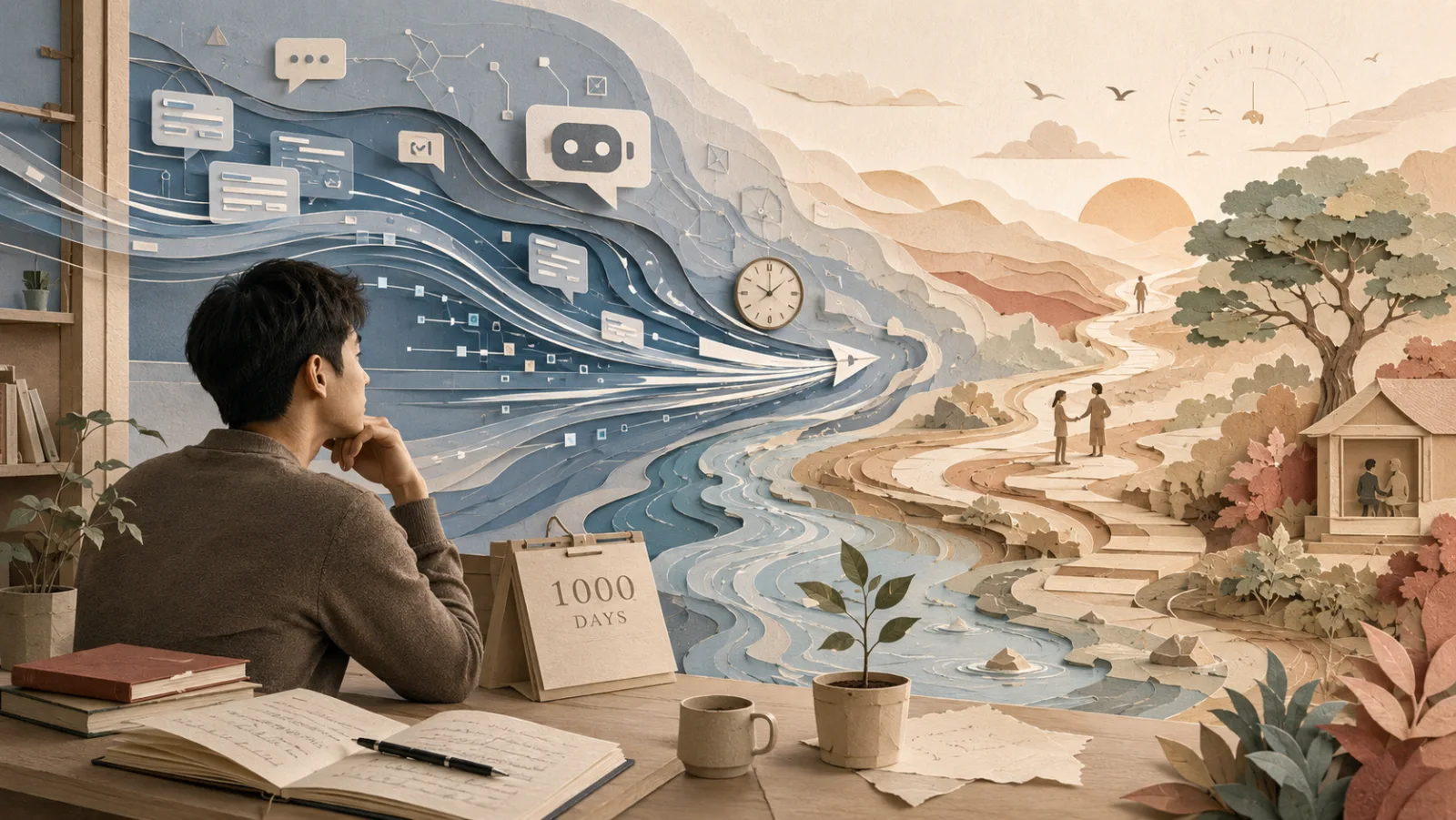
The subtitle of “The Next 1000 Days (opens in a new tab)” impressed me deeply: How much of your current efforts will be ineffective in the AI era?
When I first read this book in a bookstore, I subconsciously thought of work. Will one day suddenly no one needs the skills we have worked so hard to develop?
But in the past few days, I found that my thoughts gradually changed from which abilities will fail to another question: What kind of people will we become in 1,000 days?
Because change never happens suddenly one day. It is more like water, seeping into life little by little. By the time you notice, some habits will have changed.
The first thing I felt was the speed
In the past, it would take a while to check a piece of information, draft a letter, or organize a chaotic idea into a few key points. Now, these things are almost instantaneous. Just type a few words and the answer will appear in front of you.
Well, that’s certainly good. But I gradually discovered that what really changed was not the speed itself, but my patience with slowness.
A book that takes three days to read may feel like too long. A message that requires you to wait for the other party to reply the next day will feel ineffective. Even if I have an idea that I haven’t thought through clearly, I can’t help but want to throw it to the AI immediately and let it help me complete it.
But I know very well that some things cannot be rushed. For example, trust in a relationship, a judgment that truly belongs to oneself, or an article that one is convinced by one’s writing, are often grown up little by little in the slowness. This is why I always remind myself to pursuing the philosophy of “slow down for one second”, and in an era where everything is instant, I deliberately leave myself some room to slow down.
What I worry about is that after 1,000 days, we will become accustomed to immediacy and no longer be able to bear the need to wait for anything.
The next thing that concerns me is the answer
AI almost always has the answer. No matter what I asked, it gave me a response that seemed reasonable, even pretty. This is where it’s powerful, and it’s also where I think we need to be careful.
Because the real growth of a person often does not occur at the moment when the answer is obtained, but at the time when the answer is not yet available but the person is willing to continue thinking about it.
That state of “I don’t know yet” is actually very precious. It forces us to check, ask, or boldly try and make mistakes. It also forces us to be honest about how much we know.
If a ready-made answer pops up every time we get stuck, will we gradually lose our ability to deal with uncertainty over time? Will it become that once there is no standard answer, we don’t know what to do?
Of course, I’m not saying that AI giving answers is a bad thing (after all, I ask questions every day and work very hard). I just remind myself that the answers can be outsourced, but the judgment cannot. In the past few years, I have become more and more convinced that AI will not make you stupid, but it will not make you stronger. The key always lies in whether you leave the dominant power of thinking in your own hands.
After 1,000 days, there will only be more and more things that can give answers, but there may be fewer and fewer people who are willing to take responsibility for their own choices and can afford to judge.
Which ones will expire and which ones will become rarer
Thinking of this, I seem to have some new ideas about which abilities will become invalid.
What will fail are mostly those parts that can be copied and automated: organizing, producing, memorizing, or moving information around. AI will only do these things faster and faster and better. When everyone can produce in large quantities with zero threshold, after obtaining the information, the real value is the judgment of understanding people’s minds; in the same way, when AI-like articles are flying all over the sky, the problem is often not that your writing is not good enough, but that you are too easily replaced.
But looking at it on the other hand, some abilities will not only not expire, but will become more rare. For example, among a bunch of options that all seem to be right, decide what is really important. For example, when faced with someone who doesn’t fully cooperate with you, you are still willing to understand and adapt. For example, when there is no standard answer, you still dare to make a decision and bear the consequences.
AI cannot help us practice these things. It can accompany us to think about it, but it cannot experience it for us.
Therefore, what “The Next 1000 Days” really reminds me may not be to quickly strengthen new skills. But in the process of chasing AI, don’t accidentally let go of these abilities that are most human-like and most need to be practiced in person.
What I care more about is whether we have become less like ourselves.
I have always felt that the biggest change brought about by AI may never be how much it can do. Rather, it quietly changes our pace, our patience, and our definition of worthy.
In 1,000 days, we will probably all be better at using AI. Tools will become more convenient and efficient, and many things that may seem difficult today may not matter by then.
However, what I hope even more is that at that time, we still retain the ability to slow down, tolerate uncertainty, and are still willing to take responsibility for our own judgments.
Technology will continue to advance, I am not worried about this. What I care about more is whether we have accidentally become less like ourselves because we have become better at using AI when we look back 1,000 days later.
If the theme of “AI and companionship” also resonates with you, I wrote about it from another angle too: “When AI Starts to Take Over Companionship”, on whether, as AI begins to catch our emotions, we grow less and less used to facing a real person.
If you also like to read a book as a dialogue with yourself, the reading experience of “One-person Company Management in the AI Era” that I wrote before may also be suitable for you. More of my ideas on using AI to run a one-person company are usually placed at vista.tw. You are welcome to come and have a look.
Next step
Bring this topic to your team
Vista Cheng speaks and runs workshops on AI workflows, writing and content systems for companies, schools and public agencies.