Treat health as a depreciating asset: Chen Xiaowei’s “wisdom of no longer holding on” provides health risk management lessons to the sandwich generation
*▲ Health is not something that can be replenished by exercising too much one day, but an asset that needs to be depreciated less every day. *
Most health lectures start by telling you “should”: you should eat a balanced diet, exercise regularly, and get enough sleep. We nodded vigorously while listening, and continued as usual after returning home. Tonight’s “Corporate Life Strategy” health assets class is different. My friend Teacher Chen Xiaowei put away the “should” as soon as it started, and asked a question that I am very familiar with: where is your asset depreciated now?
I have been talking about one-person companies and Income after Sleeping for many years, and I have been talking about how to turn your major into an asset that can be accumulated and earn interest. The biggest fear of asset thinking is never spending money, but never taking inventory. Teacher Xiaowei applied the same logic to physical health care. As I listened, I discovered that this was basically a risk management class taught in the language of nutrition.
After the age of 35, your body no longer belongs only to you
She pointed out a fact that I have become increasingly aware of in recent years: after you reach the age of 35, your body rarely belongs to you. You are at the same time an employee of the company, a team leader, a partner at home, a child of your parents, and maybe a parent of a young child.
The point is, these characters are connected. She put it very bluntly: As soon as you are tired, your work performance will be affected first; when you fall down, your family arrangements will be messed up. For a worker who relies on himself to run operations, this sentence is almost a risk warning of a single point of failure. We will do backup for the server, but rarely do it for our own host.
A non-reasonable inventory list
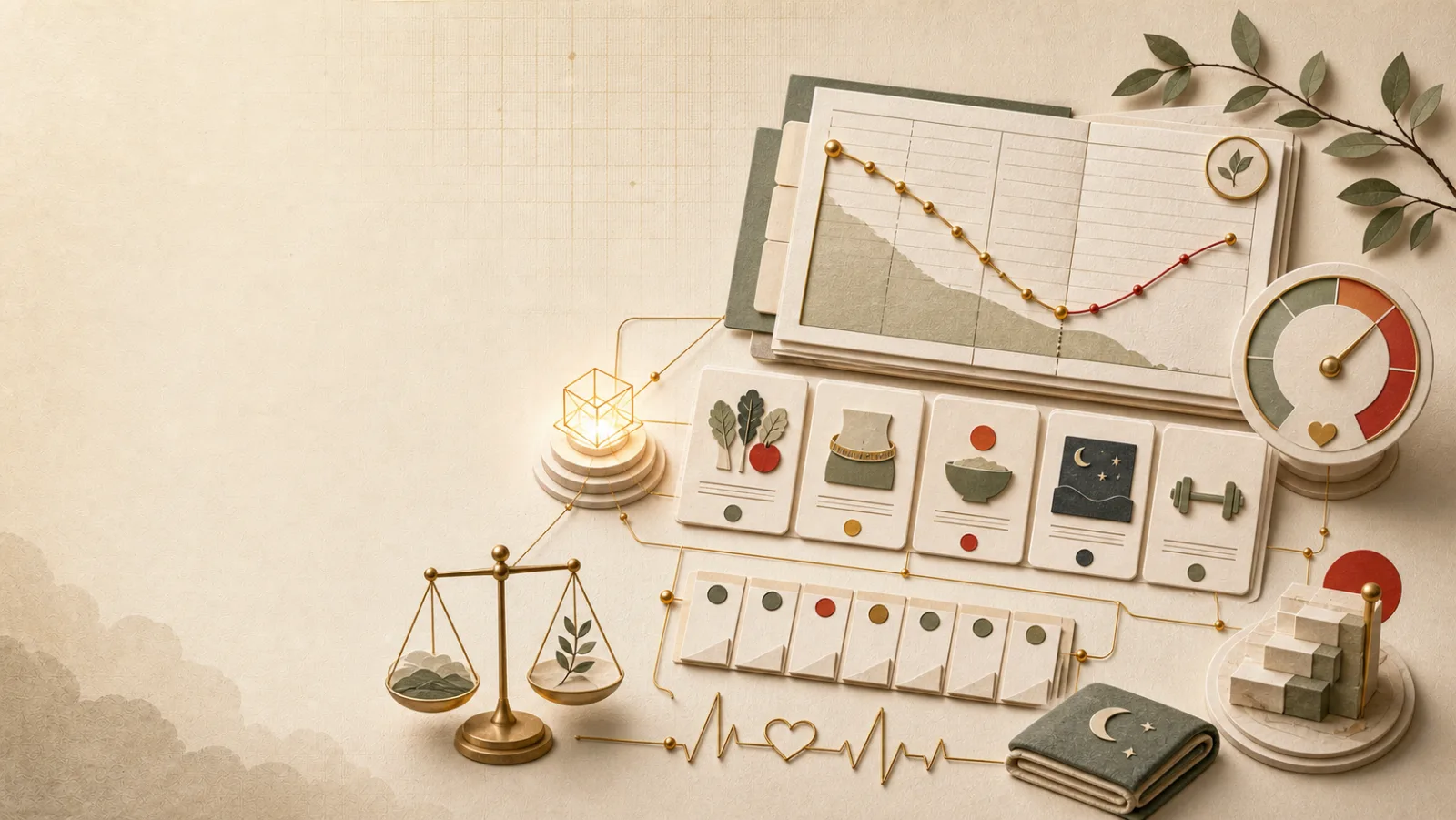
Xiaowei didn’t stuff our heads, she gave us a table that we could use to self-evaluate on the spot. She used a phrase that I like very much: “Age is not a problem, failure to take stock is a problem.” The whole scene revolves around five body signals, and I compiled them into a collectible checklist:
- Vegetables: Don’t you see a fistful of vegetables in every meal? This is the minimum threshold for dietary fiber.
- Waist circumference: Tightening of pants, obvious belly when sitting down, and the ability to pinch a handful are all metabolic reminders. Waist circumference ≥90 cm for men and ≥80 cm for women is the warning line for metabolic syndrome.
- After-meal battery: Does it charge or power off 30 to 60 minutes after lunch? Lethargy is usually caused by eating too much refined carbohydrates and causing sharp fluctuations in blood sugar.
- Turn off your phone before going to bed: 30 minutes before going to bed, how many of your mobile phones, head, mouth, and lights should be turned off?
- Muscle deposits: When you become breathless when climbing stairs, get stuck when squatting, or your hands and feet become loose, you are losing muscle mass.
The smartest thing about this chart is that it doesn’t judge you, it just allows you to determine where you stand now.
Three concepts that were jotted down on the spot.
After listening to the whole thing, what really hit me was not the knowledge points, but several redefined concepts.
The first one is vegetables. Xiaowei said: “Vegetables are not meant to look healthy, but so that you won’t lose power after eating and can still be online.” I immediately changed this sentence into the language of productivity: We spend a lot of money to buy tools to increase efficiency, but we let ourselves use the computer for two hours every afternoon. A fistful of vegetables may be the productivity investment with the highest return rate, and it is also the most easily overlooked prerequisite for being a high-density worker.
The second one is the waistline and the scarlet letter. She described metabolic syndrome as “not a verdict, but an early reminder from the body.” The scary thing is not seeing the scarlet letter, but seeing it and saying “leave it alone” and then dragging it to the third level. This is exactly the same as my attitude towards the financial affairs of a one-person company: the numbers themselves are not scary, it’s the pretending not to see them that is scary.
The third thing, and what I think is the most important thing to take away tonight: “Health is not restored by exercising too much one day, but by not continuing to decline every day.” This is completely a negative teaching material about compound interest, reminding us of positive operations. Assets do not rely on one stud, but rely on less depreciation every day.
From taking care of yourself to supporting a family
Later in the lecture, Xiaowei’s tone slowed down when she talked about Changzhao. She said that the scariest thing about long-term care is not the care itself, but “your life that is suddenly changed”: once your parents fall, your time, emotions, money, and work will be reordered on the same day.
The solution she gave was restrained and not tear-inducing: the best filial piety is to take care of yourself first so that you can take care of others. Even when feeding the elders, she is very practical: “Taking care of the elders is not about stuffing them with nutrients, but making them willing to eat, able to eat, and eat enough.” I thought about this sentence for a long time, because it is equally true for “teaching” and “leading people.” The point is never how much you pour in, but whether the other party is willing to catch it.
My seven-day challenge
At the end, Xiaowei set a threshold that I agree with: health KPIs do not need to be great, but they need to be small enough not to fail and to be implemented for a long time. She asked everyone to choose only one of the five movements and do it for seven days.
I chose the “power off ritual before going to bed” for myself. The reason is simple: the thing that causes me the most problems is not eating, but staying up late with a vengeance. I always feel like I’ve had a busy day and want to leave more time for myself. But Xiaowei’s reminder is very reasonable. Poor sleep is often not a lack of a bed, but a lack of a shutdown process; and sleep is the time when the body truly metabolizes and repairs. For a person who relies on his brain for a living, this deposit cannot be overdrawn.
If you are also in this station of the sandwich generation, my advice to you is the same as hers: don’t rush to change your life today, just pick the one you feel most from those five signals, set a seven-day action that is too small to fail, and start accumulating. Health is an asset that must be taken into account continuously rather than improvising on a temporary basis. This also echoes what I have always believed: Whether it is body or career, truly stable people are those who know how to take stock of resources and operate in the long term.

📮 Do you want to turn AI into a tool to amplify yourself? Welcome subscribe to "Vista AI Inspiration Supply Station". I will regularly share first-hand experiences of AI applications, content creation and one-person company management, and help you turn your expertise into a cumulative asset.
Thank you, Teacher Xiaowei, for sharing this hour. Keeping your health to yourself is indeed the key to being prepared for the second half of your life.