I wrote a biography of Musk twelve years ago, and now I am reading "The Musk Book": What we should learn is not his scale, but his way of dismantling.

Do you believe it? I once wrote a biography of Elon Musk.
In July 2014, “He is Seriously!” co-authored by Yang Shifan and Wu Jurui. : “Iron Man” Elon Musk’s 10 Abilities to Change the Future](https://www.books.com.tw/exep/assp.php/vista/products/0010643088?utm_source=vista&utm_medium=ap-books&utm_content=recommend&utm_campaign=ap-202607 (opens in a new tab))” was published. It was probably the earliest book about Elon Musk in Taiwan. Time flies so fast, twelve years have passed in the blink of an eye.
At that time, it actually took a lot of effort to convince readers that this person was worth writing about. I really want to thank the editors of the publishing house for their favor. Thinking about it afterwards, maybe we wrote the book a little too early?
At that time, Tesla was still struggling with Model S production capacity, and SpaceX was still struggling with launch failures one after another. Writing a book about an entrepreneur who is often said to be a braggart is obviously not a safe bet in 2014.
Twelve years have passed, and Musk has gone from a name only known in the tech world to a person even my mother knows. And my interest in him has quietly changed: in the early days, I was curious about why this person was so brave. Now, what I want to know more is, what does he think?
So when Eric Jorgenson’s “The Book of Elon” came out, I read the English version without waiting for the Chinese version. Recently, I am very happy to see that Jinwei Publishing has introduced it to Taiwan. The title of the book is translated as “Musk’s Book of Books (opens in a new tab)”.
The parts of this book that are deliberately not written are its value.
First, let’s make it clear what this book is and what it is not?
In the preface, Jorgenson makes it very clear: This is not a biography or a gossip column, and the book does not spend any space on Musk’s family life or politics. If you want to read about love and hatred, Walter Isaacson’s biography is more exciting.
What Jorgenson did was another thing: he spent thousands of hours collecting, filtering, and editing Musk’s statements scattered in interviews, earnings meetings, tweets, and speeches over the past two decades into a usable thinking system. His last book “https://www.books.com.tw/exep/assp.php/vista/products/0011012422?utm_source=vista&utm_medium=ap-books&utm_content=recommend&utm_campaign=ap-202607 (opens in a new tab)” used the same approach to Naval Ravikant.
This approach resonates with me. Because the content work I have been doing in the past few years is essentially the same thing: precipitating judgments scattered everywhere into a reusable original. Jorgenson said it well in the preface. He said that it broke his heart to see life-changing ideas disappear into algorithms. I can totally understand this sentence.
The difference is that I am sorting out my own judgments, while he is sorting out other people’s. The latter is actually harder because you have to resist the urge to add insult to injury.
When we wrote biographies back then, we wrote about what a person did; Jorgenson’s book deals with what a person thinks. The former requires textual research, while the latter requires refinement, and refinement is more prone to distortion. This is also the rule that I kept in mind when I read this book.
What is most useful to me is the sequence of dismantling problems
The book contains sixty-nine core rules and four major modules. But if I had to pick one that really made the biggest difference to my daily routine, I would pick the Five Step Engineering Method.
Musk’s sequence is this: first question the demand itself, then delete the parts that can be deleted, then simplify and optimize, then speed up the cycle, and finally automate.
The key is order. But interestingly, most people do it backwards.
I have seen too many companies import AI adopt the method of moving existing processes to AI intact, and then announce that they have digital transformation. This is the last step in Musk’s sequence, but everyone regards it as the first step. The result is that a process that should not exist in the first place is automated more efficiently.
I have been saying the same thing in the past few years: The starting point for utilizing AI is not to pick tools, but to dismantle the workflow. Looking back now, Musk’s five-step engineering method is basically the engineering version of this sentence, and he emphasized the sequence even more harshly: not only must it be dismantled, but it must also be asked whether it is necessary to exist.
To be honest, I’ve made similar mistakes myself. A while ago, I helped automate a process for a certain company, and I realized halfway through: that step didn’t need to exist at all. I just did it this way in the past, so I never thought to ask why? It only took three minutes to delete it, but I had already spent two full days on the automation.
So, now I have developed a habit: any work that is to be handed over to AI, first ask whether it is necessary to do it. This question usually saves all the effort later.
First principles are not a slogan, they are a very tiring way of thinking.
The word “first principles” is now so bad that it has become almost a decoration. But the book reduces it to a very simple thing: don’t use analogies to reason, but re-derive from the physical level.
Musk’s most commonly cited example is batteries. At that time, the consensus in the industry was that battery packs cost US$600 per kilowatt-hour of electricity, and everyone said it could not be lowered because it had always been this price in the past. Musk’s question is: What materials are batteries made of? How much are these materials worth on the London Metal Exchange? Adding up the market prices of carbon, nickel and aluminum, the answer is about $80 per kilowatt hour.
The gap of more than five hundred dollars is obviously not a law of physics, but industry inertia.
If I apply this idea to my work scenario, it should be like this: When I am thinking about how long a piece of content work will take, I should not ask how long it takes on average in the industry, but what is the physical lower limit of this matter? What is the truly incompressible part of writing an essay? Is it a judgment, a choice, or those experiences that only I know? The rest of the data collection, formatting and multi-platform rewriting can all be carried out.
This kind of training in simplifying complexity is not limited to the technology industry. I had a similar experience when reading “Techniques of Dismantling Problems”: if you dismantle a complex matter to the point where it can no longer be dismantled, the answer will often emerge on its own.
But I’m also going to be honest: This way of thinking is tiring. It requires you to ask the why of every habitual behavior afresh, something the human brain is hard-wired to resist. Therefore, first principles are not something to talk about, but to be used in key decisions. You can’t think this way about everything, that would be paralyzing.
My reservations about this book
After reading this, you probably think that I am going to recommend it unconditionally. Oh, no.
There are two places I want to remind everyone.
First, there is an inherent risk in a book like this that systematizes someone’s ideas: it will make those ideas appear more coherent than they actually are. The real decision-making scene is often chaotic and full of luck, timing and hindsight. When you condense twenty years of conversations into sixty-nine rules, those rules will read with a sense of inevitability, as if you will succeed if you follow them. But Musk has also failed many times, but the failure part is not easy to become a rule.
I particularly feel this. When we wrote the biography twelve years ago, we had in our hands the twists and turns along his journey; and when these twists and turns were compiled into methodology, the elements of hesitation, luck, and narrow escapes were smoothed away.
Second, and what concerns me more: Musk’s approach has huge hidden costs. That crazy sense of urgency, sleeping on the factory floor, and pushing the team to the limit may be cost-effective given his scale and resources, but copying it to a small company or one person will often just end up burning yourself.
The book mentions that in the face of crisis, he did not rely on blood to support himself, but relied on an extremely rational execution system. I agree with the first half of this sentence, but I would like to add another sentence: Although the rational execution system can be learned, the intensity of burning does not need to be learned deliberately. The reason is simple, because these two things are tied together in him, but they can be separated in you and me.
This is why I think that when one-person company or a small team reads this book, what they should learn is not its size, but its method of disassembly.
I also wrote about this when reading “Amazon’s Digital Growth Mindset”: It’s not about learning to grow bigger, but learning about Day 1. You can’t copy the scale of large companies, but the way they think about problems can be used by you today.
Twelve years later, have my views on this person changed?
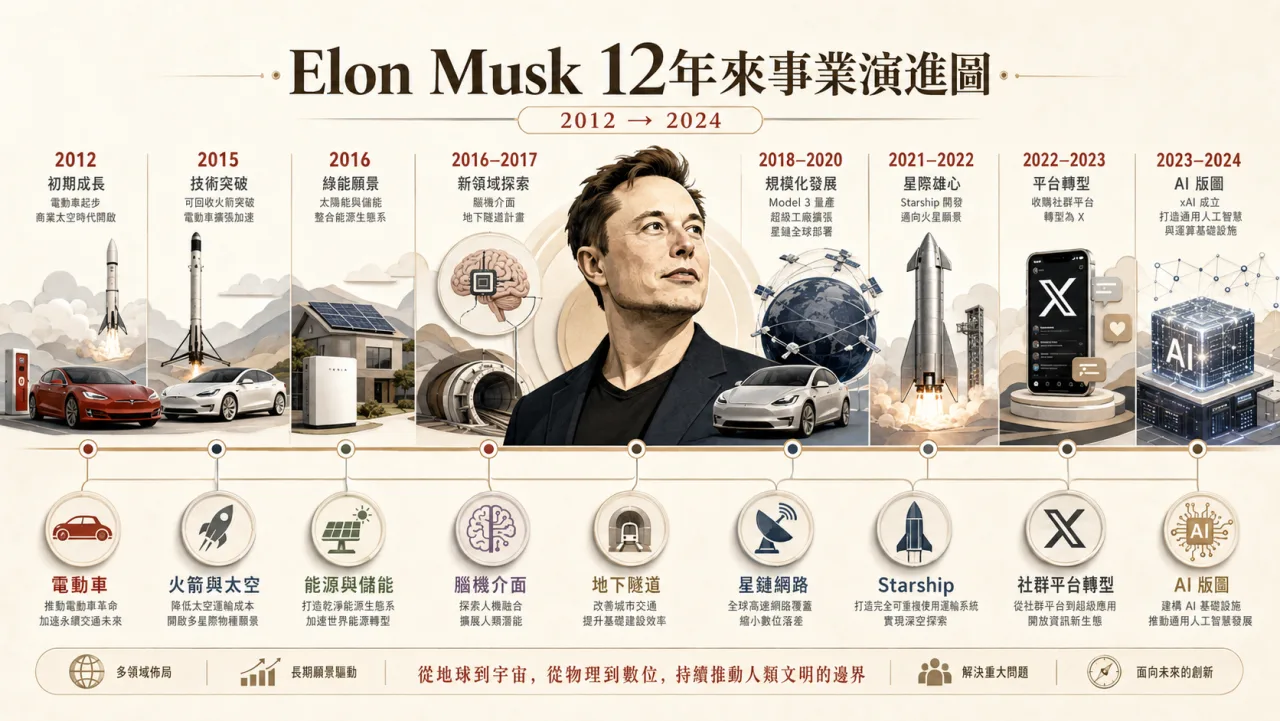
When I wrote my biography in 2014, I positioned Musk as a person who dared to bet on life. Looking back now, I don’t think that description was accurate enough.
What’s really special about him is not that he dares to bet, but that he breaks down the bets to the point where they can be calculated. For example, he deduced the possibility from the physical level and used engineering methods to shorten the correction cycle. Then while others were still meeting to discuss the feasibility, he had blown up three rockets and knew how to modify the fourth one?
In other words, he does not dare to take risks more than others, but converts risks into engineering problems earlier than others.
Jorgenson makes an observation in the book that I really like: In the past, the richest person on earth was often a king, an oil heir, or a financier. Today, the richest person is an engineer, an entrepreneur, and an American immigrant. We are learning to honor the Creator (opens in a new tab), not the rulers.
This sentence is an encouragement to everyone who makes things (opens in a new tab).
If you only have one afternoon
This book is not too thin, but its structure is very friendly. The four parts can be read separately, and the overall texture makes people put it down.
If you are an entrepreneur or are leading a team, it is recommended that you read Part 2: Extreme Execution, the most practical chapters on the five-step engineering method and organizational design. If you’re looking for a direction worth investing in, Part 1 Pursuing a Mission will give you some different questions. As for the stories of PayPal, Tesla and SpaceX in Part 3, they are the easiest to read, but they are also the easiest to read as inspirational stories. It is recommended to save them until the end.
What I return to most often are the sixty-nine rules at the end of the book. Not because they are deep, but because they are short. When I’m stuck on a decision, I scan the pages and usually find a question I haven’t asked myself.
If a book can do this, it’s already worth keeping on hand.
Twelve years ago I wrote his story, and today I read his method. What separates these two events is not only the distance between him from the verge of bankruptcy to the richest man in the world, but also the distance between me from a curious observer to an operator who has to make decisions every day.
The person mentioned in the book is still the same, but the people reading it have changed.
Next step
Bring this topic to your team
Vista Cheng speaks and runs workshops on AI workflows, writing and content systems for companies, schools and public agencies.