Self-discipline is not asceticism, it is the multiplication of freedom: Listen to Liu Yiyou talk about "Self-Discipline to Freedom"
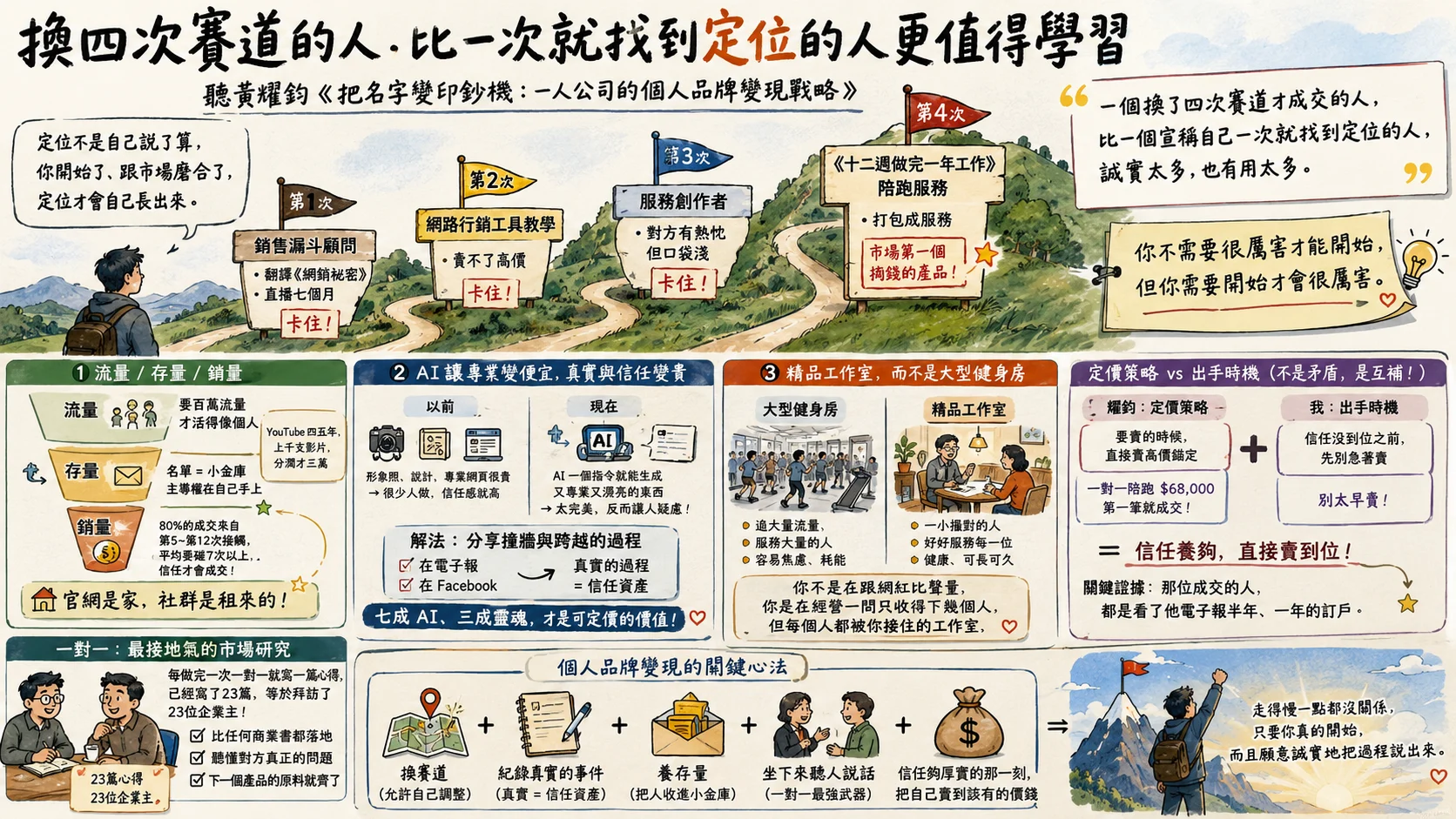
Our biggest misunderstanding about “self-discipline” is that we think of it as a kind of asceticism: getting up early, giving up sugar, making one percent progress every day, and tightening our willpower like a muscle. However, this kind of thinking can easily have a fatal side effect - it makes you more anxious the more self-disciplined you are, and the harder you work, the less happy you are. After listening to this interview with Liu Yiyou, my biggest gain is not to learn new methods, but to better understand a contradiction: some friends have done a lot of things this year, but never feel that they are “self-disciplined.” The problem is not whether they work hard enough, but that they have got the definition of self-discipline wrong!
Last night, I listened to Reader’s Facebook Live broadcast, and my friend Liu Yiyou came on the show to share. The entry point of his book [“The Skill from Self-Discipline to Freedom”] (https://www.books.com.tw/exep/assp.php/vista/products/0011051871?utm_source=vista&utm_medium=ap-books&utm_content=recommend&utm_campaign=ap-202606) sounds a bit counter-intuitive. Most success studies tell you that self-discipline can buy freedom, but he said that these two things are opposed by most people - it seems that if you want self-discipline, you have to sacrifice freedom, and if you want freedom, you cannot have self-discipline. The solution he gave was to multiply them, not subtract them.
Freedom is a multiplication, not a penance
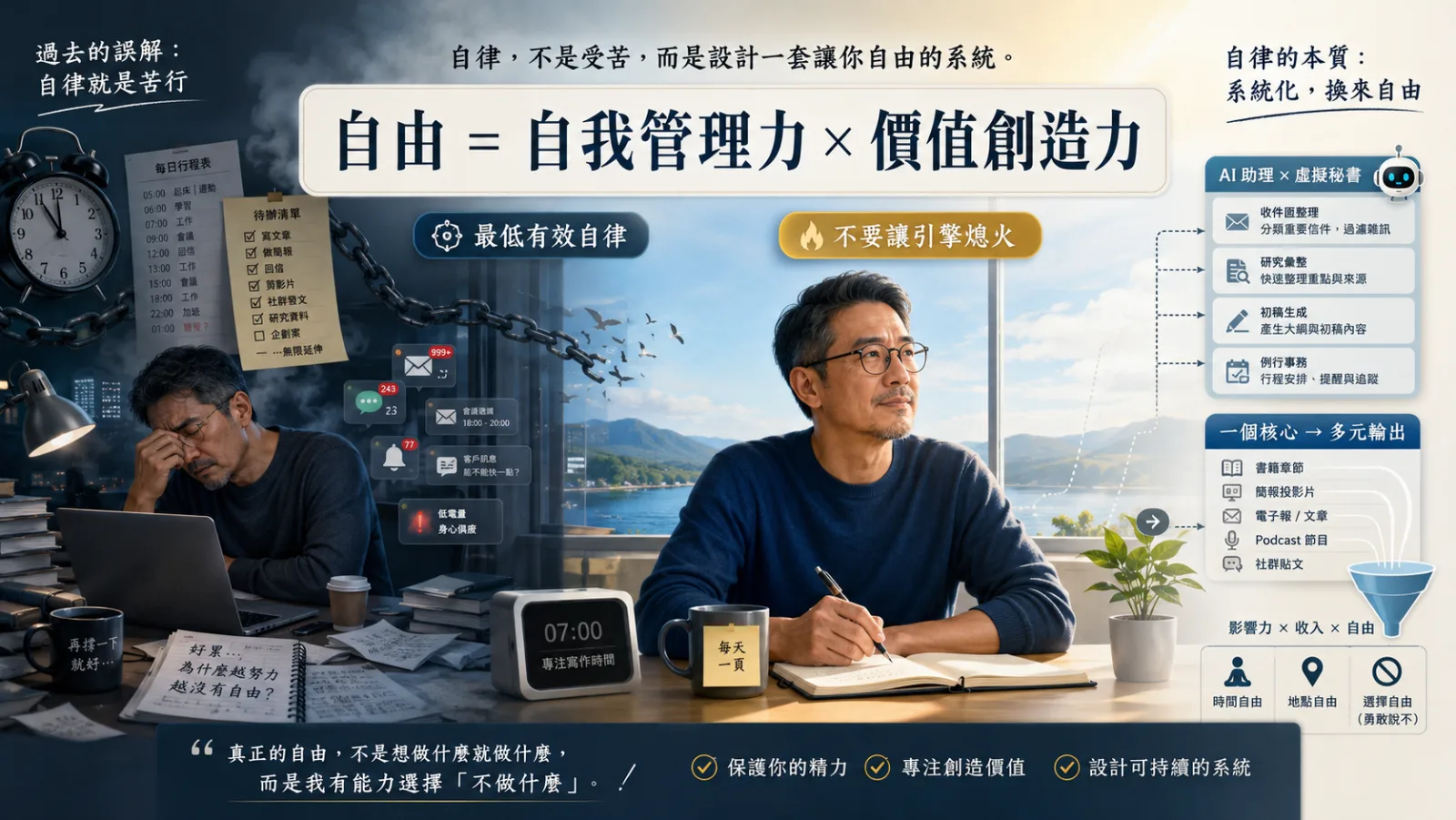
In his book, he proposed a formula that I found very interesting: freedom = self-management × value creativity.
The key is that “multiplication sign”. Self-management determines your lower limit, and value creativity determines your upper limit; as long as one side is zero, multiplied to zero. With high self-management and low value, you are a screw with a regular schedule, stable but can be replaced at any time; with high value and low self-management, you are an out-of-control genius with amazing output but no organization dares to keep you. Real freedom is when both parties are high enough, and when you want to say no, you have the confidence to say no.
Many people’s self-management has been relying on hard work for a long time - relying on weekend explosions and improvising, rather than relying on a system that can continue to operate. Liu Yiyou’s multiplication reminds us: we cannot put all our bets on the upper limit and let the lower limit continue to leak.
Furthermore, his definition of self-management is also worthy of reference. He said that the essence of self-management is to clear the load on the brain - just like if you open too many apps on your mobile phone, it will be unable to run. If your life is hijacked by to-do lists and group messages, your brain will not be able to make room for what is really important. I got this right accidentally.
This year, I handed over a lot of routine work to AI and a virtual team of secretaries: morning newspapers, inbox offloading, first drafts, and information checking. I outsourced more than half of the cognitive load of “deciding whether to do something and when to do it.” Liu Yiyou even directly said that both self-management and value creativity can be outsourced - find managers to supplement constraints and teams to supplement creativity. Freedom does not need to be carried by one person.
Minimum effective self-discipline: I only need to write one page every day
After listening to the whole episode, the concept that impacted me the most was “minimum effective self-discipline.”
He borrowed the “minimum effective dose” from medicine: start with the lowest effective dose, and maintain the effectiveness as long as it is effective. Add more if it is not enough, because overdose will have side effects. The same goes for self-discipline - you can’t be at your peak 365 days a year, you’ll get sick, you’ll get tired, you’ll have emergencies at home. If you ask yourself to achieve 100 points every day, as long as you fail in one day, it will be a serious round of self-blame and internal friction, and internal friction is the murderer that makes you really give up.
His solution is to set a startup threshold that is so small that it will not fail: when you work overtime until you are very tired at night, you don’t have to force yourself to write a thousand words, you just need to turn on the computer and write one sentence. Behind it is the law of inertia - after pushing things forward, only a small amount of effort is needed to maintain them. The most laborious and terrifying thing is always “stopping and restarting”. So the real goal of self-discipline is not to do the same amount every day, but to not interrupt.
For example, if I set myself a goal of writing two thousand words a day when writing a book, I might be forced to stop writing after a few days! But if the standard can be reduced to “opening a file every day and writing one paragraph, it will count”, it will be easier to implement it all the way. Of course, the same logic applies to making briefings: we don’t need to ask ourselves to complete a briefing in an afternoon, we only ask to advance it a few pages every day. Liu Yiyou used one sentence to help everyone explain this experience clearly - if your condition is good, do more, if your condition is bad, do the minimum, but never let the engine stall.

🛰️ Want someone to accompany you to see clearly in the wave of AI changes?
Almost all the public articles you see are finished products after repeated polishing. But what I cherish the most are the warm judgments before the finished product - this is exactly the reason why I created [Vista AI Inspiration Supply Station] (https://www.facebook.com/iamvista/subscribe/): a weekly thought note for fellow travelers in the AI era, sharing those Yoshimitsu Kataha that will not appear in formal articles with you who are willing to get closer.
The antidote to burnout is to take back a small amount of dominance
His perspective on job burnout is also very accurate. Most people think that burnout is caused by being too tired due to doing too much, so they want to relieve it by lying down and resting. However, when they return to work after taking a break, the feeling of powerlessness comes back immediately. Liu Yiyou said that the essence of burnout is not physical tiredness, but the loss of psychological dominance and the inability to feel the value - so rest only treats the symptoms but not the root cause.
The first prescription he gave was small but very graphic: to regain control for a short period of time in the day. For example, enter the company one hour early. During that time, you won’t turn on the computer or look at your phone, and just do what you want to do most. The point is that it’s also about controlling time. Using it to catch up on dramas and scrolling on your phone is a completely different experience than using it to do something of your own choice.
This is exactly the thing that made me feel the strongest when I went from being an office worker to a one-person company. I have a fixed period of [free writing and morning newspaper time] (/blog/do-a-good-job-in-self-management) every day. During that time, I don’t reply to messages or receive requests, and I just talk to myself. Frankly it doesn’t directly help with “output,” but it serves as an anchor for my dominance throughout the day. Without it, even if I finish a bunch of things, I still feel like I’m being pushed around at night. Liu Yiyou’s second prescription - to recalibrate your inner values and stop living to meet other people’s expectations - is also in the same direction as my own in recent years: to shift my positioning from what I can deliver to what I truly identify with?
One thing brings out several things: the trick I am most familiar with
The book uses two dimensions to filter the key 20%. I think it is the most practical tool in the entire episode. The first dimension is Leverage: After doing this, will other things become easier or even unnecessary? The second is controllability: Is the success or failure of this matter more than 60 to 70% in your hands? The reason why many people are tired is because they spend 80% of their efforts on things that consume high energy, low leverage, and low control. You are just a screw on the production line and cannot change the overall situation, so of course you feel tired.
After finding the 20%, the synergy he talked about is what resonates most with me: an article can be turned into pictures, podcasts, and various forms. When you do one thing, you can copy several outputs. This is almost the main focus of my work this year - [A briefing can be split into courses, grown into a chapter, and then fed into the funnel] (/blog/turn-teaching-into-long-term-assets-with-ai); the material of a speech can be reflowed into a book. Liu Yiyou himself also wrote the book in this way: he used the backward method to schedule back from the publication date, and then connected all the speeches and collected cases during the writing of the book into the same line. While writing the book, he was also preparing for the speech. It’s not about working harder, it’s about being smarter and letting everything build on each other.
Three adjustments for yourself
After listening to this episode, I don’t plan to memorize the entire book - this also echoes Liu Yiyou’s words about reading: The value of reading is not how much you know, but what it changes you; find something that can be used immediately, and you will earn it. So I leave myself with three concrete next steps:
- Make up the lower limit. If in the past we often tried to increase the upper limit (write more, do more), we should now spend the same amount of effort designing a self-management system so that output depends on mechanisms rather than exhaustion.
- All tasks must meet a minimum threshold. Every long-term project begins with a daily action that is small enough to not fail—a paragraph for a book, a page for a presentation, and the beginning of a sentence for an email. The standard is to run without interruption, not to rush without interruption.
- Hold on to that unproductive time. Free writing in the morning is not a luxury, it is an anchor of my agency. It needs to be scheduled and not discussed later.
Liu Yiyou finally talked about AI, which I want to use to wrap up. He quoted a study: when efficient workers use AI, their performance increases by about 30%; when inefficient workers use AI, their performance drops by 10 to 15% - [AI will amplify your original state] (/blog/a-cruel-watershed-in-the-ai). This sentence is a reminder to me who uses AI heavily: Tools will not help you build self-discipline, it will only amplify your existing self-discipline or laxity in equal proportions. So the real thing to take care of is never the tool, but whether the person pressing the button is professional enough and knows what he wants. Self-discipline is not about pushing yourself to the limit, but about one day having the confidence to say no to things you don’t want to do – that’s freedom.