AI can write articles, but cannot write your taste: Registration is open for the "AI Content Production System Workshop" on October 3

It was less than nine o’clock in the morning on August 30, and the classroom was already full of students. I moved the complete five-layer content production structure into the classroom and taught it for three hours.
The first unit talks about concepts and setting the environment; the second unit progresses from a simple idea to writing a first draft; the third unit refines the first draft and converts it into a six-platform format. There was a question in the middle, and I thought about it for a long time: If AI can already check information, draft, and change formats, then what else should be taught in this class?
My answer is: teach the three things AI can’t do.
Taste, judgment, temperature, AI cannot learn it in the short term
Anyone who has written articles using ChatGPT must be familiar with the feeling: the grammar is correct and the logic is smooth, but after reading it, something feels strange. Well, it’s not that the AI wrote it wrong, it just doesn’t taste like you.
The problem isn’t that the tool isn’t smart enough, it’s that you treat one-time prompts as everything you write. AI has no memory, so it doesn’t know which words you hate. It has no taste, so it can’t tell where to put this sentence. It also has no judgment, so it doesn’t know whether to keep or delete this paragraph. These things cannot be learned in a short period of time.
The solution is not to change to a stronger model, but to first build a style file for AI: throw in some of the most satisfying articles you have written in the past, and let it learn your tone, sentence structure, and wording. Then let the AI run a draft first, and then you will revise it yourself. I have tested it myself. After doing this, the AI flavor index of an article will drop from seven points to two or three points.
I have kept a 43-second classroom transcript of this discussion on judgment and style files. You can read it here in full: Why do the articles written by AI not taste like you? (opens in a new tab)
The real reason why content takes time is not that you are not good at it, but that you don’t have a system.
Content is actually a collective noun. Graphics, text, videos, short videos, feature films, all included. Many people think that their slow writing is due to poor writing skills. In fact, most of the reason is that the process is not systematic: they open blank files when they think of something, halfway through searching for information they forget what they originally wanted to write, and after writing, they have to re-cut it one platform after another.
The logic of the five-layer architecture taught in the workshop is very simple: the input layer organizes the scattered thoughts in your mind into structured materials; the research layer allows AI to verify, compile, and cross-reference; the production layer uses a narrative framework to draft; the refinement layer removes the AI flavor and injects your own story; the distribution layer automatically converts a master material into six platform versions.
How to connect the five links can be drawn more clearly:
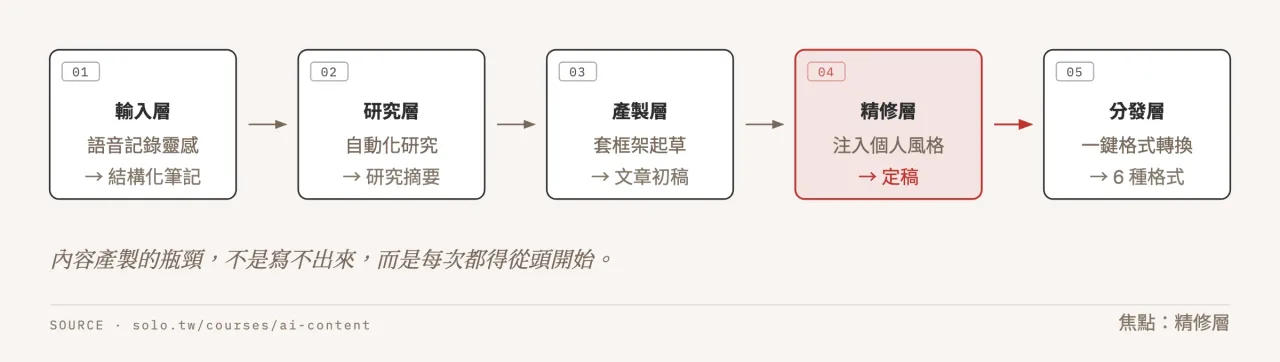
The ones marked in red in the picture are the finishing layers, they are not chosen randomly. The aforementioned style profile and AI taste index have been reduced from seven to two or three points. This is exactly what they do: the AI runs one round first, and the human edits it again to determine whether an article will sound like you in the end. Without the input layer and research layer, you will be slow; but without the refinement layer, you will be so fast that there is no soul.
There is only one principle throughout the whole process: you are responsible for auditing the drawings and verifying the results, and leave the implementation to AI, and then match the style file to ensure that the output is still your own voice.
The difference is clear when you look at it. The method of writing a one-time prompt is: remember the inspiration in your head, check the information and open a dozen pages to read it, rethink the structure from scratch every time you draft, and rewrite it again when you change the platform. One article takes four to six hours. The five-layer architecture is as follows: voice memos are converted into structured materials, AI automatically assembles research summaries, drafts using a fixed narrative framework, one main material is converted into six platform formats, and one article is compressed into forty minutes to one hour. The difference is not who can type faster, but whether there is a division of labor.
For a complete demonstration of this logic, I also left a one-and-a-half-minute class record: Complete workflow from inspiration to multi-platform distribution (opens in a new tab)
People who really become faster don’t change their typing speed.
A student once asked me: If it took only 30 minutes to write an article from eleven hours before, what has really changed?
The answer is not that typing has become faster, but that we can hand over the two links of checking information and drafting to AI, which we originally had to do ourselves. Student Liu Jing was more specific: After using Claude Code, the verification work that she had to do in the past became much faster. This class allowed her to start to look at collaboration with AI from a more complete perspective. Lin Junyi said that Claude Code is a friend he hired for 600 yuan a month.
Among the students on the first ladder, Bengo Li was most impressed not by the five automated processes, but by the very first step: establishing his own style profile. Peng Zhiwei said that this is equivalent to having a team of five assistants. For the first time, Josh Chao saw with his own eyes how AI Agent works: connecting workflows together through preset skills. Ma Shaoen observed that skill is not just a Prompt, but a workflow module that can be activated by a trigger word.
These words were not said by me, they were shared with me after the workshop.
Why should I teach this course?
I have been in the digital content industry for more than 20 years. I was the product director of “Wind Media” and the editor-in-chief of “Digital Times”. He has written 21 books, including “Learning Vibe Coding from Zero Basics”, “ChatGPT Question Course” and “Slow Reading to Understand in Seconds”. He has given more than 200 AI theme speeches and led more than 100 internal corporate trainings. The number of subscribers of “Vista Newsletter” has exceeded 19,000.
Anyone who has been in the editorial desk of print media or digital media knows that the issue of content production capacity is never new. Before the advent of AI, we were struggling with deadlines, cross-platform revisions, and inability to find materials. However, there were no tools to divide the work at that time, so we had to rely on human power. The title has changed several times over the years, but what has never changed is my persistence in “how content can be transformed from an idea into a publishable article.” After the emergence of AI, I did not throw away this set of judgments, but reorganized it into a set of processes: let AI do the execution it is good at, and leave taste, judgment, and stories to humans.
This is not a class where I parachuted in from other industries and followed the trend to teach AI. This is the system I use every day and teach you.
October 3, Taipei, sixteen seats
AI Content Production System Workshop
One piece of material is automatically produced in six formats, from input to multi-platform distribution in one go.
- Date: October 3, 2026 (Saturday) 9:00 to 12:00
- Location: Taipei City (will be notified after registration)
- Number of people: limited to 16 people
- Fee: NT$5,500, early bird NT$5,000 (register before September 12)
Six things will be taken away from the get out of class: five-layer architecture blueprint, six-format conversion template, personal style profile prompt, research automation process, MCP integration guide, and content scheduling template. There are only two things you need to prepare before class: a Claude Pro account, and two or three articles you have written in the past to build a style profile.
No need to know how to program at all. Claude Code uses Chinese natural language to operate, and the class can be taught from scratch.
If you already know how to use ChatGPT, do you still need to take this class? My answer is: the course teaches systematic methods, not tool questioning skills. You have already learned prompts. What you need to learn in this class is division of labor, not typing skills.
Early bird registration ends tomorrow.
Conclusion: You already know how to write, but now you have to write faster
Go back to the last ten minutes before the end of that class. Some students asked me, after learning this system, will I no longer have to think on my own?
I said no. What AI wants to do for you is what you are currently doing so hard: checking information, drafting, and changing formats. What you should do is what AI cannot do, make judgments, tell stories, and decide what this article wants to say.
You can write. Only now, you can write faster and still feel your own way.
October 3, Taipei, sixteen seats. I want to sign up.
Extended reading
Next step
Bring this topic to your team
Vista Cheng speaks and runs workshops on AI workflows, writing and content systems for companies, schools and public agencies.