For friends thinking about publishing a book: From topic selection to launch, the complete book publishing process I went through with "Zero Basics of Vibe Coding"
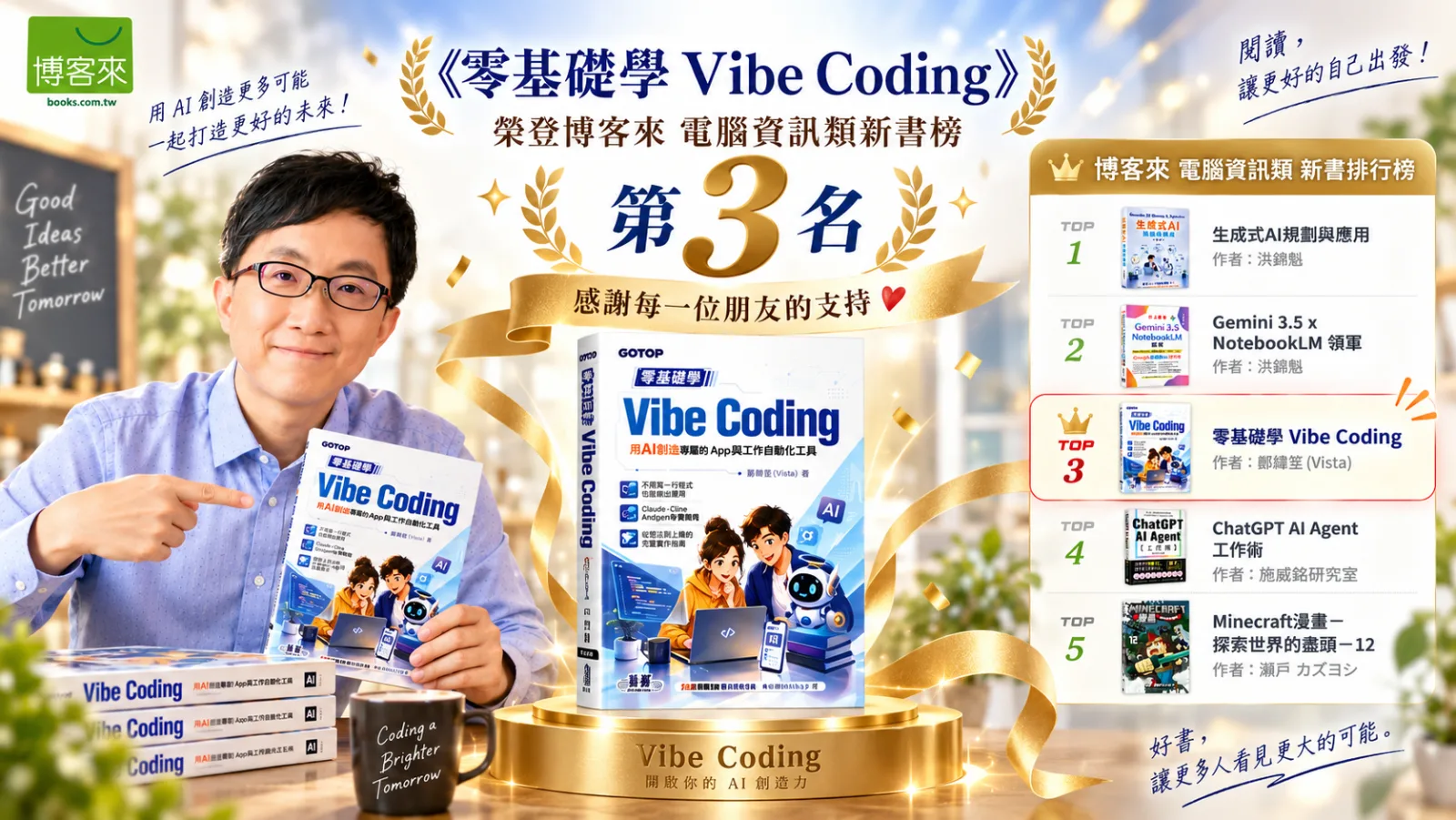
Today, “Zero Basics of Vibe Coding (opens in a new tab)” simultaneously appeared on the new computer information book lists of Bloglai, Jinshitang and Duzhu Life, and simultaneously took the third place.
Before writing this book, I had been thinking about a question: There are already so many books on the market that teach AI programming, but most of them assume that readers already know a little bit of program logic. What about people who have no basic knowledge and just want to use AI to do something for themselves? Where do they start?
This book is intended to answer this question. Without writing a line of code, you can rely on AI to make your own website, app, or even work automation tool. The book starts with the concept of vibe coding mentioned by Andrej Karpathy and helps everyone from idea to production. In the process of writing, the most common thing I ask myself is: “If someone who has never touched procedural programming is reading this book, will he get stuck at this step?”
The biggest significance to me of being on the list is not the ranking itself, but that it proves that this judgment may be correct: there is really a group of people waiting for an AI programming book that is written from scratch and speaks human language.
Here, I would like to thank a few groups of people in particular. Thank you to every reader who bought the book, read it, and even made something according to the steps in the book. Your feedback is the most direct acceptance of this book. Thank you to the editorial team of Qifeng Information for helping me turn my teaching notes into a book that can actually be put on the shelf, from structure discussion, text polishing to cover design. Publishing is never a one-man business.
Because of this, many friends have asked me the same thing in the past few days: I also want to write a book, where should I start?
So I wrote down the entire path, from topic selection, proposal, negotiation, writing, manuscript submission, proofreading, to the operations before and after the listing. This article does not talk about mental methods, but only practices. You can regard it as a process that you can follow.
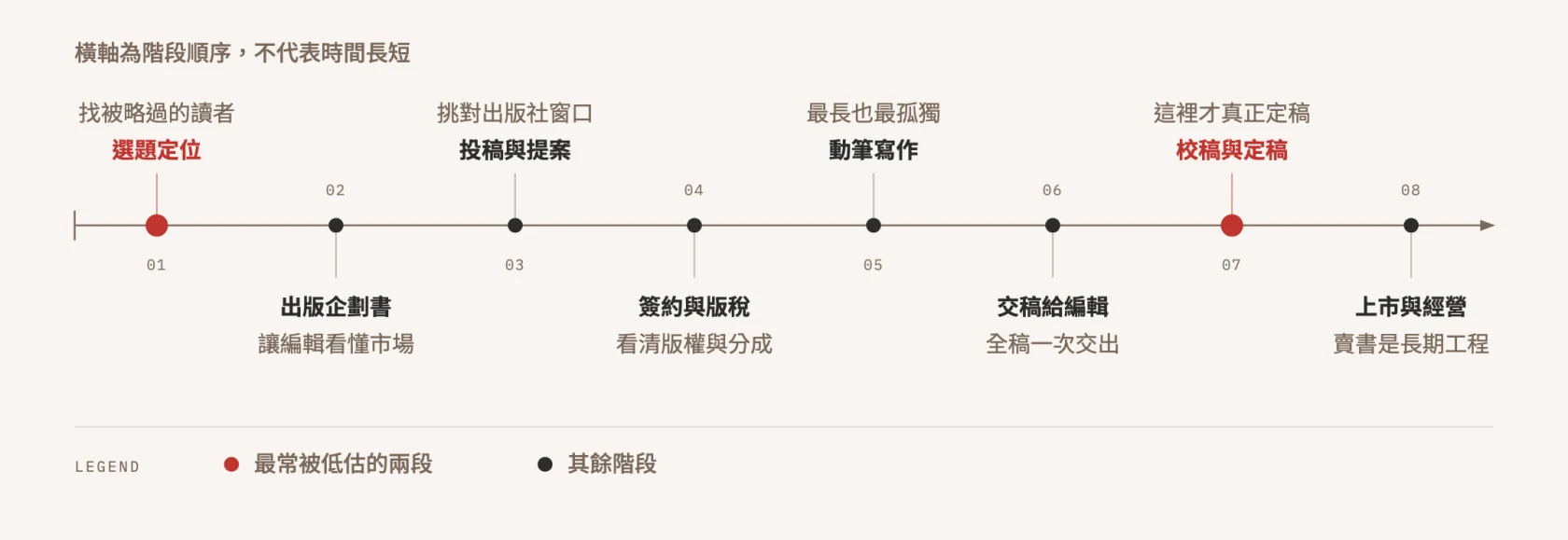
▲ Eight stages of book publishing: from topic selection to listing and operation
Before writing: first find a group of readers who have not been served.
The reason why most authors’ first books fail to sell is rarely because of their writing style, but mostly because they don’t have an audience who are clearly waiting for this book.
The most common way for novice writers to start is to ask themselves: What do I want to write most? There’s certainly nothing wrong with the question, but it’s not enough to support a book. A book is something that needs to be put on the shelf, something that needs to be picked up by a stranger in a bookstore, and something that needs to be decided to pay for within thirty seconds. Your wanting to write and someone wanting to read or buy are two completely different things.
A more useful question might be: Which group of readers is not taken care of on this topic? Or even skip existing books?
The method I use is simple and you can do it on a weekend afternoon.
Just walk into a physical bookstore and find the section corresponding to the topic you want to write about. Pick three to five books that are closest to you, open the table of contents and the first chapter one by one, and then write one thing in your notebook: What does the author of this book assume the readers already know?
After you finish writing, you will see a list. And that list is the audience that has been skipped.
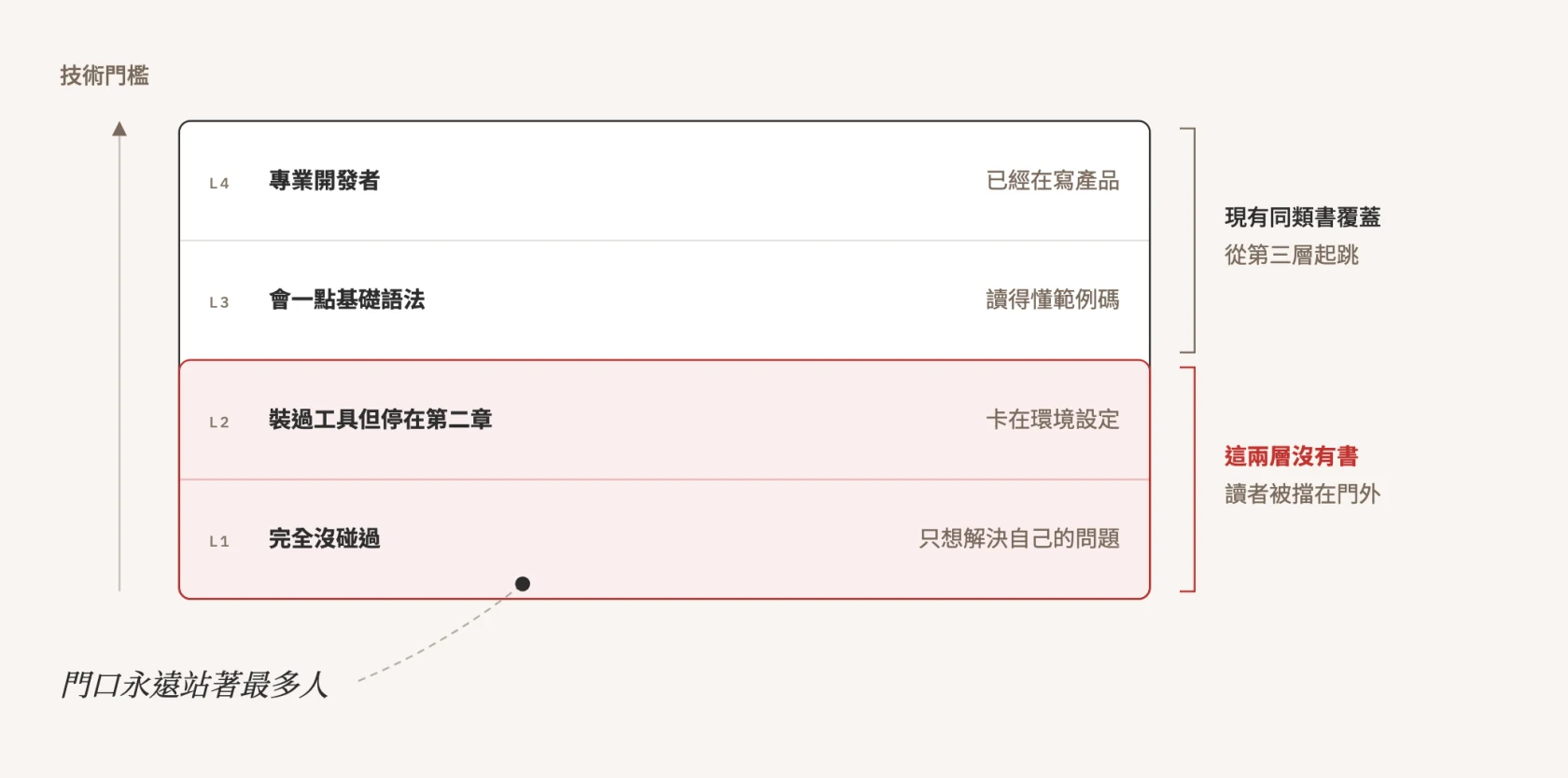
▲ Reader’s Ladder: Most existing books start from the third level, and the bottom two levels are vacant
I stood in the computer book section and studied for a long time, and the answer I got was: almost all books on teaching AI programming assume that readers at least know what variables are, what functions are, and what terminals are. Well, of course the author didn’t mean that. The person who wrote the book has already known it himself, and those premises are not considered premises at all in his eyes. But for an administrator, teacher, business or creator who just wants to make a small tool to save himself time, those premises are undoubtedly a high wall.
When you hit that wall, the theme is established. Your book does not need to be newer or better than others, sometimes it just needs to be one level lower than others.
Here is a criterion that you can keep for future reference: If your topic can only attract people who already know it, the market will be small; if your topic can catch those who are wandering at the door, the market will be large. You know, there are always the most people standing at the door.
On the other hand, there is also a very tempting but be careful topic: the concept is new and you are excited to talk about it, but no one is actually suffering from it or even willing to pay to solve the problem. This kind of writing is the most enjoyable, but selling it is the most difficult. It’s not difficult to judge. You just need to ask: Has anyone asked about this everywhere on the Internet? If you can’t find anyone asking, it’s probably too early.
Turning Ideas into Proposals: Six Things Publishers Are Really Looking for
After you have figured out the outline of your reader, don’t rush to write. The next step is to write a publishing proposal.
Many people get stuck here because the imaginary plan is a very formal and complete document. In fact, it only needs to answer six questions and be written in three to five pages.
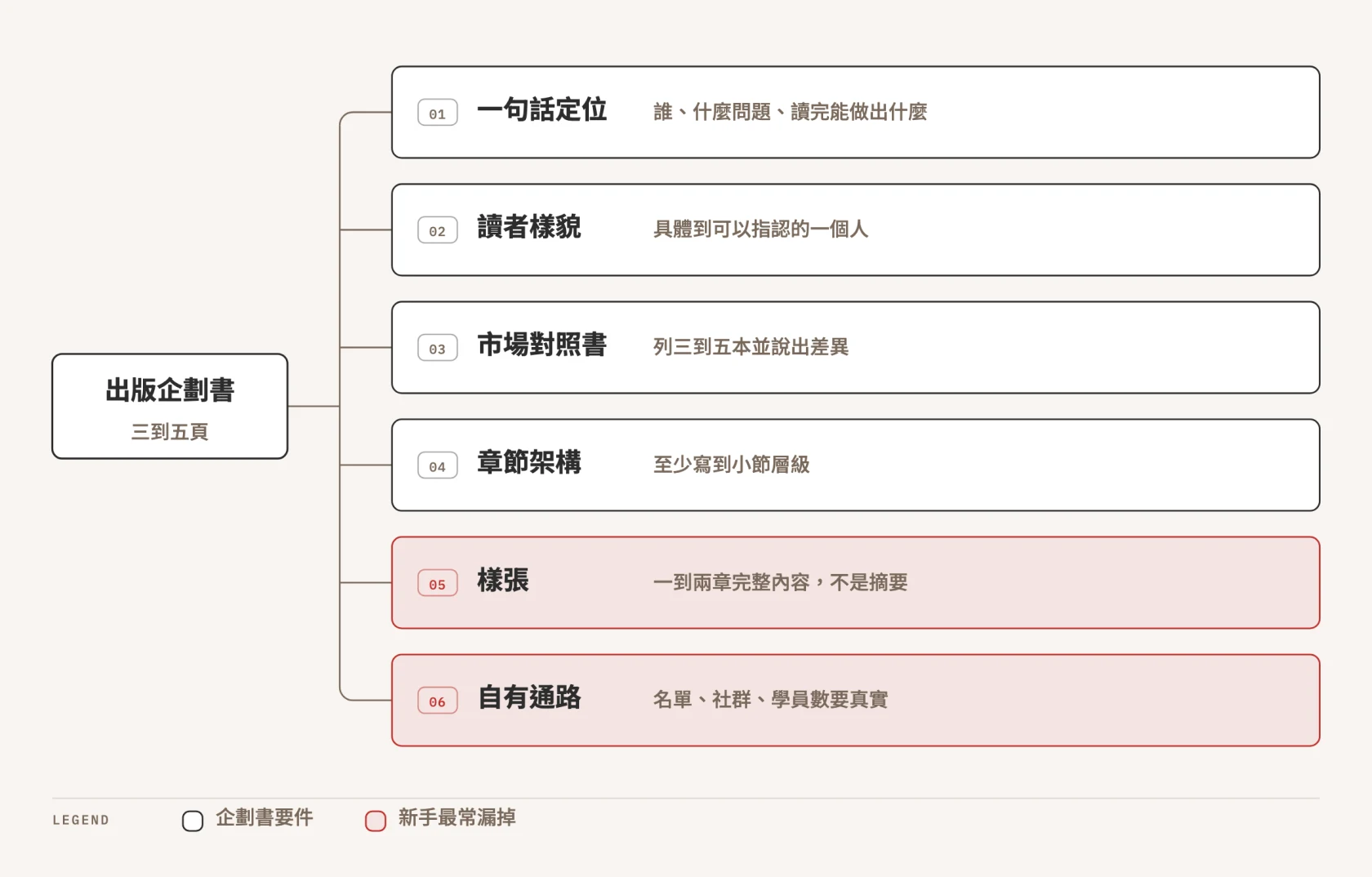
▲ Six questions to answer when publishing a business plan
First, positioning in one sentence. Who, what problems are encountered, and what can be done after reading this book. Pay attention to the last paragraph and what can be done. The value of a reference book is not that you feel something gained after reading it, but that you have a finished product in your hands after reading it. The answer to my book is: People who have never written a program can put their own website or widget (opens in a new tab) online using AI after reading it.
Second, the specific appearance of the target readers. Take my new book “Zero Basics of Vibe Coding (opens in a new tab)” as an example. Don’t write about office workers who are interested in AI. This way of writing is equivalent to not writing. Write someone you can identify: For example, a thirty-five-year-old executive who manually organizes reports for four hours a week. He has heard of ChatGPT but has never installed any development tools. He has bought several programming computer books, but they always stop at the second chapter. The more specific you are, the better the editor will be able to judge where the book should go and what the cover should look like.
Third, market comparison book. List three to five similar books and write down the differences between you and them. When the editor reads the proposal every day, he will automatically compare it with the existing book list in his mind. If you explain it clearly first, you will help him complete his homework. One thing please note, don’t deliberately disparage other people’s books, just make it clear that they serve different readers.
Fourth, chapter structure. Write at least to section level. This one will directly determine the editor’s trust in you, because it proves two things at the same time: you have thought clearly, and you can finish writing.
Fifth, proofs. Prepare one or two complete chapters, not just a summary, but a real finished product. The reason is simple, because what editors want to see is your writing rhythm, picture-to-text ratio, or explanation ability. These things cannot be seen by just looking at the abstract.
Sixth, the pathways you can bring in. This point is most often overlooked by authors, but it is an important part of decision-making. Publishers evaluate not only whether the content is good, but also whether the book can be sold. Your number of newsletter subscriptions, community tracking, number of course students, and units you frequently cooperate with can all be written in. Taking myself as an example, my “Vista Newsletter (opens in a new tab)” has nearly 20,000 subscribers, and the AI Community (opens in a new tab) I run has more than 110,000 readers. Just from my private area, I can reach more than 100,000 people.
Regarding the sixth point, I want to say one thing in particular: please write down the real numbers and don’t deliberately fill them in. Please don’t feel embarrassed because the number is small. An electronic registration list of 1,000 people may not seem like a lot, but if the open rate is high, it will be more convincing than 10,000 silent followers. Inflated numbers will only be revealed after the launch, and publishing is a long-term relationship that you will want to maintain many times.
After the plan is written, who should it be sent to? If you already know an editor, you may wish to send it directly to him. If not, look for publishers with similar books on your bookshelf. Almost all official websites have submission mailboxes. For the text of the letter, simply write three paragraphs: who are you, who does this book serve, and the attachments are the plan and sample sheets.
Negotiating a contract: Don’t be afraid, but ask clearly
If you are very lucky, after you win the favor of the publisher and receive the intention to publish, you will enter the contract process. Authors who publish a book for the first time often ignore the importance of the contract and accept all the terms offered by the other party at this level because they are too embarrassed to ask.
My suggestion is: the terms of the contract are meant for discussion, and making a list of issues and sending them to the editor is actually a sign of professionalism, not looking for trouble.
Here are a few things I think you should at least ask when publishing your first book. The practices of each publishing house vary greatly, so I won’t give you numbers, just questions.
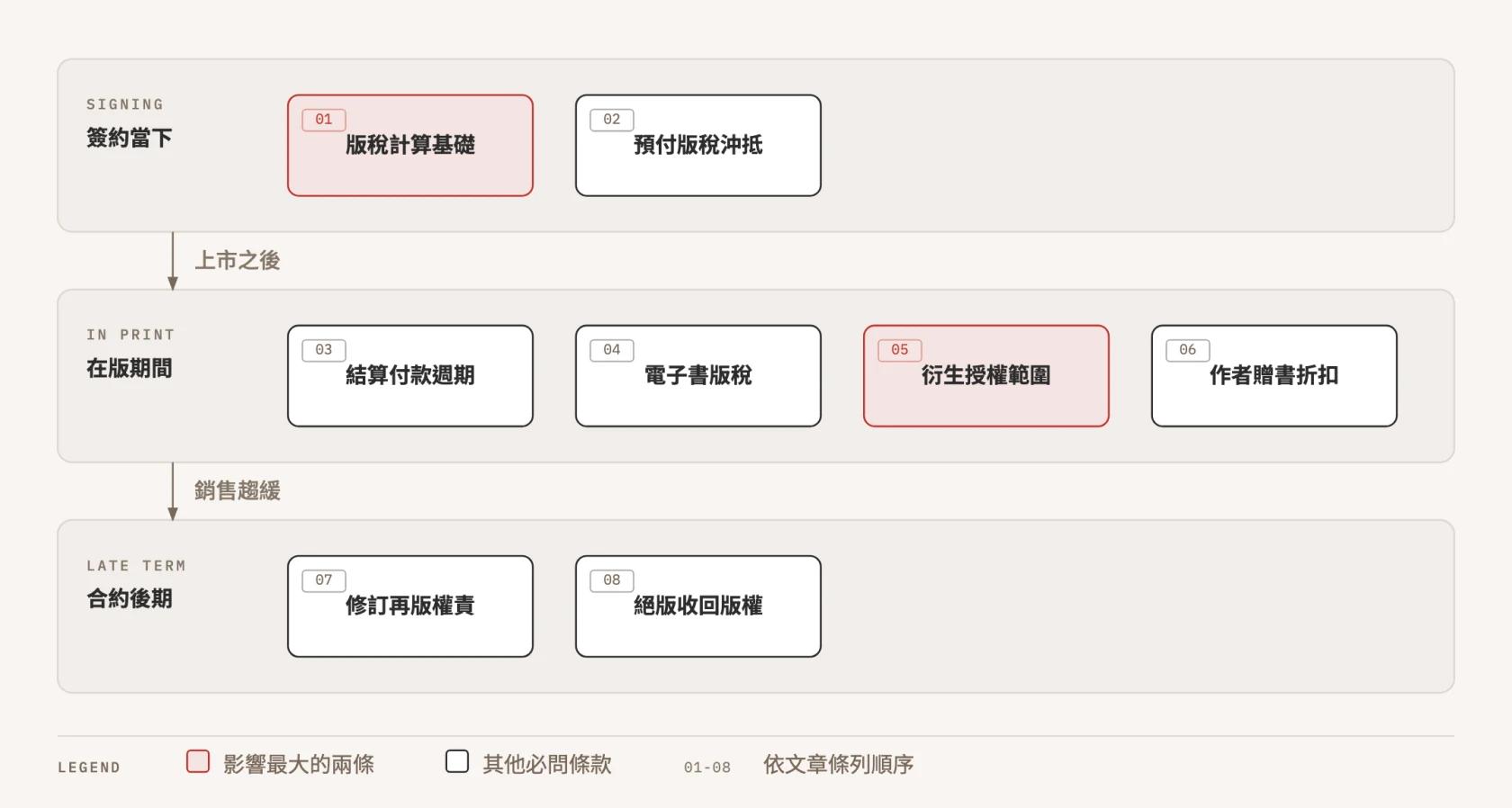
▲ Eight contract terms, each will affect you at what period
Is the basis for calculating royalties based on pricing or actual receipts? There is a big gap between the two, especially when the channel is discounted.
Settlement and payment cycle. How often does settlement occur, how long does it take to pay after settlement, and whether there is a minimum payment threshold. Last time, I met a friend who said that he only received the royalties two years after writing the book. It was incredible.
Are there any prepaid royalties? If so, how can they be offset?
How to calculate royalties for e-books and whether they are calculated separately from paper copies.
Scope of Derivative Licenses. Simplified Chinese version, foreign language version, audio book, adapted into courses or videos, who owns these rights and how are they divided? This is especially important for authors who are teaching. You need to make sure that you will not violate your contract by using the content of the book to teach.
Revision and republication. For technical books, in particular, you need to ask: If a revision is needed after two years, who will decide and how will the manuscript fee be calculated?
Out of print and copyright recycling. How long after a book ceases printing can I get the copyright back?
The number of books donated by the author, and the discount for the author’s own purchases. You may use these books when organizing events in the future, sending them to students, or sending them to recommenders.
After asking these questions, you will have a basic understanding of this contract. If there are passages in the contract that you don’t understand at all, you can ask AI to help you understand it first, or you can directly ask the editor to explain it in vernacular. This is a normal request.
Writing stage: treat the book as a product development
After actually starting to write, I suggest writing a book by developing products instead of writing articles.
What’s the difference? When writing an article, you count it as one after you write it. On the other hand, when making a product, you first define what tasks the user wants to complete, and then go back to the design process.
Taking the new book “Zero Basics of Vibe Coding (opens in a new tab)” as an example, I did several things.
First, each chapter corresponds to an outcome that the reader can accomplish. The way a chapter is defined is: after reading this chapter, the reader will have something more in hand. With this constraint, chapters do not bloat into lists of knowledge.
Second, ask that sentence once every time you write a step: If someone who has never touched the procedure is reading it, will he get stuck at this step? I asked this question hundreds of times throughout the writing process of this book. It forced me to write out a lot of actions I took for granted, such as what the window looked like, where the buttons were, and what to do when an error message popped up.
Third, find people with real zero knowledge to test. Don’t look for relatives, friends or peers, because relatives and friends will tolerate your shortcomings in writing, and peers will automatically help you fill in the steps you missed. Please find a friend who you have never met before and ask him to follow the chapter you wrote while you watch from the side and don’t help. Every place where he got stuck was a hole in the book that needed to be filled. This step is naturally painful, but the value of what it saves is higher than any polished manuscript.
Fourth, the material must be managed at the moment of writing. The screenshots should be marked with the software version and date of shooting, the instructions should be copyable, and your personal information should not appear on the screen. It is best to complete these processes in one step. It will be very painful to do it later because the interface has already been revised.
Fifth, progress is calculated by deliverable chapters, not by word count. The word count on Word will give you the illusion of progress. In fact, the value of a manuscript that is 80% written and stuck at the last 20% of a chapter is close to zero. Speaking from experience, I would rather finish it chapter by chapter.
Well, here’s another little-talked-about tip: write the third chapter first, not the first.
The first chapter and introduction are usually the most difficult parts of the book to write because they set the tone. When you haven’t written the entire book, do you usually not know what tone to set? Therefore, it will be much smoother if you start with a topic in the middle that you are most familiar with, and then go back to the beginning when the structure of the book is formed.
Special dilemma for technical book authors: Your book will definitely expire
If you are going to write a reference book or technical book, please read this paragraph carefully.
Your book may have a short lifespan, meaning it may expire soon. Software will be revised, interfaces will be rearranged, commands will be renamed, and even large language models will change from generation to generation. It usually takes two to four months from the time a book is submitted to the time it is put on the shelves, and this time is enough time to change a lot of things.
My processing principle is very simple, which is to divide the content into two layers.
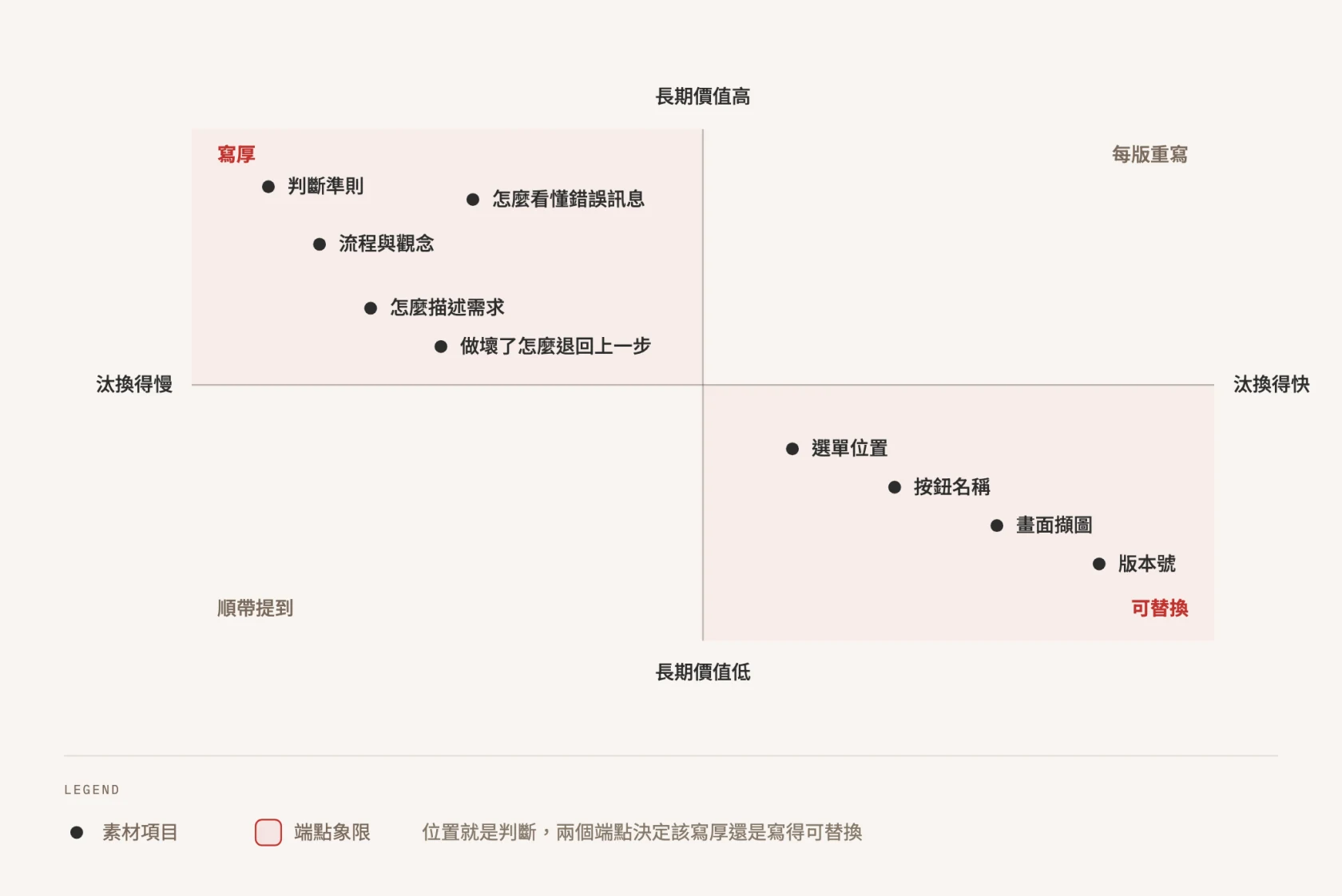
▲ Content freshness: two-axis positioning of replacement speed and long-term value The first level will not change, including concepts, processes, judgment criteria, how to describe requirements, how to understand error messages, and how to go back to the previous step when something goes wrong. This layer naturally needs to be written well.
The second layer will change, including screen shots, menu positions, button names, and version numbers. This layer should be written to be replaceable, and the version and date should be clearly marked to let readers know that it is normal for the pictures they see to be different from those in the book.
In addition, I suggest you leave an Online Update Page URL in the book and attach a QR Code. Firstly, readers will have a place to check when they encounter a revision. Secondly, this page will guide readers back to your own site for you and become the entrance to your subsequent business list. This needs to be planned before the book is sent to print because the URL needs to be printed in the book.
I have a simple criterion that can help you decide how detailed the content should be: if you teach where the button is, this paragraph will be useless after one year; if you teach how to judge when encountering this situation, someone will still benefit from this paragraph five years later. Therefore, try to teach methods as much as possible, don’t just teach buttons and interfaces.
Delivery is not the end: the period of collaboration with the editor is critical
Many authors think that it is over when they submit the manuscript. In fact, the other half of the journey begins only after the manuscript is submitted.
The editorial team does more for your book than outsiders imagine. Based on my experience this time, from architecture discussion, chart modification to cover design, every level is turning a teaching note into a product that can be put on the shelf. Your specialty is content, while the editorial team’s specialty is turning content into books. These two things are really different.
I give three specific pieces of advice to first-time authors.
First, please consider the editor’s comments as a gift. He was the last serious reader of the book before it was published, and he would constantly ask questions for stranger readers in the bookstore as he read. When he says he doesn’t understand something here, it’s usually not that he doesn’t understand it, but that he knows someone else doesn’t understand it. Don’t think of your editor as a troublemaker; he will be your best partner.
Second, proofreading should be arranged in a continuous period of time, not relying on scattered gaps. This is a lesson I learned just recently. I have another book that will be published at the end of the year, and the proofreading work for it has been on the to-do list for nearly a week, and it was interrupted by other things every day. Until I ranked it as the first priority of the day, it was all proofread and sent out in one day. Proofreading is admittedly a physical job that requires complete concentration rather than willpower.
Third, proofreading is done in rounds, and only one thing is done in each round. The first round only looks at whether the facts and code are correct, the second round only looks at the consistency of writing and wording, and the third round only looks at the layout, illustrations and numbers. Trying to take care of everything at once will result in missing out on every item. Instead of trying to do everything, focus on doing one thing at a time.
Well, there is one more thing worth preparing in advance: the recommended preface and waist copy. These require help from someone, and finding someone takes time. If possible, please start inviting invitations as soon as the manuscript is submitted, rather than waiting for the editor to urge you. When inviting, attach a complete manuscript or at least two chapter proofs, and clearly give the other party a deadline and word count range. This is basic courtesy and consideration.
Four weeks before launch: What authors can and should do
Each publishing house is good at its own thing, and they will also do marketing, but no one will do for you what the author can do.
The following is a list of what I actually did for this book publication.
Create a page belonging to this book. It is not a post, but a permanent web page that contains trial content, purchase links from various channels, extended resources mentioned in the book, and the online update page mentioned earlier. This page will be the landing point for all your promotions, and every subsequent article, speech, and letter will point to it.
Prepare all the path connections at once. Blog Lai, Jinshitang, Eslite, Reading Life, Shopee, momo, etc. The purchasing habits of readers are very different. If you put one less channel, you will catch one less group of people.
Plan your content properly instead of just posting ads. In the weeks before and after the launch, what you need is a series of content related to the book but valuable in itself, such as: an extension of a concept in the book, a practical demonstration of a certain chapter, and choices in the writing (opens in a new tab) process. Readers actively follow it because the content is useful, not because you are selling books.
Community schedules should be sent in batches. If you run multiple fan pages or communities like me, the audiences are actually highly overlapping. The same post will be posted everywhere at the same time, and the same person will see it several times in a row, which will give a bad impression. The method is to divide them into batches according to the degree of overlap of the audience, distribute them at intervals, and change the angle of entry for each batch.
Take inventory of your list. Newsletter subscribers are your most direct connection, but think of it as a network, not a broadcast station. The letter of listing must have content value, not just a hawking.
Align your lessons with presentations. If you teach, every session before and after the launch is a natural touchpoint. There is no need for a hard sell, it is natural to use the book as an after-class extension resource and provide it to students.
After IPO: Ranking is a signal, not a report card
After the book is put on the shelf, you will go through a very strange psychological process: constantly paying attention and refreshing the ranking.
My own experience is that it is gratifying to be on the list, but it measures short-term concentration, not the long-term value of the book. The real performance of a book depends on whether anyone is buying it two months later (or even two years later), whether anyone recommends it to friends, and whether anyone makes something based on it.
So, I focused on three things.
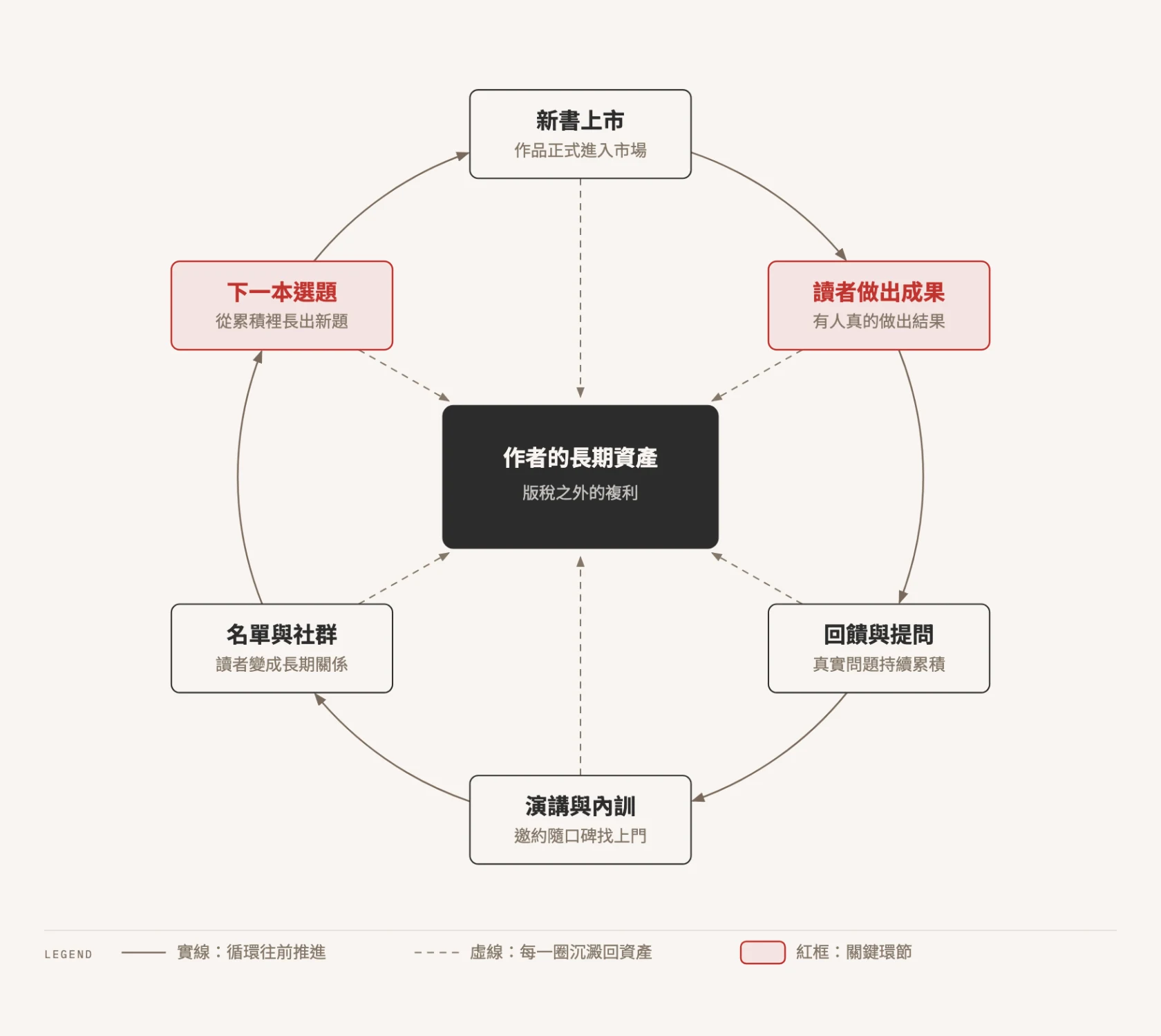
▲ Treat books as long-term assets: a cycle driven by a book
First, collect real usage feedback. Especially those readers who follow the book and make a finished product. Their process will tell you which chapter is good enough and which chapter is not enough. This feedback is extremely valuable and is the most precious material for the next book or revision.
Second, record which piece of content is most frequently asked. If the same question is asked more than three times, it means that the paragraph in the book is not clearly written. You can first write an article to make up for it, and then fix it in the revision.
Third, treat books as a long-term asset rather than a one-time activity. The book will continue to bring you speaking invitations, in-house training or cooperation proposals, and these follow-up values often far exceed the royalties themselves.
Checklist for coming up with your first book
Finally, I condensed the entire publishing guide into a checklist that can be directly compared.
Before publication:
- I can name a group of readers who have skipped existing books and know where they get stuck
- I can tell you in one sentence what readers will do after reading this book.
- I make a list of three to five books to compare with and I can tell the difference
- I finished writing the chapter structure down to the sub-section level
- I have prepared one or two complete proofs of chapters
- I took an honest inventory of the channels and resources I can bring to the table
When negotiating an appointment:
- I asked about the basics of royalty calculation, settlement cycle, e-books, derivative licensing, revised reprints, out-of-print recycling, free books and self-purchase discounts.
- There was no paragraph in the contract that I didn’t understand but I signed it anyway.
At the time of writing:
- Each chapter corresponds to an outcome that the reader can complete
- I have found real zero-based readers who have actually tested at least one chapter.
- Screenshots and instructions are marked with version and date
- Progress is calculated by completed chapters, not word count
After submission:
- Proofreading is arranged in a continuous period of time and is carried out in rounds
- Recommended prefaces and book waists will be invited as soon as the manuscript is submitted.
- The URL of the online update page is determined before going to print
Before listing:
- The permanent page of the book is now online, with trial reading, access links, and extended resources available.
- Content is scheduled instead of just a few promotional posts
- The community publishes in batches based on overlapping audiences
- The letter in the e-newsletter has actual content value
Writing a book, in the final analysis, is to explain things that you already know and know where others will get stuck, in an order that they can understand. The difficulty is not the writing itself, but the willingness to return to a position where you know nothing and look at the road again.
If you are preparing your first book, I hope this process will help you avoid unnecessary mistakes. If you want to know more details, you are welcome to discuss with me (opens in a new tab).
Finally, please allow me to say it again: publishing is never one person’s business. Finding a group of people who are willing to accompany you to turn your manuscript into a book is more important than anything else.
Next step
Bring this topic to your team
Vista Cheng speaks and runs workshops on AI workflows, writing and content systems for companies, schools and public agencies.