Watch my friend Yong Xi use AI to write a book: When the card box grows a third hand
Tonight, I made a cup of tea and clicked on Yongxi’s online live broadcast.
Speaking of Zhang Yongxi, I have known him for many years. In the early years, he lectured on “Handbook work methods from Japan” at Eslite Nanxi’s Life Lab, and I ran to listen to him against all odds. When his book “Unsuccessful Because You Are Too Fast” was published, I saw the display of new books in the stationery store, and I was secretly envious. So this time he said he wanted to share “How I use AI to write a book now”, and I almost immediately cleared out my schedule - after all, it doesn’t happen every day to see how a person who has been writing cards for many years translates his methods into AI.
Moreover, he dropped an exchange condition at the beginning that I found hard to refuse: to anyone who shares his experience on the open mic, he would give him an e-book link to the book; the condition was that you had to read it and then write an article about his experience to him.
“Because the most difficult thing about AI is that it doesn’t know what human beings really feel.” Yongxi said, “You ask it, ‘What makes you feel the most about this article?’ It will give you a hard answer every time. It has no feelings at all. So I need the feelings of real people.”
Well, this article is, in a way, my homework.
He turned a book into a world shipping map
The first thing Yongxi demonstrated was to throw the manuscript into a software called TheBrain.
This software has a history of thirty years, but it is completely different from the “folder plus file” we are familiar with. The folder is linear and branch-like; TheBrain is mesh-like, like a spider web—and, now, it’s connected to AI.
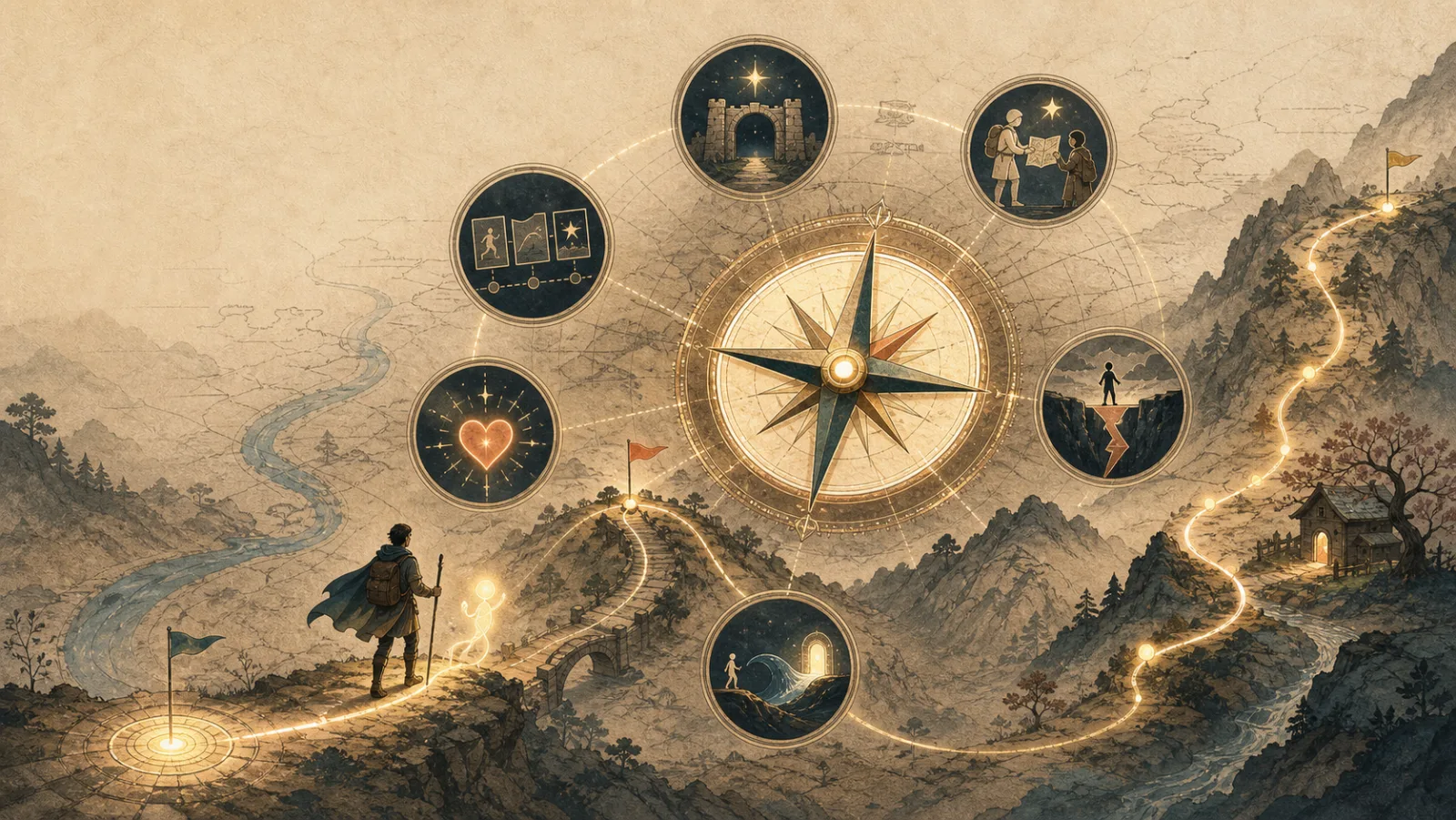
He opened a mental map and told us: Think of it as a world shipping map. Kaohsiung Port, Hong Kong, Los Angeles Port… Each port may be a nine-square grid or an eighty-one square grid. It is a “point”. But the focus has never been on how big a port is, but on the routes connecting ports.
He said something that I still remember today: How can the entire East Asia transform from the “sick man of East Asia” to an economy that is getting better and better? It’s because of shipping that we can exchange what we need. The same goes for the card box - at first there are individual cards, and then they are slowly connected into longer and longer thoughts, and then the thoughts are intertwined into a network. Just like the roots of a tree, when they grow to a certain extent, they will become entangled and correct their mistakes. At that moment, your speed of moving in this knowledge network will be several times faster.
For example, when we wrote articles in the past, we rowed between isolated islands; now what Yongxi is doing is to pave channels between these islands. You still drive the boat, but you don’t have to start from scratch every time.
What really made me “wow” was the semantic search
Yongxi broke down three ways to find things in books. I think it is worth writing down by everyone who does knowledge work.
The first is called Chapter Search - if you remember a certain concept in 3.2.5, just turn over it. The premise is that you have read this book. The second type is called accurate search - if you know that there is a rare name “Ume Tadashi” in the book, just search for this word. He said something very graphic: “I often buy a book just to search for a word.” Kindle can do both.
But the third type, Kindle cannot do - Semantic Search.
You don’t know the exact words used in the book at all, you only have a vague idea, throw a sentence in natural language to it, and it will find it. Yongxi demonstrated on the spot: He asked TheBrain’s AI, “Compare the difference between the nine-square grid and the eighty-one-square grid in the ‘whole system’ mind map.” This question is actually a bit difficult. The AI has to find two thinking paths in the book and then spell out their correspondence. He added a very honest statement: Even if the word does not actually exist in the book, it will find similar things and “hardly” put them together to generate a text for you - this is “generation”.
To be honest, I was a little shocked when I saw this paragraph. I am also writing a book myself, and the manuscript is scattered everywhere. I often feel like “I remember I wrote something similar somewhere” in my head, but I can’t find it. What the semantic search is looking for is exactly that “like”. What it captures is not keywords, but your vague intuition.
FIRE: Turn the accidental path into a highway
The skeleton of the entire sharing is a chapter in Yongxi’s book called FIRE Rule. Fire means more like firing or shooting. I took notes for him and myself:
- F (Fleeting/numbering): Temporary notes and numbering system. He talked about a piece of history that I particularly liked - during World War I, Vienna began to number house numbers for each house in order to recruit soldiers; the same thing happened in Japan, where Taichung’s East, West, South, and North Districts, Xitun, Nantun, and Beitun were essentially numbered for administration and military recruitment. Luhmann spent thirty years programming 90,000 numbers on 90,000 cards. To put it bluntly, numbering is not for neatness, but for “findability”.
- I (Index/Keyword): He listed 81 keywords and 8 core reference books. He asked AI to use the “weight” of the vector to help him sort out the most important words in each chapter, and then manually fine-tuned them.
- R (Root/Path): This is the part that he himself said is “the most important today”. He originally called it Reference and Relationship, but recently he finally changed it to a more satisfactory word - Root, which is the path. Take the path you accidentally discovered and turn it into an asphalt road, then a highway, or even a world-class waterway. R is the deep context of knowledge.
- E (E-book/e-book): Finally, it becomes a finished product that can be given to you and read.
What I particularly like is R. Yongxi said that a book that only has a table of contents but no index, and the relationship between the two is not well established, cannot be called a good book. He used the metaphor of a hammock: the hammock has to be tied between two trees, with only one side, how can you lie down comfortably? Directory and index are those two trees.
The third hand of the card box: Centaur
If I take away only one concept from this sharing, it would be the “Centaur Card Box”.
Yongxi divides the evolution of card boxes into three stages: paper (Lumann’s generation, purely handwritten, 90,000 cards in thirty years), digital (Obsidian, Hypertext, moved to computers), and the third generation - Centaur, human plus Agent. Semantic search, automatic classification, and automatic tagging may take three or four hours on Luhmann’s paper, and are difficult to do on a computer card box, but it can be done in a few seconds by AI.
The word centaur is very expressive. It does not let AI write for you, but allows you to retain the reins and AI to contribute. Yongxi asked AI to automatically classify the three parts of the manuscript, add labels with colors and icons, and even wrote a Skill to “automatically generate a nine-square grid summary.” After only ten days of learning, he “passed” this level.
As I looked at it, I suddenly thought of something: Those of us who write, what we fear most is never writing, but “facing a blank page.” Yongxi recounted that a friend of his who was studying for a Ph.D. in Berkeley would often open Word at night and cry at the blank screen—he had done countless research, but could not write a paper of the proper level. The Centaur Card Box explains exactly this: Don’t start from a blank page, but go back to your card box first, find a few keywords and a few opinion cards, so that there is something to connect to the page in front of you.
But what he really wants to talk about is the underlying logic
Halfway through the sharing, Yongxi suddenly slowed down his pace and said something that I thought was the most important thing in the whole session.
He said that when most people teach AI, they are teaching you tool technology—how to write Codex’s Skill, how to write TheBrain’s Script, and what are the differences between Claude and ChatGPT. But these will soon be surpassed by new tools. What really cannot be surpassed is the underlying logic you master.
Then he gave an example: That weekend, he was helping his wife in Meinong to make a production and sales resume for agricultural products, checking the land number, crops, and farmers’ identities one by one. He said that the underlying logic of this land number was exactly the same as the number on the note card. At this point, he even clicked on me and said, “Vista is very good at writing articles. He has been thinking about copywriting and marketing issues. It is also an accumulation of underlying logic.”
I was a little embarrassed to be told this by an old friend in public, but I was really hit. Because I have always believed in one thing: tools will change, but craftsmanship will not. AI has changed round after round, but “how to explain a point clearly and how to make readers willing to read on” has not changed in twenty years. Yongxi just repeated the same principle again on cards and numbers - what will be replaced is the standardization work; what will not be replaced is your accumulated judgment on a field. **
Written at the end: He hasn’t finished writing yet, and that’s exactly the point
Listening to the whole scene, what moved me the most was the passage where Yong-seok said, “I haven’t finished writing yet.”
He said that what he is doing now is not rushing to finish writing, but going back to write keywords and establish cross-links - making this book like wine, getting better as it ages. Only when he feels the wine is good enough will he release it.
I want to give this sentence to everyone who is writing something but feels that they “never finish it”, including myself who is writing a book. We often regard “finishing” as the end point, but Yongxi demonstrates another possibility: writing is not about filling up the words, but about weaving the context. When you develop enough routes between your cards, a lot of things will naturally emerge.
*Extended reading: Schenk Aarons’s “Card Box Notes” (reviewed by Yong Xi and Zhu Qi), Ume Tadashi’s “Technology of Intelligent Production”, Xu Rongzhe’s Bullseye Man Formula. *