It’s not that you don’t know how to tell stories, it’s just that no one told you that stories have a structure.
I often meet a kind of person. He obviously has a lot of experience, has been through many pitfalls, and has real materials at hand, but when he wants to tell these into a story that people will remember, he gets stuck. Then he would say the same thing: I’m not very good at telling stories.
I want to dispel this misunderstanding first. Storytelling is not an innate talent, but a structured craft. Those stories that make you fascinated when you hear them and make you cry when you watch them almost all follow the same path. You just never had anyone show you that path.
So I made a free little tool called Story Generator and put it in my AI lab. Before introducing it, I want to show you what the world-class storytellers are all doing.
Master storytellers are actually walking on the same path
Human beings have told stories for thousands of years, leaving behind many methods that have been verified repeatedly. I’ll pick the six that have the most profound impact and condense them for you.
The first one is Joseph Campbell’s Hero’s Journey. He studied myths from all over the world and found that their skeletons were surprisingly similar: an ordinary person received a call and left the familiar world, went through trials and the deepest trough, and finally came back with changes. From “Star Wars” to “The Lion King”, this structure is used.
The second is the story spine of Pixar. This is the most commonly used formula within them. It is as simple as one sentence: Once upon a time there was one…every day…until one day…because of this…until the end… Don’t underestimate it, the core of “Finding Nemo” and “Toy Story” can all be supported by these few sentences.
The third one is Donald Miller’s StoryBrand. He reminded brand people of one of the most common mistakes: in a customer’s story, the protagonist is always the customer, not you. At most you are the guide who hands the hero a map. No one wants to hear a brand story that puts you as the protagonist.
The fourth is screenwriter master Robert McKee. He revealed the essence of the story in one sentence: the story lives in the gap between “expectation” and “reality”. Without conflict, there is no story. A smooth running account is the most boring thing.
The fifth one is the Heath brothers who wrote “Creative Viscosity”. They studied why some information is remembered and others are forgotten in a second, and the conclusion is that concrete, emotional, and unexpected stories stick far better than abstract truths. A good story is worth a thousand theories.
The sixth one is Nancy Duarte, the queen of briefings. She dismantled countless excellent speeches and found that they were all doing the same thing: swinging back and forth between “current situation” and “beautiful possibilities”, using that gap to create tension that made people sit still and wonder what happened next.
Have you noticed that they are actually talking about the same thing? A person wants something, encounters obstacles, goes through twists and turns, and finally comes back with changes. This is the greatest common denominator of the story.
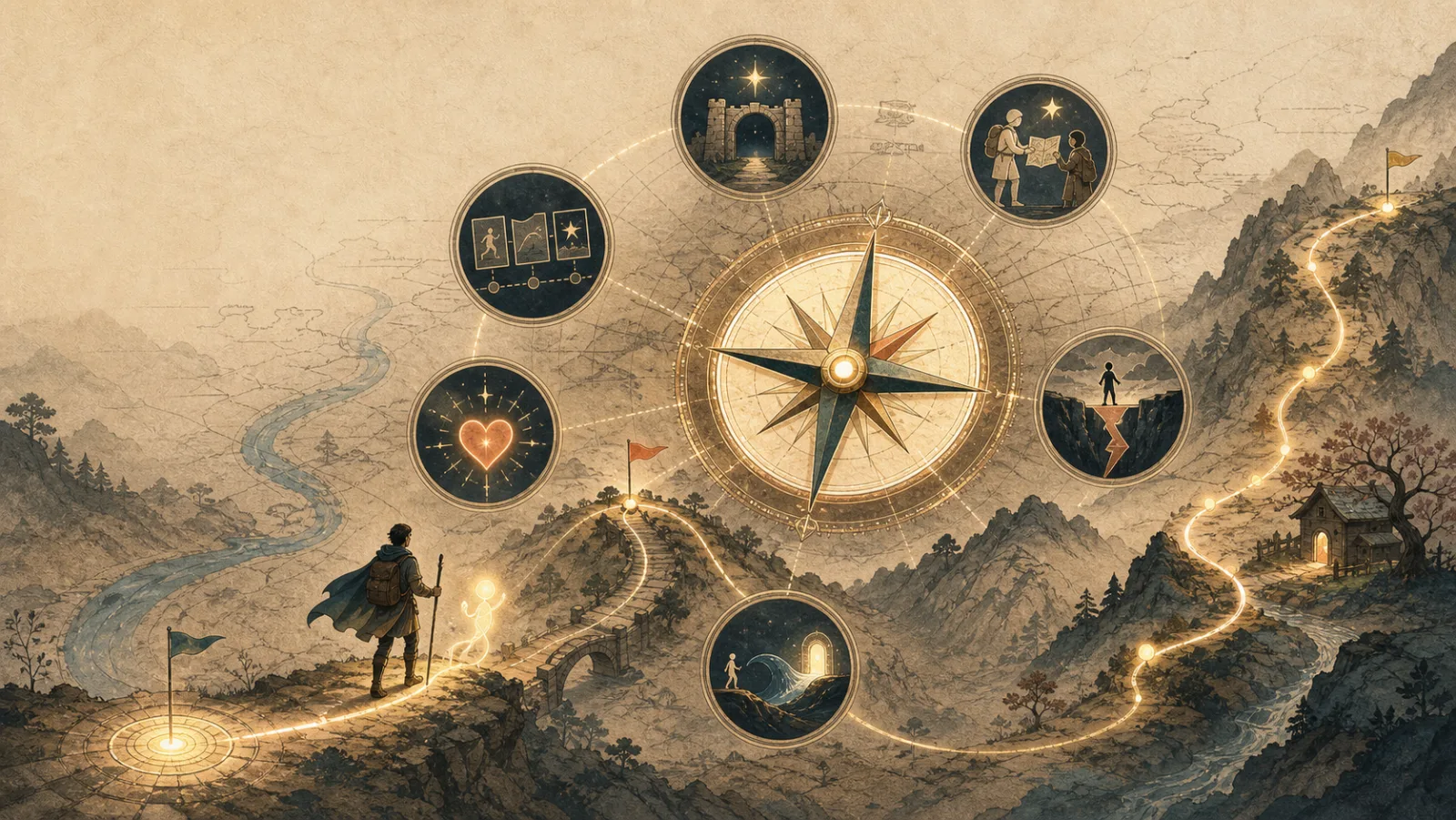
I put these thoughts into a set of “Story Compass”
Just because you understand the truth, doesn’t mean you can write it. So I put the above masters’ ideas into a framework of my own design, called “Story Compass”, and then made it into a tool that will guide you step by step.
It breaks a story into three parts, just like the ups and downs of the hero’s journey:
Departure is the beginning of the story. The principle here is to talk about events, not data, and talk about details, not superficiality. Don’t start with “statistics,” start with a picture you can see and smell.
Challenge is the engine of the story. Write out the conflicts, pain points, and the low points that make people stuck, and then give a twist: until one day, something happened.
Harvest is the return of the story. Write out the results and changes, and echo the theme word you planted at the beginning, so that the whole story can be recovered.
Before you start writing, the tool will ask you to anchor three things: who am I, who is the hero of the story, and what is the core of this story. These three questions may seem simple, but they are the ones most people miss and the ones that most easily make the story lose focus.
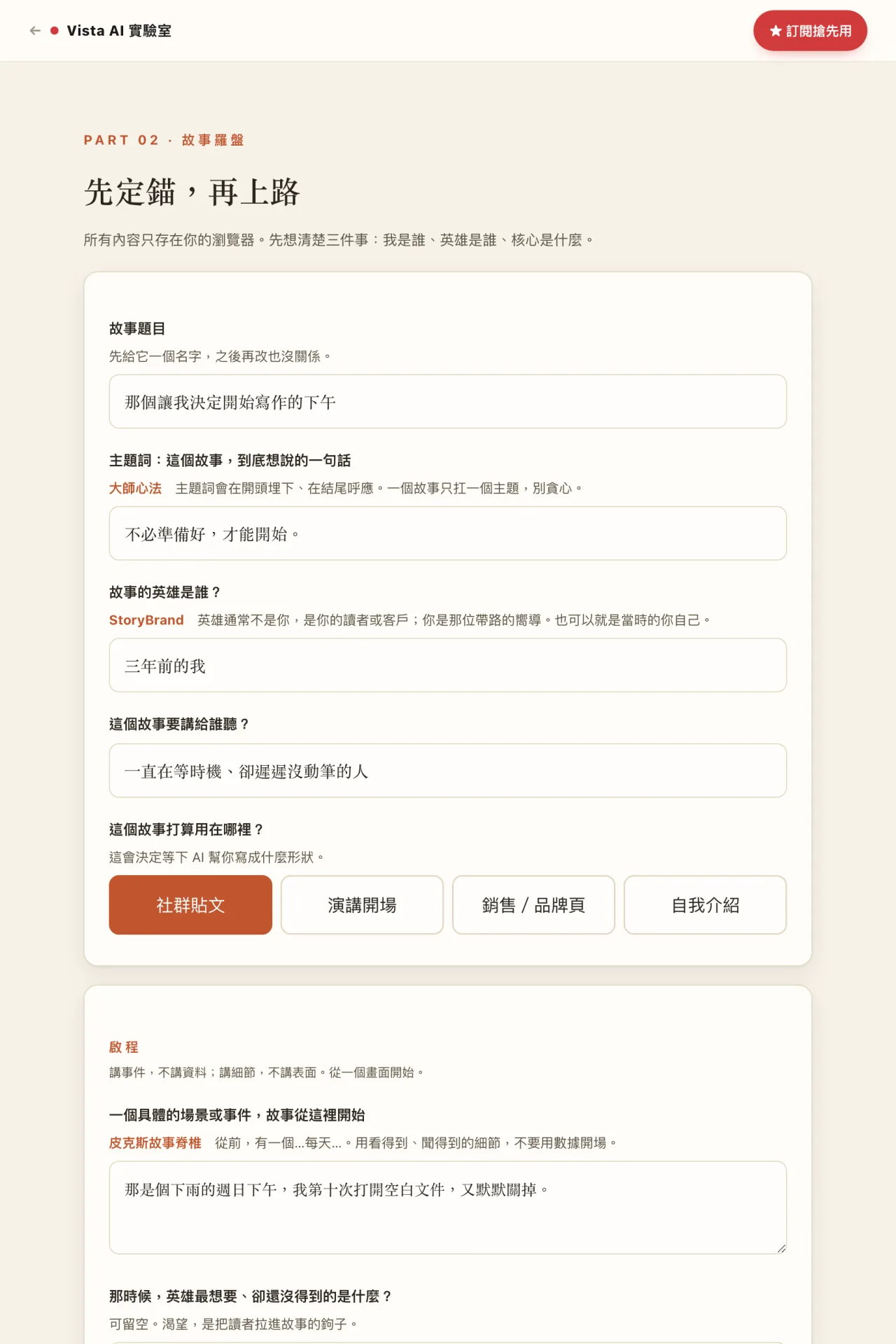
*▲ Set anchor first, then hit the road. Next to each column, I marked the corresponding master’s mental method, and I learned as I filled it in. *
It will do three things for you
First, string your materials into a page of stories. You fill in the materials along the journey, challenges, and harvests, and the tool will help you form the skeleton of a story and draw your own unique story journey curve: starting from the journey, falling to the bottom of challenges, and then climbing to the peak of harvest. You will “see” what your story looks like for the first time.
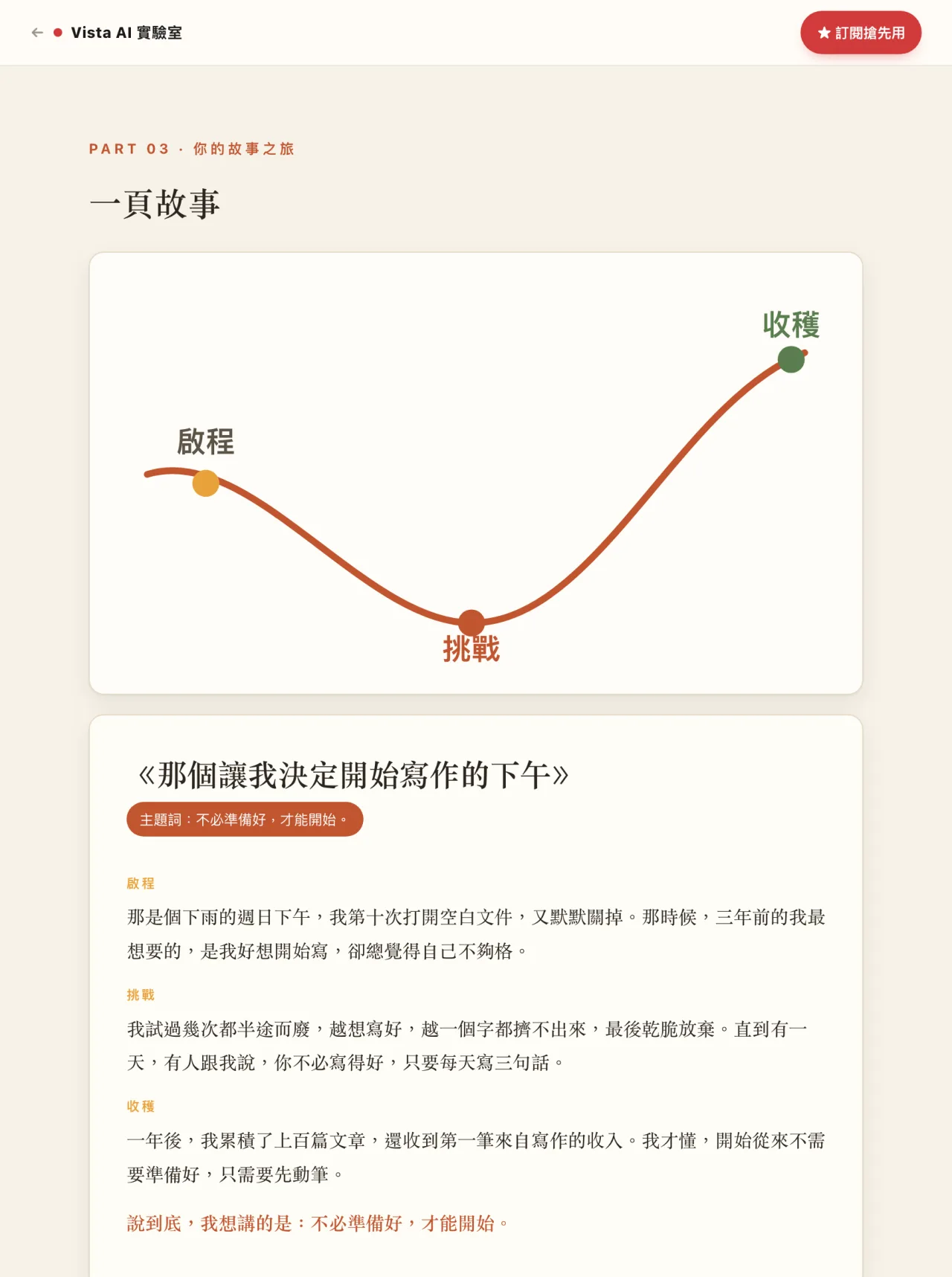
*▲ See the shape of the story at a glance. The topic words will be buried at the beginning and automatically echoed at the end. *
Second, I’ll give you an AI editing prompt that you can use directly. Now that the skeleton is in place, the flesh and blood can be given to the AI. The tool will generate a prompt with your story material according to the purpose you choose, whether it is a social post, speech opening, sales page or self-introduction. Paste it into ChatGPT or Claude, and it will write a graphic and rhythmic version of your skeleton, and give you two different openings.
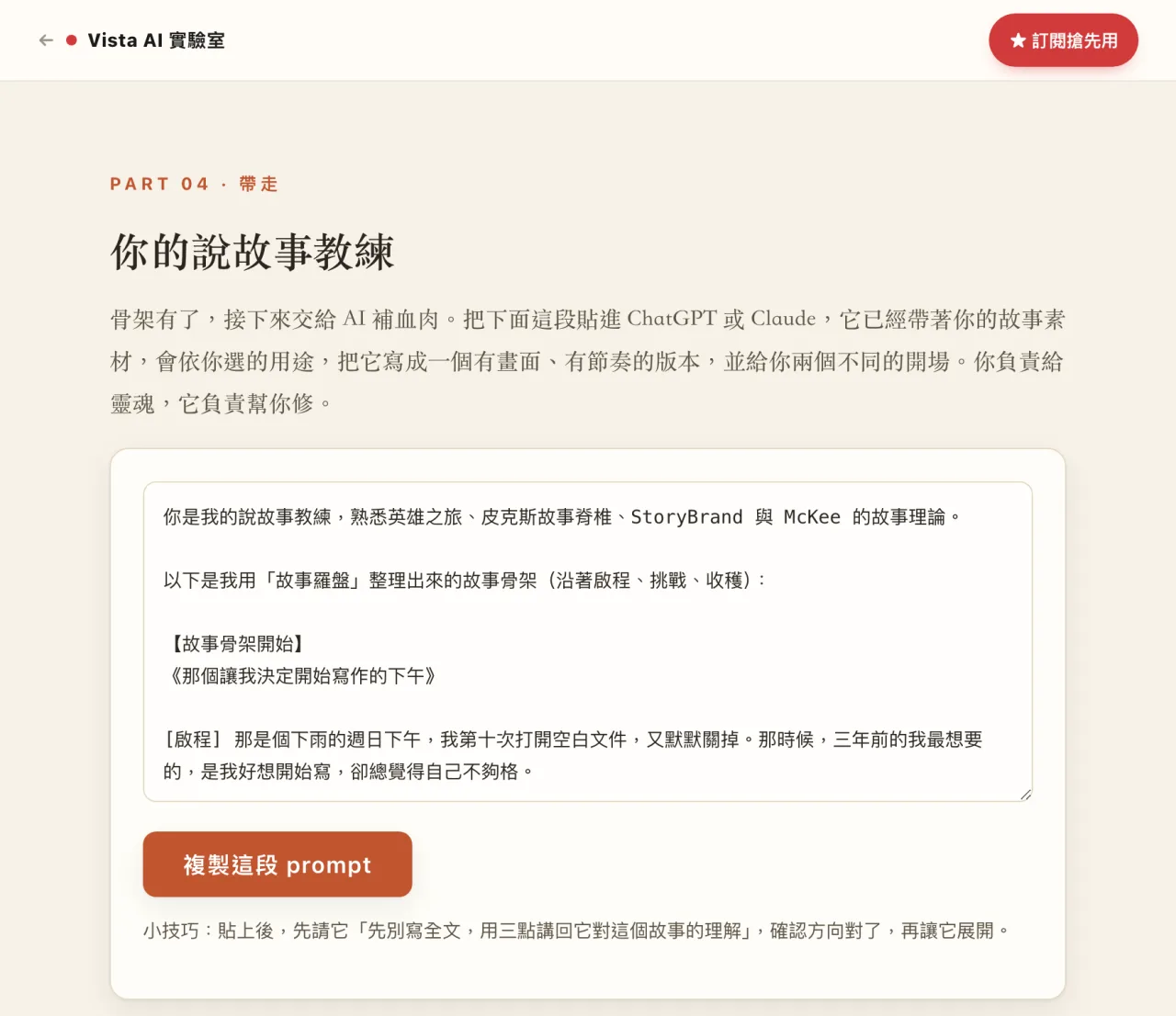
*▲ This prompt specifically reminds AI: Let the truth be hidden in the story, don’t preach, and you are the last level. *
Third, remind you to keep the most important line. The framework is the skeleton, and AI is the assistant, but the soul of the story is your unique experience, which cannot be given by machines. This is also what I want to convey most when I make this tool: in the AI era, there is a story first, and then the AI starts working. You are responsible for giving it to the soul, and it is responsible for helping you cultivate. Both frame and text AI can make up for it, but the judgment of “which paragraph is something only you can say” is always yours.
Now tell your story
This tool is completely free and can be used as soon as you open it without logging in: Story Generator. Pick an experience that you have always wanted to tell but don’t know how to talk about it, and spend ten minutes walking through it. You will find that you are actually very good at telling stories, but you just lacked a map before.
This is one of the tools I keep in my AI lab. I will design some useful and high-quality gadgets from time to time, and with each new tool, subscribers can use it first. If you also want to use it first-hand, please subscribe to my Vista AI Inspiration Supply Station, and I’ll see you there.
And if you don’t just want to tell a single story well, but you want to turn AI into a content production system that will help you research, write, and distribute content, that’s what I will lead you to build in the AI Content Production System Workshop.
Your experience itself is a good story, it just hasn’t been well told yet. Now, let’s talk about the first one.