AI transformation course for middle and high school students: Your experience is the most lacking golden asset of AI
✍️Originally published in “Technice Island”
In recent years, at various corporate training and public speaking occasions, I have often been quietly grabbed by students after class - most of them are supervisors and senior professionals in their 50s and 60s. They were in neat suits, but their tone was a little helpless: “Teacher Vista, I feel that I am getting older and it is difficult to learn these new AI things. Look at how fast those young people swipe their phones and use tools. Are we going to be eliminated?”
To be honest, I have heard this statement too many times. Every time I hear this, I can’t help but feel sad. It’s not that they are really lagging behind, but that these students have misestimated their own value. AI is indeed good at generating, organizing, and calculating, but one thing it cannot do is gain insight into human nature.
Having said that, sometimes what we think of as disadvantages are often hidden advantages.
I remember one time when I was writing in a coffee shop, I happened to overhear an interesting conversation. There was a young marketer who asked an elder in his sixties for advice. He excitedly showed a plan that seemed to be generated by ChatGPT and asked for their opinions. The senior looked at it for a few times and said calmly: “The information is very complete, but have you ever thought about whether your target customer group will really think this way?” Well, this sentence was like a wake-up call.
It is true that AI can analyze consumer behavior, but it is difficult to understand the motivations behind it; in other words, although AI can generate reports, it cannot smell risks. The experience and experience accumulated by middle-aged people in the workplace, as well as their sixth sense about the market, are difficult for AI to imitate in the short term.
Therefore, I often say to my middle and high school friends: You are not lagging behind AI trends, but you should be grateful that you have the most lacking piece of the puzzle in AI.
I have been doing training in enterprises and public sectors for a long time, and I know very well that before this wave of AI, many people will inevitably feel anxious. They felt a little uncomfortable when they saw young people quickly getting started with various tools, and even began to complain that they couldn’t learn quickly. But I have to say that speed is never the decisive point, understanding and judgment are.
I recalled that I had previously coached a company to transform its business. The boss was 65 years old and his son was 35 years old. It’s great that young people are actively introducing AI, but the boss’s experience is worth more than 100,000 pieces of information. As the saying goes, contextual knowledge exerts power, so knowing how to use tools is great, but it also requires the assistance of local experience.
Let me share another story with you. There was once a chief financial officer of a technology company who confidently told me: “I am very sensitive to numbers. It doesn’t take ten minutes to tell whether a company has problems just by looking at its financial report!” He added with a smile: “It’s not the numbers that speak, but the relationship between the numbers.” Well, this kind of experience and intuition is more about the accumulation of years than talent.
Of course, trust capital is also important. A procurement executive in the technology industry once told me that after the company he worked for introduced AI automated procurement, suppliers instantly became very cold. It’s not surprising when you think about it. “After all, doing business is not just about price, but also about human relationships,” he said.
Having said that, these three things, context, intuition and trust, are the gold mines in the AI era. In fact, many people already have it, but they just don’t know it.
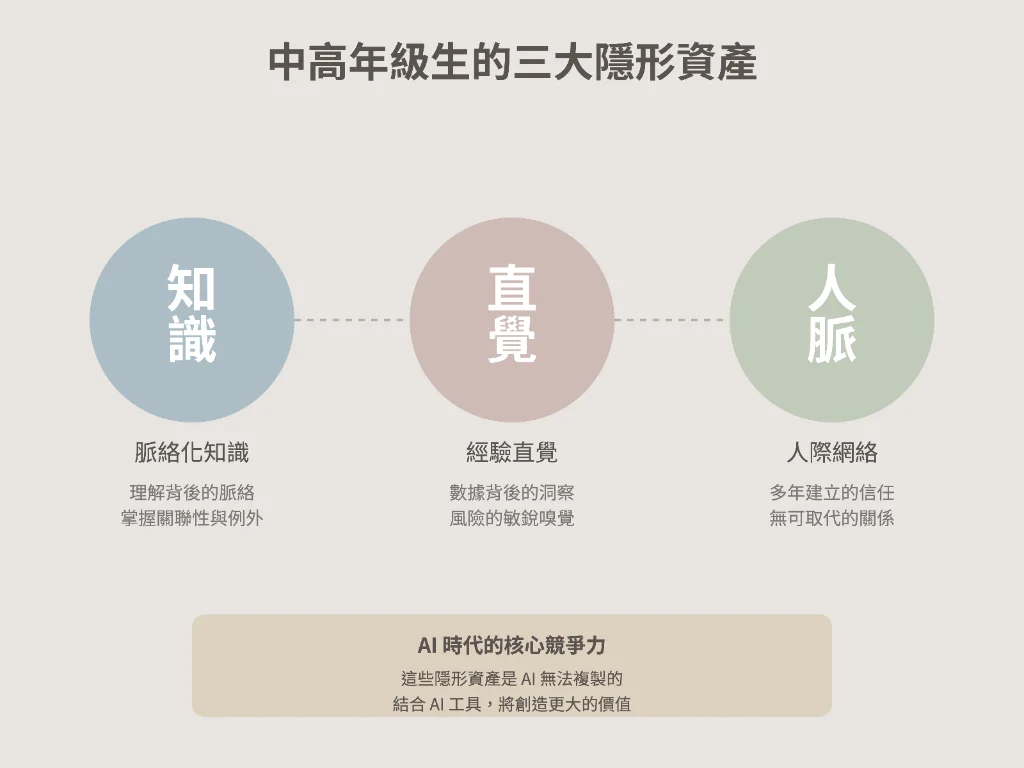 ▲ The three hidden assets of middle and high school students. (Photo/Provided by Zheng Weiquan)
However, I can understand the fear. Recalling the first time I came into contact with generative AI, I asked myself: “If even AI can write articles, do everyone still need to learn writing? Am I still valuable?”
After half a year, I gradually figured out one thing, which was the nature of fear, which was most likely a misunderstanding. Many people regard AI as a competitor, but forget that it is actually an amplifier. As long as it is used properly, AI can amplify your creativity, your judgment, and even the valuable experience you have accumulated for many years.
For example, I know a senior copy editor. She was originally extremely resistant to AI, until a deadline was about to open when she was rushing to write a manuscript, and she was forced to use AI to help with polishing and typesetting. She said that moment she felt like she had regained freedom: “AI is like a serious but inexperienced assistant. It saves me time and gives me the freedom to do really valuable things.”
AI will not replace professions, but it may bring them back to their essentials. For middle and high school students, the key is not to understand technology or new tools, but to change their mentality. I would also like to suggest that you should stop saying “I don’t know how” easily and change it to “Let me try.” Stop worrying about “This is too difficult” and change it to “I’ll learn slowly.” Curiosity is the best anti-aging medicine.
When you see AI diagrams shared by others on the Internet, don’t just say “It’s awesome”, but ask “How does it do it? Can it help me solve my problem?” The point of learning AI is not to catch up with the latest technology, but to rekindle the joy of exploration in the process. This is also the reason why more and more mature learners are investing in AI courses on lifelong learning platforms such as Coursera.
According to my observation, many people’s understanding of AI remains at “see a lot, use little”. This is like a person learning to swim who memorizes many theories but never gets into the water. The most effective way to learn AI is to apply what you have learned and use it in what you are most familiar with.
For example, if you are a business, let AI help you generate the first draft of a report on customer visits. If you are planning, you can let AI sort out market trends and competition data. If you are a financial person, you can ask AI to help you draw financial statements and analyze abnormal values.
I know the results may not be perfect on your first try, but relax because that’s what learning is. Every modification or feedback helps AI understand you better. The important thing is to get into the habit of having this kind of conversation, where you provide it with complete context and background information, and it can give you a lot of interesting inspiration.
I often remind students that the key to learning AI is not to operate, but to ask questions. Young people often ask me: “Teacher, how should I do social marketing?” And you can ask: “I work for a B2B company, and my customer base is purchasing executives over fifty years old. Do they really look at Instagram?”
Seeing this, I believe you have discovered: smart questions will make AI get twice the result with half the effort! This is what Harvard Business Review constantly emphasizes: In the era of AI, questions are more important than answers.
In my opinion, the most effective way to use AI is not to ask what comes to mind, but to integrate it into your work rhythm.
For example, we can first establish a fixed process:
- Let AI help you collect information before starting the project;
- When writing a plan, let it draft the structure first;
- Once completed, use AI to generate the briefing and let you adjust the tone and style.
Through this kind of human-machine collaboration, you can get rid of the tedious tasks and spend your time on things that humans should do, such as thinking, judgment and communication.
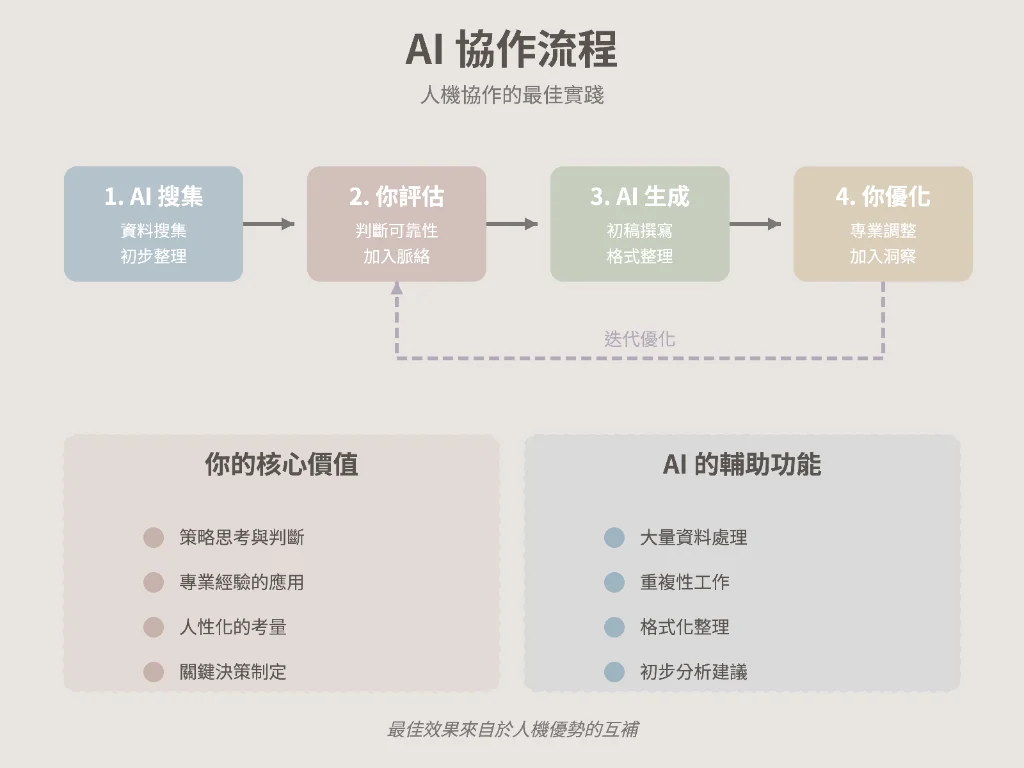 ▲ Best practices for human-machine collaboration. (Photo/Provided by Zheng Weiquan)
Another key is to learn to guide.
Simply put, AI is like a new assistant, and you have to teach it your preferences, your tone, and your style. Explain the reasons after each revision, and over time, it can predict the direction of your thinking. This can not only improve efficiency, but can also be said to be a process of establishing a second self. This is also a new type of productivity under command economy.
In addition, it is recommended that everyone develop the habit of verification.
The AI sometimes spouts serious nonsense, meaning its data may not be correct. If it involves data, quotations or proper nouns, it is recommended that you check it in advance before using it. You must know that AI’s answers are only references, not the truth; in other words, your judgment is the final insurance.
To be honest, I have seen too many people doubt AI when they first came into contact with it. Later, after getting familiar with it, they relied too much on it and even lost their ability to think. This phenomenon is quite common and can be said to be somewhat dangerous. Because AI is not a person. Its essence is a tool, not a brain. In other words, all decisions and responsibilities still belong to you and me.
Additionally, some people are too trusting and don’t realize that AI can cause hallucinations. A friend once used AI to generate market data and put it directly into the briefing without any doubt. As a result, he was slapped in the face by the client because the data did not exist at all. This is also the importance of “AI literacy” mentioned by Microsoft Work Trend Index.
Therefore, I suggest that everyone develop the habit of doubt. AI can be trusted, but verification and verification must be done in advance.
Also, don’t let AI flatten your creations. Because when everyone starts using AI to write reports and make briefings, the world may become like a chorus without personality. A better approach is to let the AI do the basics, but be sure to add your own perspective and tone at the end.
Before, I met a retired professor in his seventies by chance in a coffee shop. The old professor told me that he started teaching himself to write programs in AI this spring. Someone asked him why he had to work so hard to learn new things at this age. He laughed and said, “Because I don’t want to just live a mediocre life, I want to keep my brain full of energy. How great it would be to be able to do something that interests me!”
Now, he uses AI to help community elders build an oral history database, and he is very busy every day!
Having said that, in this era of rapid changes in AI, what we really need to learn is not to follow the trend, but to find our own rhythm. We must realize: AI will not replace people who know how to learn, nor can it replace people who have judgment, stories, and souls.
So, friends in middle and high school grades, don’t doubt yourself. Your value does not lie in whether you can use AI, but in whether you know how to make good use of AI and let your wisdom be seen.
When you know how to use experience to guide AI to amplify experience, you are no longer a person pushed by the times, but a person who is ahead of the times.
After all, AI is just a tool; people are the creators of meaning.
Therefore, I suggest you not to panic. It is right to try to catch up with the times, but more importantly, you must find your own position and even try to lead the times. After all, we have wisdom, experience and warmth, which are the most irreplaceable forces in the AI era.