
Stop asking AI to help you sort out your thesis topic: Use research questioning scaffolding to turn vague ideas into writeable research questions
Have you ever had this experience: open ChatGPT, type “Help me sort out the topic of such-and-such paper”, and then get an answer that looks complete, but cannot be put into the paper at all? It seems neatly organized and has an authoritative tone, but each sentence is like the average content of ten blog articles. It has no position, no theory, and no verifiable literature, let alone helping you approach a research question worth writing about.
The problem is not that the AI is stupid, but that the questions themselves are too loose. Having said that, when you give a rough topic, AI can only give you a network average. Rather than blaming the AI for not being smart enough, it’s better to go back and practice a more basic thing: Learn to ask the right questions.
The Research Questioning scaffolding gadget I designed is to solve this problem. It can’t help you write a paper, but it can help you reorganize the unclear research ideas in your mind into a problem that AI can really handle. Next, let me take you to break down the method behind it and walk it through with a complete real-life case.
为什么问得好,比答得好更重要
There is a shift in collaborative research with AI that many people are not aware of: your focus shifts from coming up with answers yourself to designing questions that can force good answers.
It’s not laziness, it’s even more difficult. Because a good academic question must explain four things clearly at the same time: whose position do you want AI to think in, what is the context of your research, what exactly do you want it to do this time, and what form do you want it to be delivered in? If any part is missing, the AI will figure it out on its own, and the direction it figures out is usually the network average. I talked about it in “The prompt words will expire, but you won’t: What is really valuable is the ability to ask questions and your voice”: When AI makes execution cheaper, the ability to ask questions becomes the most difficult ability to be replaced.
The research question scaffold breaks these four things into four columns, and each accounts for 25% of context completeness. There is a real-time meter on the interface. Every time you fill in a column, the completeness will jump up. This design is very clever: it turns the originally abstract matter of “did you speak clearly” into a visible progress bar.
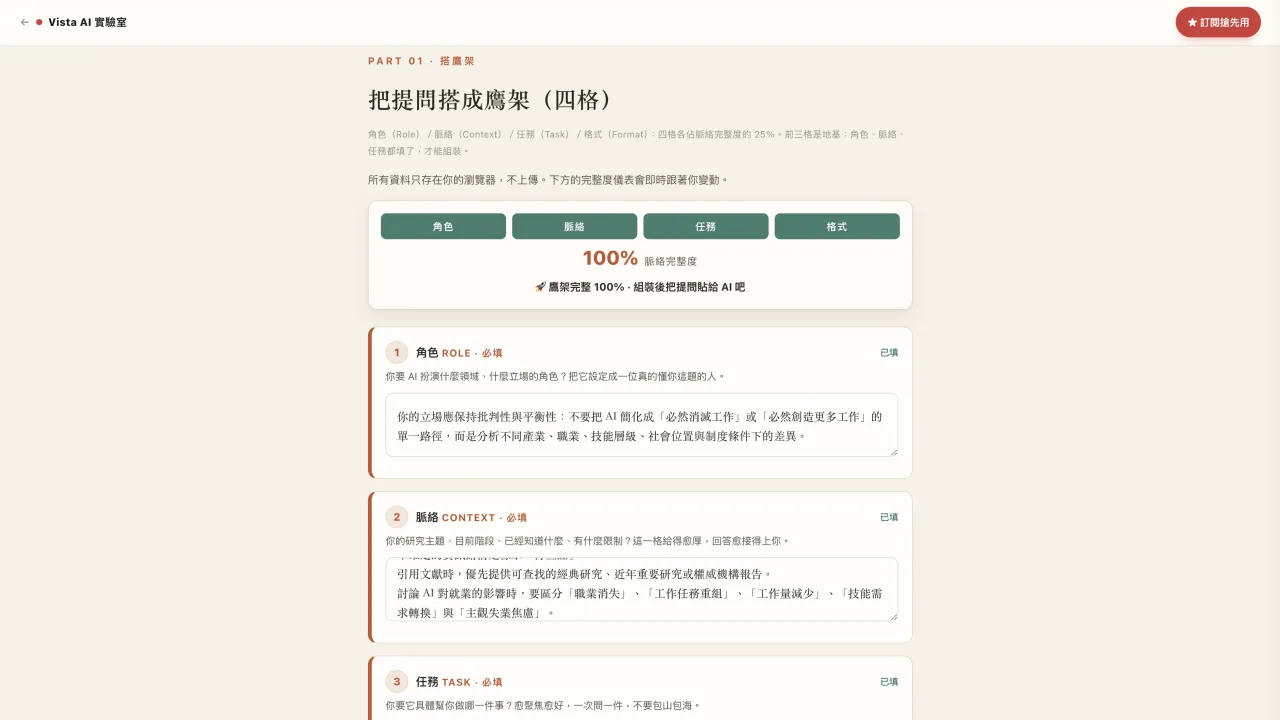
Below I use a real prompt word designed for the academic paper “AI and Labor Unemployment” and show it to you column by column.
Column 1 Role: First decide where the AI will stand
Many people ask that the AI does not have a role, so the AI defaults to answering in a neutral know-it-all tone, and what the neutral know-it-all is best at is talking nonsense that is universally applicable but useless.
Setting a role is equivalent to defining the scope of knowledge and stance for AI. See how to write this template:
Please play the role of an interdisciplinary scholar who is familiar with “artificial intelligence, labor market changes, unemployment risk narrative and communication research”. Your expertise includes AI automation and job substitution, labor economics and skill-biased technological change (SBTC), how the media frames AI unemployment, issue setting and framing theory, qualitative research design, APA seventh edition citation standards…
Note that it doesn’t just give a title, it also lists specific areas of knowledge. What’s more critical is the final position setting:
你的立场应保持批判性与平衡性:不要把 AI 简化成「必然消灭工作」或「必然创造更多工作」的单一路径,而是分析不同产业、职业、技能层级与制度条件下的差异。
This sentence directly transforms AI from a villager who can choose sides to a researcher who can analyze differences in conditions. The more specific the characters are, the less likely the AI’s answers will slip into generalities. This is what “Ask questions like an expert and get professional feedback” has been emphasizing: Where you put the other party often determines the level of answer you will get.
Second column Context: Tell AI what your research looks like
Context is the column with the largest amount of information among these four columns, and it is also the column that most determines success or failure. What it wants to answer is: what is your research background, what do you really care about, and what lines cannot be crossed.
The context column of this template does three things and is worth copying as a template.
First, it clearly delineates the real concern of the study, not just the topic:
What I care about is not whether AI can really completely replace humans, but how society understands and imagines this matter.
This sentence alone changes the research from “predicting which jobs will disappear”, a red ocean that everyone is walking on, to a blue ocean that few people are walking on. When the AI receives this sentence, the entire focus of the answer changes.
Second, it opens up all possible theoretical perspectives: framing theory, issue setting, risk society, narrative theory… This is equivalent to telling AI: Please help me think within this theoretical spectrum, and don’t create irrelevant concepts out of thin air.
Third, and most easily overlooked: it clearly states the constraints.
Do not directly regard news, social posts, and interviewees’ statements as objective facts. Do not falsify documents, research materials, authors, journals, or DOIs. For uncertain information, please clearly mark it as “pending verification”.
When discussing the impact of AI on employment, it is necessary to distinguish between “career disappearance”, “work task reorganization”, “workload reduction” and “increased anxiety”.
Each of these limitations blocks a typical bad habit of AI: fabricating documents and treating interviews as facts. The most common thing that graduate students are fooled by AI is fake documents, and this context fills this hole before the question is even asked.
Column 3 Task: Ask only one thing at a time
The scaffolding’s prompt on the taskbar is “The more focused the better, ask one question at a time.” This is a discipline that many of us fail to achieve because we always want to ask everything at once.
But AI is just like humans. If you ask five questions at a time, it can only answer very shallowly. The taskbar of this template sticks to its job. It does not ask AI to write a literature review or design an interview outline. It only asks one thing:
Based on the above research directions, propose 3 feasible, research-worthy and executable versions of the research question.
And it also splits “What does a good version of the research question look like” into seven sub-items: formal expression, core contradictions, theoretical perspectives, data types, research methods, novelty compared with existing research, and possible research risks. This is not to make the task complicated, but to clarify the acceptance criteria for the same task.
Column 4 Format: determines whether you get a draft or materials
Although the format field is optional, it directly determines whether you can directly use the AI output. The template reads:
Please answer in Traditional Chinese, with a total length of approximately 1,500 to 2,000 words. Please use a table to present three versions of the research question. The fields include: version, research question, core contradiction, theoretical perspective, materials and methods, research contribution, risks and suggestions for correction. After the table, add an analysis of about 300 words, indicating which one is most suitable for development into a doctoral thesis and which one is easiest to collect data.
It specifies the language, word count, tables, table fields, and even what analysis should be attached after the table. The answers you get in this way can often be copied and pasted into your research notes, instead of having to spend another half an hour reorganizing them.
The format column also adds a very important requirement at the end:
If literature is involved, please indicate it by author and year, and list references in APA 7 format at the end of the article. Do not include literature that you are not sure about.
Once again, it adds another layer of security against counterfeit documents at the format level.
Don’t just ask once: three levels of iterative questioning
Filling out the four columns and formulating the first structured question is just the starting point. The research questioning scaffold also has a built-in set of “three-layer iterative questioning templates” that correspond to three actions: seeking basis, finding counterexamples, and seeking sources.
This means that after the AI gives you the first answer, you should not accept it all, but continue to ask:
What is the basis for this judgment? (Basis required). Are there any converse cases or opposite research conclusions (find counterexamples). Which verifiable document can this statement be traced to (source required).
These three levels of questioning essentially turn the spirit of skepticism at the core of academic research into a set of sentence patterns that you can apply over and over again. The things AI gives you in the first round are often beautiful but fragile. Really valuable content often emerges only after you force it to provide evidence and face counterexamples.
 *▲ Do you like this kind of AI × academic research practical approach? Welcome to subscribe to Vista AI Inspiration Supply Station. I will continue to interpret the latest tool usage and trends and send them to you as soon as possible. *
Two reassuring designs
Finally, add two points that are easily overlooked but are very practical for graduate students.
The first is privacy: all research ideas you fill in are only stored in your browser and will not be uploaded to any server. This is important for research topics that are still in the confidentiality stage.
Second, it not only gives you a framework for asking questions, but also comes with AI collaboration boundary cards and a literature review matrix to help you figure out what can be done by AI and what must be done by yourself, so as to avoid unknowingly outsourcing judgments that should be borne by researchers.
Think of tools as muscles, not crutches
Back to the original situation. You are also studying AI and unemployment. If you “Help me sort out this paper topic”, you will get the average Internet value; after going through the four columns of role, context, task, and format, plus three levels of questioning, you will get three versions of the research question with theoretical perspectives, data methods, and research contributions, and the literature to be verified is marked.
The difference is not in the AI, but in the way you ask the question.
This is the most important muscle for graduate students in this era: not to outsource thinking to AI, but to treat it as a research partner who can accompany you to approach good problems.如果你想更进一步,把单次的好提问变成一套能重复运作的系统,可以参考我写的《研究者如何打造一个可重复运作的学术副驾驶》。 The tools will help you set up the scaffolding, but it is always you who climbs up and sees the scenery.
If you want to practice this method more systematically, from how to ask, how to follow up, to how to let AI safely enter your paper writing process, you are welcome to sign up for my AI Empowered Academic Research and Writing Practical Workshop. Throw in the research idea that you have yet to explain and give it a try, and you will quickly feel: It turns out that as long as you ask the right questions, your research will get off to a good start.
Now open the Research Questioning scaffolding and ask the question you are worried about into a question that AI can answer.
📖 深入探索相關主題