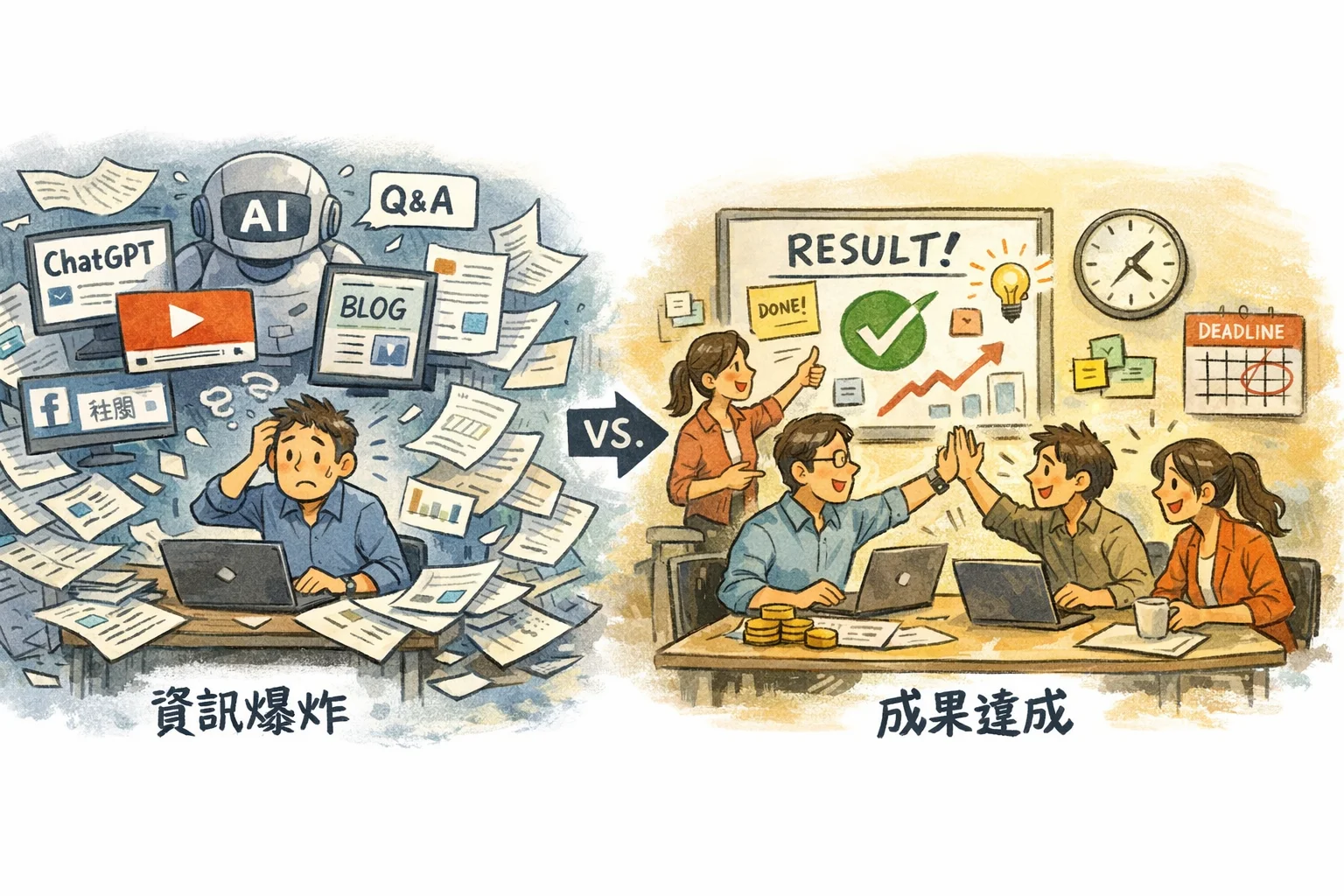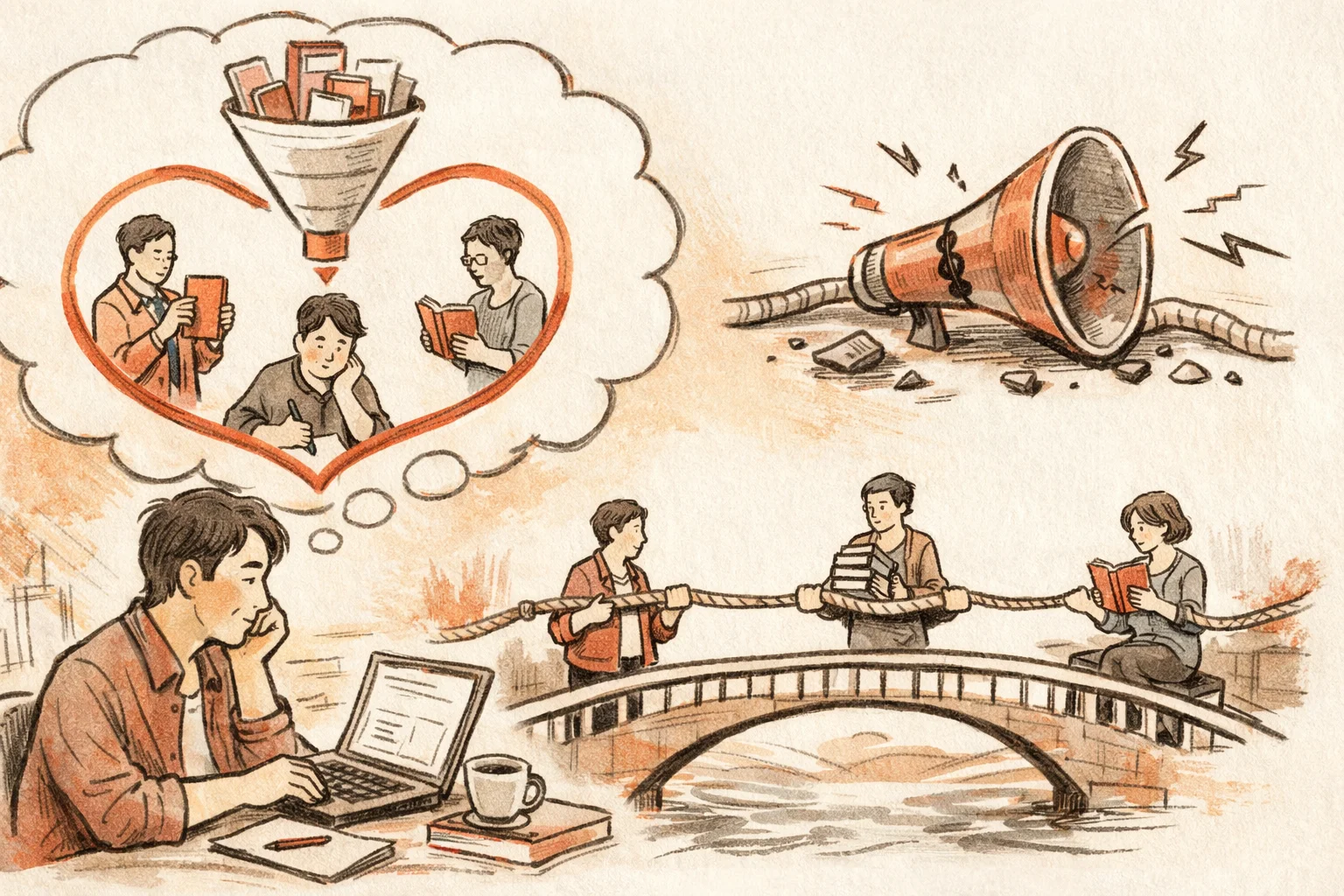
What the publishing industry really lacks is not exposure, but relationships
When I opened my mailbox two days ago, I received a typical invitation letter from a publisher: the tone was polite, the format was complete, and the schedule was clear. Oh, right! The last sentence is also very familiar - since this book will be released soon, I look forward to sharing the new book on your social platform within a certain period of time. Please reply with the recipient’s name, phone number and address before the deadline, and the gift book will be sent after the book is published.
I stared at the letter for a few seconds. The first thought that came to my mind was not whether I wanted to help, but how could I find someone to cooperate in this way? Help, of course I want to help, but…
To be honest, this discomfort is not due to calculation. As an author who has published 20 books, I understand all too well the difficulties faced by publishing houses: marketing budgets are shrinking, channel discounts are squeezing gross profits, attention is divided by algorithms, and the relationship between authors and readers often bypasses the publishing house and connects directly to the community. To be honest, it is difficult for a publisher’s marketing staff to achieve the same level of success as in the past with fewer and fewer resources.
But it is precisely because of my understanding that I want to use this incident to make it clear: This kind of standardized, work-assigning invitation method is not only easy for creators to resent, but more importantly - it is not cost-effective for the publisher itself.
Because the current battlefield is no longer who posts more posts on social media, but who has a longer, deeper and more sustainable relationship with readers?
 ▲ What the publishing industry really lacks is not exposure, but reader relationships that can be continuously accumulated
Let’s first see the situation clearly: there are not fewer new books, but there are so many that no one can finish them.
Everyone says that the publishing industry is in a slump, and it is easy to simplify the publishing dilemma into one sentence: fewer readers, people stop reading books, or short videos are too strong.
Of course, these all have an impact, but when you stand on the publishing supply side, you will see another more glaring reality: there are not fewer books, and there are even so many that it is almost impossible for marketers to promote every book.
According to statistics from Taiwan, the number of new book publications from January to November 2025 alone reached 49,600. To put it into context, on average, more than a hundred new books line up in the market every day, waiting to be seen, introduced, discussed, and purchased.
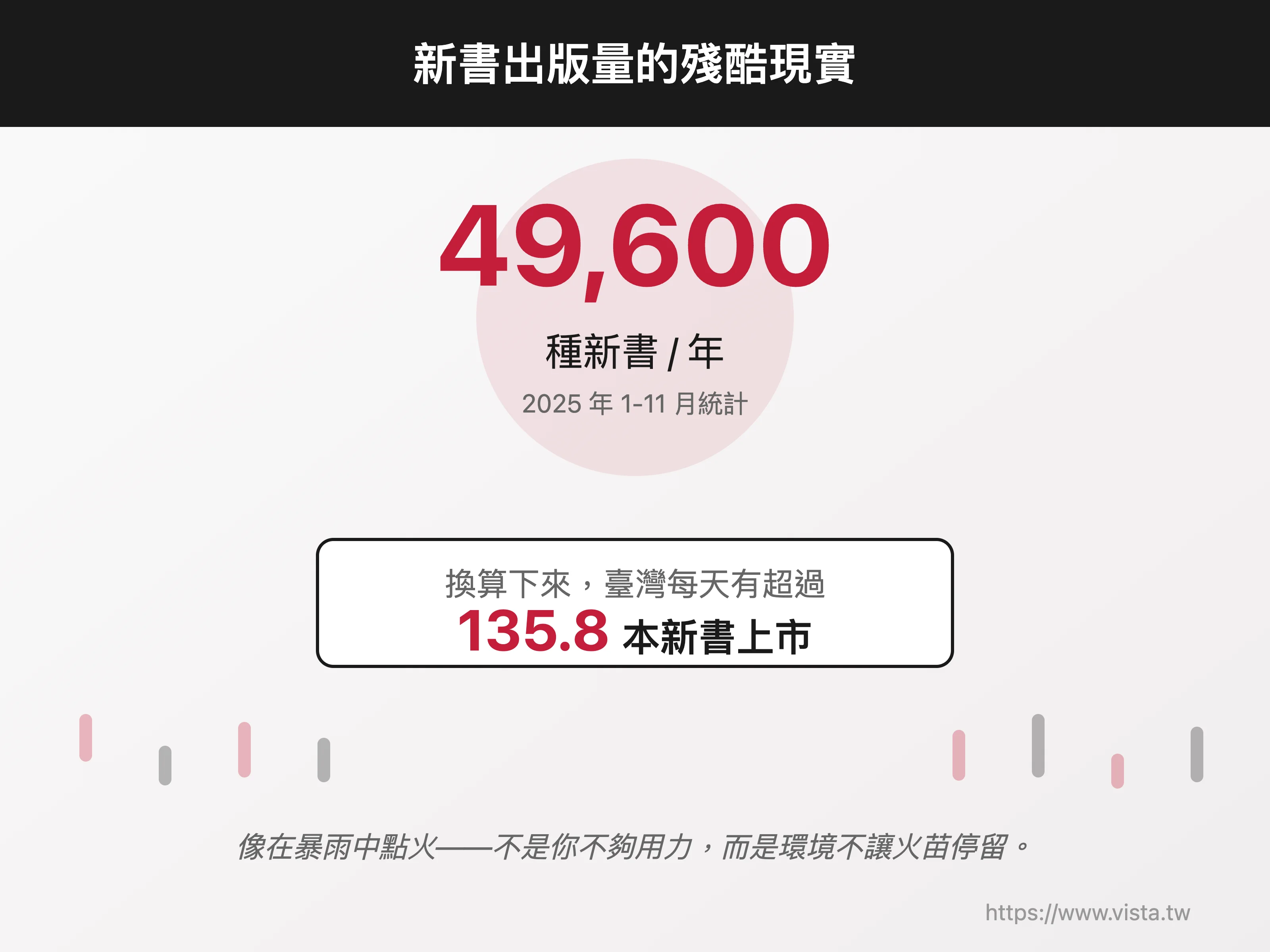 ▲ More than a hundred new books line up in the market every day, and no matter how hard the marketers work, it’s like lighting a fire in a rainstorm
Imagine this: at such a density, no matter how hard the publishing department’s marketing department works, it’s like lighting a fire in a rainstorm—it’s not that you don’t work hard enough, but that the environment doesn’t allow the flames to stay.
What’s even more troublesome is that the form of the book is no longer single. National Library of China’s ISBN annual report shows that the number of applications and format distribution of e-books continues to expand, and publishing is no longer a simple path to putting paper books on shelves. When content carriers are diversified, channels are dispersed, and recommendation power is transferred externally, if publishers still use the release schedule of a single book as the core rhythm, marketing will naturally become more and more difficult.
Therefore, I would like to first propose a hypothesis: the real problem in publishing marketing may not be insufficient exposure, but that the frequency and life span of exposure are too short.
When you put all your efforts into the publicity in the week of release, but do not establish a mechanism for the book to continue to be talked about, then every new book is a war of attrition starting from scratch. This is not because marketers are not working hard, but because there is something wrong with the rhythm design of the entire industry.
What this invitation letter really steps on is: treating creators as channels, not partners.
Re-examining the letter from a marketing perspective, one can quickly dissect its underlying logic:
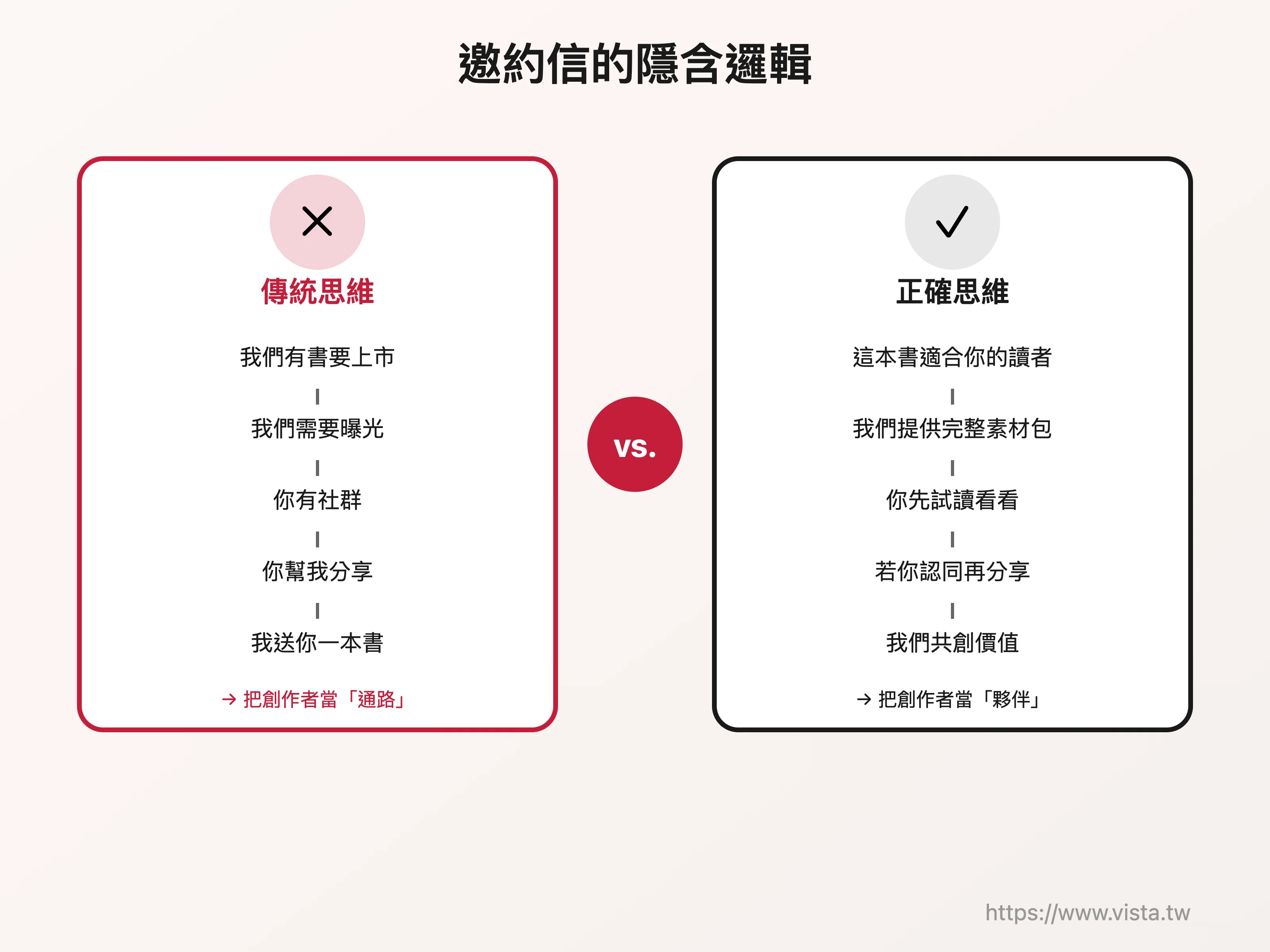 ▲ The implicit logic of traditional invitation letters: I have a book to be released, you have a community, you share it with me, and I will give you a book
- We have a book coming out
- We need exposure
- You have a community
- You help me share
- I’ll give you a book in return
Five or six years ago, this logic might still have worked, because at that time the supply of the community was not so explosive, the algorithms were not so fierce, and the paths for readers to obtain information were not so fragmented.
But today, such an invitation would make two fatal mistakes at the same time:
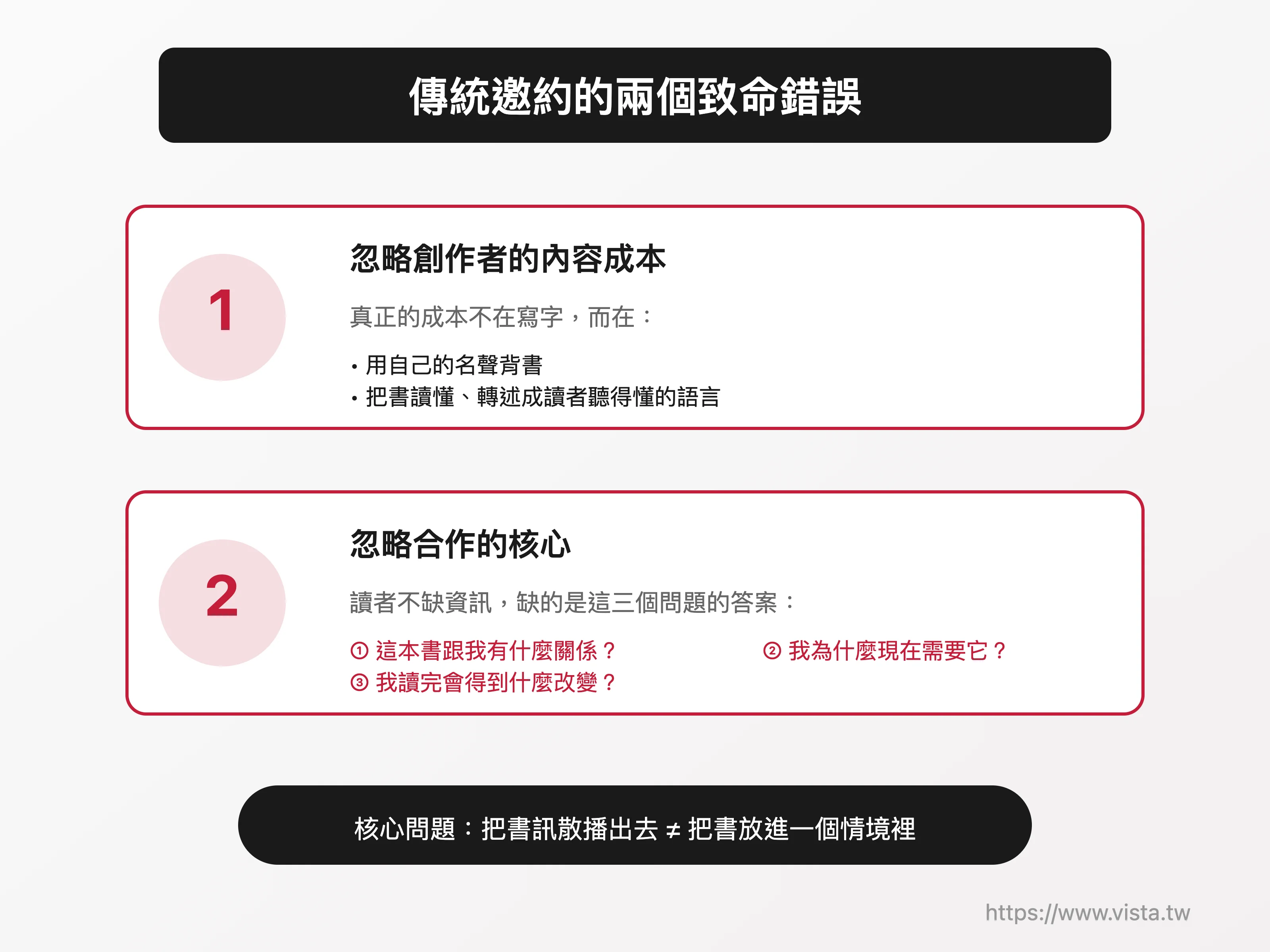 ▲ Ignoring the content costs of creators and ignoring that the core of cooperation is situation rather than dissemination
First, it ignores the content cost of the creator
Sending a gift book does not cover the creator’s cost of producing a post. Because the real cost is not in writing a recommendation article, but in using your own reputation to endorse and understand the book and translate it into language that readers can understand. Having said that, it is actually time, credit, and trust assets accumulated through long-term operations.
From an economic point of view, this is a kind of hidden cost externalization - when the publishing house passes on the cost of marketing work to the creator, there is no equivalent exchange of value.
Second, it ignores that the core of cooperation is not to spread the news about the book, but to put the book into a suitable situation.
Readers of creators really don’t lack information, but what they lack is:
- What does this book have to do with me?
- Why do I need it now?
- How will I change after reading it?
If the invitation letter does not answer these three things, then it is just a request to “Please help me post it” - the success rate is of course low, and even if it is posted, it will be difficult to form an effective conversion.
What’s more, the process design of “please be exposed within a certain period of time, please reply with personal information first, and then send the book after publication” will give people a subtle psychological feeling:
Before I agree, you first treat me as someone who wants to cooperate with your process.
This is where the discomfort comes from.
It’s not necessarily malicious, but it takes away the smell of equality and respect from the very beginning. In an age when attention is scarce, emotions actually affect collaboration decisions more than you might imagine—because every creator is making a choice: Which book, issue, and brand should I put into my reader relationship today?
The structural embarrassment of publishing houses: mastering content but losing readers
I actually don’t mean to blame the marketer, because when we zoom in, this letter actually presents a microcosm of the structural problems of the entire publishing industry.
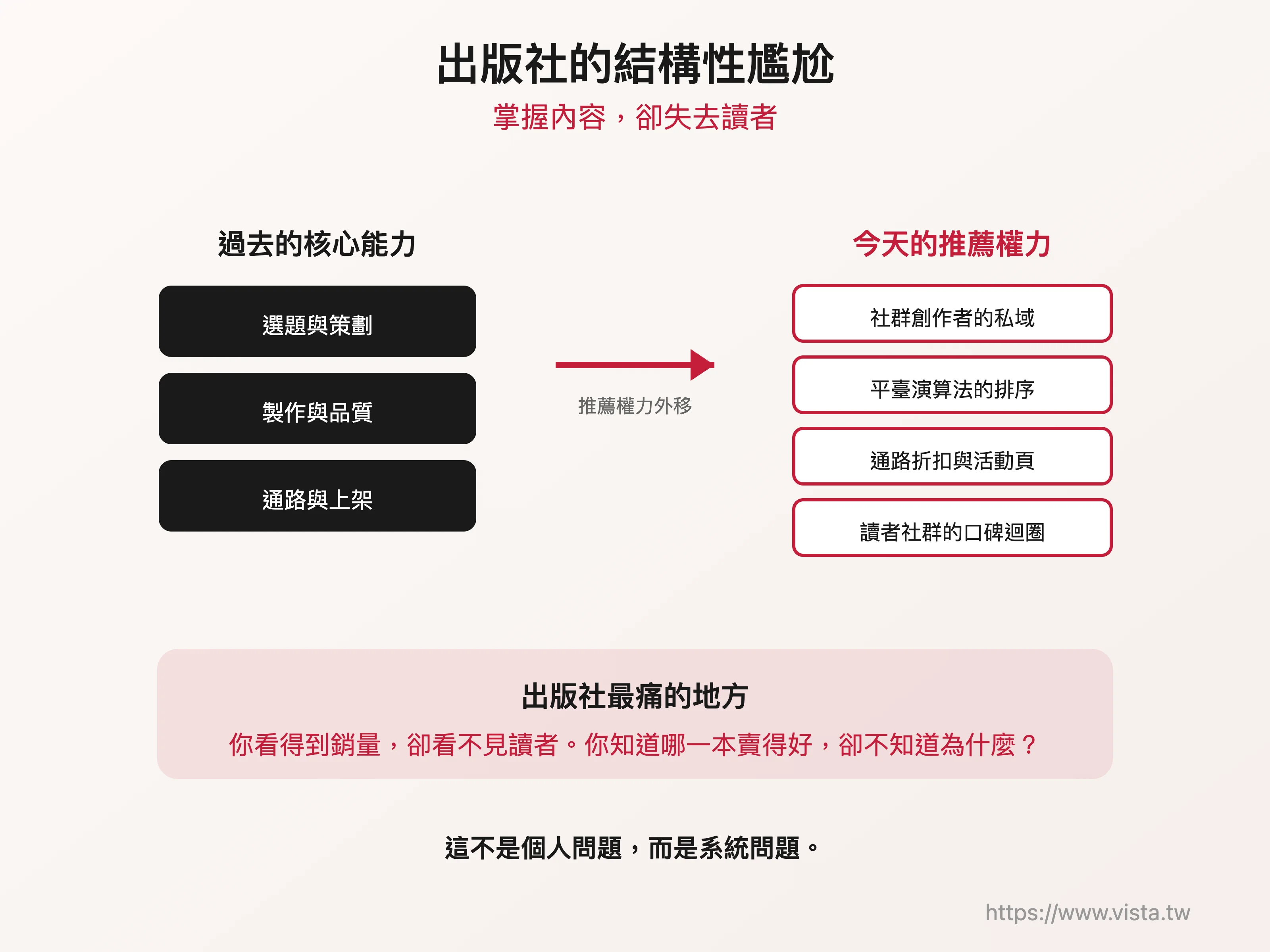 ▲ The publisher controls the content, but loses the direct connection with readers
It is obvious that the core capabilities of publishing houses in the past were:
- Topic selection and planning – knowing what is worthy of being published
- Production and quality - making the work into a trustworthy product
- Access and shelves—let books enter the market and bookstores
However, today’s recommendation power is no longer limited to bookstores and media, nor is it concentrated in publishing houses. Recommendation power is distributed to:
- Private domain for community creators
- Sorting of platform algorithms
- Channel discounts and activities page
- Word-of-mouth feedback from the reader community
The most painful part for publishers is:
You can see sales, but not readers. Do you know which book is selling well, but not why?
Obviously, this is a steep data gap: sales data is in the hands of channels, reader behavior data is in the hands of platforms, and publishers are caught in the middle. We don’t know who bought the book, nor why they bought it, nor what they thought after buying it.
Having said that, this is why managing readers is so important and has become a keyword that has been mentioned repeatedly in the publishing industry in recent years. Because publishers have finally realized that if the readership relationship is not in your hands, you will always have to look to the outside world for exposure every time a new book comes out. And when budgets shrink, platforms become more powerful, and attention becomes more expensive, the more urgent you ask for it, the easier it is for cooperation to turn into letters of invitation to hand over work.
This is naturally not a personal problem, but a systemic problem.
Genuine advice to publishing marketing partners: Change invitations from asking for exposure to offering delivery
If you are a marketer at a publishing house and your resources are really limited, I would suggest you do a smarter thing: use the same amount of time to write the invitation letter more like a cooperation proposal rather than a request for support.
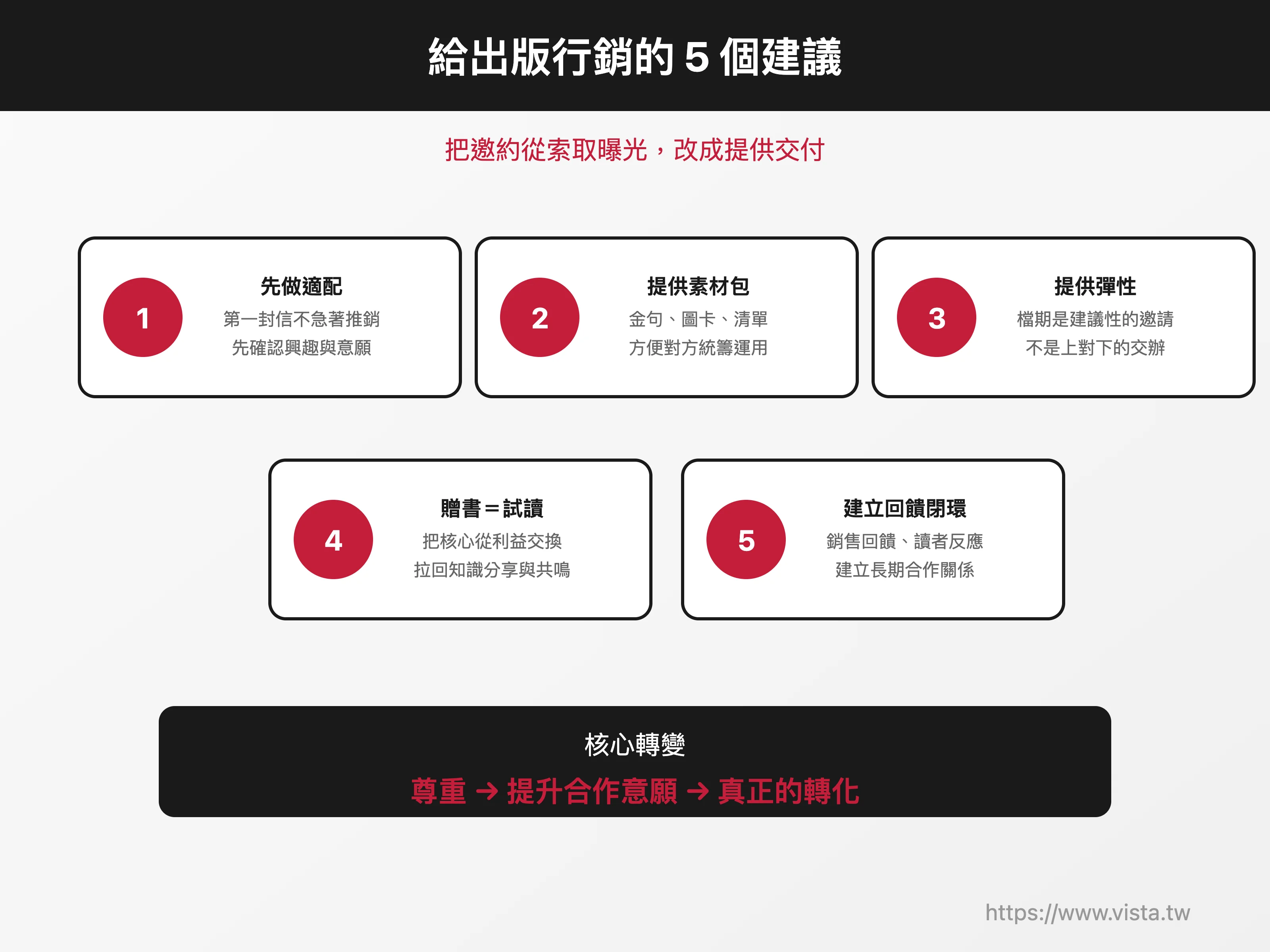 ▲ Change the invitation from asking for exposure to providing five specific suggestions for delivery
The following is what I think is effective and respects each other:
Suggestion 1: Don’t rush to sell the first letter, just confirm the adaptation and willingness.
If possible, please change the process into two paragraphs:
- The first letter: Why am I looking for you? How does this book relate to your readers? Would you like to take a look first?
- The second email (after the other party is interested): Provide a form or option for the other party to choose whether to send an e-book or paper book.
The benefits of doing this are actually very clear. Because you will not force the other party to enter the process before trust has been established, and you can also greatly reduce the other party’s vigilance and resentment.
Suggestion 2: Don’t just attach a book excerpt, but attach content that can be paraphrased.
As a business consultant, I often tell brand clients:
If you want someone to speak for you, you need to provide them with materials that make it easier for them to speak for you.
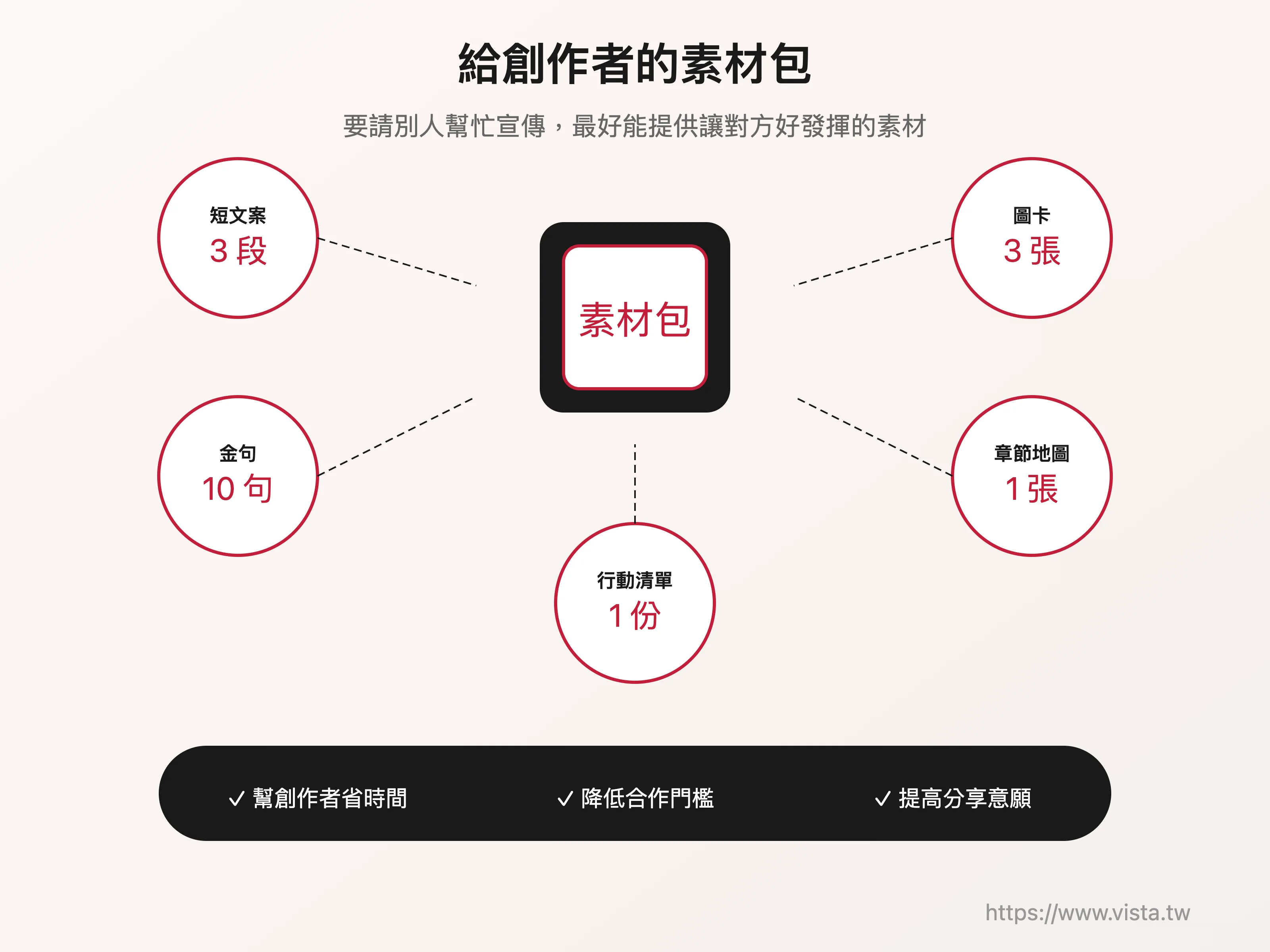 ▲ The most suitable materials for a book to be spread by the community: golden sentences, frameworks, lists
According to my own observation, the most suitable material for a book to be disseminated by the community may not be a long book excerpt, but:
- A sentence of insight that can hit the pain point (can be used as a golden sentence card)
- A framework that can be applied immediately (can be illustrated)
- A checklist that readers can take action after reading (can be used as a template)
Therefore, what you send to the creator should be a material package: three short paragraphs of copy, ten golden sentences, three picture cards, a chapter map or an action list. These costs don’t have to be high, but they will make the creator feel like you’re saving him time rather than outsourcing marketing work to him.
Suggestion 3: Change the designated schedule to provide flexibility.
You can suggest a schedule, but the tone should be like an invitation, not a rush to do something.
For example: “If you happen to be free in early February, we will be very grateful; if your schedule is full, it is no problem at the end of February or March. We will focus on your pace.”
In fact, the meaning is the same, but the message behind this sentence is respect. Respect will naturally directly increase willingness to cooperate.
Suggestion 4: Position the gift book as a trial reading, not a reward
Many creators or opinion leaders may think that it’s not like I can’t afford books, so why should I regard gifting books as a great favor?
Therefore, I suggest that the marketing partners of the publishing house should be more honest about the book donation: “We would like to invite you to try reading it first, and then share it if you really think it is worth it.”
Well, I think this is more powerful! Because it brings the core of cooperation back from the original exchange to the level of resonance. And arousing resonance is the reason why social recommendations can truly convert.
Suggestion 5: Establish a closed loop of feedback instead of one-way request
Good cooperation should be two-way, and this truth should not be difficult to understand. In addition to asking creators to share, publishers can also provide:
- Sales feedback after the book is launched (let the creator know whether his recommendation is useful)
- Collection of reader feedback (allowing creators to feel a sense of participation)
- Commitment to prioritize future cooperation (an inducement to build a long-term relationship)
When creators feel that they are not just being used, but valued, their willingness to cooperate will naturally increase significantly.
A bigger solution: The future goal of publishing houses is not to be better at promoting books, but to be better at managing reading situations.
If you only manage readers by sending out newsletters and posting new book information, your chances of success are really low. Because in the era of information explosion, ordinary readers usually have no specific emotions towards the publisher’s brand. In other words, they lack emotional anchors. However, readers are likely to become attached to the growth brought about by a certain theme.
For example, Silent Book Club is a global reading community in more than 55 countries and has nearly 2,000 chapters. There is no designated reading list, readers bring their own books, and the emphasis is on community sharing after quiet reading. Provide discussion, companionship and a sense of belonging through online events (such as virtual meetings) and social media. Some chapters combine online and offline gatherings to make reading a shared experience. And Reese’s Book Club selects a book with a female protagonist every month and sends recommendations through apps, social media and e-newsletters. Readers can participate in online discussions, live interviews with authors, and share their thoughts on Instagram or Facebook, creating a strong sense of community.
Well-Read Black Girl Book Club With more than 430,000 members, it highlights Black, Brown, and Indigenous voices. Monthly book selections to promote reflection and dialogue through social media, e-newsletters and online discussions.
Although these units have diverse backgrounds, they have several obvious common characteristics that transform reading from individual behavior to collective participation:
-
Community-oriented core design: They do not just recommend books, but treat books as materials, with the focus on creating a sense of belonging. Readers feel accompanied and connected by joining a community, such as sharing their experiences through social media (such as Instagram, Facebook groups), or participating in regular discussions, creating an atmosphere where we read together.
-
Regular content delivery and interaction: Most units use newsletters as their main tool, sending out book selection recommendations, discussion questions, or event notices every week or every month. This not only maintains reader stickiness but also makes reading an ongoing experience. Online events (such as Zoom meetings, live author interviews, Q&A) are another common thread, making geographical restrictions no longer an issue and allowing readers from around the world to participate.
-
A combination of book selection and companionship: They emphasize professional book selection (often focusing on specific themes, such as women’s stories, multiculturalism, or black voices) and provide discussion guides or reflection questions to help readers delve deeper. This kind of companion reading prevents readers from being alone, but feels like they have a mentor or partner beside them.
-
Wide application of digital tools: Use free platforms such as Substack and App, or use social media and library websites to lower the threshold. Some also integrate free eBook lending or video access to make participation even more convenient. Across the board, they’re expanding from offline to online, and even hybrid models (think Silent Book Club’s virtual and physical gatherings).
-
Inclusion and Diversity: Many units create services for specific groups such as women and black readers, but at the same time welcome broad participation and emphasize cultural connections and lifelong learning. This makes the community more cohesive and attracts more loyal members.
These commonalities reflect that the modern reading community has shifted from traditional book reviews to the experience economy, which emphasizes emotional connection rather than pure knowledge transfer.
Publishing houses have traditionally focused on selling books, but these foreign models provide inspiration for transformation and can turn publishing house suppliers into community builders. The following are some specific suggestions that Taiwanese publishing houses can refer to and implement based on local culture:
-
Establish your own reading community: Publishers can launch brand reading clubs, for example, select a new book of their own every month, and send recommendations and discussion topics in conjunction with e-newsletters. Borrowing from the model of Reese’s Book Club, invite authors or celebrities to participate in live interviews to increase exposure. This not only promotes the book, but also builds a loyal readership, which translates into long-term sales.
-
Use digital tools to enhance interaction: Use Substack or LINE official accounts to issue free/paid e-newsletters, including book selection lists, reading experience sharing or online event invitations. In addition, you can also integrate the eBook platform like the New York Public Library (NYPL) to allow readers to try out some chapters for free and lower the purchase threshold. Publishers can also create Facebook groups to encourage readers to interact and discuss and create a sense of belonging.
-
Focus on themes and companionship experience: Learning from the pertinence of Well-Read Black Girl, publishers can design book clubs for specific readers such as the younger generation, women, or fans of environmental issues, and provide discussion guides or online workshops. This allows readers to feel accompanied rather than just buying a book. At the same time, hold virtual author meetings or book marathons to turn reading into a social event.
-
Expand cooperation and accessibility: Cooperate with libraries or radio stations (such as Library Speakers Consortium) to jointly host events; or, like Silent Book Club, allow readers to choose their own books to increase flexibility. Publishers can make some content available for free to attract new readers, who can then be directed to paid services such as membership subscriptions or limited edition books.
-
Data and feedback-driven: These units often adjust book selections through community feedback. Publishers can learn from this and use Google Forms or community surveys to understand reader preferences. This not only improves content quality, but also predicts market trends, such as launching podcasts or short videos to supplement discussions.
In short, by borrowing from the above-mentioned models, publishing houses can stand out from the highly competitive book market and shift to an experience-oriented business model. When starting out, you can start with a small-scale test (such as an online book club of a single book series) and then gradually expand. This not only enhances brand loyalty, but also addresses the challenges of the digital age.
Three paths for publishing house transformation
As for what can be done specifically? Below, I provide three paths, all of which can be accumulated slowly with a low budget:
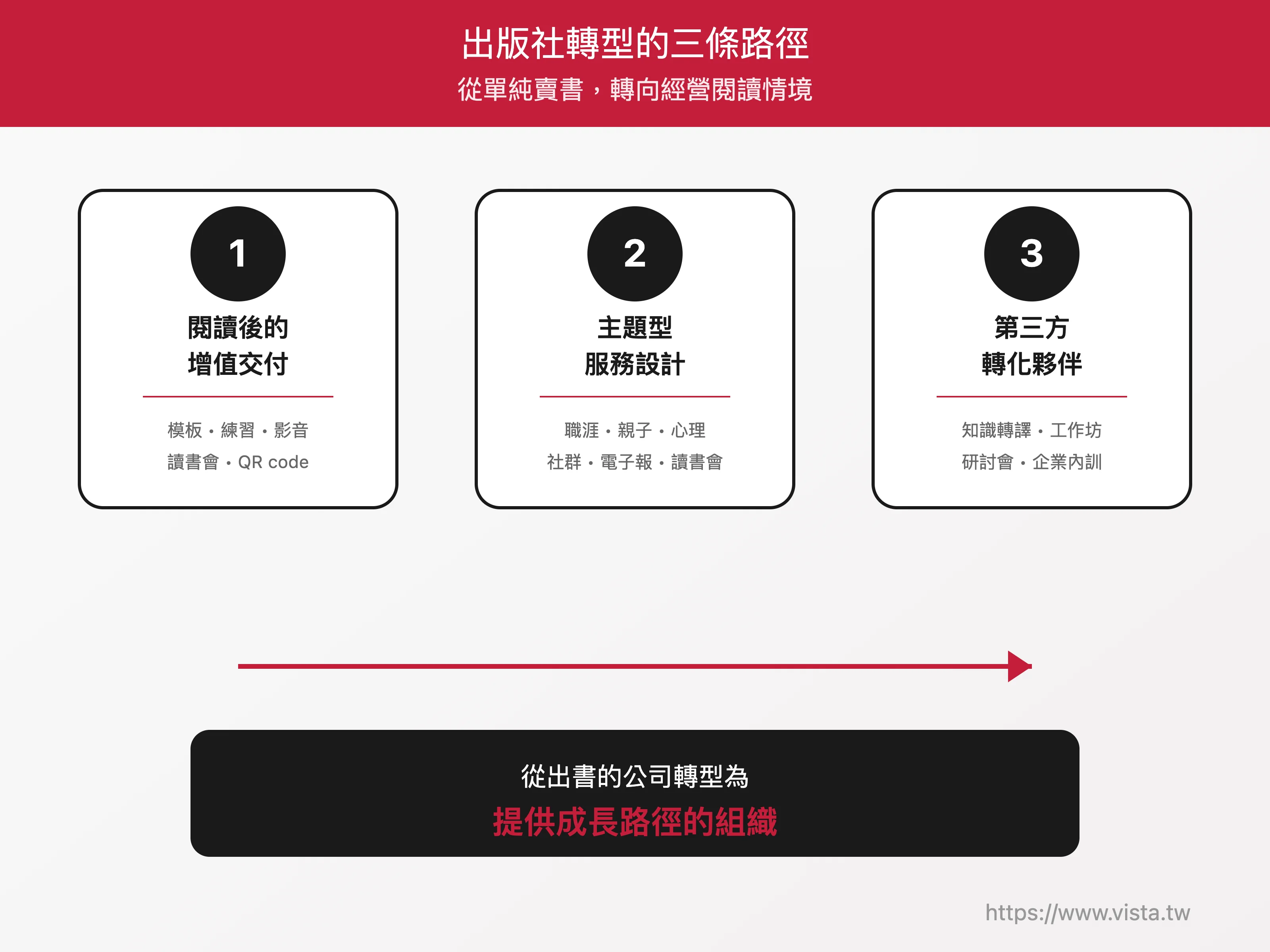 ▲Three transformation paths that can be accumulated slowly with a low budget
Path 1: Every book must be designed with value-added delivery after reading
Don’t let your readers leave after buying the book. At this time, you might as well design a QR code to guide:
- Action list
- Notion / Google Doc Template
- Practice questions and self-assessment sheets
- Extended video by the author (10 minutes)
- Reading club registration page
The point is not to lead back to the purchase page, but to allow readers to leave their contact information and create a persona that you can see. As long as everyone starts to see you, your marketing will no longer rely solely on social platforms.
Path 2: Change the publishing rhythm from a single book to a theme-based service
Rather than starting from scratch for each book, use themes to build long-term columns:
- Career growth
- Parenting
- Emotions and psychology
- Business management and self-management
- Writing and communication
Each topic can be expanded into a community, an e-newsletter or a book club. Books are just material that naturally appears in them, not their sole purpose.
Path 3: Introduce third-party conversion partners to turn books into actionable products
Readers don’t lack content, they lack output. My friend Teacher Qiu Yilin’s suggestion is great. He mentioned that publishers can cooperate with people who are good at illustrations, notes, workshops or lesson plan design to extend a book into:
- Knowledge map
- Action Manual
- 7-day gamification challenge
- 60 minutes of online learning together -In-company training module
In this way, a publishing house is not just a company that publishes books, but an organization that can provide a path for growth. Moreover, these extended products often bring a more stable profit structure than books.
If you want to solve system problems, it is better to build a system yourself. My Vibe Coding practical workshop can help you create your own digital products!
Conclusion: Stop chasing instant exposure and build longer relationships.
I have written 20 books, worked as a marketing consultant, and have been writing for the Economic Daily for a long timeColumn, I know very well how hard the publishing industry is: How much editing, design, printing and distribution costs are required to produce a book, but in the end it is often beaten to pieces by platform discounts and scarcity of attention.
Having said that, it is precisely because of such hard work that I hope that the publisher will not spend all its energy on asking for a post to promote it. It’s not that it’s useless, but it’s too short, too urgent, and too unsustainable.
What can really change the fate of a publishing house is not being better at promoting new books, but being better at managing readers’ growth experience.
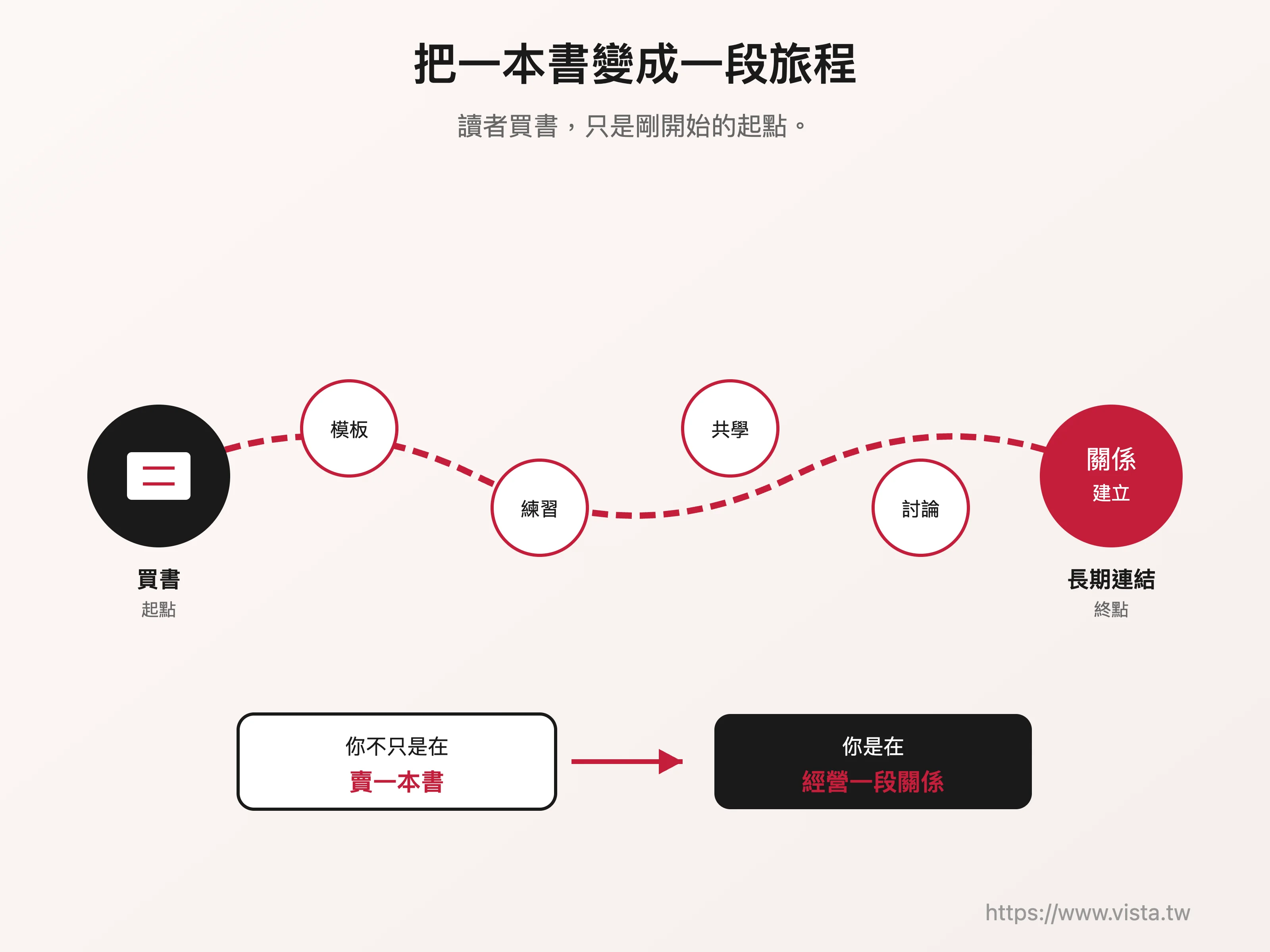 ▲ When you turn a book into a journey, you are no longer just selling books, but building a relationship
Just imagine, when you start to turn a book into a journey: the reader buying the book is just the starting point, followed by templates, exercises, shared learning, discussions, author interaction and action feedback - then you are no longer just selling a book, but running a relationship.
Relationships are the rarest and most valuable asset in this era.
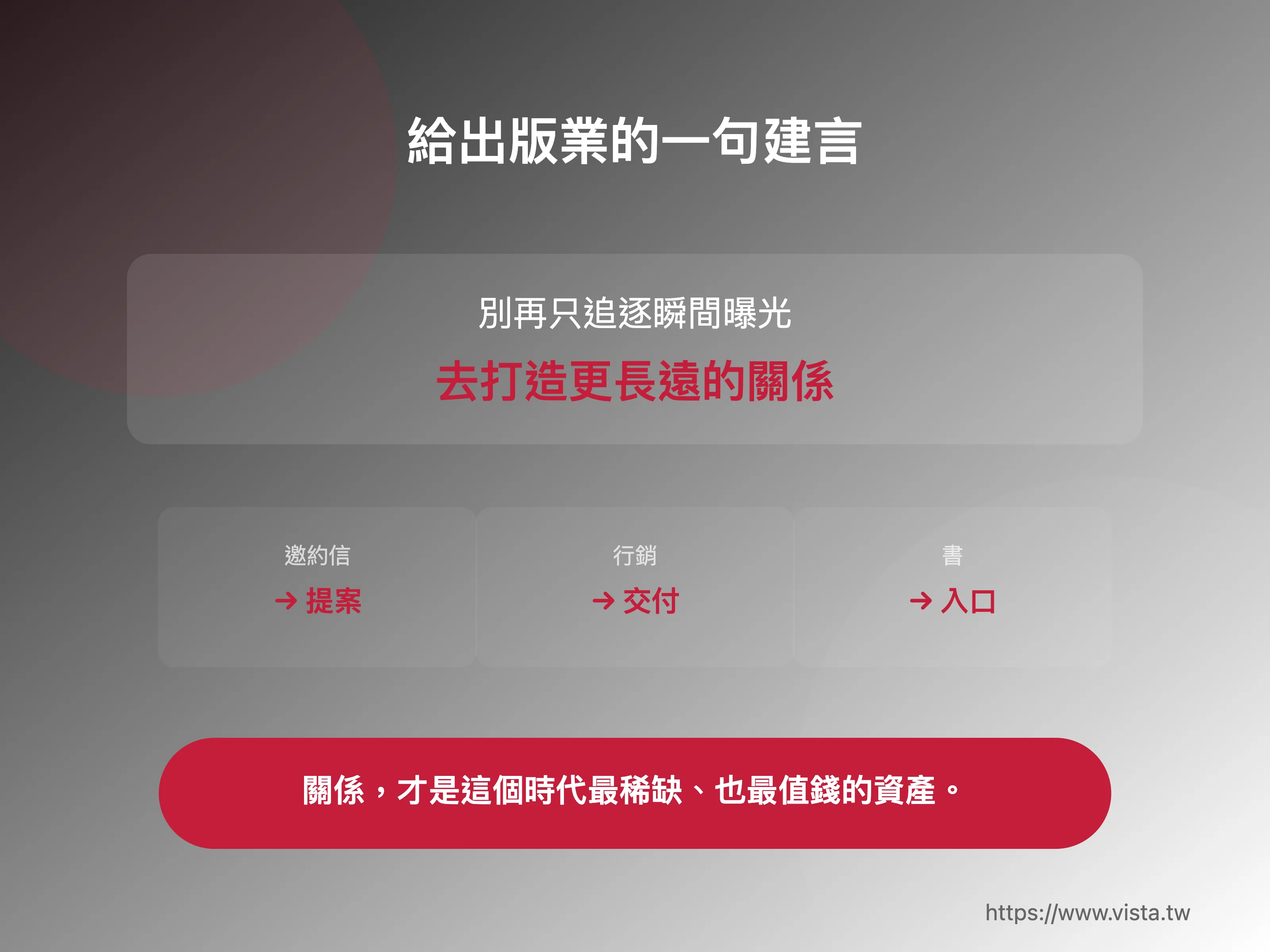 ▲ If the publishing industry is willing to write invitation letters more like cooperation proposals, small budgets will not be a desperate situation
If the publishing industry is willing to write invitation letters more like cooperation proposals, make marketing more like delivery, and make books more like entrances, then a small budget will not be a desperate situation—it may instead inspire a healthier, longer-term, and more mutually beneficial cooperation method.
Further reading:
- What is content marketing? A complete guide to help you master the core concepts
- 9 major trends in content marketing to grasp the future direction of content management
- Build your personal brand: A complete guide from positioning to management
📖 深入探索相關主題