How to choose between the two offers? First break it into three columns, and then use the basis to discuss salary.

Company A’s monthly salary is 58,000 yuan, and Company B’s monthly salary is 62,000 yuan. If it were you, which one would you choose?
When most people see these two figures, they already have the answer in mind: Company B earns 4,000 more per month, which is 48,000 more per year.
Don’t rush to reply yet. The one with a higher monthly salary, calculated as a whole year, may not be more; and you may not get what HR promised you on the phone.
I cut the method of comparing offers into a two-minute animation, and I will explain the five steps in detail in text below.

*▲ The companies, numbers and conditions in the film are all fictitious representations. *
Let’s look at an example first: the monthly salary is high, but the whole year is low.
Use the two companies in the video to do the calculation (the numbers are fictitious demonstration values, not real market prices).
Company A’s monthly salary is NT$58,000, and the offer says “Guaranteed for 2 months at the end of the year” in black and white. Therefore, you get 14 months of guarantee per year, which is NT$812,000.
Company B’s monthly salary is NT$62,000, but the offer only mentions 12 months. At the end of the year, HR said on the phone, “We’ll have at least four months at the end of the year.” If we only look at the written form, Company B’s annual guarantee is 744,000 yuan.
Compared with the monthly salary, Company B earns NT$4,000 more per month; when spread over the whole year and only counting the money guaranteed in writing, Company A earns NT$68,000 more.
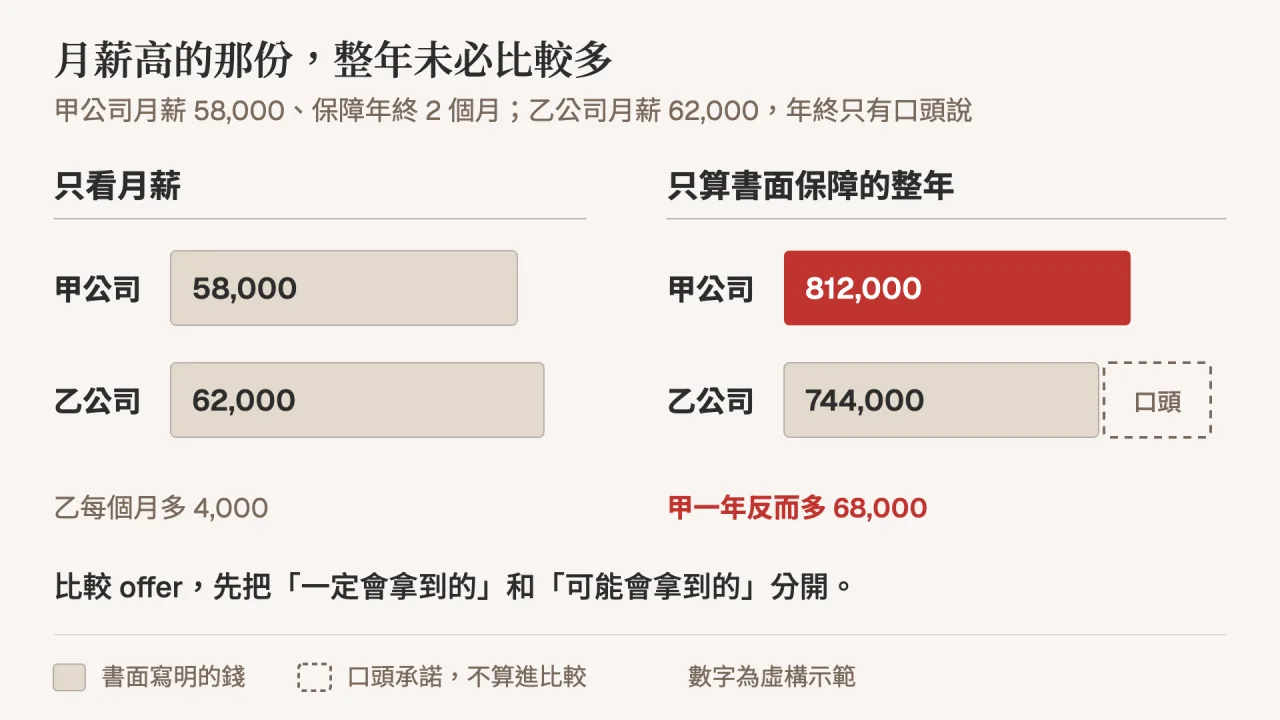
*▲ Looking only at monthly salary and only counting the entire year of written guarantee, the conclusions are opposite (the numbers are fictitious examples). *
Company B may actually pay out at the end of the year, or maybe even more. The point is not who is better, but that you must first separate “what you will definitely get” from “what you may get” before you know what you are comparing.
Step one: Split the annual salary into four levels
The term “annual salary” is easily misunderstood. Similarly, when talking about an annual salary of 800,000 yuan, some people add up the monthly salary for twelve months, and some also include non-guaranteed performance bonuses.
I followed the division method of the 104 Labor Bank Salary Survey and divided the annual salary into four layers, one on top of the other:
-
Annual salary: monthly salary multiplied by 12.
-
Fixed annual salary: annual base salary, plus a fixed monthly allowance.
-
Guaranteed annual salary: a fixed annual salary, plus a fixed year-end guaranteed bonus.
-
Total annual salary: Guaranteed annual salary, plus variable amounts such as performance bonuses, commissions, employee dividends, attendance bonuses, etc.
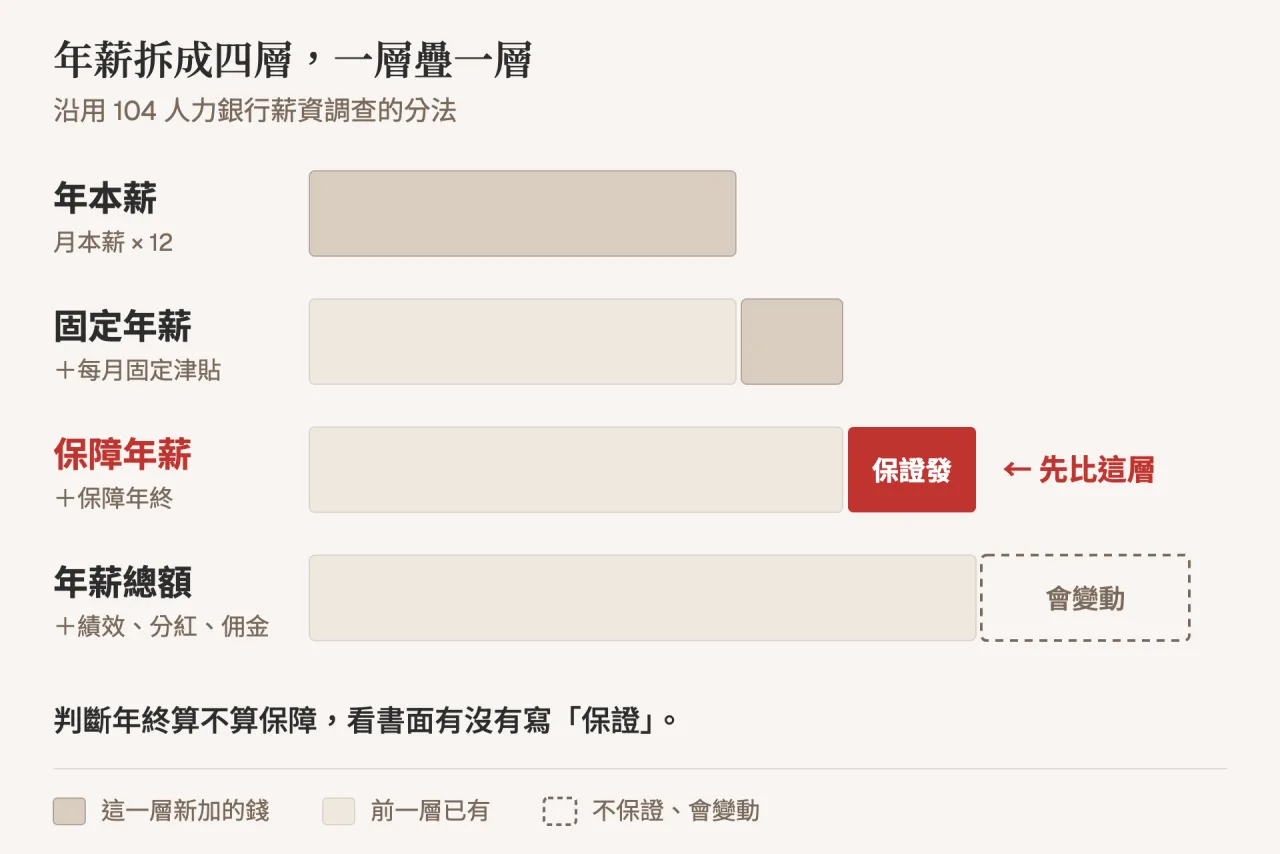
*▲ There are four levels of annual salary one after another. Compare offers first and compare with guaranteed annual salary. *
When comparing offers, start with the level of guaranteed annual salary and then look at others. The total annual salary of an offer looks better, but it often just adds performance bonuses or stocks; those are “possible”, not “already”.
To determine whether a year-end sum is considered a guarantee or not, it depends on how it is written. Writing “guaranteed for one month at the end of the year” is a guarantee; writing “paying out at the end of the year based on company operations and personal performance” is not.
Step 2: Divide each offer into three columns
The fourth layer talks about how the annual salary is composed, and the third column talks about how certain each amount of money is. Get a piece of paper or a spreadsheet and draw three columns for each offer:
-
Guaranteed money: salary, allowances, guaranteed year-end. If it is written on the offer, it will be issued regardless of the company’s performance.
-
Expected money: There is a written basis, but the amount will change with performance, such as a performance bonus that states a target percentage. In each box of this column, write down the hypothesis you used, such as “Assume that the performance reaches 100% of the target.”
-
Guaranteed money: stocks, options, bonuses with a wide range of options. Just list them out, don’t add them to the total yet, just think about them in several scenarios.
The offer says “Performance bonus for 0 to 2 months”. 2 months is the upper limit, not the number you will get. Human Resources said that “the average department last year was 1.2 months.” This is a past statistic, not a promise.
There is another column that should be especially separated: verbal commitment. The words “at least four months after the end of the year” and “can be adjusted after half a year” that I heard on the phone were all put into this column. When comparing, they are excluded by default. If you want it to count, ask the other person to put it in writing.
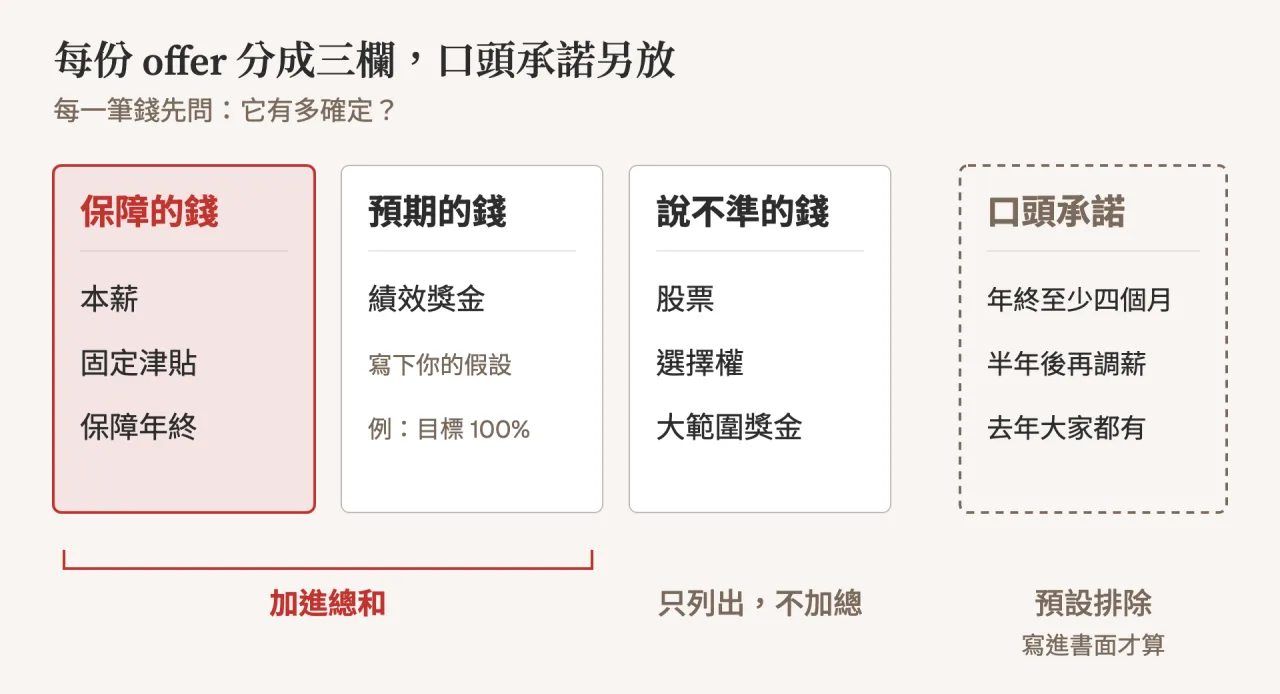
*▲ Only the guarantee and expectation columns are added to the total, verbal commitments are placed separately and excluded by default. *
Step 3: Leave the calculation to the spreadsheet, not to AI
After the conditions are divided into columns, it is necessary to add up, estimate labor health insurance and income tax. Many people will want to leave it to AI to calculate directly.
My advice is don’t. AI will make mistakes when calculating money, and it can make mistakes with confidence; if you use a wrong number to discuss with human resources, you will bear the consequences yourself.
Please submit the total and tax amount to the spreadsheet formula. The advantage of the formula is that you can see how each cell is calculated, and you can find any calculation errors.
AI is suitable for two other things: organizing a long offer letter into a list of conditions; and comparing the items that should be asked to find out what you haven’t asked clearly yet, such as the length of the trial period, the time of year-end payment, and remote regulations. If a number appears during the sorting process, ask it to just copy what you gave it and do not convert it yourself.
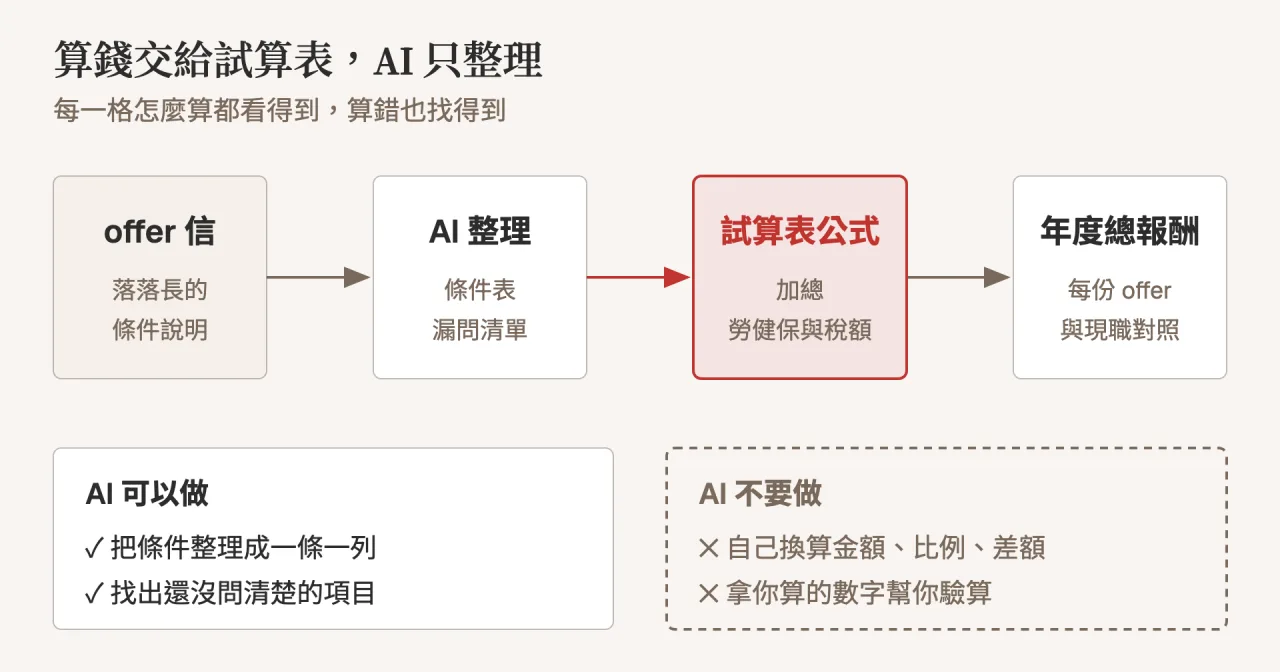
*▲ AI is responsible for organizing, and calculating money is handed over to the formula of the spreadsheet. *
Step 4: Speak with evidence
After the comparison is clear, if you want to strive for better terms, the way you open your mouth will determine how the other party responds.
Don’t just say “I hope it can be higher.” This sentence does not give the other party any reason to report it.
You can change it to this:
According to the two bases I compiled, one is the scope of duties of this position, and the other is my achievements in my current position. I want to get a monthly salary of 68,000, and other conditions are as stated in the offer.
This sentence has three elements: your basis, a specific number, and ceteris paribus. The other party wants to go back and report to the supervisor, and there is something he can relay.
In addition, it is best to discuss the monthly salary, rank, start date, and bonus guarantee together. Only talking about one item at a time, and then coming back to ask for rank after talking about monthly salary, can easily make the other party feel that it is endless.
Step 5: Get the negotiated conditions in writing
No matter what is negotiated, ask the other party to update the written offer. The adjustments agreed to over the phone are still in the verbal commitment column in the second step before they are put into writing.
Finally, here are two things not to do: Don’t fabricate another offer to raise the price, and don’t falsely report your current salary. Once these two things are verified, your credibility will be damaged, and in the same industry, it is easier for people to meet each other than you think.
Five steps together
-
Break down the four levels: first compare the guaranteed annual salary.
-
Divide into three columns: guaranteed, expected, and uncertain; verbal commitments are placed separately and excluded by default.
-
When calculating money, leave it to the spreadsheet. AI only sorts out the conditions and only copies the numbers.
-
Open with evidence and discuss the whole package together.
-
Get the negotiated conditions in writing.
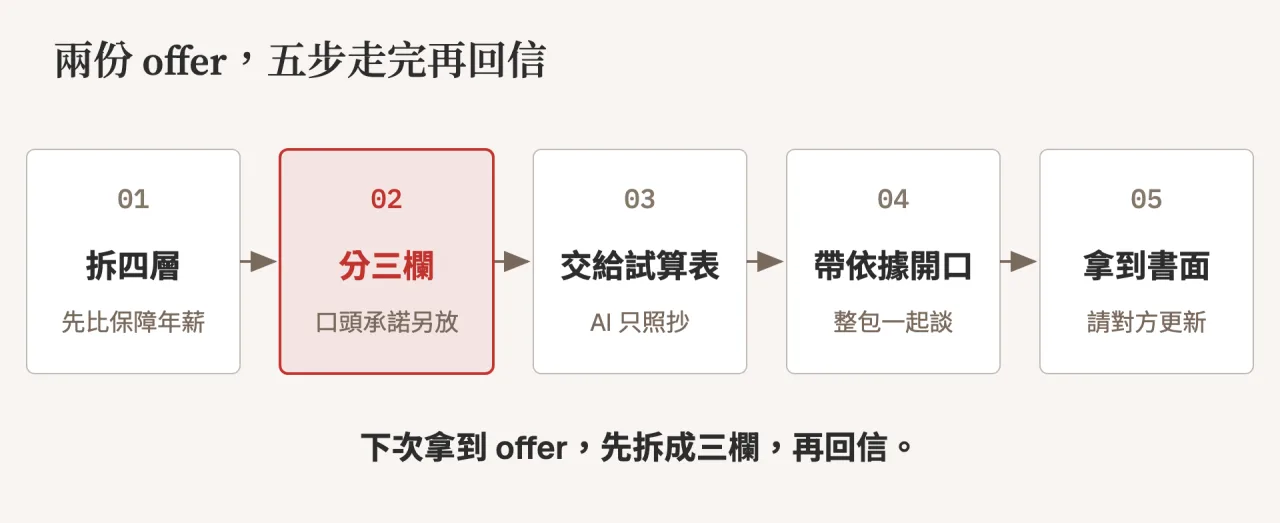
*▲ Five steps to compare and negotiate offers. *
Next time you get an offer, split it into three columns and then reply. Which one you want to take is ultimately up to you.
If you want to take a look at the entire job search process, from resume, interview, salary negotiation to promotion, you can read this article “The four levels of office workers, from resume submission, interview, salary negotiation to promotion”, which contains a complete trial calculation demonstration of a high monthly salary but a low guaranteed annual salary.
I want a form that can be filled in directly
The five steps described in this article come from the “Salary Negotiation and Offer Evaluation Package (opens in a new tab)” that I made. The manual contains complete steps, tested prompt words, and an offer comparison spreadsheet that converts each offer and current position into after-tax annual total compensation. There are also sample counteroffer letters and salary negotiation exercises.
The manual does not guarantee any salary outcome and the outcome of the negotiation is determined by both parties. What it can help you with is making you clear about what you are comparing and making your arguments sound when you speak.
The last time you compared offers, what did you ultimately look at to make your decision? Feel free to leave a message and tell me.
Next step
Bring this topic to your team
Vista Cheng speaks and runs workshops on AI workflows, writing and content systems for companies, schools and public agencies.