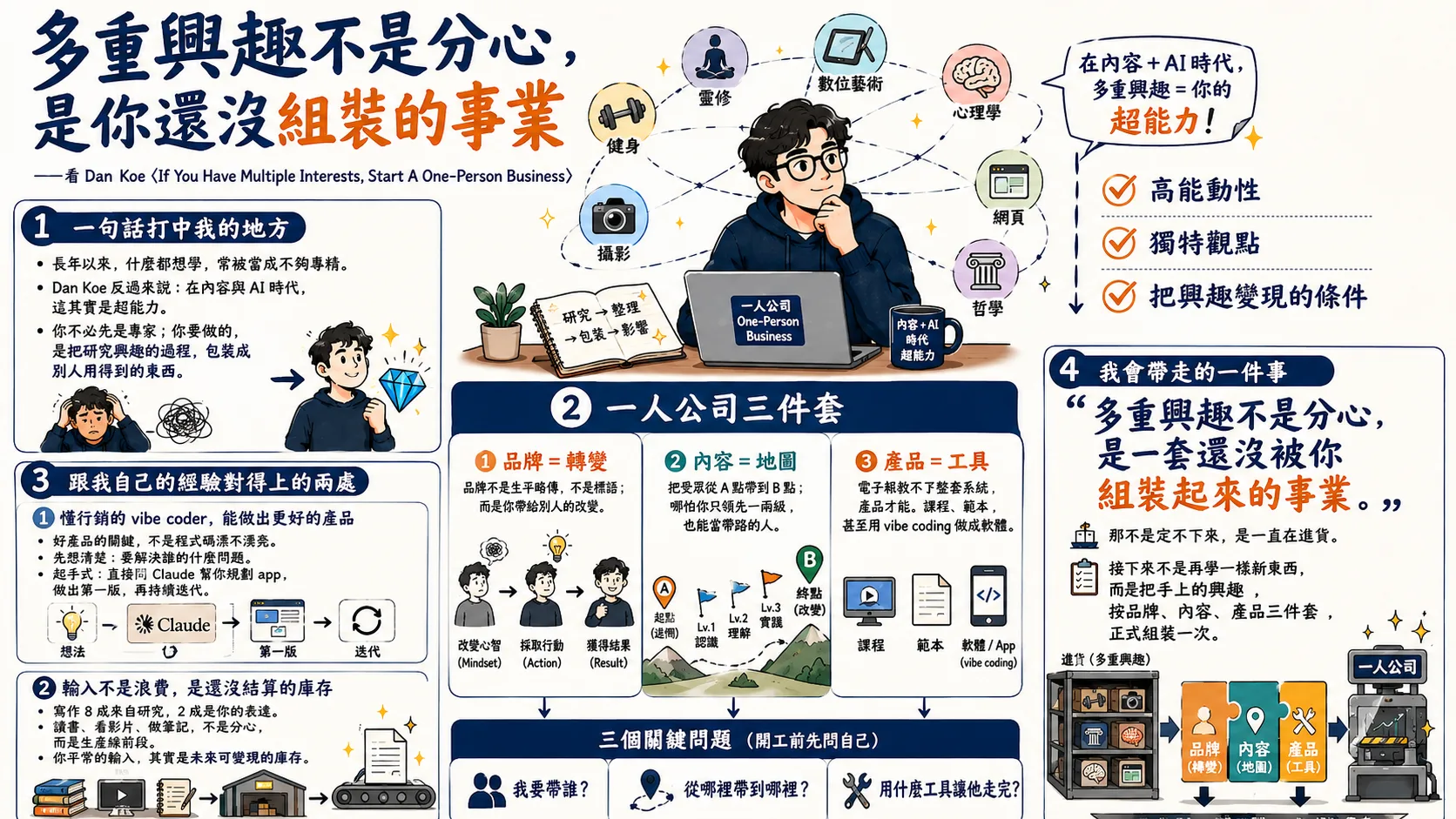
Multiple interests aren’t distractions, they’re careers you haven’t assembled yet: Dan Koe’s one-person company three-piece package
*▲ Multiple interests are not distractions, but a set of careers that you have not yet assembled. *
The place where one sentence hit me
At the beginning of the video, Dan Koe said that he is a person who is obsessed with many things: fitness, spirituality, digital art, photography, web pages, psychology, philosophy… one after another. I was shocked when I saw this paragraph, because it is almost a portrayal of myself. For many years, this tendency to want to learn everything and learn a little bit of everything has been regarded as a shortcoming: lack of expertise, inability to settle down, and laxity in everything. On the other hand, he said that this is a superpower in the era of content and AI - it sends three signals: high motivation, unique perspectives, and all the conditions to monetize interests.
Reframing the same trait from anxiety to asset is worth the 30 minutes. Over the years, I have taught people how to run a one-person company (https://www.vista.tw/topic/personal-brand) and AI literacy. Most often, I encounter students stuck in the same knot: I am not an expert, so why should I do it?
Dan Koe has helped everyone decipher this sentence - you don’t have to be an expert, what you need is to package the process of researching your interests into something that others can use.
If you are not averse to English, I highly recommend spending half an hour watching this video in its entirety:
What really comes in handy is the clean three-piece suit
The most noteworthy thing about this video is not that it is inspirational. It is that Dan Koe split a one-person company into three pieces, which is so clean that it can be directly drawn into a slide film:
- **Brand = Transformation. ** A brand is not a biography or a slogan, it is the change you bring to others. You will admire a person because he first changes your thoughts and then your actions, and you give him the credit for the results brought about by his actions. Therefore, the brand is invisible and grows bit by bit through content.
- **Content = map. ** Put the audience at point A and take them to point B, like game level design. Even if you are only one or two levels ahead, you can be the one leading the way.
- **Product=Tool. ** E-newsletter cannot teach a complete system. Product capabilities-courses, templates, or simply use vibe coding to make software. He put it very clearly: the realization of the creator economy is the system economy.
I have made so many funnels and taught so many monetization lessons. Looking back, these three sentences are easier to teach than most marketing frameworks I have seen. The reason why it is easy to use is that it reduces the abstract personal brand into three specific questions that can be asked: Who should I take with me, where should I take it from, and what tools should I use to get him there.
Two things that are consistent with my own experience
In the first place, he talked about how vibe coders who understand marketing can outperform engineers who can only write programs - because the former can make better products, and whether the code is beautiful or not is not a necessary condition for a good product. I completely agree with this. I have used Claude to make a bunch of small things this year, not because I can write programs, but because I know whose problems I want to solve. He even made the starting point couldn’t be simpler: ask Claude directly, I want to make an app, please help me plan it, and then do it step by step. The first version will definitely suck, the only difference is whether you continue to iterate. This is the same thing I’ve been teaching about archetypal thinking in class.
The second location is lower. He said that 80% of writing comes from research, and only 20% comes from writing it out in your own way; therefore, the duty of a one-person company is to turn yourself into a researcher and carrier. This sentence is worth savoring carefully, because it helped me string together a bunch of things that were originally scattered - the books I usually read, the videos I watch, and the notes I take. It turns out that they are not distractions, but the first part of the production line in itself. I always felt that I spent too much time typing. After reading this paragraph, I realized that typing is never a waste, it is inventory that has not yet been settled. Turning these inventories into output in a systematic manner is what I wanted to solve most when designing the “[AI Content Production System Workshop] (https://www.solo.tw/courses/ai-content)”.

🛰️ Want someone to accompany you to see clearly in the wave of AI changes?
Almost all the public articles you see are finished products after repeated polishing. But what I cherish the most is the warm judgment before the finished product - this is the reason why I created [Vista AI Inspiration Supply Station] (https://www.facebook.com/iamvista/subscribe/): a weekly thought note for fellow travelers in the AI era, sharing those Yoshimitsu Kataha that will not appear in formal articles with you who are willing to get closer.
One clarification I want to add
In full disclosure: the middle part of this video is the placement of Dan Koe’s own content tools. The concept is closely tied to the product, and there are also a few beautiful numbers in the middle that have not been independently verified. My own habit of reading this kind of content is to pull out the tools first and see if the remaining skeleton still stands. After the tool is removed, the skeleton of this one is still standing, which is why I am willing to share it with you.
But he said at the end that what this video gives is not the steps, but the belief: this road is feasible, the steps can be found everywhere, and what you lack is belief. He’s not wrong, but perhaps only half right. For those Taiwanese friends around me who want to start a one-person company but are not good at sales, having faith alone is not enough. What they are really stuck on is translating faith into “the first action of the week.” Faith is responsible for letting people go on the road, but someone still has to accompany them to remove friction every step of the way. This is exactly the position I can fill.
One thing I would take away
If I only leave one sentence, I will leave this framework he mentioned: Multiple interests are not distractions, they are a set of careers that have not been assembled by you. It made me re-examine my seemingly scattered accumulation over the years - it’s not that I can’t settle it down, it’s that I’m constantly restocking. The next thing to do is not to learn another new thing, but to formally assemble these interests according to the brand, content and products.
Extended reading: If you want to have a more complete understanding of Dan Koe’s one-person company mentality, you can continue to read my article - “[Dan Koe: How to build a one-person company] (https://www.vista.tw/blog/dan-koe-how-to-build-a-one-person)”. That article talks about micro-level creative methods, and this article supplements the macro-level business structure. Together, the two articles are almost a complete map of a one-person company.