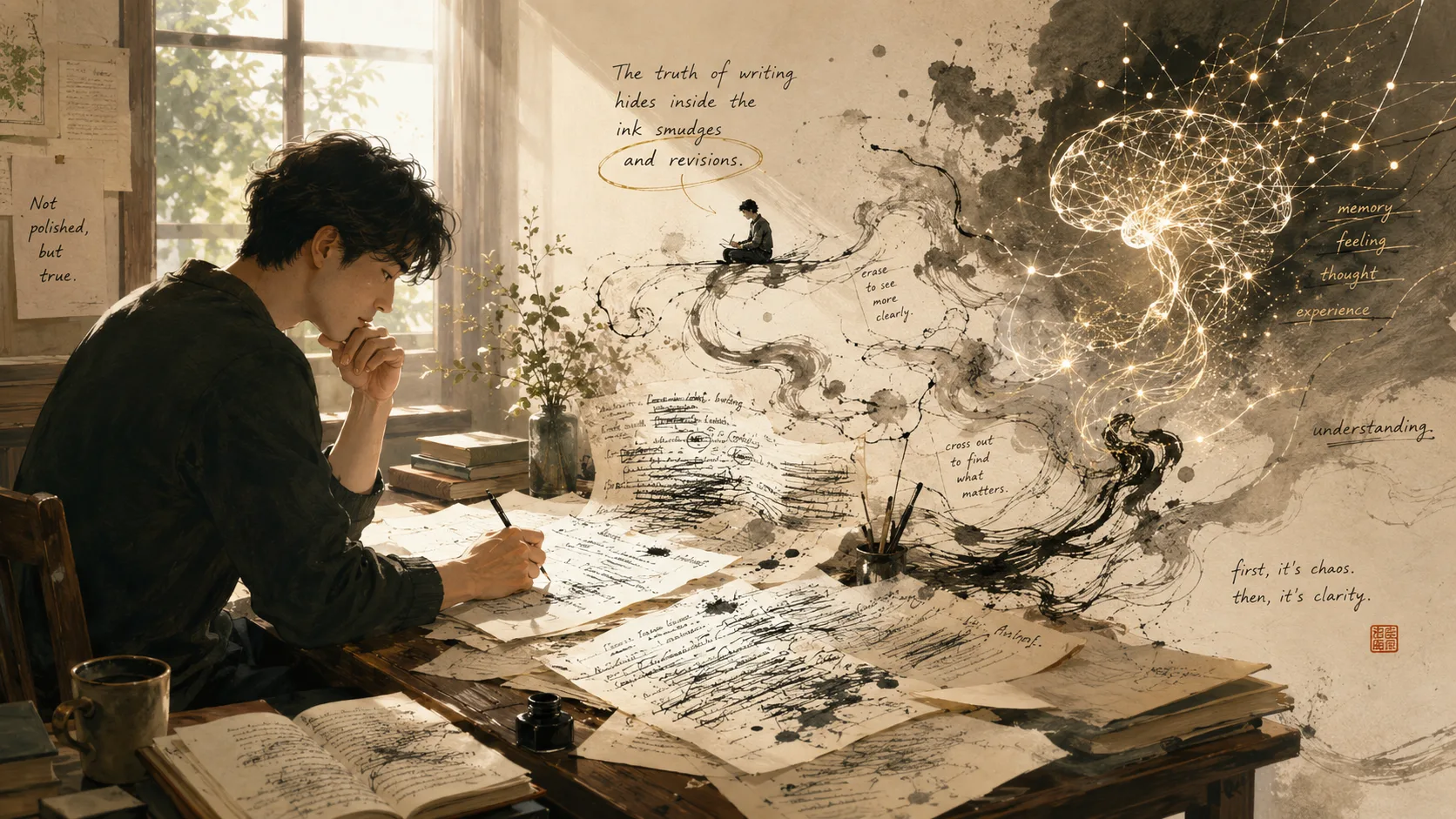
The writing is ugly, but it is precious: the truth of writing is hidden in those erased ink stains
*▲ The truth of writing is not in the neat finished manuscript, but in the ink stains that have been corrected and the bad drafts that have been rewritten. *
On Sunday afternoon, I chatted with some friends about creation. While we were chatting, my friend Yongxi suddenly said something: “It’s not uncommon to write something that is so good nowadays, but something that is written ugly is actually very precious.”
When I first heard these words, I was stunned for a moment. Because this sentence almost overturns the view of writing we have been taught since childhood - we always think that the goal of writing is to write beautifully: the wording must be precise, the structure must be neat, and it is best to finish it in one go without leaving any traces.
But over the years of teaching writing and writing every day, I have become more and more certain of one thing: the truth of **writing is not found in the neat and beautiful finished manuscripts, but is hidden in the erased ink stains, crossed-out sentences, and bad drafts. **
Next, let’s talk about this.
The three greatest pieces of calligraphy are all drafts
Let me start with a counter-intuitive fact.
In “The Beauty of Chinese Calligraphy”, Jiang Xun revealed a secret that has been misunderstood by many people: the three works regarded as the pinnacle in the history of Chinese calligraphy - Wang Xizhi’s “Lanting Preface”, Yan Zhenqing’s “Manuscript of Sacrifice to My Nephew”, and Su Shi’s “Huangzhou Cold Food Post” - are essentially drafts that have not yet been transcribed.
“Lanting Preface” retains Wang Xizhi’s spontaneity and ease when he first wrote it. Even the ink stains and scratches in his thinking process have become ups and downs in the writing rhythm. Precisely because it is a draft, it completely restores the true state of mind at the time of writing; that vitality cannot be imitated by any deliberate and neat reproduction.
In other words, these three works are great not because they are flawless, but precisely because they are not embellished for the sake of being seen.
**Perfection is for others to see, and draft is to prove that you have lived. **
We are too accustomed to only treating the final version as a work, and treating the corrections in the process as failures to be hidden. But sometimes, those sentences that you cross out and the paragraphs that you reject after writing them truly record the trajectory of your thinking.
Why writing by hand is easier to understand than typing?
The second thing is related to the brain.
In 2024, a research team from the Norwegian University of Science and Technology conducted an experiment: 36 students were asked to write down single words by handwriting and typing, while their brain activity was observed using electroencephalography.
The results are amazing. When students write by hand, multiple areas of the brain responsible for movement, vision, sensory processing, and memory are active simultaneously, forming dense neural connections with each other; while when typing, there is almost no synchronized activity in these areas.
The key is that “slow”. Handwriting is slow, so you can’t copy down everything you hear - you’re forced to prioritize, integrate, relate: Which sentence is the most important? What does this have to do with what I already know? How can I condense it in my own words?
This process of “making the information your own” is the moment when understanding occurs.
**Typing is to transfer information to paper, while handwriting is to engrave information into the brain. **
This also echoes a concept that I care about very much. Cognitive science calls it “Writing to Learn”: when we write, we often do not write because we have thought clearly, but because we finally think clearly through writing.
So I often tell students: Don’t be afraid of messy drafts. That mess is evidence that your brain is working on the spot.
Understand first, or express first?
When we talk about this, we will encounter a more fundamental question: Which comes first, understanding or expression?
Many people’s intuition is “understanding first” - I figure it out in my mind first, and then express it. I used to think this way, and even thought: “Understanding is the first thing. Once you understand it, write it down and it will be good.”
But the philosopher Whitehead put forward a proposition that just breaks this intuition: **understanding cannot be separated from expression. **
Current commentator Cao Lin often discusses this matter in class. The real way of thinking is not as linear as “first complete the understanding in the mind and then express it”. Many times, you think you understand, but once you really want to write it down, you find that there are loopholes everywhere - whether you can express it clearly is a test of whether you understand or not.
So writing is not the end of understanding, but the process of understanding itself.
**You think you are writing an article, but in fact your brain is borrowing your hand to organize itself. **
This is why I never recommend “waiting to think clearly before writing.” Because many times, you just have to put pen to paper before you can think clearly.
So, please allow yourself to write ugly
Put these three things together and you’ll see that they all lead to the same conclusion.
The history of calligraphy tells us that the most vital works are drafts; brain science tells us that slowness and imperfection force the brain to truly operate; philosophy tells us that writing is inherently a part of understanding.
So, what is so valuable about those “ugly written” things? What’s precious is that they are real - they faithfully record the scene of your thinking when you are still groping, still struggling, and have not yet been modified.
In recent years, it has been very popular to talk about Japan’s “Wabi-sabi” aesthetics. Writer Joe Moran wrote something I love in “If You Fail”: “Wabi-sabi acknowledges that nothing is perfect, complete, or lasting. It is unevenness, imperfections, and decay that give things their true beauty.”
This is true even when teaching children to write. Educational neuroscientists at Vanderbilt University found that when children practice writing “A”, it looks crooked and different every time - and it is this “different every time” variability that helps them consolidate their conceptual understanding of the letter.
In other words: **Imperfect writing is never an obstacle to learning, it is learning itself. **
If you also want to start writing, but are always stuck at the level of “I don’t write well enough”, I will give you the same advice as before - start with free writing: don’t care about writing style, don’t care about structure, just put what is in your head onto paper truthfully for 5 minutes after a meal. As for what to write, I have also sorted out six directions that I often recommend for collecting materials. You will not be short of materials, what you are missing is just the habit of being willing to write them down.
The next time you write an ugly, redacted draft, don’t delete it just yet.
That’s not because you’re writing bad, it’s probably because you’re really thinking about it.
📖 深入探索相關主題