Inspiration is a bonus, but ability is your duty: nine fields and a set of workflows where writing coaches proactively collect creative inspiration
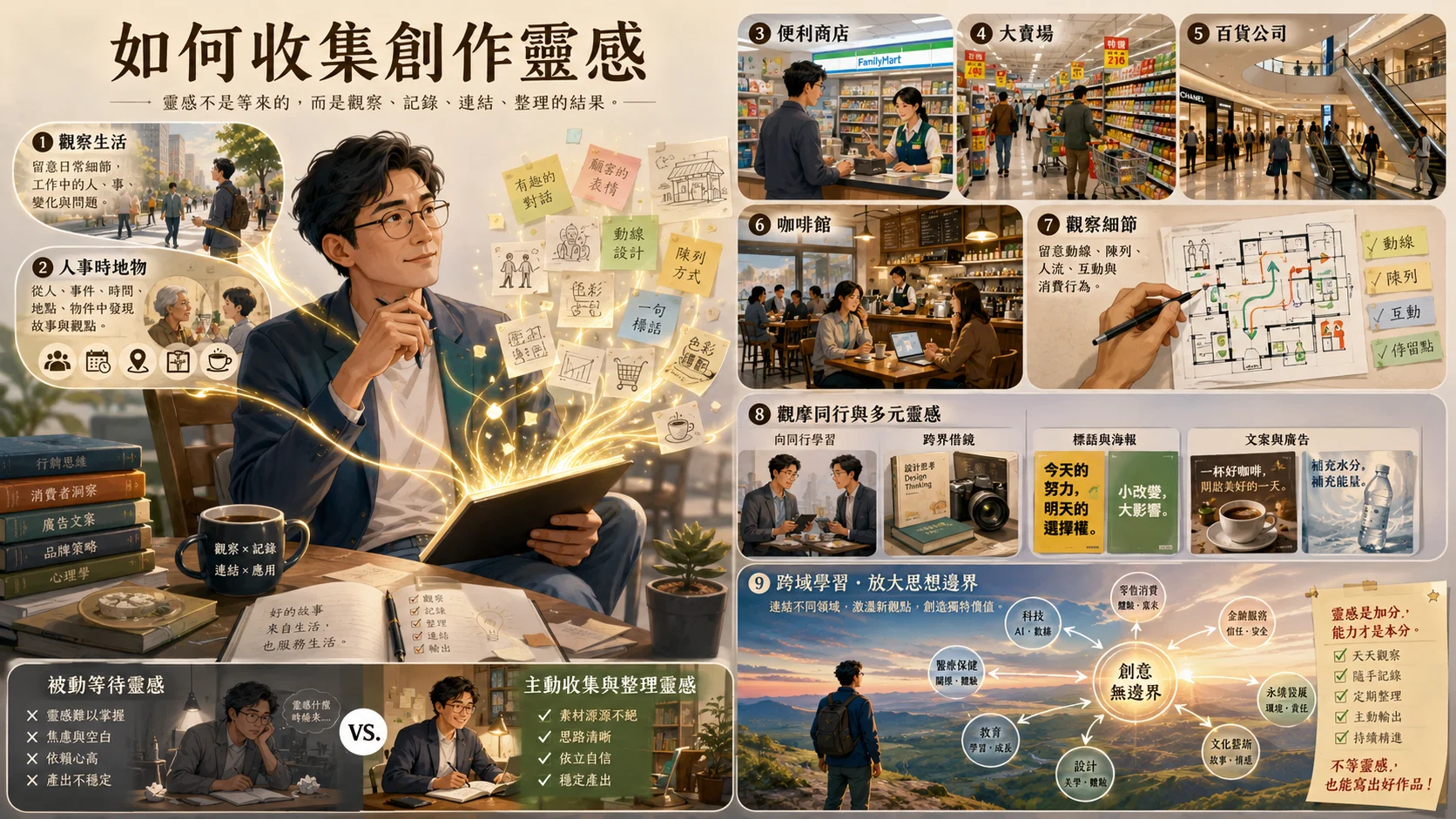 *▲ Inspiration is not something you wait for, but the result of observation, recording, connection, and organization. *
As a writing coach, I have been asked the same question thousands of times in the past ten years: “Teacher, where do you get your inspiration from?”
My answer has never changed:
Inspiration is a bonus, ability is the key.
It sounds like pouring cold water on it, but it is actually the most important relief for writers. Once you tie your output to inspiration, you won’t be able to write a word on the day you don’t have inspiration. But the reality is: you have to submit a manuscript every week or every month, and inspiration doesn’t just happen to knock on the door that day.
I wrote an article “A brief discussion on writing rituals and inspiration” a few years ago. The conclusion at that time still holds true today: professional writers should not rely too much on inspiration, but should actively manage inspiration. In today’s article, I would like to spend some space to make the four words “active management” more specific, and share nine fields that I have actually used over the years, four key points of observation, and a set of workflows that make inspiration available for a long time.
Passively wait for inspiration vs actively collect inspiration
Let’s talk about the conclusion first:
People who passively wait for inspiration will experience:
- Inspiration is hard to grasp
- Anxiety and blankness
- High dependence
- Unstable output
People who actively collect and organize inspiration will get:
- An endless supply of materials
- Clear thinking
- Build confidence
- Stable output
The difference is not in talent, but in whether you have turned “collecting” into a daily action. The passive person sits at the desk and waits, while the active person goes outside to look for it.
Nine Inspirational Fields I Actually Run
Many people think that to find inspiration, you have to go to a quiet place or wait for a very touching moment. My experience is just the opposite: inspiration often comes from places where the pace is fast, there are many changes, and there are people coming and going.
1. Observe life: people, events, places and objects
Well, this is actually the most basic and most easily overlooked one. Find stories and perspectives from the people around you, events that happened, specific times, places, and objects.
I have a habit: the first thing I do when I get up every day is not to read the news on my mobile phone, but to think about the most unusual moment yesterday. It could be a word spoken by a taxi driver, a conversation at a table next to someone in a coffee shop, or the expression of a stranger on the MRT. Unusual moments are the source of 90% of good articles.
2. Convenience store
I often encourage students: If you have nothing to do, go shopping at 7-11, FamilyMart or Leif. I don’t want you to buy anything, I want you to read:
- Where are this season’s new products placed?
- How do shop assistants interact with customers?
- How to write promotional copy in the checkout area?
Convenience store displays change every two weeks, which is the cheapest and easiest way to observe consumer trends.
3. Hypermarket
When you have free time, please also visit the hypermarkets! In hypermarkets and convenience stores, we look at different levels: convenience stores mainly look at immediate consumption, while hypermarkets look at household decision-making. A housewife hesitated in front of the shelf for three minutes before putting which jar of soy sauce into the trolley? These three minutes are the seed of a consumer behavior article.
4. Department Store
In department stores, we mainly look at brand language. They both sell cosmetics, but CHANEL and SK-II have completely different counter designs, store clerks’ vocabulary, and trial procedures. You don’t have to be a cosmetics expert. Just observing “How do they make you feel that the same product sells for 5,000 yuan as it is worth the money?” is a marketing lesson.
5. Cafe
As for cafes, what we want to look at is how does space determine behavior? For the same cup of latte, if you look at Starbucks, Louisa or the independent cafes that line the streets, the length of stay, proportion of laptop use, and conversation volume are all different. If you can answer this “why”, you will have the skeleton of a good article.
6. Observe details: movement lines, displays, interactions, stopping points
No matter which field you enter, always look at these four things:
- Movement lines: How do people flow? Where will it stop? Where will it go?
- Display: What items are placed at the “golden height” (120-150 cm)?
- Interaction: Is the clerk active or passive? How do guests ask questions?
- Stopping point: At which point will a person stop for more than 30 seconds?
These four observation items are common to all industries. Later, when I did content strategy, course design, and website interface creation, I still used the same logic.
7. Observe your peers
It’s also a great way to directly watch what people who do the same thing as you do. But it’s not for plagiarism, it’s for finding gaps.
I follow 30 content creators regularly, but instead of looking at what they write, I look at what they don’t write? Everyone is talking about AI tools, but who is talking about AI ethics? Everyone is teaching prompt, who is teaching reflection? The vacancy is often your place.
8. Cross-domain reference
This one is the most powerful. A lot of my inspiration for writing articles comes not from the writing circle, but from:
- Design Circle: Learn layout rhythm, white space, and hierarchy
- Product circle: learning needs insight, user journey
- Medical Circle: Learn how to speak professionally into human terms
- Financial Circle: Learn how to package abstract concepts with stories
Every time you enter an area, you add another level to your metaphor arsenal. Readers think you are particularly good at writing. It is probably not because your writing is good, but because your metaphors come from a wider range of sources than others.
9. Cross-domain learning: enlarging the boundaries of thought
This is an extension of Article 8. Learning from peers is parallel learning, and cross-domain learning is in-depth learning.
Every year, I force myself to read at least 3 books that have nothing to do with my field of study. For example, recently I have been reading the history of the space industry, the business model of the funeral industry, and the oral histories of early textile workers in Taiwan. After reading it, I feel that it has nothing to do with my work, but these materials or inspirations may be used three months later!
This also echoes the argument I made in the article “Two foundations of writing: sense of object and sense of picture” a few days ago: The source of the sense of picture is never imagination, but how many specific scenes are stored in your brain that others do not have.
After collecting: Build your inspiration database
Mere observation is useless. 90% of inspiration that is not written down will evaporate within seventy-two hours.
My own inspiration database looks like this:
- Notes: mobile memos, Voicenotes (direct dictation from walking observations), paper notebooks
- Weekly organization: spend 30 minutes every Sunday to pull scattered records into the main database (I use Obsidian + Anytype dual track)
- Add tags: Each transaction should be marked with at least 3 tags, including characters, scenes, and theme types, to facilitate future retrieval.
- Regular review: Check the database once a month and let AI help me find entries where the same observation has been recorded more than three times. That is the article that should be written.
The key is not what tools to use, but whether the cycle of “collection, consolidation and review” is running? Many people stop at the first step, so there are 300 pieces of inspiration lying in their notebooks, but their minds are still blank when writing articles.
Three myths that are easy to trip up
Finally, I would like to share with you three points where I have seen the most people get stuck.
Myth 1: Thinking that inspiration must be “special” to be worth remembering. wrong. “Special” is filtered out after the fact. You can’t judge at the moment, so write it all down and talk about it later.
Myth 2: Thinking that observation must be “purposeful”. wrong. Inspiration comes most easily when you look at it without questions. If you observe with questions, you will only see what you want to see; if you observe with an open mind, the world will show you its true texture.
Myth 3: Thinking that “thinking” is enough and there is no need to “write”. wrong. Inspiration that is not written down is not inspiration, it is only an illusion. Force yourself to write “Why does this attract me?” Just writing this sentence will force you to think clearly.
I write this to give you a pragmatic next step.
If you have built your own inspiration database, but still feel that you only have materials but no stable output, then the problem that is holding you back may not be the inspiration, but the process.
This is why I opened the “AI Content Production System Workshop”: to break down my more than ten years of writing process, from material collection, style setting, first draft writing, AI flavor removal, to multi-platform distribution, into collaborative Skill modules.
A piece of material is automatically produced in six formats. You are responsible for observation and judgment, and AI is responsible for execution and reorganization.
If you also want to change your writing from a gamble of inspiration to a stable output:
👉 Click here to view course details
Next show on June 28, 2026 (Sunday), limited to 16 seats.
One last word for you. This is a sticky note I have posted on my studio desk for five years:
You can write good works without waiting for inspiration.
Inspiration is never the ticket to writing, the habit of continuous observation and recording is.
See you in class.
Next step
Bring this topic to your team
Vista Cheng speaks and runs workshops on AI workflows, writing and content systems for companies, schools and public agencies.