Read "Hao Hui Reading" from the perspective of the book club host: Turn the books you have read into a part of your life
I love reading, and all my friends know this.
In the past few years, I have led many reading groups - from small gatherings of ten people to simultaneous online reading with hundreds of people, I have held them all. In this process, I have seen too many scenes where people read a lot but are of no use: the bookshelf is full of books, and a bunch of golden sentences are drawn with a fluorescent pen. It seems that he is very diligent, but after closing the book for a week, if you ask him what the book has changed, he often cannot answer.
So, when I got teacher Hao Hsu-lieh’s new book “[Hao Hui Shushu: Teach you to transform the classic wisdom of growth, wealth, logic and education into useful perspectives in life] (https://www.books.com.tw/exep/assp.php/vista/products/0011050121?utm_source=vista&utm_medium=ap-books&utm_content=recommend&utm_campaign=ap-202604)”, I opened it with the expectation that this book would be different.
After reading it, I can honestly say: this book is really different.
Let’s talk about the author first: the bookish style that makes people want to get close to him
I have known Brother Hao (Hao Hsu-lieh teacher) for several years.
What impressed me most was not how beautiful his academic background was, nor how full his lecture schedule was, but the gentle and elegant bookishness of him. That kind of temperament is very special - it’s not a pretense of a scholar, nor a deliberately created sense of literary youth, but the smell that a person naturally exudes after years of soaking in books and thinking about problems seriously.
I have an observation: Whether a person writes a good book or not is often related to his aura. People with a frivolous aura cannot write solid books; people with a restless aura cannot write books that can be read with concentration. Brother Hao’s book style is very calm, so this book is particularly practical to read - you will not feel that the author is promoting himself, but you will feel that he really wants to give you something.
Readers can feel this sincerity.
Why does reading need to be taught again?
As someone who has led a reading club for many years, I am often asked a question:
Vista, how do you read so many books?
To be honest, my previous answers were all vague. Because my own reading methods have been accumulated over many years, I have a system, but it is not easy to explain clearly. It wasn’t until I finished reading “Hao Hui Shushu” that I realized one thing——
Reading is something that needs to be taught again.
Sounds counter-intuitive, right? Haven’t we been reading since childhood? Why do we need to teach again?
But if you think about it carefully: what we are taught in school is to read for exams. After leaving school, no one taught us to “read for life.” The methods, rhythm, and focus of these two things are completely different.
The value of Brother Hao’s book lies in the fact that he helped us make up this lesson. He used his lifelong reading experience to break down the matter of reading for life into a set of replicable methods.
The core of the book: Four-Year Reading Method
I think the essence of the whole book is the April Reading Method proposed by Brother Hao:
A book story. A sentence from the book. A story about me. One word from me.
The first time I saw these four sentences, I was stunned for a moment, and then laughed.
Laughing because – it’s so true.
Let’s dismantle them one by one:
1. A book story
From the entire book, pick out the one story that struck you the most. Not an abstract, not an outline, but a story that is specific enough to tell others.
Why a story? Because the human brain cannot remember abstract ideas, but it can remember scenes. When you can tell that there is a story about someone in this book, you will anchor the book in your memory.
2. A sentence from the book
From the entire book, pick out a quote that you most want to copy down and stick in front of your desk.
Don’t be greedy for too much. An entire book is usually worth copying just one sentence—but only one sentence you are willing to carry with you for the rest of your life.
3. A story about me
This step is critical. Brother Hao does not let you stop at the “reading” level, but forces you to ask yourself:What does this book have to do with my life?
Think of a scene from your own life that echoes the story in the book. It might be a decision made ten years ago, it might be a conversation with someone last week, it might be a confusion you haven’t resolved yet.
After this step is completed, this book will no longer be someone else’s wisdom, but will enter your timeline.
4. A word of mine
Finally, in your own words, summarize what this book taught you.
It’s not copying, not quoting, not paraphrasing—it’s using your own tone, your own experience, and your own context to say a golden sentence that belongs to you.
This step is the key to molding the wisdom in the book into your own perspective.
These four steps may seem simple, but I guarantee you - the absorption rate of a person who can complete these four steps is more than ten times higher than that of a person who only reads and writes.
When I was studying in the past, I could only do the first and second steps at most. The third and fourth steps were slowly figured out after a long time. Brother Hao makes it systematic and teachable, which is a great gift to readers.
Three highlights I saw from the perspective of the book club host
After reading “Hao Hui Reading”, I saw three things that are particularly worth sharing from the perspective of a person who has organized many reading clubs.
Highlight 1: He regards “output” as the core of reading, not an extension
Many books on reading methods will put writing notes, making experiences, and discussing with others in the “advanced chapter”. It means: finish reading first, and then do these when you have enough energy.
Brother Hao is different. He directly puts “Output” at the core of the reading process. If there is no output, it is not finished reading.
This is completely consistent with my experience in leading book clubs. I discovered a pattern: members who are willing to share and output in a book club will remember and use the book three months later much better than those who just listen silently. Output is not a by-product of reading, but reading itself.
Highlight 2: He talks about “transformation”, not “absorption”
When many people talk about reading, they talk about “how to absorb the knowledge in books.”
Brother Hao is not talking about absorption, but transformation.
Absorption is passive, like a sponge drinking water. Transformation is active, like refining raw materials into steel. The worldviews behind these two verbs are very different.
When your goal is absorption, do you care about how much you read; when your goal is transformation, do you care about who you become?
This difference in perspective will completely change the way you choose, read, and use books.
Highlight 3: He regards “wisdom of life” as the end point of reading
This is what I feel most about.
The end points of many books on reading methods are “read more books”, “read faster” and “organize better notes”. But the end point of Hao Ge’s book is the accumulation of life wisdom.
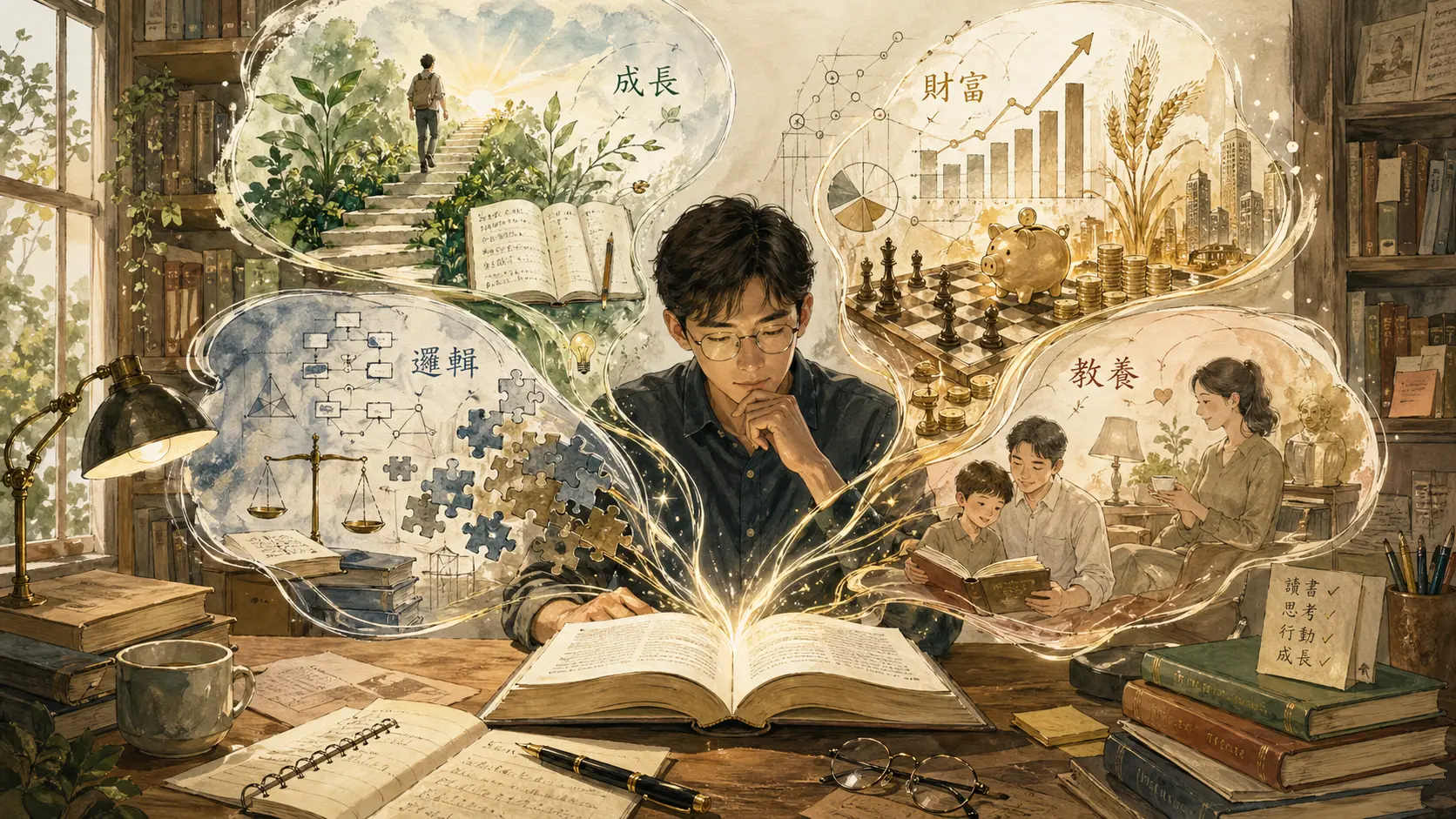
What is life wisdom? Brother Hao continues to demonstrate in the book: When facing the four major life issues of growth, wealth, logic, and education, can you extract ideas that can be directly used from the books you have read?
From this perspective, reading suddenly becomes sacred - you are not doing an elegant thing for the literary youth, you are preparing materials for your own life. Every book you read carefully will become ammunition for you to make decisions at a critical moment in the future.
Reading this book in the AI era is even more meaningful.
I feel that in the AI era, the value of the book “Hao Hui Shushu” is even greater than before the emergence of AI.
Why? Because AI has already helped us complete the work of “finding information”, “organizing summaries” and “quick understanding”. If you ask ChatGPT the key points of a book, it will give it to you in three seconds.
But what can AI not do? It is to transform the wisdom in the book into your judgment.
AI can give you a summary of the book “Principles”, but AI doesn’t know what the conflict you had with your colleague last week has to do with Dalio’s “absolute honesty.” AI can tell you what “The Courage to Be Disliked” is about, but AI doesn’t know what kind of dialogue is hidden between the decision you didn’t make ten years ago and Adler’s “teleology.”
Only you can complete the transformation from the book to me.
And Brother Hao’s “[Hao Huishu] (https://www.books.com.tw/exep/assp.php/vista/products/0011050121?utm_source=vista&utm_medium=ap-books&utm_content=recommend&utm_campaign=ap-202604)” is a reference book that teaches you how to do this transformation.
In other words: after the AI era, reading will not disappear, but will become differentiated. One kind of person reads to let AI help him quickly dispose of a book; the other kind of person reads to connect the book to his own life. The former reads quickly, but cannot retain it; the latter reads slowly, but every book becomes a part of him.
What kind of reader do I want to be? The answer is no brainer.
I would like to recommend this to you especially if you are leading a reading club.
If you are also leading a reading club, organizing a reading group, or running a knowledge-based community, I am happy to recommend you to read this book.
It’s not because Brother Hao needs my recommendation (he doesn’t need it at all), but because this book really solves the two most common problems we book club enthusiasts encounter:
- How to make members remember the book after reading it? Four-one reading method gives the answer directly. 2.How to prevent the discussion from becoming a discussion where everyone has their own opinions? With the layer of my story + my words, what everyone brings is not just a book excerpt, but a real life experience, and the discussion immediately becomes warm and in-depth.
Who is suitable to read this book?
- People who want to read but can’t finish it every time, or forget about it after reading.
- People who like to buy books but don’t know how to “use” them.
- [Moderator or promoter] (/blog/create-your-own-reading-ritual) who leads reading clubs, reading groups, and learning organizations.
- In the AI era, people who want to find [a reading method that cannot be replaced by AI] (/blog/ai-reading-revolution).
- People who want to slowly accumulate scattered readings into their own “life wisdom library”.
If you are like me and have a pile of books on your bookshelf, but often feel that you have left nothing behind after reading them, then this book “Hao Hui Shushu” will be one of the most worth buying books for you in 2026.
Don’t forget – getting a book into your head is just the first step. Letting the book really become a part of you is the ultimate meaning of reading.
And Brother Hao just happened to pave this road for us.
Further reading:
- After reading “Di Bono’s Horizontal Thinking Dialogue Method”, I re-understood what it means to be able to chat
- [Rereading “Sun Yun-suan Biography”: The man who used the spirit of an engineer to lift Taiwan up] (/blog/sun-yun-suan-biography)
- AI Reading Revolution: In the era of information explosion, how to read effectively
- Create a reading ritual for yourself
External resources:
📖 深入探索相關主題