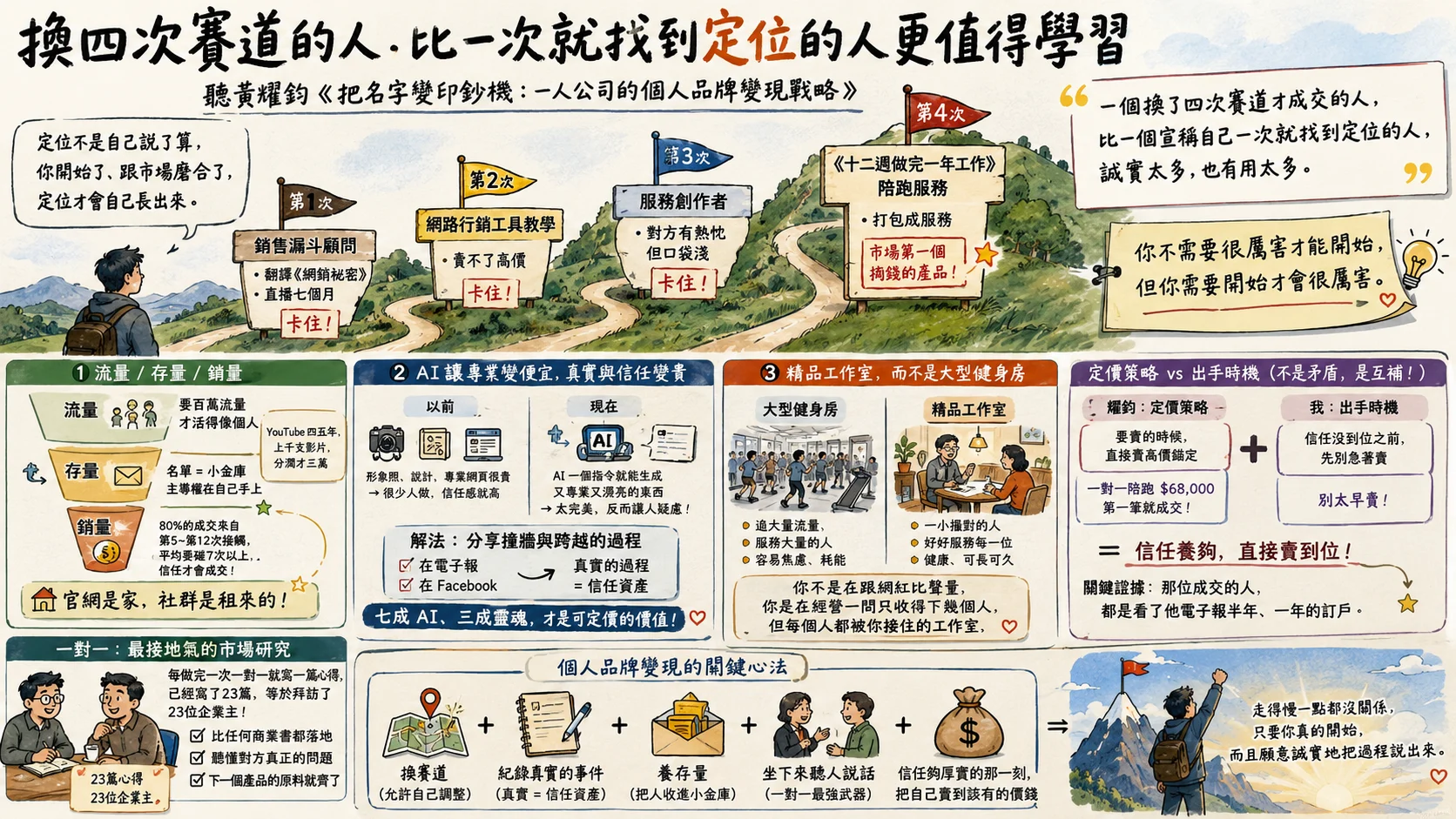
People who change tracks four times are more worthy of learning than people who find their niche once: Listen to Huang Yaojun talk about personal brand realization
*▲ The real road to realization is never a beautiful straight line - it is about changing the track, spreading the reality, maintaining the stock, and then selling yourself at the price you deserve at the moment when you have enough trust. *
Listen to Huang Yaojun’s “Turning Names into Money Printing Machines: Personal Brand Monetization Strategy for a One-Man Company”
Regarding [How to monetize your personal brand] (/blog/ai-personal-brand-guide), I have heard from many experts and consultants over the past few years. Most speakers will describe their own path as a beautiful straight line: After a lot of hard work, I found a unique position, then accumulated trust, launched products and services, and then I successfully monetized it. Well, it sounds very inspiring, but it is actually very limited in helping people in the audience - the reason is very simple, because the real road is never a straight line.
But Yaojun’s sharing was different. It is precisely because he generously spread out that crooked line for everyone to see that I listened to it from beginning to end, and even wrote this review.
Unravel the crooked road as it is
He started as a sales funnel consultant, [translating Russell Bronson’s “Internet Sales Secrets”] (https://www.facebook.com/iamjim1618/posts/%E6%9C%89%E5%9C%A8%E7%9C%8B%E6%88%91%E5%88%86%E4%BA%AB%E7%9A%84%E8%B3%87%E8%A8%8A%E7%9A%84%E6%9C%8B%E5%8F%8B%E6%9C%83%E7%9F%A5%E9%81%93%E6%88%91%E6%9C%89%E5%9C%A8%E7%BF%BB%E8%AD%AF%E8%88%87%E5%88%86%E4%BA%AB%E7%B6%B2%E8%B7%AF%E8%A1%8C%E9%8A%B7%E7%95%8C%E5%82%B3%E5%A5%87%E5%A4%A7%E5%B8%AB-%E7%BE%85%E7%B4%A0%E5%B8%83%E6%9C%97%E6%A3%AErussell-brunson%E6%89%80%E6%92%B0%E5%AF%AB%E7%9A%84%E7%B6%B2%E9%8A%B7%E7%A7%98%E5%AF%86dotcom-secrets%E4%B8%80%E6%9B%B8%E9%80%99%E6%98%AF%E4%B8%80/10227399928197735/), and live broadcasting for seven months; he found that wealthy business owners couldn’t handle it alone, and poor individual operators couldn’t understand it, so they were stuck. I went back to teaching online marketing tools, but I couldn’t sell it at a high price and I was stuck. I switched to serving creators. The other party was enthusiastic but had shallow pockets and was stuck. It wasn’t until the fourth time that he picked up “[One Year’s Work in 12 Weeks]” (https://www.books.com.tw/exep/assp.php/vista/products/0010974991?utm_source=vista&utm_medium=ap-books&utm_content=recommend&utm_campaign=ap-202606) that was gathering dust on the bookshelf, and packaged the running company as a service - this thing that was incomparable to the previous three or eight poles, instead became the first product to attract money from the market.
A person who changed tracks four times before closing a deal is not only more honest, but his experience is also more useful than a person who claims to have found his position in one go.
Yaojun used his specific experience of four turns to explain this sentence - it is not that you first think about the positioning before starting, but that you start and get used to the market, and then the positioning will grow on its own. His words, “You don’t have the final say on positioning,” impressed me deeply. To be honest, I have seen too many people think about their positioning for two or three years without even sending out a single word. Yaojun tells them from personal experience: The perfect positioning you have thought of for two or three years may still not be sold when you actually start selling it, because the market does not know you and does not believe you. Positioning is ground out, not imagined.
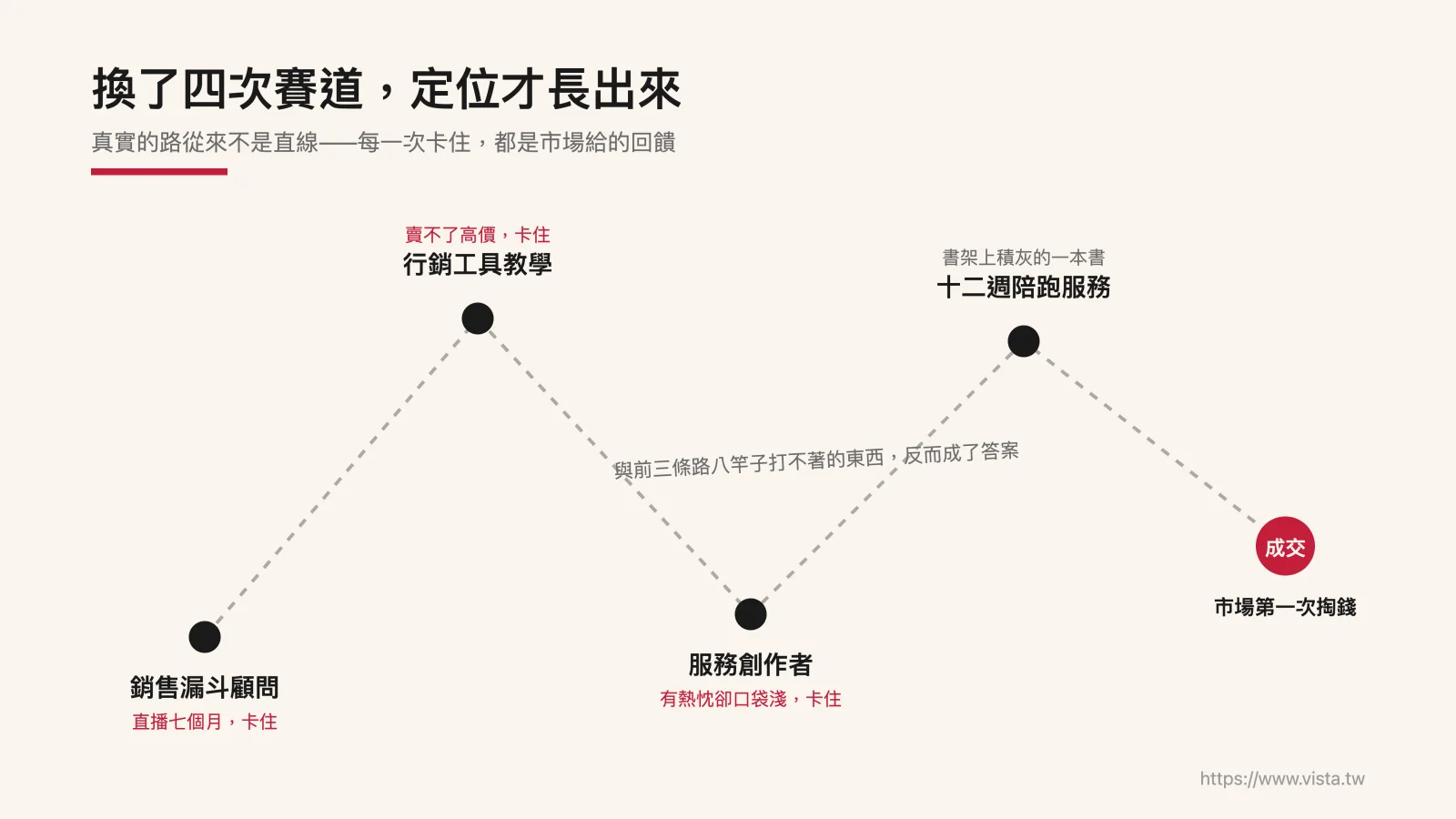
*▲ Positioning is not something you have the final say - only after you start and get used to the market will the positioning grow on its own. *
When I listened to the middle part, there were three places that I directly underlined because they were almost different ways of talking about the same thing that I have been talking about in the past few years.
The first one: traffic, stock, sales, the key lies in the middle layer
Yaojun said that everyone wants to directly convert traffic into sales, but that way requires millions of traffic to live like a human being - he has operated YouTube for four to five years, with thousands of videos, and the cumulative profit share is only 30,000. The real key lies in the inventory in the middle: the private domain where you can directly contact potential customers. His favorite is the e-newsletter. In other words, the list is your little treasury.
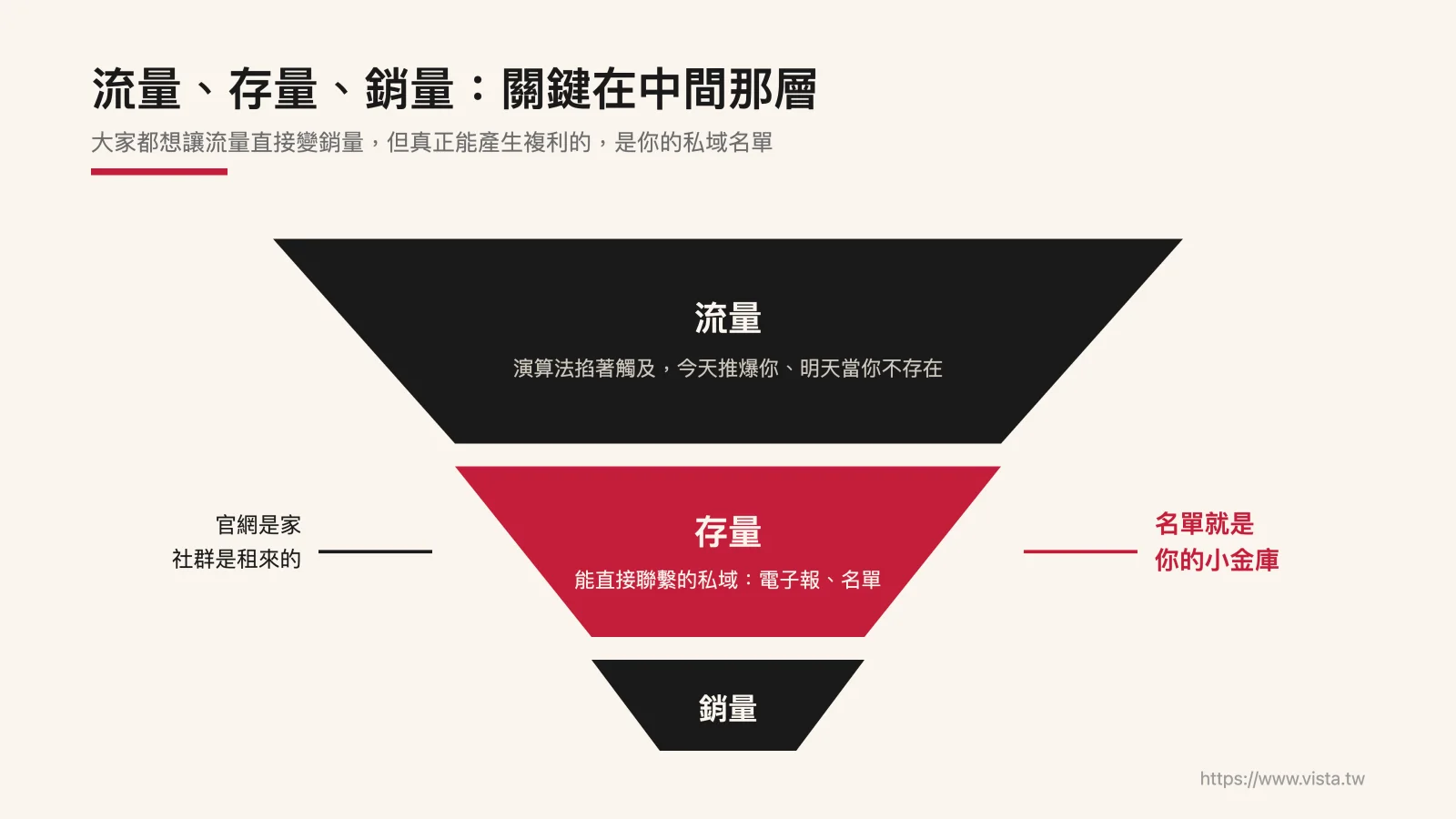
*▲ Traffic belongs to others, and sales are the result. What can really compound interest is the stock in your hand in the middle. *
This is the same truth as what I have been saying “The official website is home, the community is rented”. The reach of social platforms is controlled by algorithms. Today you will be pushed out, but tomorrow you will be treated as if you don’t exist. Only by adding people to your own list can trust be compounded one by one. I was also impressed by the set of marketing figures he quoted: 80% of transactions come from the fifth to twelfth contact, and it takes an average of more than seven contacts to cross the critical point of trust - and you can’t make up for these seven contacts on other people’s platforms. Stock means that you take back the control of these seven times to yourself.
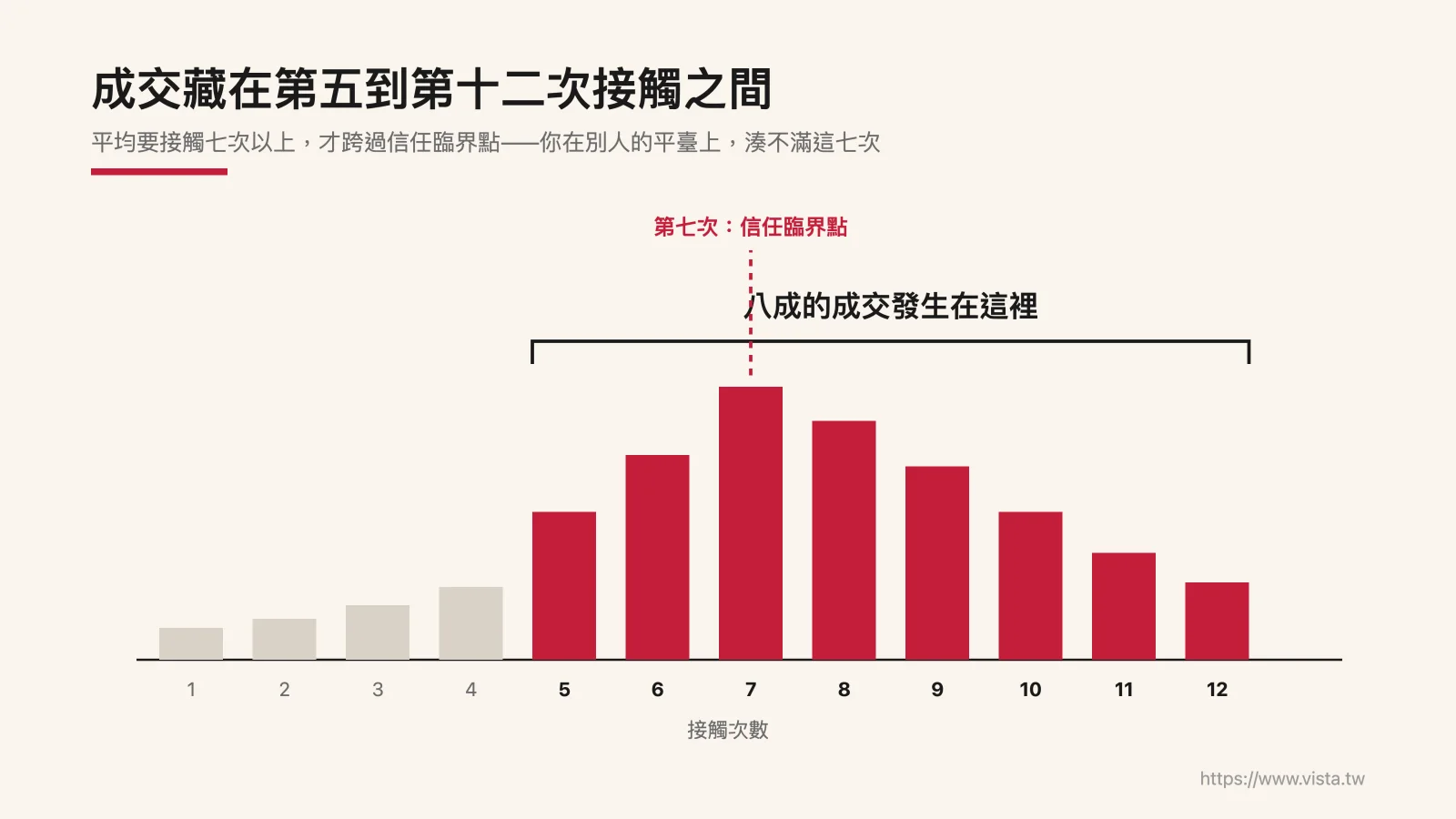
*▲ 80% of transactions occur between the fifth and twelfth contacts. If you can’t make up for these seven times, don’t blame the market for not paying the bill. *
Second: AI makes professionalism cheaper, authenticity and trust more expensive
He said that in the past, it was very expensive to take image photos, or design posters or professional web pages, so few people did it, and trust was high if they did it. Now, AI can produce professional and beautiful things with just one command. The results are too perfect, which makes people doubtful, and reality has become super expensive. His solution was to share in e-newsletters and Facebook what walls he hit and how he got over them.
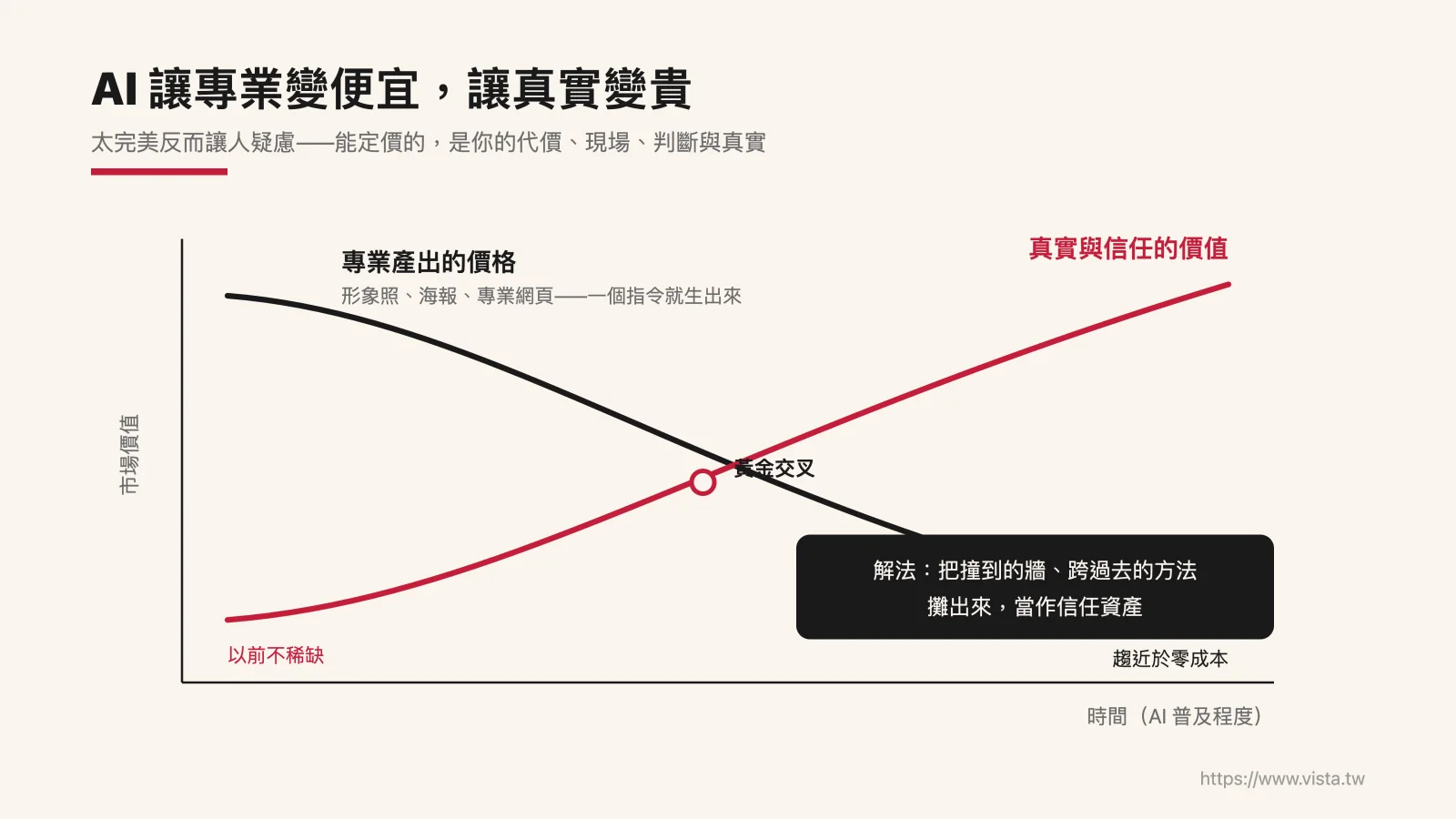
*▲ When “professional and beautiful” is beaten by AI to the point where it is close to free, it is too perfect and makes people suspicious - it is true, so it becomes the most expensive asset. *
This is almost the live version of my saying “70% AI, 30% soul”. When the glamorous 70% is reduced to zero cost by AI, only the 30% that can be priced is left - your price, your scene, your judgment, and your truth. Yaojun is not using AI to make more beautiful things. Instead, he is deliberately using imperfect processes as trust assets. I wholeheartedly support this direction, and it’s the same thing that I say “The best marketing is marketing that doesn’t feel like marketing”.
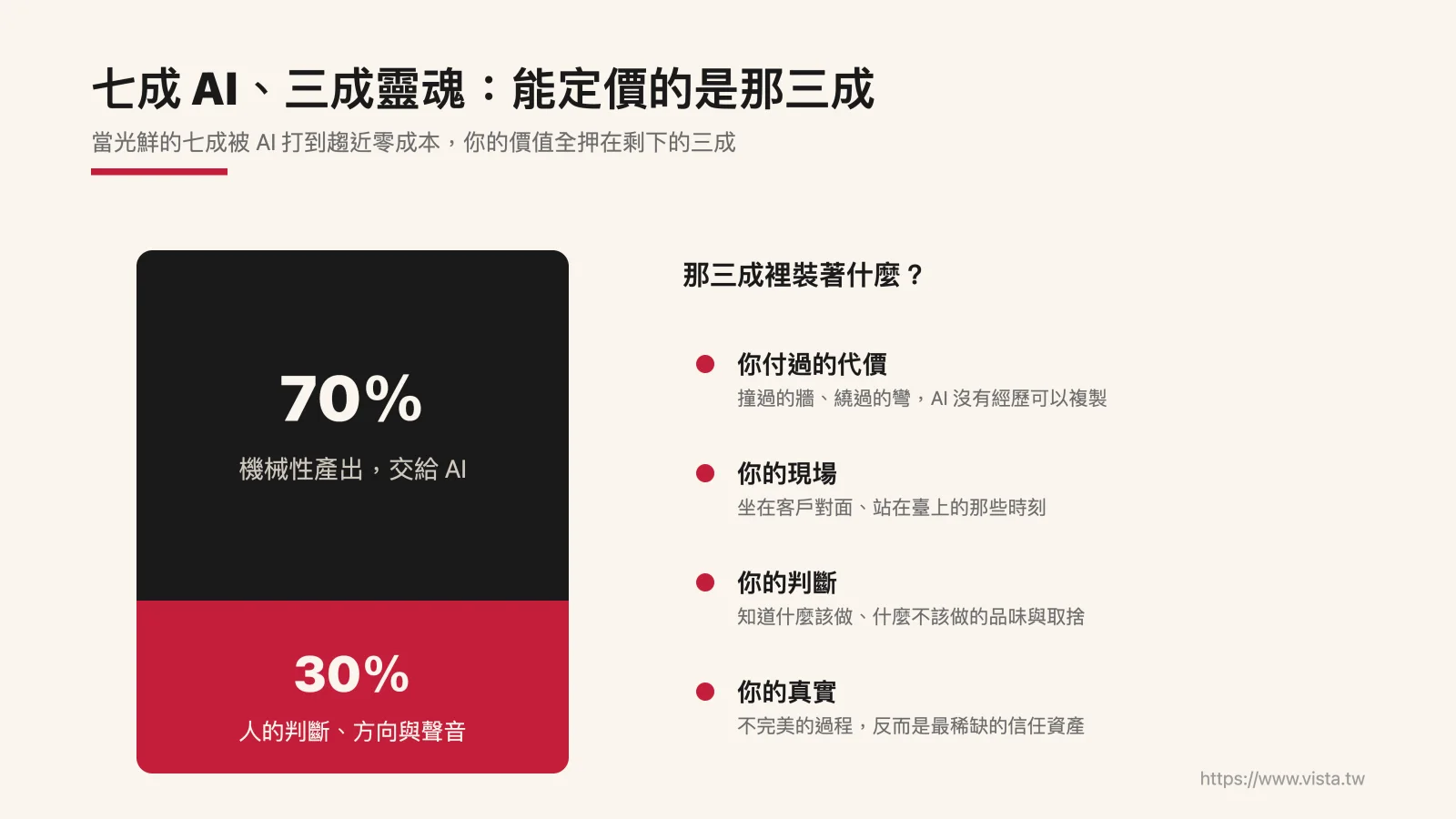
*▲ 70% AI, 30% soul - what can be priced is always the 30% that AI cannot copy. *
Third: You want to open a boutique studio, not a large gym
He doesn’t want a lot of traffic, he just wants a small group of right people and good service. I like this metaphor so much, because it cuts through the anxiety of how big your personal brand should be: you are not competing with Internet celebrities, you are running a studio that can only accept a few people, but everyone is caught by you. This is a healthy constitution for one’s career.
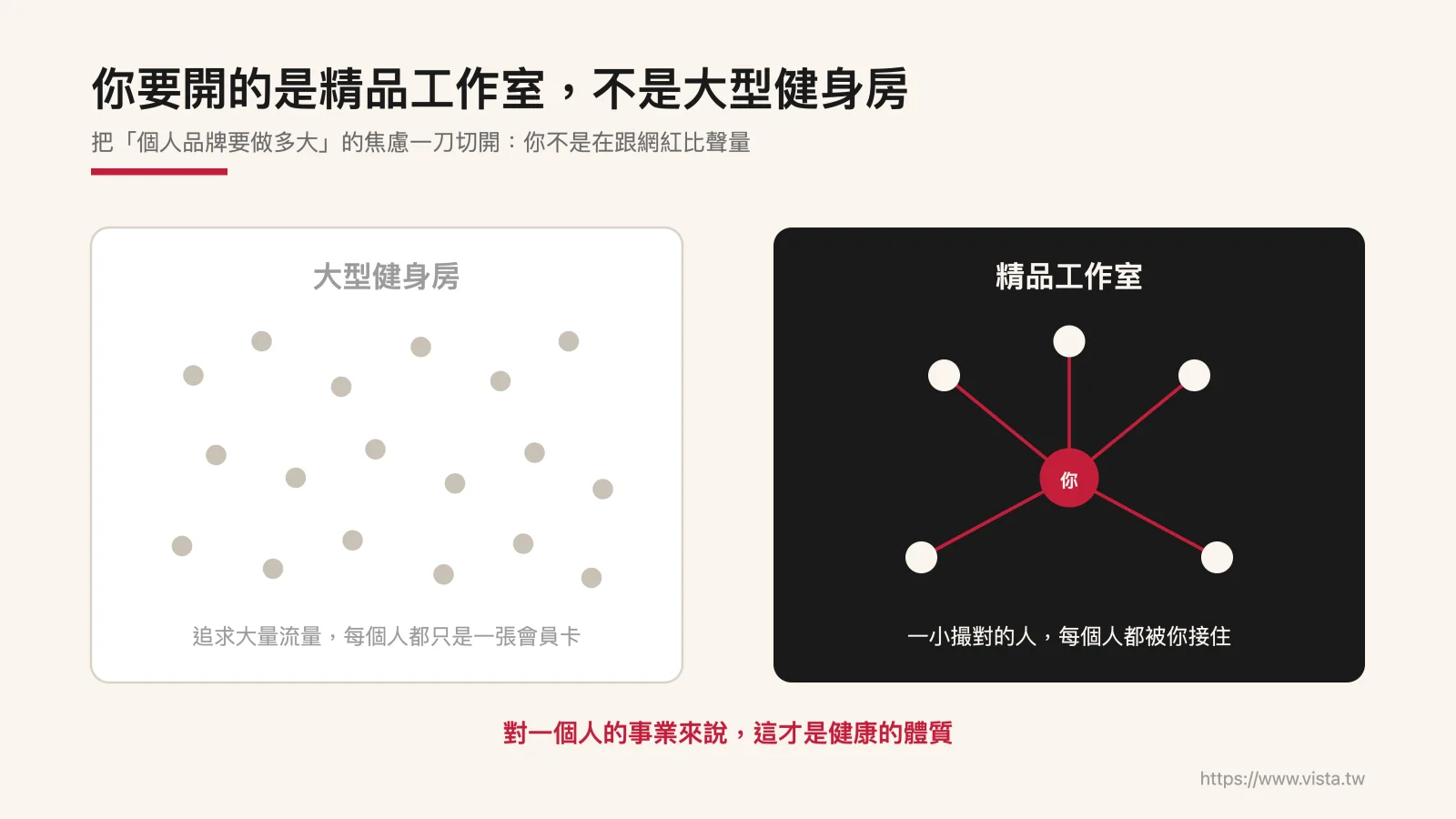
*▲ Large gyms rely on members who “pay the fee and won’t come” to arbitrage; boutique studios only need a small group of the right people to catch them. *

🛰️ Want someone to accompany you to see clearly in the wave of AI changes?
Almost all the public articles you see are finished products after repeated polishing. But what I cherish the most are the judgments that are still warm before the finished product - this is the reason why I created [Vista AI Inspiration Supply Station] (https://www.facebook.com/iamvista/subscribe/): a weekly thought note for fellow travelers in the AI era, sharing those Yoshimitsu Kataha that will not appear in formal articles with you who are willing to get closer.
The point I want to argue with him is: climb the value ladder in reverse order
Of course, in a good sharing, there will always be a point where you want to argue with the speaker. To me, it’s that he climbs the value ladder in reverse – don’t sell at a low price, sell directly at a high price.
Yaojun’s experience is: if he sells from 1,000 to 3,000 upwards, his self-confidence will be greatly affected if he can’t sell. On the contrary, if he sells directly for 68,000 one-on-one, the first transaction will be completed. His conclusion is - don’t sell from small to large, sell directly to the largest.
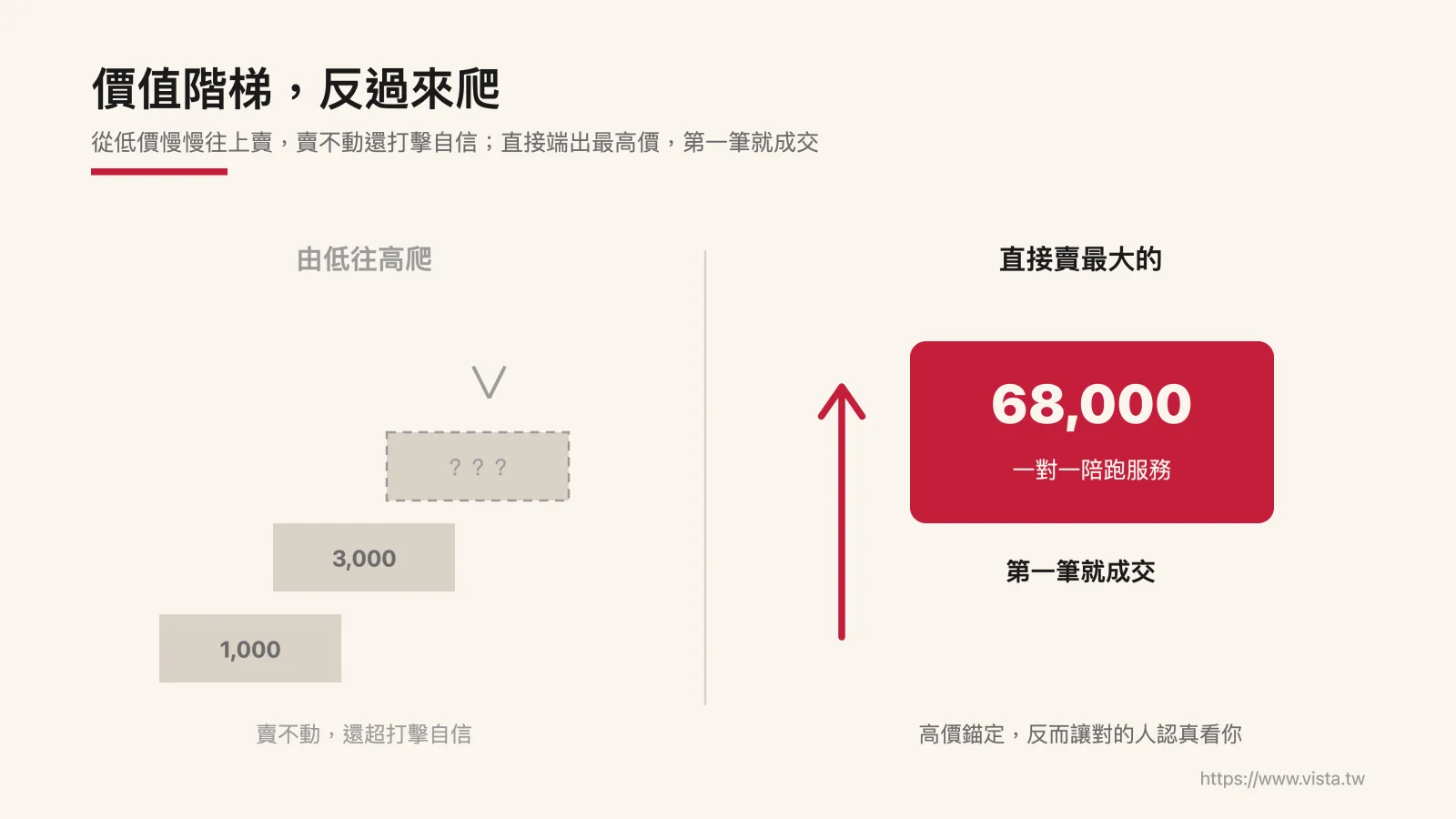
*▲ Sell from cheap to high, every step undermines self-confidence; go from high to low, but the first sale will be completed. *
And in the new book I’m writing, I happen to have an article called “Don’t Sell Too Soon,” which seems to be about the exact opposite: Don’t rush to sell before trust is in place.
At first glance, you might think that our opinions are completely different. But I thought about it over and over again and found that what we are talking about are basically two things, and they are complete only when they are combined.
Yaojun talks about pricing strategy (when you want to sell, anchor at a high price); I talk about the timing of selling (don’t sell before you have trust). How is one sold and when is the other sold?
And the most critical evidence is hidden in his own words - the 68,000 people he sold were “all subscribers of my e-newsletter for half a year or a year.” So he didn’t directly offer a high price to a stranger and then close the deal. He only offered the high price after building trust in the stock for more than half a year. In other words, he didn’t sell too early at all. He waited long enough to sell everything at once.
After thinking about it, I felt that he helped me make up for the second half: don’t sell too early, but once the trust is in place, don’t sell yourself cheaply. Too many people are stuck between the two extremes of not daring to sell and selling too cheaply - in the first half, I suggest you not to sell too early, but in the second half, you can just sell at a high price.
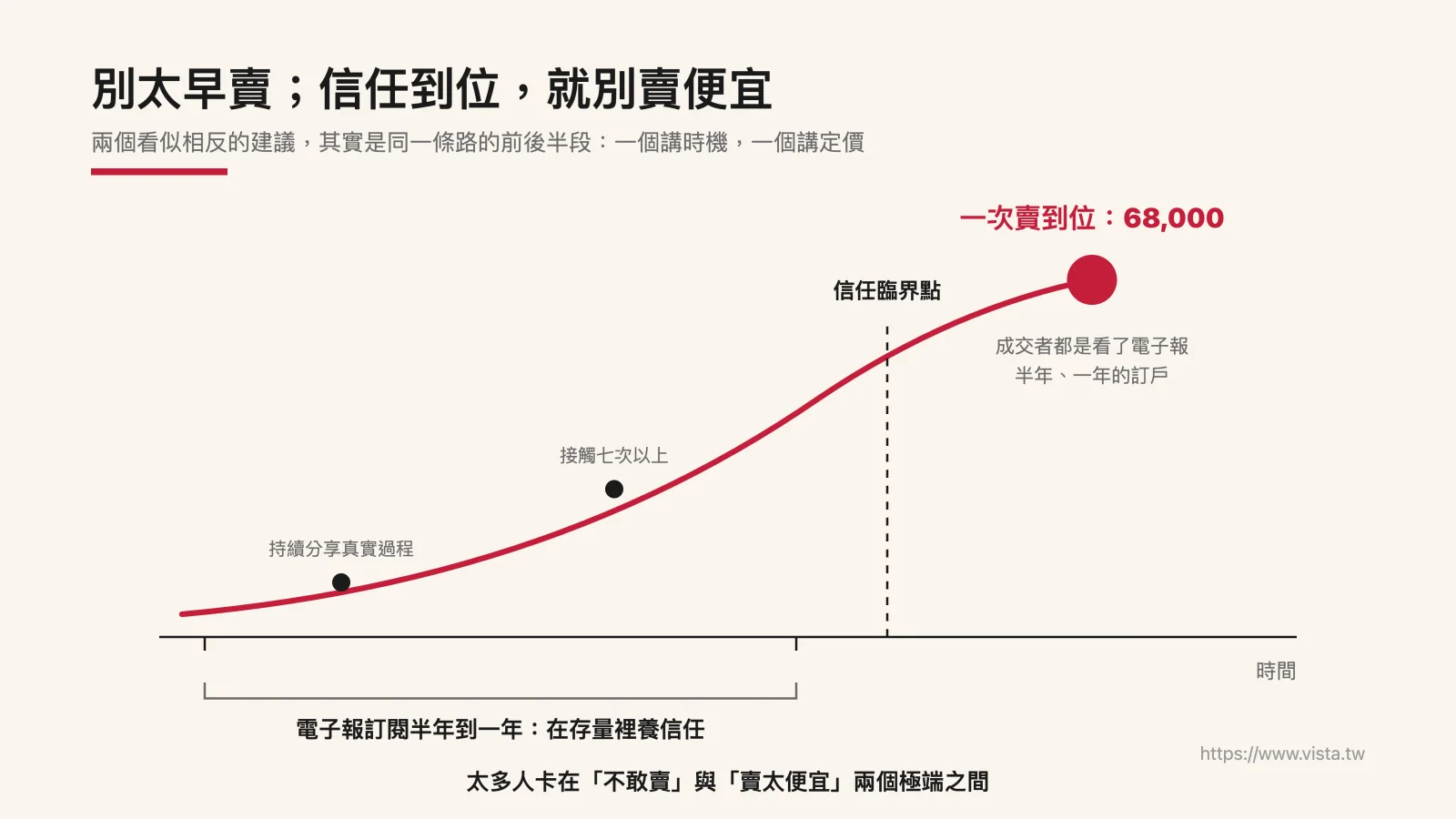
*▲ Don’t sell too early, but once trust is in place, don’t sell yourself cheaply—these two sentences are complete together. *
The most touching thing: one-to-one, the cheapest and most in-depth market research
After listening to the entire lecture, what touched me the most was actually his BNI one-to-one line.
He said that after every one-on-one meeting, he would write an article about his experience. He has written 23 articles, which is equivalent to visiting 23 business owners. In fact, it is more practical than any business book. The last 68,000 for one-to-one running is closely related to this line.
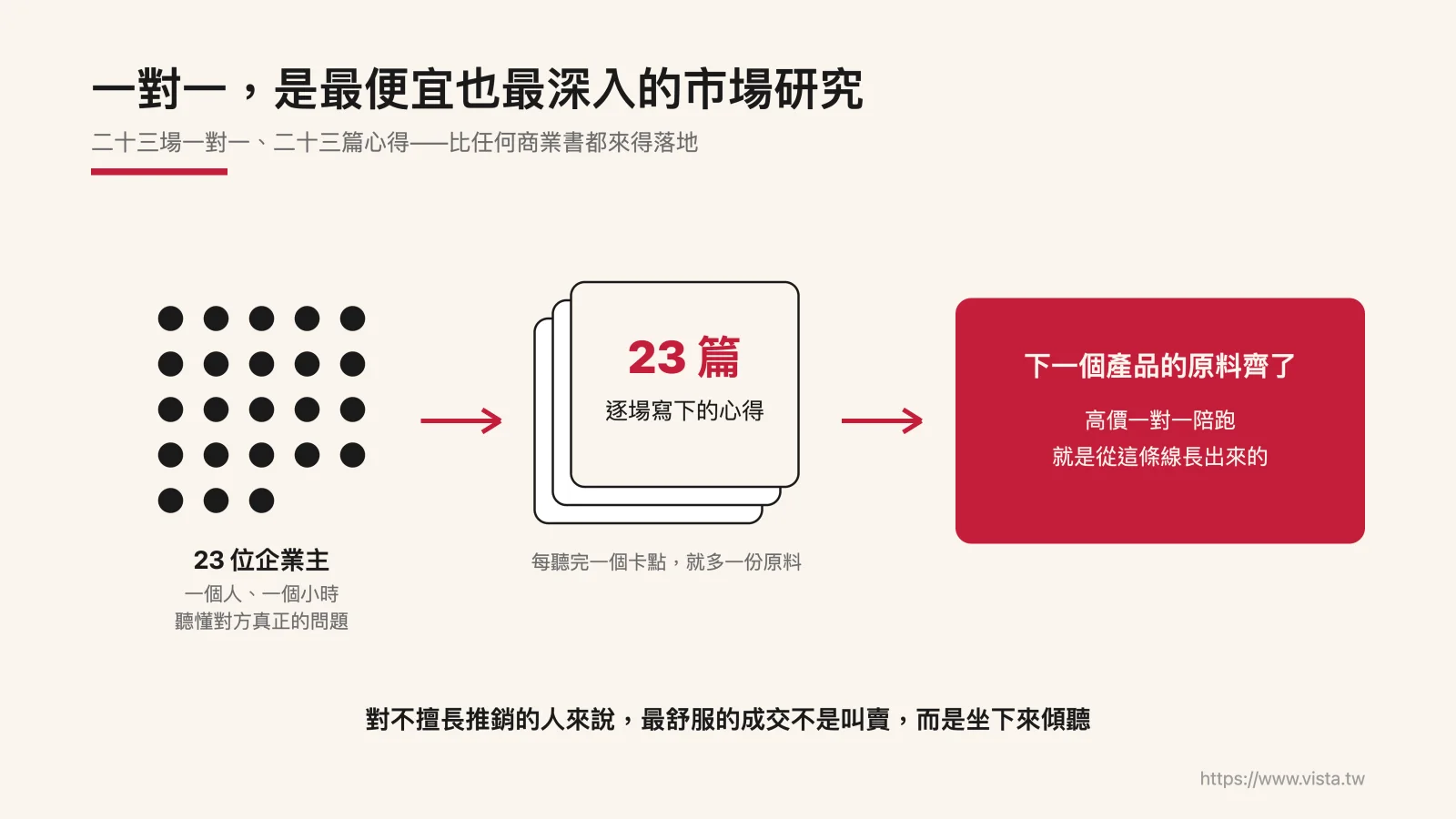
*▲ One-to-one is not just a transaction channel - it is your cheapest, deepest, and closest to the front line of market research. *
I have always believed that for people who are not good at sales, the most comfortable way to close a deal is not to stand on the stage and sell, but to sit down and understand the other party’s real problem alone for an hour. Yaojun used his 23 articles to help us verify one thing: one-on-one is not just a transaction channel, it is your cheapest, deepest, and closest to the front line of market research. When you finish listening to 23 business owners talk about their stuck points, you will have all the ingredients for your next product.
Therefore, the biggest gain for me from this lecture is not a certain method, but a belief that has been verified repeatedly:
Personal Brand Monetization is not about thinking of the perfect answer first and then going on the road, but changing the track, recording real events, maintaining stocks, sitting down and listening to people speak - and then at the moment when trust is strong enough, sell yourself at the price you deserve.
Yaojun changed tracks four times to get here, and I am still working hard on my track. But after listening to what he said, I am more certain of one thing: it doesn’t matter if this road goes a little slower, as long as you really start and are willing to speak out the process honestly.
You don’t need to be great to start, but you do need to start to be great. This motto he used to end it, I also want to give it to everyone!
Further reading
- What creators really sell is not words: Listen to Lin Yutang’s “Creator Awakening Day.” Monetization Class》, recalibrate your three-layer monetization logic
- Complete guide to personal branding in the AI era: from positioning, content to monetization, understand it at once
- Service as Marketing: In the AI era, the best marketing is when people don’t feel like they are marketing
- Stop blindly pursuing traffic: the secret for small e-commerce businesses to make big money is hidden in that broken bowl