When notes start talking: 9 Claude × Anytype tricks to turn your second brain into a thinking work partner
 *▲ When your notes really start to speak back, to what extent can a professional’s working style be rewritten? *
At nine o’clock on Monday morning, before your coffee is cold, your supervisor throws a message in the LINE group: “How is the follow-up progress of the case of client A last week?”
If it were you in the past, you would probably experience such a mini-disaster in the future - opening the note-taking software and searching for Customer A’s information. After two minutes, a dozen scattered records popped up on the computer. Some were meeting summaries, some were random to-do notes, and there was also a forwarded email. You have to click on it one by one, piece it together, and recall it, and it will take another twenty minutes to piece together a barely complete answer.
But if your Anytype (opens in a new tab) is already connected to Claude through MCP, this becomes a different story. You only need to type one sentence: “Please help me summarize the current progress of client A’s case, what has been completed, what hurdles are stuck, and who should I contact next?” Thirty seconds later, a well-organized summary will be presented in front of you. Well, you haven’t even finished that cup of coffee.
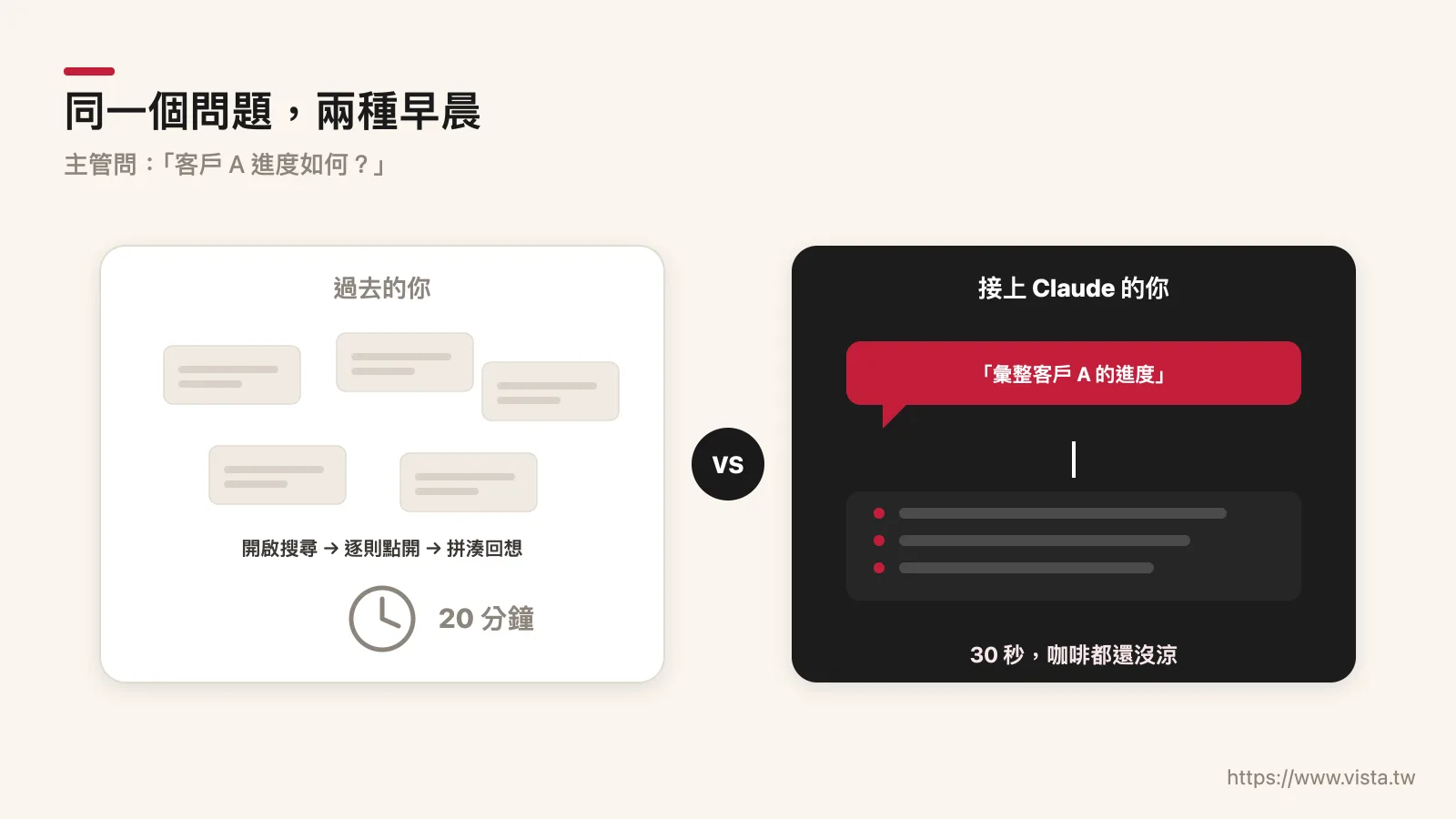 *▲ The same question, the same note, but two completely different results were obtained before and after the connection. The difference is not in the information, but in whether your notes speak back. *
That’s what I want to talk to you about in this article. In previous article, I taught you how to install this system step by step; in this article, I want to take you a little further - when your notes can really speak back, to what extent can a professional’s working style be rewritten?
Change your head first: you are not looking for information, but talking to your own knowledge
When many people first come into contact with this set, their first instinct is to regard Claude (opens in a new tab) as a smarter search engine - “Help me find such-and-such notes.” Well, of course it does, but it would be a shame if you only stopped here! That’s like buying a sports car but only using it to buy groceries.
Now, I want to give you a more powerful thinking framework. When you connect Anytype to Claude, what you really have is the ability to talk to yourself at different times. Specifically, there are three conversation modes:
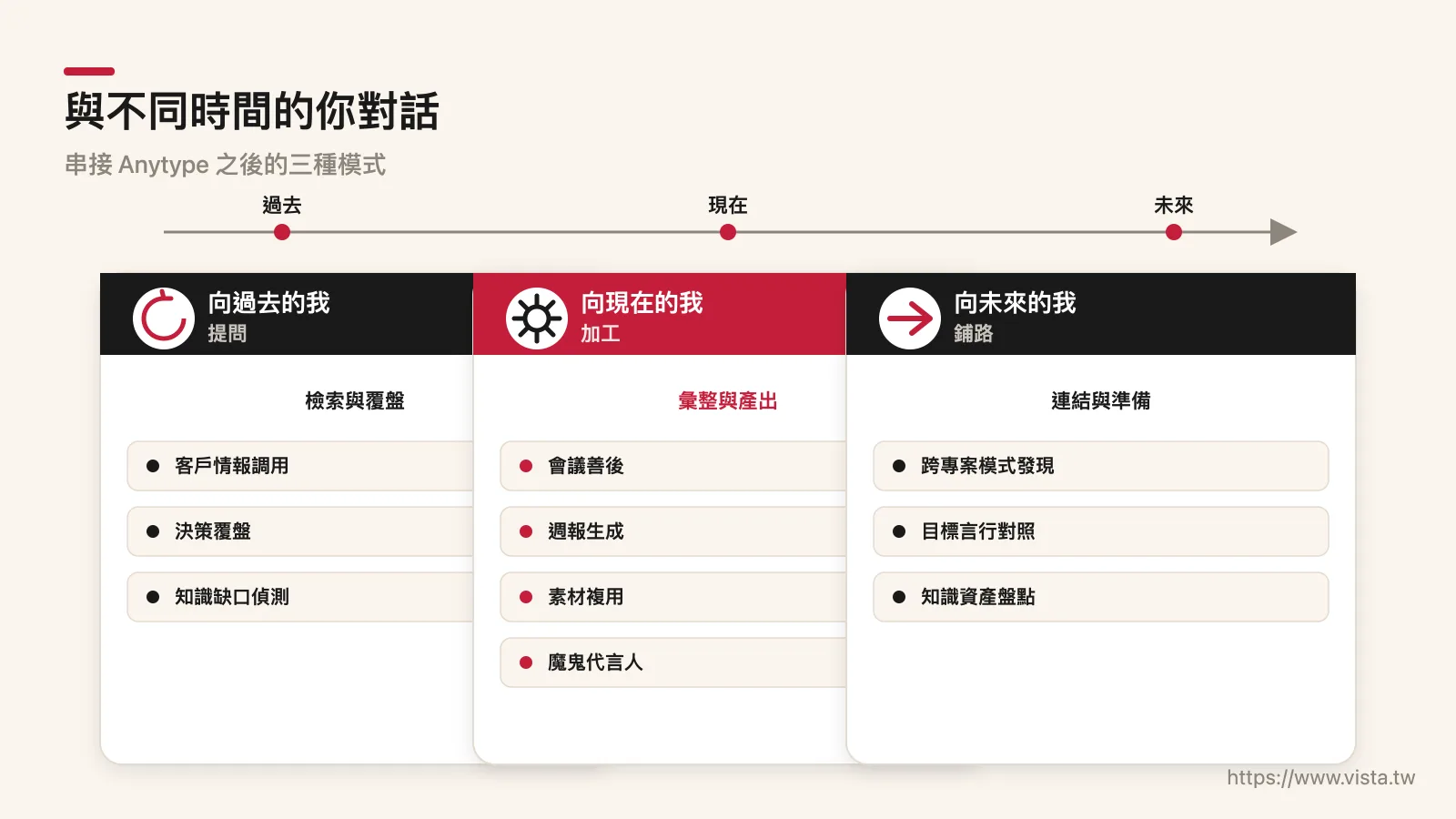 *▲ What you really have is the ability to talk to yourself at different times: ask questions to the past me, ask the present me to process, and pave the way for the future me. *
First, ask questions to my past self. Every note, every judgment, every meeting record you took in the past is a clue left by you at that time. Now you can go back and question them, invoke them, and even discover the context that you have forgotten.
Second, please process it for me now. The materials scattered in your hands are only semi-finished products. Claude can instantly collect, reorganize, and produce something that can be used directly—a letter, a report, a post.
Third, pave the way for me in the future. This is one of the most underrated, yet most critical. You can ask Claude to find trends, gaps, and opportunities from existing notes to prepare for things that haven’t happened yet.
Next, I will use these three modes to show you some really interesting uses. The point is not the move itself, but the mentality behind it that changes the way of working.
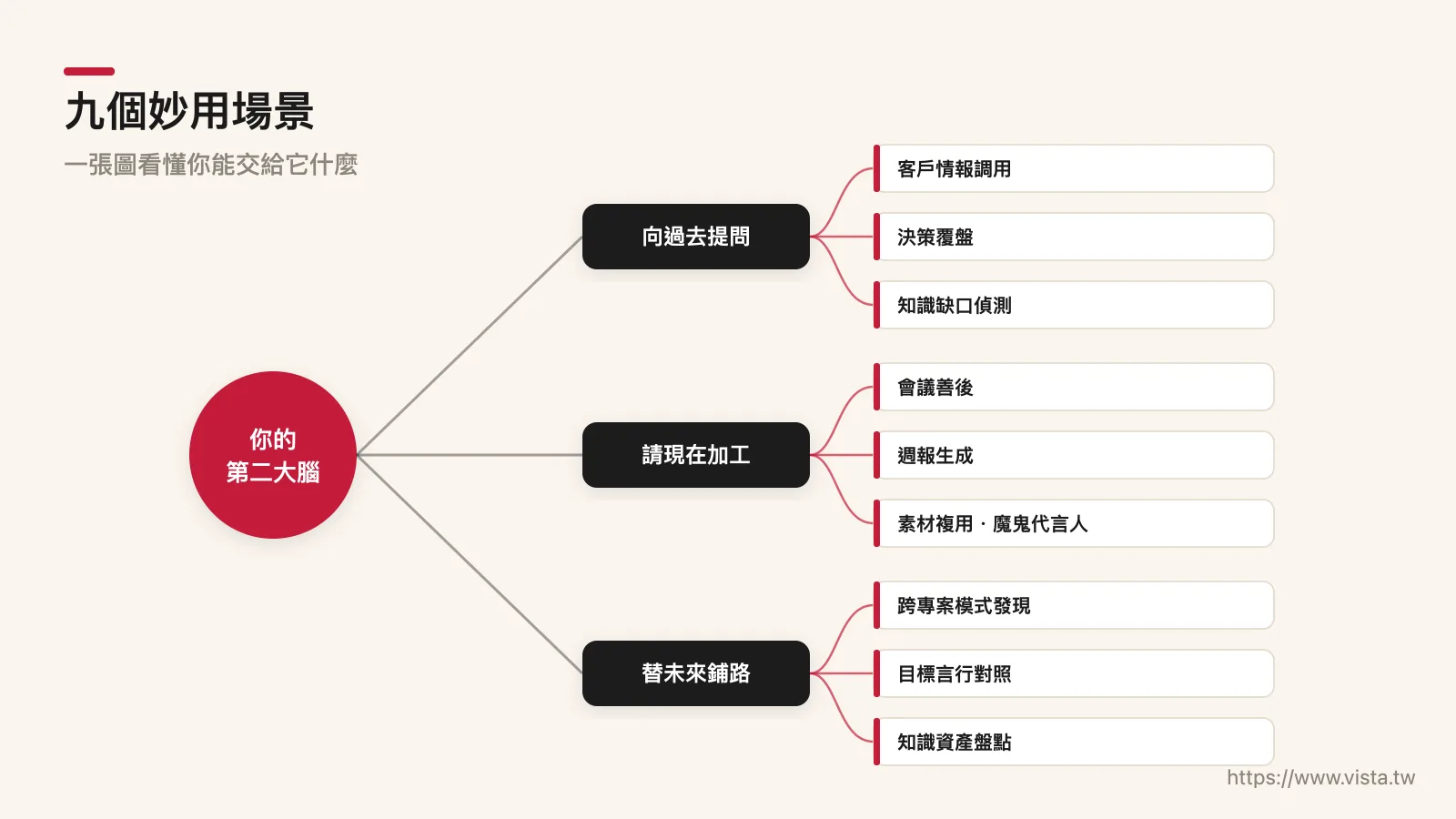 *▲ Three dialogue modes, nine magical scenes: This map is all the content that follows. You can collect it first and compare it slowly. *
Asking questions to my past self: Let the sleeping notes speak again
**Calling customer intelligence, thirty seconds becomes advance deployment. **Imagine you have an afternoon meeting with a client you haven’t heard from in a while. In the past, the most you could do was look at your last business card or email. But now, you can say to Claude before going out: “I’m going to see Mr. Wang later. Please sort out all our past interaction records from my Anytype. What does he care about, what he promised last time, and are there any unresolved issues?” So you walk into the conference room with a complete file of the other party. You can’t pretend to be that kind of calm.
**Decision review allows judgment to truly accumulate. ** The most common mistake we make is to step on the same trap over and over again without realizing it. You can ask: “When I decided to take on this project half a year ago, what was my initial assessment? Looking back now, which judgments were accurate and which parts were inaccurate?” When your decision-making process can be traced back and compared, you can truly start to accumulate the compound interest asset of judgment, not just the amount of experience.
**Knowledge gap detection reveals your blind spots. ** This is an advanced gameplay that I particularly like. You can say: “Please analyze all my notes on “AI Marketing” and tell me which concepts I have repeated many times and which ones I have mentioned but never went into depth. They may be blind spots that I thought I understood but actually did not understand.” AI will not only help you find what you have remembered, but also reveal what you have missed? This is irreplaceable value for professionals who need continuous improvement.
Please process it now: turn the semi-finished product into a deliverable finished product
**The aftermath of the meeting went from a nightmare to a matter of words. ** Throw the verbatim transcript or notes of the meeting into Anytype, and then say: “From this meeting record, please extract all the to-do items, their respective responsible persons, and what I personally promised to do.” The most annoying part of organizing after the meeting evaporated in an instant.
**Weekly and monthly reports, let the progress grow on its own. ** Do you get a headache every time you have to submit your weekly report? You can say: “Please help me write a weekly progress report to my supervisor based on all the new notes I added this week, divided into three parts: “Completed”, “In Progress” and “Needing Assistance”.” If you usually take notes carefully, this moment you will be repaid with interest.
**Material reuse, one piece of content can produce ten types. ** This is especially suitable for people who need to export externally. You can say: “Based on the notes I gave last month, please help me rewrite it into three LinkedIn posts, a blog outline, and an opening paragraph for the newsletter.” Your knowledge is no longer a stock that is sealed after writing, but a living water that can be constantly rewoven (for a more complete approach, please refer to my Writing Workflow Combined with MCP).
**Devil’s advocate before briefing. **Everyone who has used this trick is amazed. Before making a proposal, you can say: “Please play the role of the most critical supervisor and raise five questions that are most likely to be shot based on my notes on this proposal.” Let the AI play a bad role first, and you can fix every breach before actually taking the stage.
Paving the way for my future self: from sorting out the past to seeing the future
**Pattern discovery across projects. ** Think of Claude as a pair of eyes that can see through the whole situation: “Please compare my notes on these three projects and find common bottlenecks or recurring problems.” Many times, real insights are not found in a single project, but hidden in the gaps between projects. This kind of cross-domain connection is what the human brain is most likely to ignore and what AI is best at.
**The words and deeds of personal goals should be compared. ** Do you still remember the goals you set at the beginning of the year by the middle of the year? You can ask: “My goal this year is to “deeply explore the corporate internal training market.” Please judge from my work notes in the past six months, how much of my time and energy was really spent on this matter?” Let the notes become an honest mirror, reflecting the gap between your words and actions.
**Inventory of intellectual assets. ** For knowledge workers, this is almost a must-do homework every year: “Please take stock of my notes over the past year and summarize the three topics on which I have accumulated the most and have the most unique insights - these may be the seeds of my next course, column or product.” You will be surprised to find that you are already sitting on a gold mine, but you just didn’t have the tools to dig it out in the past.

🛰️ Want someone to accompany you to see clearly in the wave of AI changes?
Almost all the public articles you see are finished products after repeated polishing. But what I cherish most are the warm judgments before the finished product - this is the reason why I made Vista AI Inspiration Supply Station (opens in a new tab): a weekly thought note for fellow travelers in the AI era, sharing those Yoshimitsu Kataha that will not appear in official articles with you who are willing to get closer.
👉 Subscribe now and receive weekly emails → (opens in a new tab)
The art of asking questions: good responses come from good questions
After using it for a long time, you will realize that the ceiling of this system is often not in AI, but in whether you ask? Here, I would like to share with you some of my commonly used and tried-and-tested questioning methods.
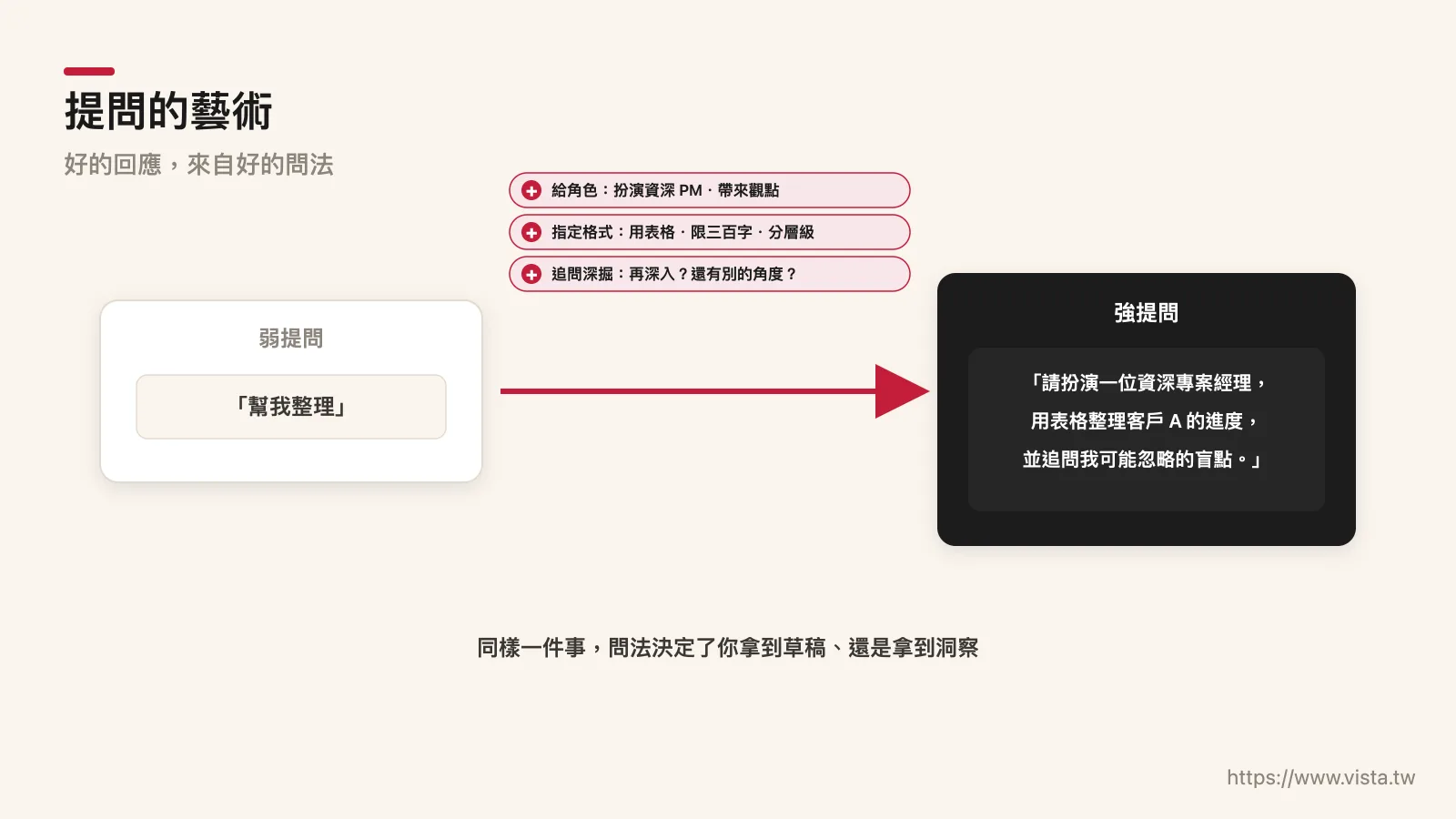 *▲ The art of asking questions: assign a role, specify the output format, and learn to ask questions - the ceiling of this system is often not the AI, but whether you can ask. *
**Give roles, not just tasks. ** Instead of saying “Help me organize it”, it is better to say “Please play the role of a senior project manager and help me organize it”. Give AI an identity, and its responses will immediately become more professional and insightful.
**Specify the format of the output. ** The more specific you are, the more accurate it will be. Tell it clearly “please present it in a table” “please limit it to 300 words” and “please divide it into three levels”, which can save a lot of time in back-and-forth revisions.
**Ask questions, not start over. ** If you are not satisfied with the first response, don’t rush to give another order. Try to ask: “Can this part be deepened further?” “Are there any angles that I didn’t expect?” The real value is often hidden in the second and third rounds of dialogue.
Three boundaries that must be guarded
I must honestly remind you that no matter how powerful this system is, it has its limits. Only by seeing these three points clearly can you use it for a long time and with peace of mind.
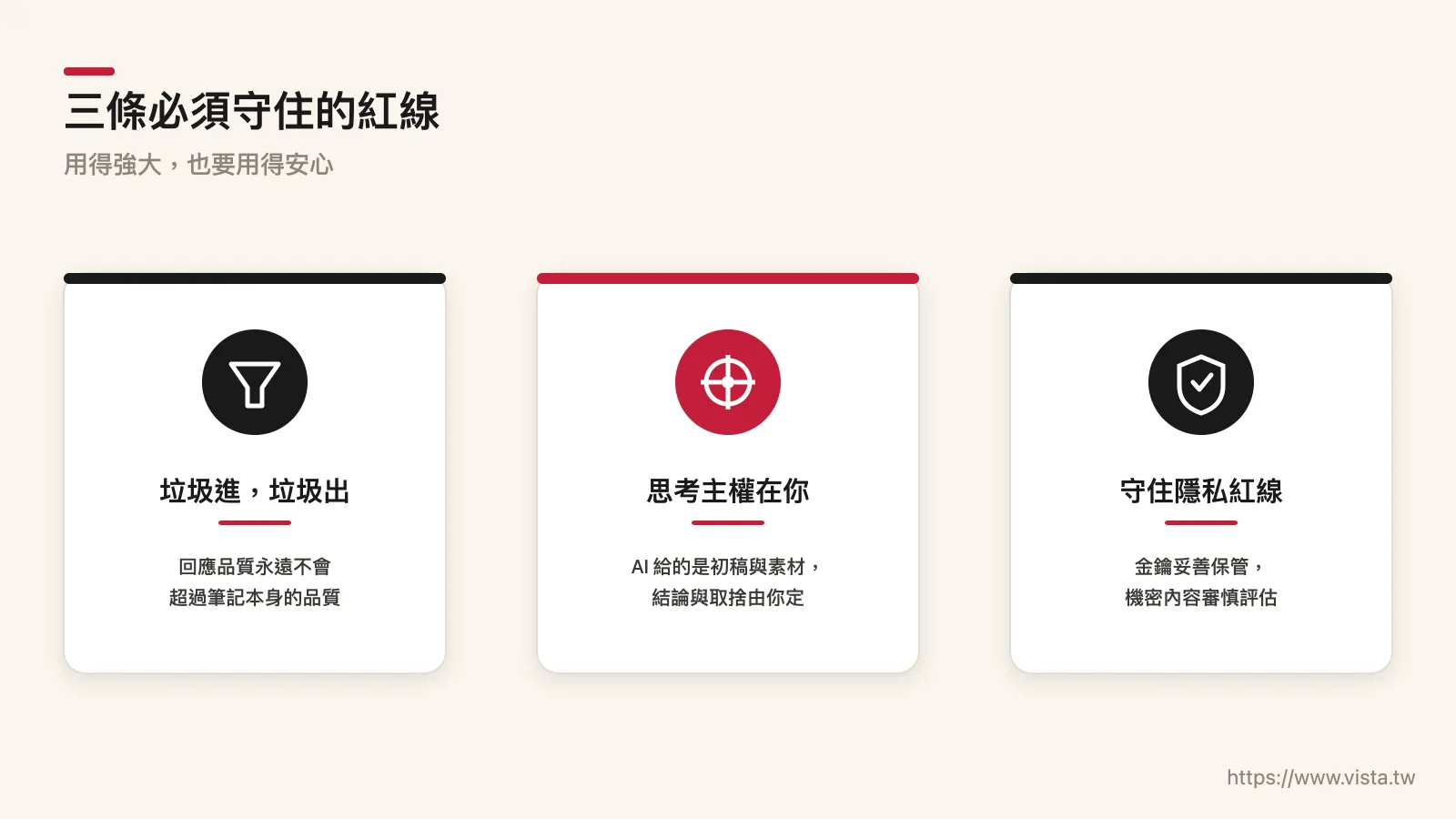 *▲ Three red lines that must be firmly guarded: garbage in, garbage out, don’t hand over the sovereignty of thinking, and keep the bottom line of privacy. *
**First, garbage in, garbage out. **The quality of the AI response will never exceed the quality of your note itself. If your notes are disorganized and thrown around, what Claude will sort out will only be a neat mess. Therefore, taking notes carefully is not obsolete in the AI era, but has become more important.
**Second, don’t hand over the sovereignty of thinking. ** AI is very good at compiling and generating, but what it will always give you is a first draft and materials, not a conclusion. Therefore, in the end, you must hold the power of judgment firmly in your own hands regarding what to ask, whether to believe it or not, and how to choose. Once you get used to letting AI think for you, your most precious abilities will be degraded.
**Third, keep the red line of privacy. ** Anytype’s local-first, data-encrypted features indeed make this combination more secure than most cloud tools. But please keep your API key safe, and carefully evaluate highly confidential content. Security comes not from the promise of a tool, but from your own vigilance.
Written at the end: From second brain to thinking partner
Back to the principle I have always believed in - man and machine. In this system, Claude is responsible for the 70% it is good at: retrieval, aggregation, output and comparison; and what we need to guard is the critical 30%: asking the right questions, making judgments and making choices.
When your notes are no longer just dead data lying quietly on the hard drive, but begin to respond to you, remind you, and even argue back and forth with you - you will find that you no longer have just a second brain, but a work partner who is always on call, familiar with your past, and willing to accompany you in imagining the future.
Tools will continue to be introduced, but you who are willing to continue to think, accumulate, and dialogue are the real core of it all. I hope this article will make you re-look at every note you type every day - they are not a burden, but your most trustworthy asset in the future.
For more practical ideas on AI workflow, second brain and content strategy, please visit my personal website: https://www.vista.tw
Next step
Bring this topic to your team
Vista Cheng speaks and runs workshops on AI workflows, writing and content systems for companies, schools and public agencies.