Bosses use AI first, which is the real starting point for digital transformation of small and medium-sized enterprises
*▲ The introduction of AI is essentially not a matter for the information department, but the beginning of managers re-understanding the company’s processes. *
Originally published in “Economic Daily”
The first key to small and medium-sized enterprises adopting AI is not which system to buy, nor which consulting company to find, but whether the boss himself is willing to start using it. Because the introduction of AI is essentially not a matter for the information department, but the beginning of operators re-understanding the company’s processes.
In the past, when talking about digital transformation, many bosses would intuitively hand it over to the information department or young employees. Because everyone thinks this is a technical problem. But generative AI isn’t exactly a technology problem, it’s more like a new working language. Whether you can use AI is not just about whether you can operate tools, but can you explain the problem clearly, can you dismantle the process, can you judge the quality of the output, and can you turn a vague idea into an executable task.
These abilities are exactly what the boss should master personally. Because the boss knows best where the company’s real pain points are: Which tasks are repetitive and time-consuming? What customer issues happen every day? Which proposals are always criticized as lackluster? What information is scattered in the minds of different people and can never be turned into company assets? Which processes can obviously be standardized, but have been relied on manual labor for many years?
This is not something the AI tool will know on its own. These are the frictions that operators feel every day in their companies.
The boss should try it himself
A while ago, I saw Youshi Digital CEO Jiang Diansi talking about the reasons why he started trying AI tools. He said that the main reason is the push from many Internet celebrities and advanced people. “The boss should try it himself” seems to have become a universal value in his stratosphere.
This sentence points out a new consensus among managers: AI is not about waiting for employees to learn it before turning back to teach the boss; rather, the boss himself should touch, try or encounter bottlenecks first to know whether it can change the company?
Jiang Diansi also mentioned that he used to have an asset management background. Although he had not touched programming for decades, he actually had a lot of systematic and logical ideas in his mind. However, he had struggled with budget and development capabilities in the past, so he had never started. It’s too expensive to find someone to make small things, and I don’t have enough development capabilities, so many ideas end up stuck in my head.
This is actually a situation that many small and medium-sized business owners are very familiar with. It’s not that the boss doesn’t have ideas, but he has too many ideas; it’s not that he doesn’t know where the process should be changed, but that every small system, gadget, and automation required spending money, finding people, scheduling, and communicating requirements in the past. As a result, a simple internal form, a customer tracking process, a quotation calculation tool or an inventory reminder mechanism all turned into “waiting until we have a budget”.
AI makes it possible for ideas stuck in budget to try a small step first
But as AI tools mature, this is changing. The boss does not have to be an engineer, but he can become a better demand describer; the boss does not have to write the program himself, but can explain the logic clearly in natural language; the boss does not have to understand the complete technical architecture, but can make a usable prototype first, and then decide whether to expand investment.
This is the most fascinating thing about AI for small and medium-sized enterprises: it allows ideas that were originally stuck in the budget to take a small step forward.
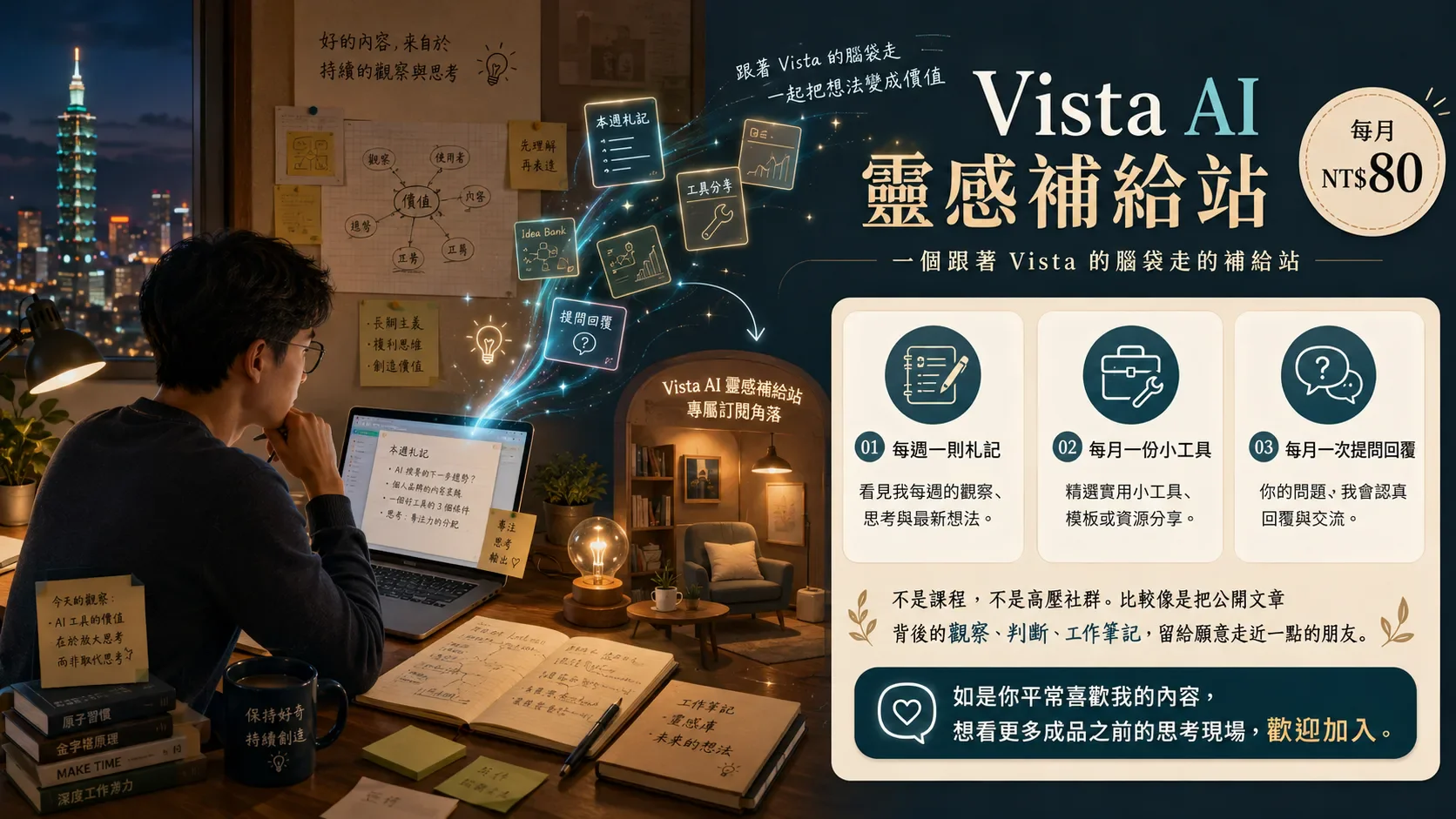 *▲ Want to continue to receive tips on AI applications like this? Welcome to subscribe to “Vista’s AI Inspiration Supply Station” to have first-hand observations delivered directly to you. *
If employees can use AI, the company will not automatically become smarter
When many companies introduce AI, they make a mistake: asking employees to take classes and then expecting the company to become smarter naturally. But the reality is that even if employees use AI, they will probably only improve their own work first and stay at the level of personal efficiency. But what will really impact a company’s competitiveness is not an employee saving 30 minutes a day, but the entire company redesigning its workflow.
The problem is that processes are usually not something employees can change. Employees can see problems, but they may not have the authority to change cross-department collaboration; employees know that a certain form is annoying, but they may not be able to cancel it; employees know that no one reads a certain report, but they dare not stop producing it; employees know that customer service language can be unified, but they cannot determine the brand tone and service standards.
These all require the boss or supervisor to step down. The point of the boss using AI first is not to take away employees’ jobs, but to demonstrate one thing: the company is allowed to rethink the way it works.
The boss needs to use it first to open the door.
Putting these together, you will find that AI import is never just a tool purchase, but a top-down cognitive update. The boss uses it first, not to become the best at giving orders, but because only operators have two key things at the same time: the perspective that best understands the company’s pain points, and the authority to truly change the process.
When the boss is willing to personally touch AI, those ideas that could only be “waited until there was a budget” finally have the opportunity to be brought out again and try a small step first. The starting point of digital transformation is often hidden in this small step.
If you also want to open this door for yourself or your company, you might as well start by observing how an AI is used every day. I have compiled my daily observations and thoughts in “Vista’s AI Inspiration Supply Station”. You are welcome to join us and turn a small step into a habit.
📖 深入探索相關主題