
The first year of AI monetization: When "knowing how to use AI" is no longer valuable, what are the people who really make money doing?
*▲ 2026 is the first year of AI monetization: knowing how to use AI is no longer valuable. Whether it can be turned into cash flow is the new watershed. *
One of the questions I am most frequently asked these days by students and business friends is: I am already very good at using AI, why hasn’t my life become more comfortable?
This question is a good one, because it pokes at one of the most embarrassing gaps in our time: there is actually a deep gap between those who can use AI and those who make money with AI.
In the past two or three years, we have been learning tools. Learn ChatGPT, learn NotebookLM, and learn various tricks to generate content with one click. But you know what? These tool bonuses are disappearing fast. When everyone can give instructions and everyone can produce a relatively smooth copy, the fact of being able to use it will no longer be valuable. The real watershed, starting this year, is drawn on the other line. It’s not that you don’t use it frequently enough, but that it’s too easily replaced.
2026 is called “the first year of AI monetization”, but what does this sentence mean to you?
If you have read several authoritative reports recently, you will find that there is a high degree of consensus in the industry: 2026 is the year when AI will officially shift from proof of concept (PoC) to return on investment (ROI).
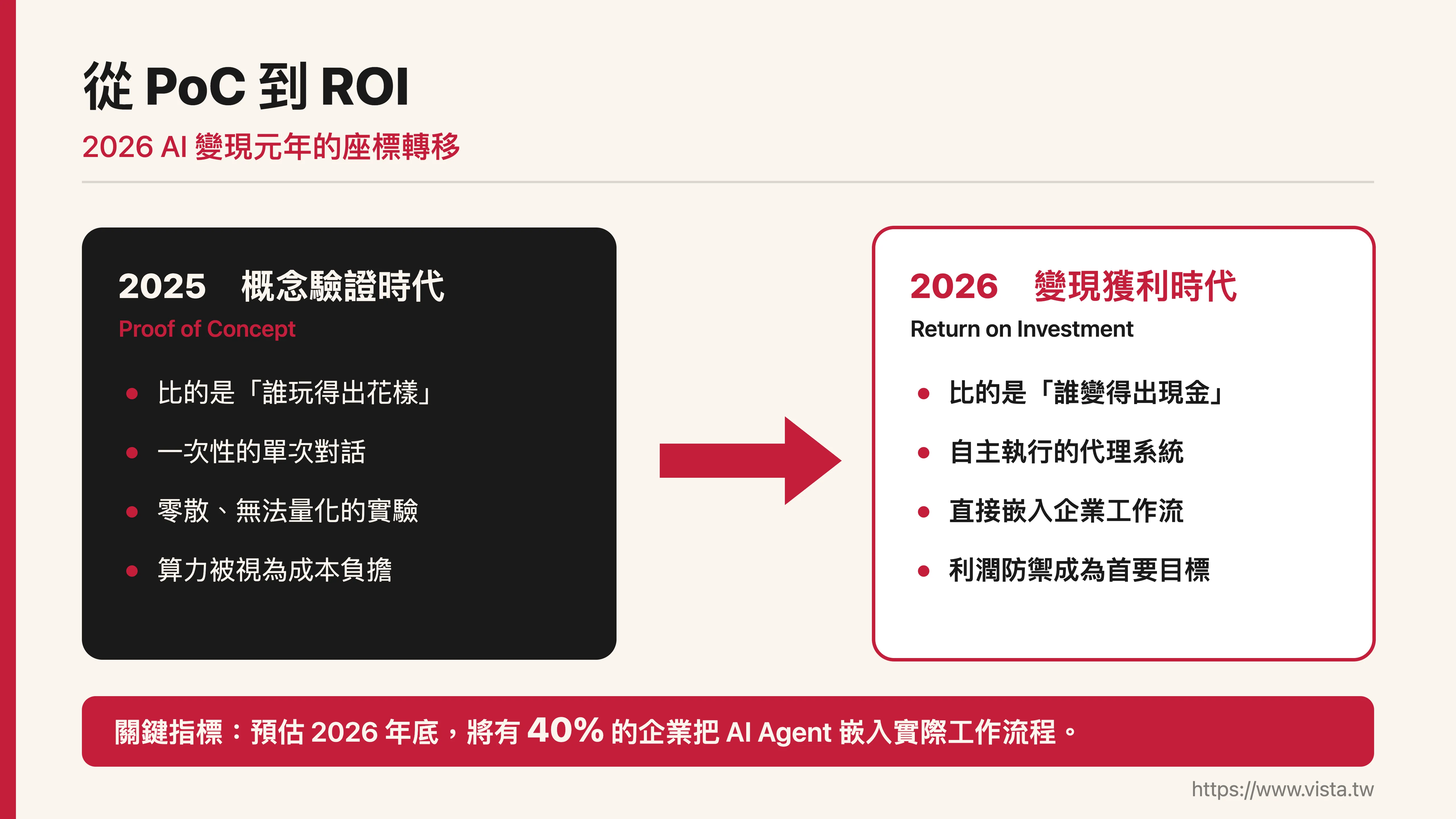 *▲ In 2026, AI will officially shift from proof of concept (PoC) to return on investment (ROI). *
This sentence sounds very corporate and macroscopic, but I want to translate it into vernacular that is relevant to you and me: In the past, everyone was competing to see who could do tricks? Starting from this year, everyone is competing to see who can turn tricks into cash flow?
According to trend observations from organizations such as Google Cloud, PwC, and Deloitte, as well as NVIDIA’s annual report, companies are no longer satisfied with those sporadic, fun AI experiments that cannot quantify the benefits. It is estimated that by the end of 2026, 40% of companies will embed AI Agents (AI Agents) into actual workflows; and as many as 35% of multinational executives list protecting marginal profits as the first priority of AI strategies.
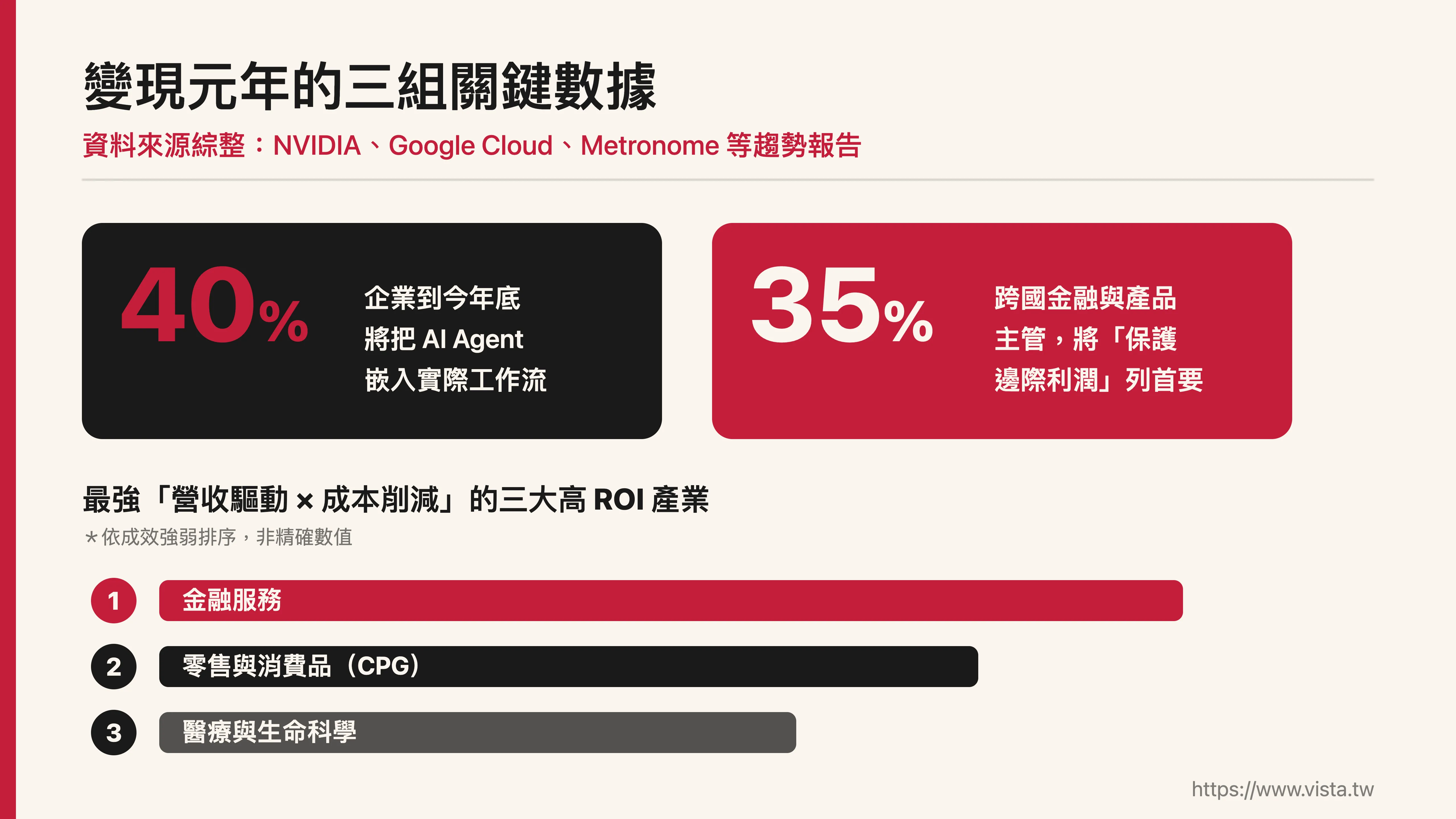 *▲ Three sets of key data in the first year of monetization: 40% of companies have introduced AI agents, and 35% of supervisors prioritize maintaining profits. *
In other words, even the largest companies are doing the same thing: taking AI from toys to systems. So, why do we, as individual workers, entrepreneurs or knowledge workers, still stay at the stage of opening a new dialog box every day and giving instructions from scratch?
The first insight: Monetization does not rely on one-time inspiration, but on a replicable system
I have to be honest, I’ve seen too many people treat AI like a wishing fountain in the past few years. Use it when you are inspired, and leave it aside if you are not inspired. This usage is essentially the same as buying a treadmill but using it to hang clothes.
The real shift happening in the industry is from a single conversation to AI agents that autonomously perform end-to-end tasks. For enterprises, this is called opening up data islands and establishing a data middle platform; for individuals, the same principle holds true: what you have to do is to [integrate content, knowledge and processes scattered everywhere into a system that can operate repeatedly] (https://www.vista.tw/blog/ai-content-production-system).
If an article is written and thrown away, that is labor; if an article can be automatically split into short videos, social posts, e-newsletters, and SEO content, and continues to bring you traffic, that is an asset. The difference is not how good you are at writing, but whether you have established a system that will help you work. (Want to know how to build this system brick by brick yourself? See my article: the marketer’s mind finally catches up with your hands.)
The second insight: Pricing logic is being rewritten, which is what consultants and lecturers should be most alert to.
This is one of the most undervalued and critical trends in my opinion.
According to a Metronome report that focuses on billing architecture, the simple software subscription system in the past is being broken, and the mainstream monetization model is turning to three hybrids: a point system based on usage, value charging based on performance, and unlocked micro-transaction modules.
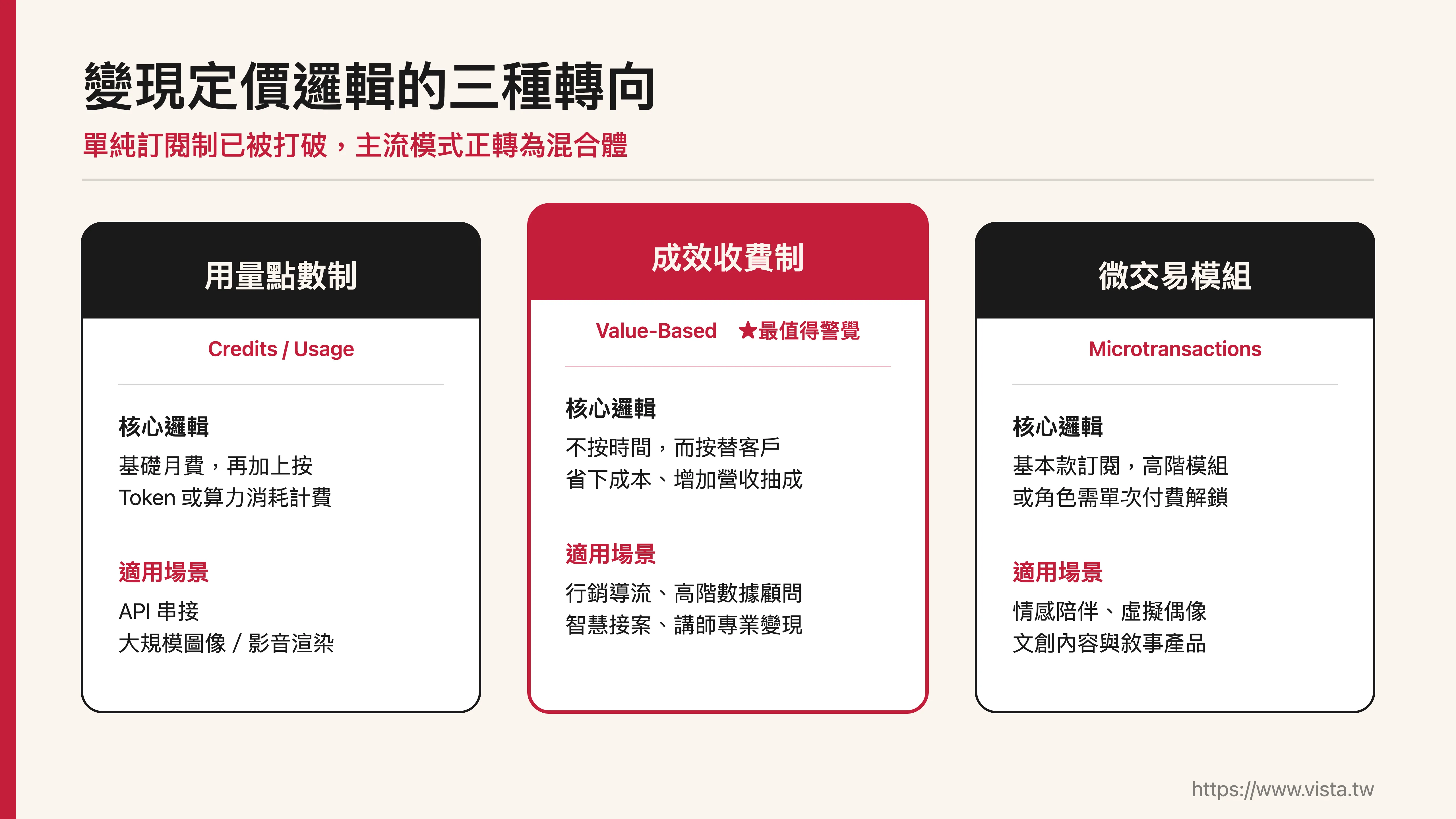 *▲ Three shifts in monetization pricing logic: usage point system, performance value charging, and unlocked micro-transactions. *
Please pay special attention to the middle one: performance charging (Value-Based). It is no longer priced based on how much time you spend, but based on how much cost you save and how much revenue you increase for your customers.
Who does this impact the most? Professional consultants, lecturers and freelance workers rely on their time to sell themselves. When AI compresses production time to the extreme, the path to hourly billing will become narrower and narrower; but on the other hand, this is also a huge opportunity: if you can prove that you create results rather than man-hours, your pricing ceiling will be completely opened. This is a crisis and an opportunity to reprice yourself.
 *▲ Do you like this kind of AI × monetization trend interpretation? Welcome to subscribe to Vista AI Inspiration Supply Station, I will continue to bring the latest tool ideas and business observations to you as soon as possible. *
The third insight: “One-person unicorn” is not a slogan, but it requires three pillars
statworx’s trend white paper proposes an exciting concept: the One-Person Unicorn. This means that you don’t need to form a huge team, and you can use AI alone to provide services that an entire department could do in the past.
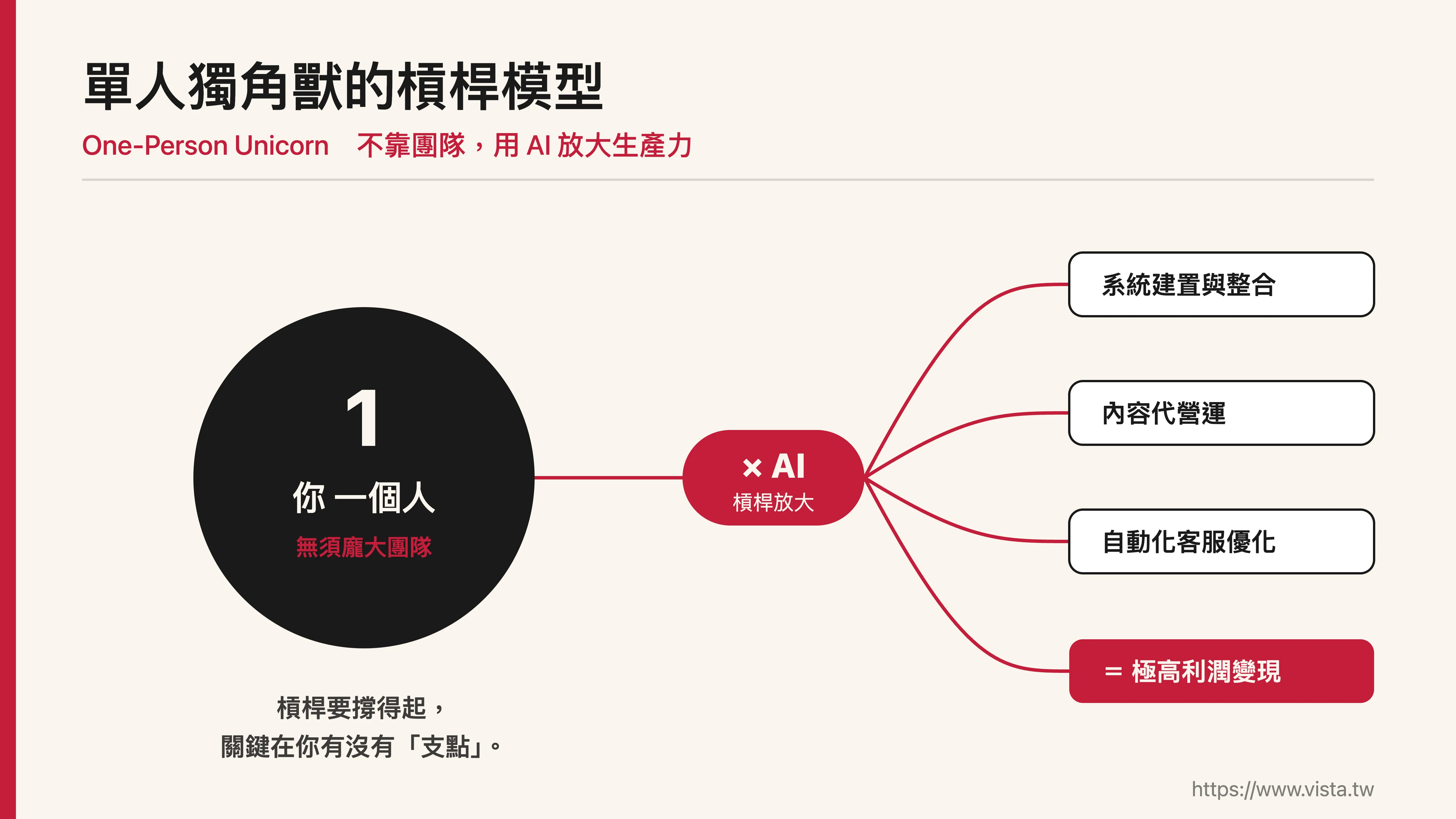 *▲ Single-person unicorn leverage model: One person can provide services that in the past required an entire department to provide. *
I like this vision very much, but I also want to pour some cold water on it: in order for the lever to be able to hold up, it must first have a fulcrum. And as I have gone through these years, I have seen that what can really hold up [Personal Monetization System] (https://www.vista.tw/blog/ai-era-one-person-company-book-review) are these three pillars.
The first one is the digital clone: Let AI handle repetitive communication and output for you, freeing you from trivial matters and focusing on high-value decisions that only you can make.
The second root is the content factory: [One person supports the all-powerful content matrix] (https://www.vista.tw/blog/ai-content-factory-system), which allows short videos and graphics to be automatically produced in batches and continuously exposed for 24 hours, rather than relying on you to support it.
The third root is traffic monetization: [Stringing SEO, community and productization into a closed loop] (https://www.vista.tw/blog/content-funnel-journey), so that content is not just seen, but truly converted into traffic and income.
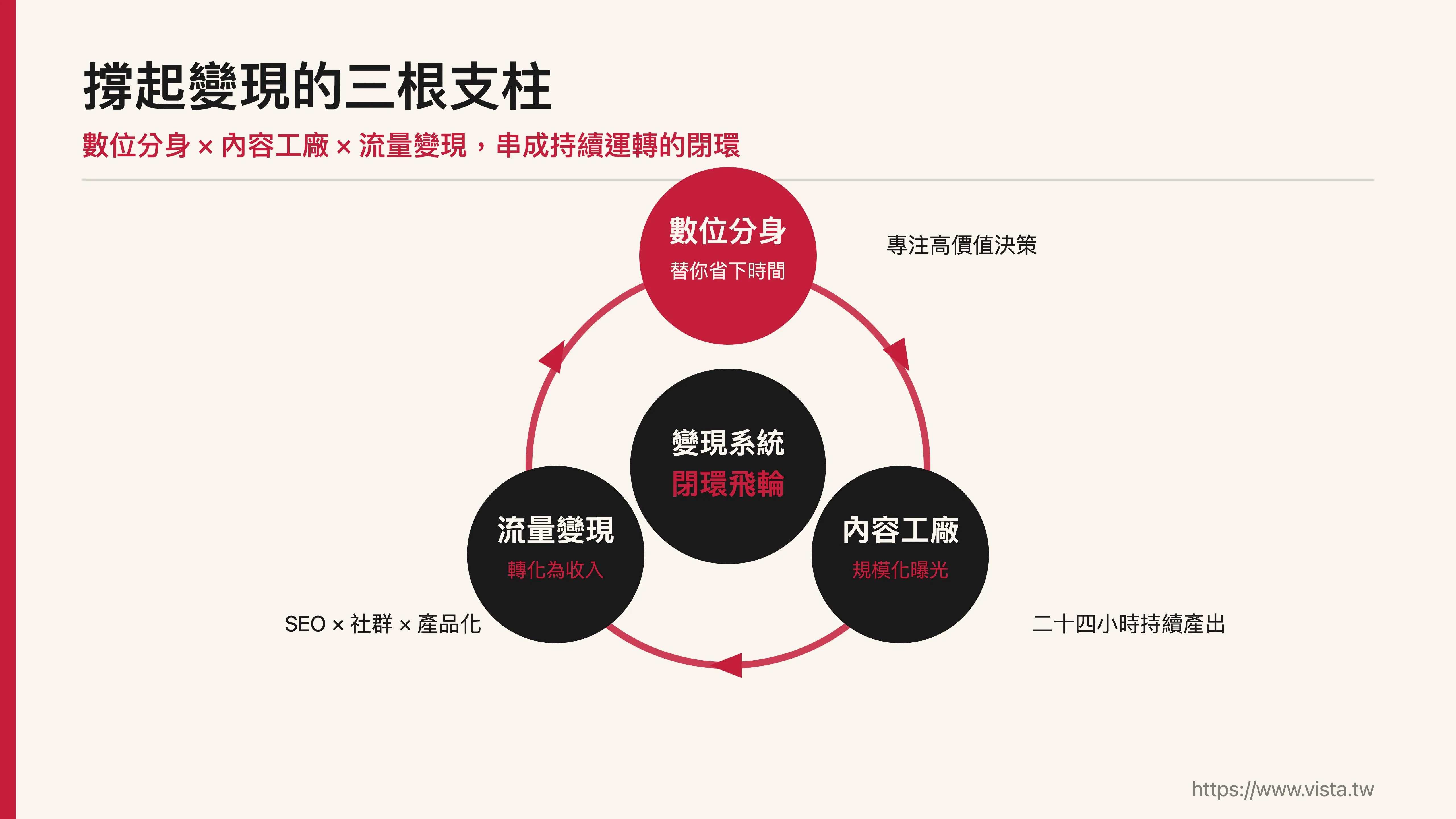 *▲ The three pillars that support the personal monetization system: digital clones, content factories, and traffic monetization. *
When these three pillars are erected at the same time, an individual truly has the capital to equal a hundred. This does not mean that you should work harder, but that you should establish a system that can work hard for you.
Learn this system all at once
As I write this, I want to report one thing to you: the three pillars above are exactly the skeleton of the course that my two partners and I are about to start.
In July, I will launch the “AI Monetization Institute”, a series of four in-depth workshops, together with brand positioning expert Joyce (Li Wenjuan) and AI automation process expert Claire (Zhang Kejia).
We deliberately designed the course to be a complete path rather than scattered tool teaching:
- 7/4 In the first session, Joyce will lead you to establish a [high-trust craftsman brand and positioning] (https://www.vista.tw/blog/ai-personal-brand-guide), which is the foundation for customers to come to your door.
- 7/11 The second session, Claire will teach you how to integrate ChatGPT, Claude, and GPTs into your own AI digital employee.
- 7/18 The third session focuses on AI avatars and video content factories, allowing one person to support the content matrix of the entire platform.
- 7/25 In the fourth session, I will talk about traffic amplification and commercial realization, and wrap up everything accumulated in the past into a closed loop that can continue to bring in income.
From positioning, system, content to monetization, this is exactly the system I talked about earlier that will work for you, but this time, we take it apart and take you step by step to build it.
If you also feel that knowing how to use AI is no longer enough and want to truly cross the realization gap, I sincerely invite you to come. The course offers a single class experience (NT$7,500) and the most value-for-money four-class bundle (NT$19,800, original price NT$30,000). Seats are limited.
For registration and complete information, please visit: AI Monetization Research Institute.
The first year of AI monetization has just begun. May you not just catch the bus, but be the one driving it.