There is no shame in using AI, only hiding it is risky: Disclosure of AI use and ethical self-examination for paper submission in 3 minutes
A while ago, my friend Amy was preparing to submit an academic paper, but it got stuck at the last minute before sending it off. It’s not stuck on the research findings, nor on the paper format, but on that inconspicuous field in the submission system: please explain whether you use generative AI in this research, and how you use it.
Amy was stunned for a moment. She did use Claude to help search for literature, polish the English abstract, and also asked it to help organize the questionnaire statistical results into a clearer chart. None of this is ghostwriting, but how do you write a disclosure statement that can be understood by journals and protect yourself at the same time? If you write too little, you are afraid of being considered to be deliberately concealing something; if you write too much, you are afraid of exposing your shortcomings. What’s even more troublesome is that she is actually not sure whether she has unknowingly stepped on the line of academic integrity.
So, she came to ask me.
I guess Amy’s anxiety is also a common situation among many researchers today.
Why AI disclosure suddenly became a required question for submissions
In the past two years, international journals, academic publishing groups, and various schools and departments have all included disclosure of AI use in their submission specifications. The reason is simple: as more and more people use AI to assist research, what the academic community needs is not a ban on its use, but transparency.
The problem is that although specifications are everywhere, few people teach you how to write them specifically. Most people either don’t write at all and bet that the reviewers won’t ask, or they improvise a guilt-ridden text. However, the former postpones the risk, while the latter may cause more doubts because the boundaries are not clearly stated.
Ultimately, exposing the use of AI is not about surrendering, it’s about protecting yourself. The point is never how much AI you use, but whether you keep the line of “AI is assistive, and the core thinking is still yours” - this is what I have always wanted to remind you in “AI will not make you stupid, but it will not make you stronger: Talking about brain-protecting AI learning methods”. Used correctly and written clearly, a disclosure statement is proof of your academic integrity; hiding it is the real risk.
A small tool that can do two things in three minutes
In fact, in order to solve the same troubles I had in the past, I made a free gadget: AI Usage Disclosure + Ethical Self-examination. I opened it and walked through it with Amy. It takes you to do two things in three minutes:
First, outline what exactly you have done with AI, and automatically generate a Chinese and English disclosure statement that can be directly pasted into the paper.
Second, follow the six ethics warning self-examination to see if you have stepped on the red line of academic integrity.
There is a real-time “compliance completeness” meter at the top of the interface, which will tell you how many warnings have not been cleared. Before you submit your article, make sure you know what it is.
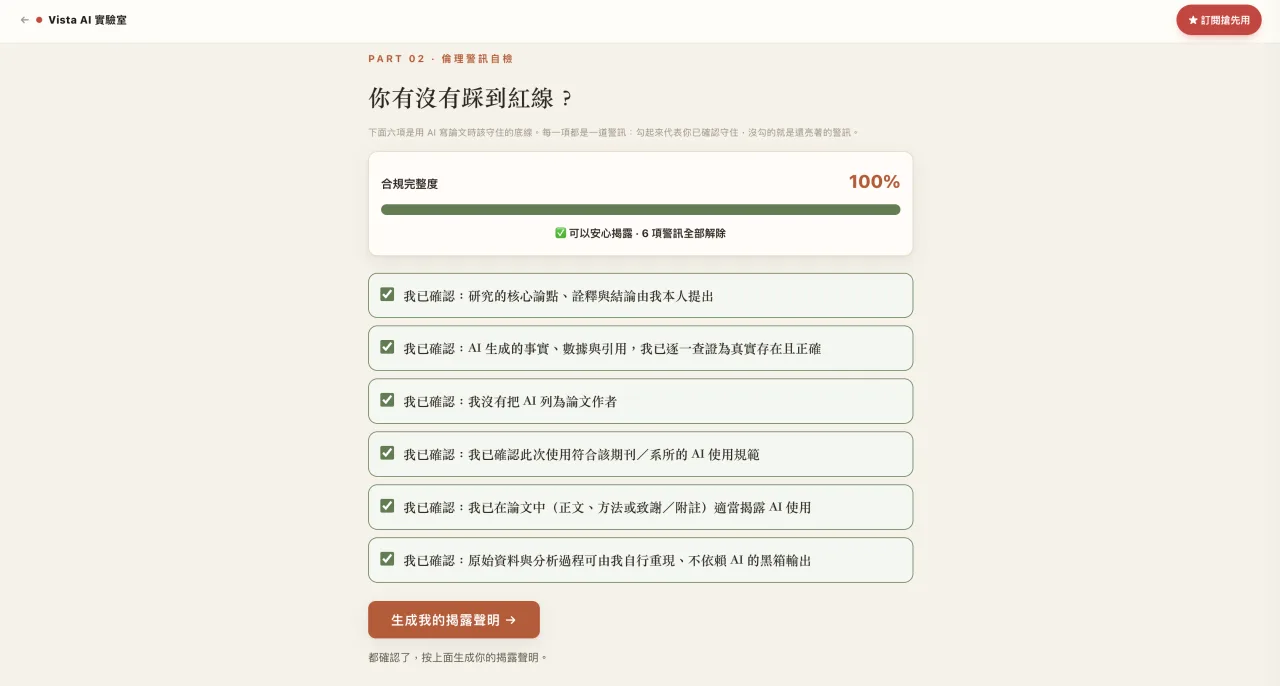 ▲ The six red lines of the ethics self-check: each item you confirm pushes the compliance meter up; only when all six are cleared and it hits 100% can you disclose with peace of mind.
Let’s use Amy’s paper (the topic has been rewritten) to take you through it.
Case: A junior high school teacher’s self-examination before submission
Amy is a junior high school teacher and also works at the Institute of Continuing Education. She has just finished writing a paper - “The Impact of Integrating Generative AI into Topic-based Learning on Junior High School Students’ Autonomous Learning Motivation” and is preparing to submit it to an educational journal. During the writing process, she used Claude to do three things: search and organize documents, polish the English abstract and proofread grammar, and organize the questionnaire statistical results into a visual chart.
Step 1: Check what you did with AI
The tool will provide a list of common AI uses, and you just need to check them accordingly. In Amy’s case, she evoked three items: literature search and organization, language polishing and grammatical proofreading, and generating diagrams or visualizations. For each item you check, the disclosure statement below will instantly grow a corresponding sentence, generated simultaneously in Chinese and English - because many journals require disclosure in English, you don’t have to translate it yourself.
Here’s the important thing: you only tick things you’ve actually done. The value of a disclosure statement lies in honest correspondence. Checking one more box will not make you safer, but will be another distortion.
Step 2: Follow the six ethical warning signs for self-examination
This is the most worthwhile part of the entire tool. It doesn’t ask you what you used, but forces you to answer six more pointed questions, which are the red lines that academic integrity really cares about:
Are the core arguments, interpretations and conclusions of the research proposed by you yourself? Have you verified that the facts, information and quotes generated by AI are real and correct? Did you list AI as an author on the paper? Does this use comply with the AI specifications of the journal or department? Did you disclose it appropriately in your paper? Can you reproduce the original data and analysis process yourself without relying on the black box output of AI?
Every time a warning is lifted, the compliance integrity level above will jump up one notch. When all six lanes turn green and the completeness reaches 100%, you will truly pass.
Amy was able to confirm the first five items quickly, but the second item, “checking the AI-generated citations one by one,” gave her pause. Because she remembered that Claude helped find two items in the literature list, and she had not yet gone back to confirm whether the DOI actually existed. This stop is the greatest value of this tool: it helps Amy stop the most likely problem of false literature before submission. After she went back to verify and make corrections, she dared to check the second item.
 *▲ Do you like this kind of AI × academic research practical approach? Welcome to subscribe to Vista AI Inspiration Supply Station. I will continue to interpret the latest tool usage and trends and send them to you as soon as possible. *
Finally, Amy got such a result
After completing these two steps, the tool will generate a result for you that can be used directly. Taking Amy’s paper, it will eventually look like this:
AI Usage Disclosure Statement|Journal Submission Papers
【Chinese version】 This paper used a generative artificial intelligence tool (Claude) during the research and writing process. Its uses include: literature search and organization, language polishing and grammatical proofreading, and generating charts or visualizations. All content generated with the assistance of AI has been verified, judged and modified by the author. The author is responsible for the core opinions, analysis and conclusions of this study; AI tools are not listed as authors.
【English】 In the preparation of this manuscript, the author(s) used generative AI tools (Claude) for the following purposes: literature search and organization, language polishing and grammar checking, figure generation and visualization. The author(s) reviewed and verified all AI-assisted content, take full responsibility for the core arguments, analysis, and conclusions of this work, and confirm that no AI tool is listed as an author.
And an ethics self-examination report:
Ethics self-inspection report (compliance completeness 100%, 6 / 6 items confirmed)
Confirmed: ✓ The core arguments, interpretations and conclusions of the research are proposed by myself ✓ I have verified that the facts, data and quotes generated by AI are real and correct. ✓ I did not list AI as an author of the paper ✓ I have confirmed that this use complies with the AI usage regulations of the journal/department ✓ I have appropriately disclosed the use of AI in the paper (text, methods, or acknowledgments/notes) ✓ The original data and analysis process can be reproduced by myself, without relying on AI black box output
Unresolved warnings: (None, all six warnings have been cleared)
It will be safer to paste the Chinese or English version into the paper’s methods, acknowledgments or notes, and then keep the self-examination report as your own manuscript. Amy later told me that what reassured her most was not that statement, but that she finally dared to send the paper out after passing the six warning signs.
A little reminder
This tool has two reassuring designs: first, the content you check will only stay in your browser and will not be uploaded to any server; second, it requires honest correspondence, not beautification for you.
The last and most important sentence: Tools can help you write a good statement and mark the red lines, but in the end you still have to follow the official regulations of the academic journal you want to submit to or your department. After all, each unit has different requirements for AI disclosure. What this small tool can give you is a solid starting point, not a gold medal for immunity.
If you want to go one step further and use AI from pre-submission disclosure to document digestion and revision, that is, to make AI truly your research co-pilot, you can read my articles Stop asking AI to help you sort out your thesis topic: Use research questioning scaffolding to turn vague ideas into writeable research questions and How researchers can build a reproducible academic co-pilot, or sign up for my AI-empowered academic research and writing practical workshop.
There is no shame in using AI, only in hiding it is risky. Open AI Usage Disclosure + Ethical Self-examination now, and give yourself three minutes of peace of mind before submitting your article.
📖 深入探索相關主題