Where does the digital transformation of small and medium-sized enterprises start? Five high-frequency scenarios where bosses use AI first
 *▲ The AI transformation of small and medium-sized enterprises often does not start with a kick-off meeting, but from the moment the boss turns on the computer and enters the first prompt. *
Originally published in “Economic Daily (opens in a new tab)”
Last time, we talked about If the boss uses AI first, small and medium-sized enterprises will have a real starting point for transformation.
For example, when the boss uses AI to create the first version of the customer development letter, employees will know that the original business process can be rewritten; when the boss uses AI to organize the weekly business report, employees will know that the original data is not used for cross-border business, but can be used for decision-making; when the boss uses AI to create an internal SOP query assistant, employees will know that knowledge management is not a slogan, but a tool that can be used every day.
So, where can SME owners start? My suggestion is not to talk about a huge AI transformation plan at the beginning, but start with the following five high-frequency scenarios.
There is no need to talk about huge plans, let’s start with five high-frequency scenarios.
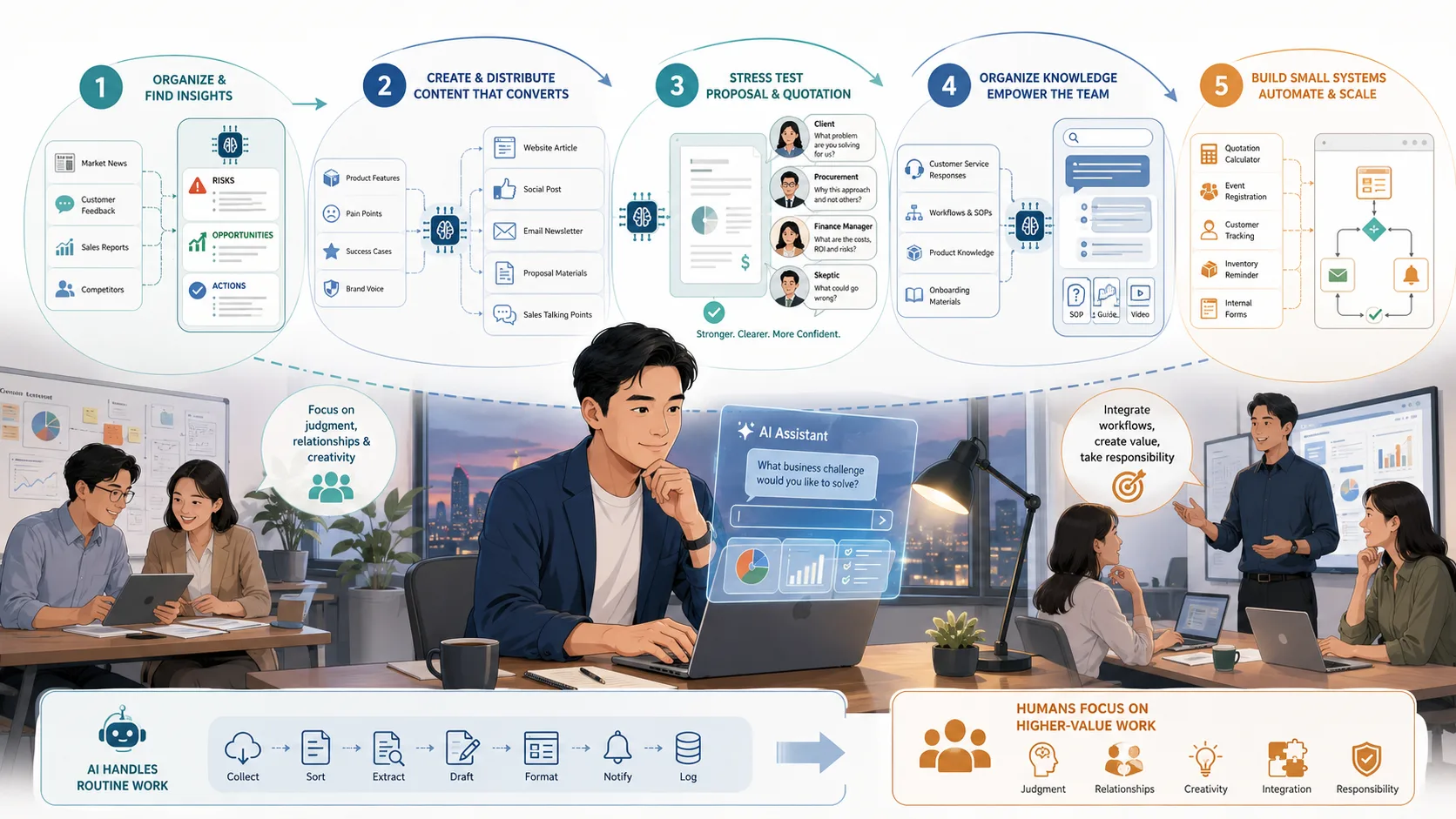
**1. Compilation of information before decision-making. ** Let AI help summarize market news, customer feedback, business reports or competitive product information, and ask it to sort out risks, opportunities and actionable suggestions. The key to this step is not how powerful the tool is, but whether you can explain the problem clearly and hand over the context of judgment to the AI.
**2. Stable output of marketing content. ** Organize the company’s product features, customer pain points, successful cases and brand tone into a database, and let AI assist in converting them into official website articles, social posts, e-newsletters, proposal materials and business words. This is exactly what I talked about repeatedly in Marketers’ AI Superpowers: stability is more important than a sudden flash of inspiration.
**3. Proposal and quotation. ** Ask AI to play the role of a customer, procurement, financial director or opponent to review the persuasiveness of the proposal in advance and help the company complete a round of virtual stress testing before sending the proposal. If you want to take it a step further, you can even set up an AI clone for different objects, who will take turns questioning you.
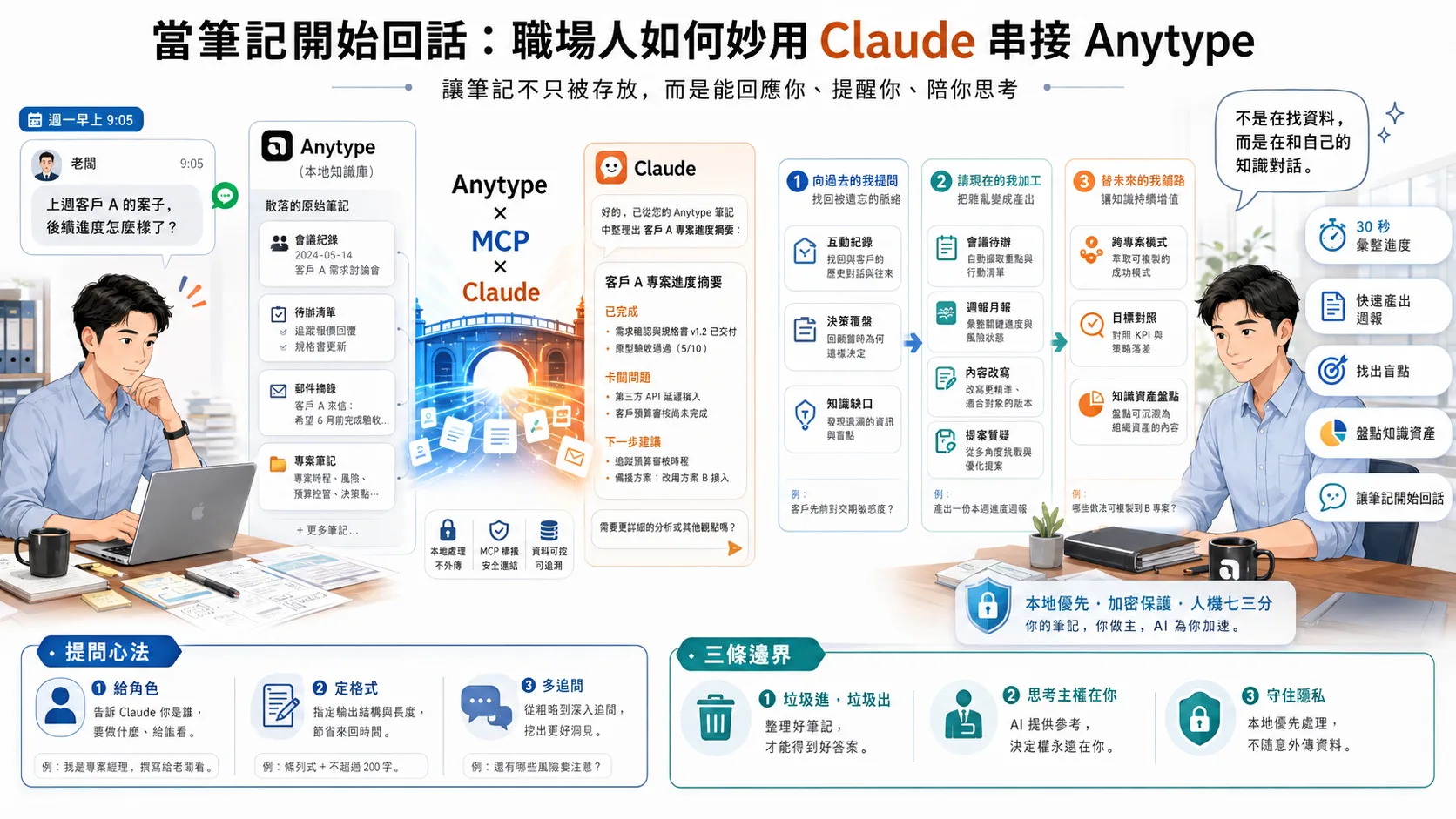
**4. Internal knowledge management. ** Gradually sort out frequently asked questions, operating procedures, customer service response, product knowledge and new employee training content, so that AI can become the query portal for company knowledge, rather than letting key experiences remain in the minds of a few people forever. You can refer to my experience using Anytype + Claude to create a second brain.
**5. Small systems and automated prototypes. ** The boss can first describe the requirements in natural language and create an MVP for quotation calculation, event registration, customer tracking, inventory reminder or internal form. It may not be officially launched at the beginning, but it can help operators concretize their ideas and reduce the cost of trial and error. This is also the most charming part of Vibe Coding: it doesn’t matter if you can’t write programs.
The boss uses AI not to replace employees, but to redefine value.
Of course, bosses use AI not to replace employees, but to redefine the value of employees.
AI can take over low-value, repetitive, and consuming tasks; what humans are responsible for is judgment, relationships, creativity, integration, and responsibility. AI can sort out customer service issues first, but how to appease customers in the end requires people; AI can write draft proposals first, but it requires people to truly understand the context of customer decision-making; AI can analyze data first, but it still needs people whether the company should pivot and which market it should bet on.
Therefore, the boss uses AI first. The most important task is not to show off skills, but to redistribute work value. You need to let the team know that the company is not using AI to make everyone busier, but to use AI to free everyone from trivial tasks and do work that is closer to customers, closer to strategy, and closer to creating value.
🛰️ Want someone to accompany you to see clearly in the wave of AI changes?
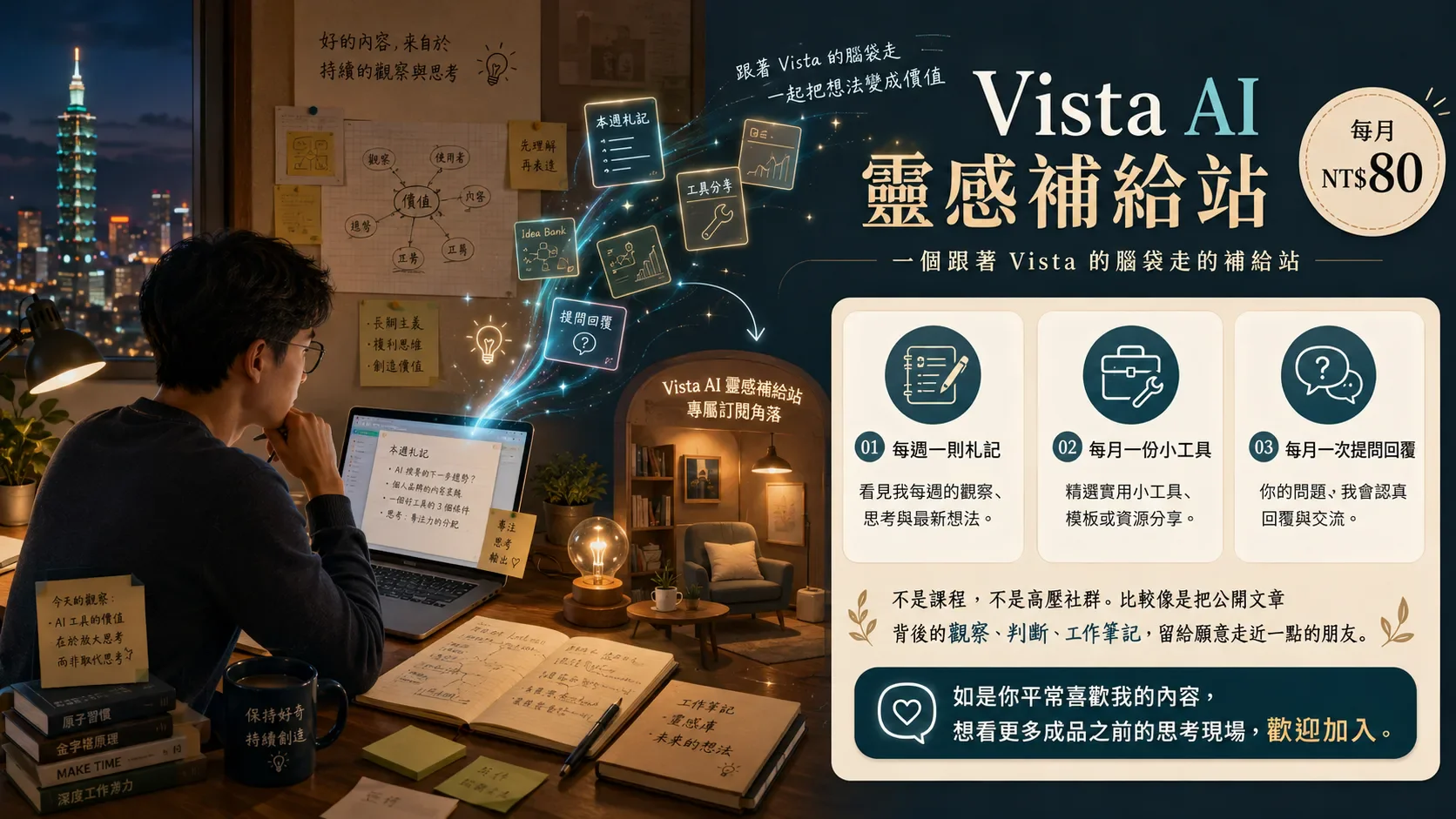
Almost all the public articles you see are finished products after repeated polishing. But what I cherish the most is the warm judgment before the finished product - this is the reason why I made Vista AI Inspiration Supply Station (opens in a new tab): a weekly thought note for fellow travelers in the AI era, sharing those Yoshimitsu Kataha that will not appear in official articles with you who are willing to get closer.
👉 Subscribe now and receive weekly emails → (opens in a new tab)
AI reopens a door
The fairest thing about the AI era for small and medium-sized business owners is that it has reopened the door.
In the past, you may have had many ideas, but lacked engineers; in the past, you may have known that processes should be changed, but lacked budget; in the past, you may have wanted to create content, systems, data, and automation, but you lacked people, time, and tools. As a result, many things can only be kept in mind and become a list of “let’s talk about it later”.
But things are different now.
You don’t need to be an AI expert to start out. You just need to be willing to open the tool, describe a real problem, and let AI help you create the first version. Then you revise, question, test, overturn, and start over. In this process, you will slowly discover that AI not only helps you complete tasks, it also forces you to explain your business logic more clearly.
The AI transformation of small and medium-sized enterprises will not start with a gorgeous launch conference. It probably just started when the boss turned on the computer one night and entered the first prompt: “I want to improve the company’s current process. Please help me break down the problem first.”
At that moment, it may be an opportunity for your company to introduce AI.
Next step
Bring this topic to your team
Vista Cheng speaks and runs workshops on AI workflows, writing and content systems for companies, schools and public agencies.