The secret to completing the first draft of your paper over the weekend: the five-step process of "writing backwards and preparing materials" learned from Prof. David Stuckler
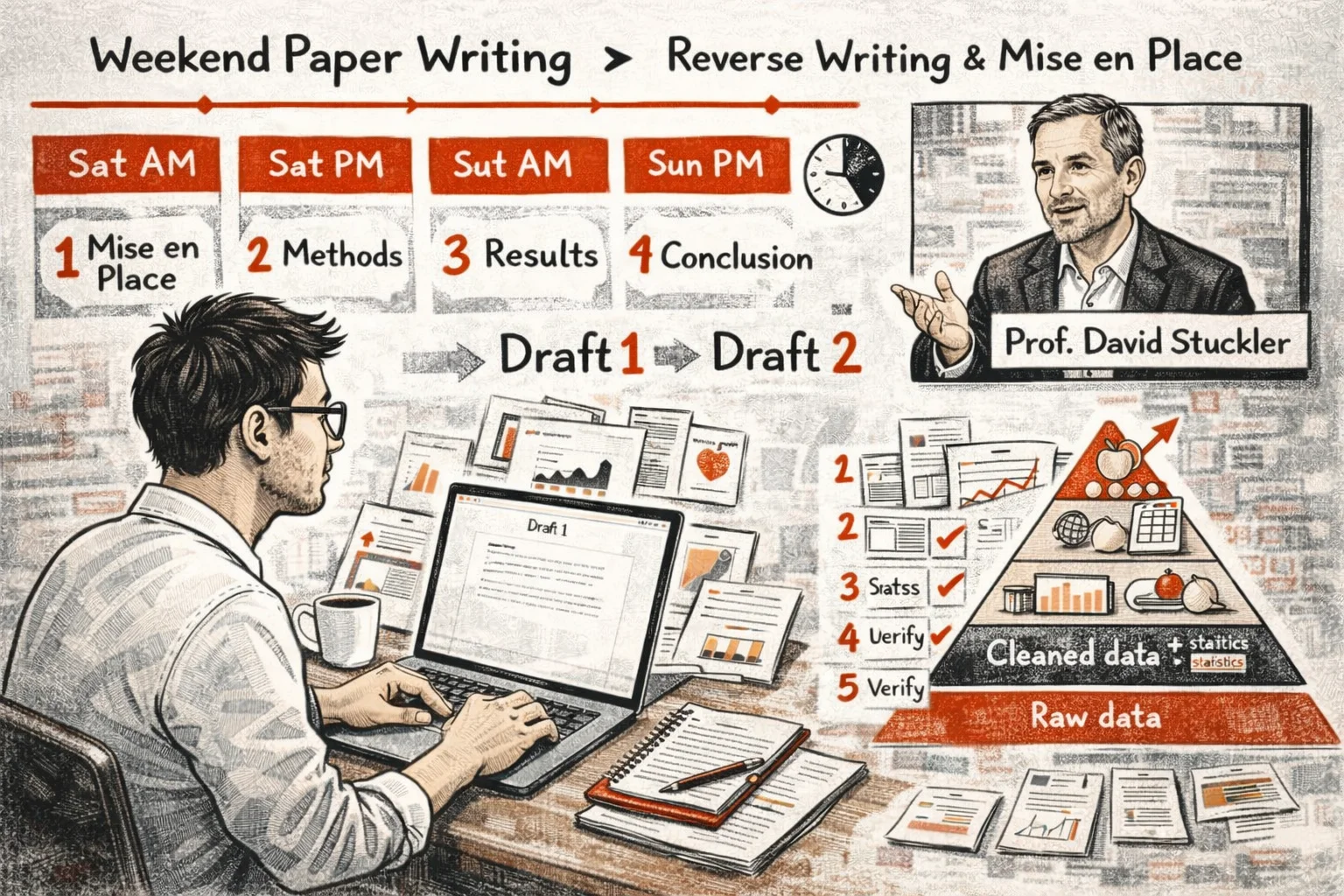
 ▲ Prof. David Stuckler’s paper writing methodology makes completing the first draft on the weekend no longer a legend
Every time Friday night comes, have you ever secretly made up your mind to write your paper this weekend? As a result, as soon as I opened Word, my head felt as if the mute button had been pressed. The cursor flashes and flashes, and you begin to doubt life: Am I not working hard enough, or is the paper not written by humans in the first place?
Prof. David Stuckler In that video, he gave a perspective that I like very much:
Writing a paper over the weekend does not rely on willpower, but on process design.
He is not asking you to be more self-disciplined, nor is he asking you to work harder, but to treat writing as a manageable project: first prepare the materials, then assemble them in the correct order, and finally polish it iteratively.

Next, try to organize the five skills he talked about into a set of weekend writing procedures that you can refer to. You will find that what really blocks you is often not your writing ability, but that you have been using the wrong order and pursuing perfection at the wrong time.
Writing is only the last 10%: what you really lack is preparation
 ▲ Turn research data into a pyramid: from raw data to graphs that can be put directly into your paper
Professor Stuckler puts it very sharply:
Writing is only the last tenth of the project.
Many doctoral students may be unconvinced when they hear this: I am in pain just because I can’t write it! But if you think about it carefully, our pain often means we don’t know what to say? But I don’t know what topics I can use?
He used cooking as a metaphor, which I found very expressive: if you haven’t cut the onions, washed the tomatoes, or taken the oil, the pot will start first, and of course it will be a mess. The same goes for writing a paper: before the information can be compiled into a tellable story, you force yourself to write the introduction, and in the end you will only end up writing an incomprehensible piece of self-torture.
Therefore, we need to turn this material preparation process into a structure that can be seen and understood. In other words, we first turn the research data into a pyramid.
The bottom layer is raw data, which is the world you collected; the middle layer is the results of cleaning, calculating, and running the model (cleaned data + statistics), which is where you organize the world into understandable signals; the top layer is the charts and tables (figures & tables) that can be directly put into the paper—that is the evidence you can use to tell stories.
When your pyramid is complete, you are not just ready to start writing, you already have the core narrative of an essay. At this time, the paper writing will start to make some progress, rather than just starting out of nothing. If you are interested in academic research tool, you can refer to the UPDF usage experience I shared before.
If you want to make the progress of material preparation more controllable, you can simplify the data preparation process into a small dashboard: proceed from data cleaning → statistical verification → chart generation → quality inspection. Clear completion conditions are set for each step: for example, “chart generation” does not just draw it, but includes the title, unit, significance annotation, data source and number of samples in place. This way, when you start writing on the weekend, you won’t be dragged back and forth by the details, like running in a maze.
According to the Harvard Writing Center (opens in a new tab), effective writing preparation can significantly reduce resistance when it comes to actually writing.
Don’t start with Introduction: write Methods first
 ▲ Break the traditional order: start with the most objective and specific paragraphs to build writing momentum
Many people fail to write on the weekend because they choose the most difficult paragraph at the beginning: Introduction.
Introduction is about convincing the world why you matter? It involves literature context, narrative tension, research gaps and value propositions; what you need most on the weekend is not to convince the world, but to get yourself moving first.
Professor Stuckler’s advice may sound counterintuitive, but it’s extremely effective:
Write Methods first, then Results.
The reason is simple: because Methods are the most objective, concrete, and least in need of inspiration. As long as you follow the research process and explain clearly what you have done, you will immediately feel that you are making progress. This kind of positive feedback is critical, because the real enemy of writing is not ability, but frustration.
For me, I think of Methods as paragraphs that explain things clearly. You can divide the entire research process into several paragraphs in order: how to get the sample, how to measure the variables, how to use the tools, and how to run the statistical method? You can even write it in a very straightforward spoken version first (for example, for a research assistant) and then change it to a paper tone. The point is not that the writing is elegant, but that the information is complete.
This method coincides with the core concept of Improve Writing Speed: first think clearly about the purpose and audience, and you can greatly improve efficiency.
Results Let the chart speak, and you be the navigator
 ▲ Each chart is like an exhibit, you just need to give readers a curation tag
After writing Methods, it is like laying the foundation for writing. Next, go to Results. Many people will get stuck here again. The reason is: they think that Results should be written in a very powerful way, like doing analysis and interpretation, and they even start sneaking into Discussion.
But Professor Stuckler’s reminder is important:
The text in Results is just a guide, the charts are the exhibits.
I really like his curator metaphor: each chart is like an exhibit, and you just need to give the reader a curatorial label: say what the chart wants you to see in one sentence, and then use three sentences to accomplish three things—describe trends, give values, and point out special findings. Don’t write it as prose, don’t write it as a review, don’t argue with the reviewer here.
If you want to make Results easier to write, I recommend a very simple but powerful approach: one picture per paragraph. Each paragraph only serves one picture. The first sentence of the paragraph is to show the card first: “Figure 2 shows…” You will find that the more clearly you tie the text to the diagram, the less likely you will get lost in the results area.
There is also a very common PhD student trap, which is to get kidnapped by secondary analysis. You run a lot of models, do a lot of checks, and end up spending the most precious time of your weekend figuring out the minutiae. Professor Stuckler reminds everyone to write the core result first, which is the heart of paper. This means that we must first finish writing the few pictures that can support the proposition of the paper, and the others are bonus points, not the foundation.
APA Style (opens in a new tab) also emphasizes that figures should be self-explanatory and the text only needs to guide the reader’s attention to the important points.
Writing the conclusion first is a reverse design, so that the whole article does not digress.
 ▲ First clarify what your research is going to deliver, and let the conclusion serve as the compass for the entire article
This is the soul of the whole process: conclusion first.
Many people misunderstand writing the conclusion first, thinking that it means shooting an arrow first and then drawing a target. But Professor Stuckler does not mean to ask you to jump to random conclusions, but to ask you to clarify first: what exactly is your research going to deliver, what is its contribution, what limitations are you willing to admit, and what step do you want the world to take?
He gave a four-paragraph conclusion formula, which I translated into a more practical way of writing:
In the first paragraph, you use one or two sentences to clearly explain the main findings, and it is best to put the numerical value or effect size directly so that readers can see the “quantity” rather than the “feeling” at a glance. In the second paragraph, you take the initiative to expose restrictions and don’t wait for reviewers to criticize you. In the third paragraph, you propose feasible and bounded future research directions, which makes people feel that you are not shouting slogans, but opening the way. In the fourth paragraph, if your field has policy or practical significance, make it clear: Which evidence gap does your research fill?
Why is this step so important? Because it will be like a compass. Once you have the skeleton of the conclusion, you can then write the Introduction and Discussion, and the paper will not become more and more scattered or become like two different papers. Having said that, if you can finish the first draft on the weekend, you often rely on staying on topic.
This kind of “reverse design” thinking is also applicable to time management: first determine the end point, and then plan the path.
Introduction: The three-paragraph format allows reviewers to understand in seconds
 ▲ Why Now, What’s Missing, What We Add - let reviewers quickly grasp your value
Many people write the Introduction like a farewell to literature: starting from ancient times, and then building up to the present. In the end, readers only remember that you worked hard, but they don’t know what you want to do?
Professor Stuckler split the Introduction into three paragraphs, which I think is particularly suitable for weekend writing, because it forces you to be short, precise, and ruthless in everything:
Paragraph 1 Why Now: Why are you doing this question now? This is not to ask you to write a bunch of background, but to create a sense of urgency. You can use data, phenomena, and trends to make readers feel that the topic is worth spending time thinking about. Paragraph 2 What’s Missing: What is the gap in the literature? The key to this section is not too much, but precision. You need to clearly point out which part of the current research is missing. It is best to present it in a comparative way of existing vs. unknown, rather than listing ten documents and then saying that we need more research.
Paragraph 3 What We Add: What do you want to add? This paragraph should be like your value proposition. In one sentence, point out where your innovation is, how you fill the gap, and what new understanding you bring?
My own habit is: write the third paragraph first, and then go back to the first and second paragraphs. Because as long as the third paragraph is not written clearly, all your previous preparations may be the wrong way to go. That would be a waste of effort!
If you want to learn more about how to use AI tools to assist academic writing, you can refer to A learning tool for doctoral and master’s students: How to make good use of Gemini Notebook.
Seek first and then seek perfection: three rounds of polishing and delivery of the first draft
 ▲Draft 0 skeleton version, Draft 1 smooth version, Draft 2 refined version - only focus on one thing in each round
If starting with the Introduction is the No. 1 landmine of weekend writing, then striving for perfection on the first draft is the No. 2 mine.
Professor Stuckler puts it very bluntly:
The first version can be vomit on the page.
Sounds undignified, but very true. You have to accept one thing: the job of the first draft is not to look good, but to exist.
Vomit on the page, often referred to as “vomit draft”, is a writing technique that requires the author to record all ideas, plots and dialogues without any editing, deletion or optimization. The aim is to complete a first draft quickly, overcome perfectionism, and get it all out on paper or screen.
We can turn polishing into three rounds, and each round only focuses on one thing:
Round 1 Draft 0: Skeleton version. Just fill in each paragraph with content, even if it’s rough.
Round 2 Draft 1: Smooth version. You start adjusting the order of paragraphs, adding transitional sentences, and removing repetitions to make it read like an article.
Round 3Draft 2: Refined version. You take care of formatting, citations, wording consistency, and figure titles.
The most important thing to remember is: don’t practice structure and grammar at the same time.
That will always stop you at the first sentence of the first paragraph, and then at the end of the weekend, you will be back to square one.
This concept of staged writing coincides with the writing process advocated by Purdue OWL (opens in a new tab): breaking down writing into stages such as prewriting, drafting, revising, and editing.
Turn tips into weekend schedule
 ▲ Prepare materials and write Methods and Results on Saturday, write conclusions and Introduction on Sunday, and finally run Draft 1
If you really want to spend two days on the weekend to produce a first draft that can be submitted to an academic journal, I suggest you follow Professor Stuckler’s advice and run at this pace instead of relying on your feelings:
- Prepare materials first on Saturday morning: Organize the most critical charts and tables and make sure there is something at the top of the data pyramid.
- Write Methods on Saturday afternoon: Explain clearly what you did according to the process.
- Writing Results on Saturday night: One picture and one paragraph, writing the core exhibits first.
- Write out the four-paragraph conclusion first on Sunday morning: get the compass in place for the entire article.
- Write the introduction on Sunday afternoon: three paragraphs, short and clear.
- Run Draft 1 on Sunday night: Make the paragraphs flow together, cut out fluff, add transitional sentences, and make it feel like a complete paper.
You will find: This is not about working hard, but about getting the order right. Many people think that what they lack is more time, but in fact, what you lack is fewer detours.
If you want to know more about Content Planning and Time Arrangement tips, you can refer to the content calendar method I shared before.
Thesis is a deliverable project, not a matter of talent.
 ▲ Thesis writing is not an inspirational work, but an engineering work—it can be disassembled, sorted, and iterated
What I like most about this video by Prof. David Stuckler is not that he talks about many techniques, but that he allows us to re-understand:
Thesis writing is not an inspirational job, but an engineering job. It can be disassembled, sorted, and iterated.
When you are willing to admit that writing is only the last 10% of the work, you will spend your energy on preparing materials; when you are willing to write in reverse order, you will build momentum from the easiest parts first; when you are willing to seek good first and then good, you will not be held back by perfectionism.
 ▲Whether I can finish the first draft over the weekend finally becomes a very pragmatic question: Do you turn writing into a process rather than an emotion
Whether you can finish the first draft over the weekend actually turns out to be a very pragmatic question: whether you turn writing into a process rather than an emotion.
Further reading:
- A powerful tool for academic writing: UPDF allows me to breathe freely in the world of knowledge
- A learning tool for doctoral and master’s students: How to make good use of Gemini Notebook
- AI-driven curriculum design revolution and educator transformation journey
External resources:
- Harvard Writing Center - Strategies for Essay Writing (opens in a new tab)
- Purdue OWL - The Writing Process (opens in a new tab)
- APA Style - Tables and Figures (opens in a new tab)
Next step
Bring this topic to your team
Vista Cheng speaks and runs workshops on AI workflows, writing and content systems for companies, schools and public agencies.