It’s not that you don’t work hard enough, it’s that the value proposition isn’t attractive enough
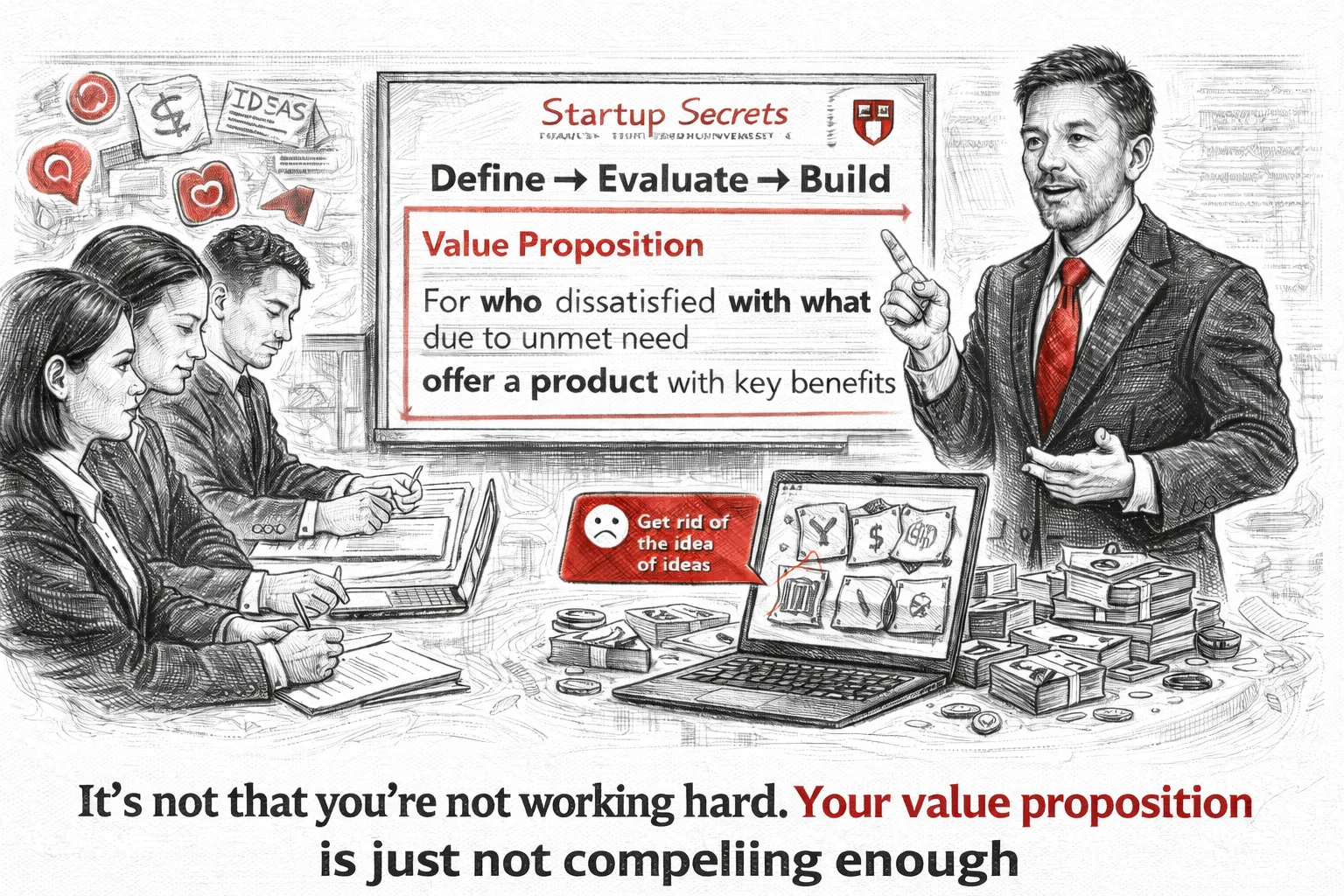
Modern people are busy with work and their attention is scarce. To be honest, I rarely watch a video on YouTube that lasts more than an hour and has an interactive classroom rhythm. I couldn’t help but take a lot of notes at the end. It felt like I was taking an entrepreneurship class.
Because this session was lectured by Underscore VC (opens in a new tab)’s founding partner Michael Skok (opens in a new tab) and was held at Harvard University in the United States Innovation Labs (opens in a new tab)’s “Startup Secrets” series of workshops will force you to do one thing from beginning to end: condense the ideas in your mind into a value proposition that will be paid for.

From the beginning, Michael Skok (opens in a new tab) made it very straightforward: the most common cause of death of a company is not insufficient technology, not marketing skills, or investors not liking it - but that you are not solving a “valuable enough” problem, so you cannot create value worthy of investment or purchase, and eventually it will die naturally. This sentence is cruel, but very fair.
The most common cause of death in a company is not that the technology is insufficient, but that you are not solving a “valuable enough” problem.
The reason why I am particularly impressed is because in the past few years, in corporate training, consulting and AI tool introduction sites, I have seen too many people stuck in the same trap: they thought they were selling products, but in fact they were just selling “imagination.”
Michael Skok first smashes the idea worship: Ideas are cheap, problems are valuable
In class, Michael Skok (opens in a new tab) said something that I like very much and sounds very harsh: Get rid of the idea of ideas.
He said that most people who come to him say “I have a great idea”, but the idea is floating in the air. If there is no problem to attach to, no scene to implement, and no clear target - then it is meaningless.
Seeing this reminds me of the pitch briefings of some new startup teams:
- “We use large language models to help you write copy”
- “We use AI to help you organize meeting minutes”
- “We use AI to help you make presentations”
It all sounds reasonable, but you just need to ask: “Then who are you saving what, preventing who from being brought down by what, and making who earn more?” The expressions of these young and promising CEOs began to change, and you can imagine the next scene.
Michael Skok (opens in a new tab)’s framework is very simple: Define → Evaluate → Build.
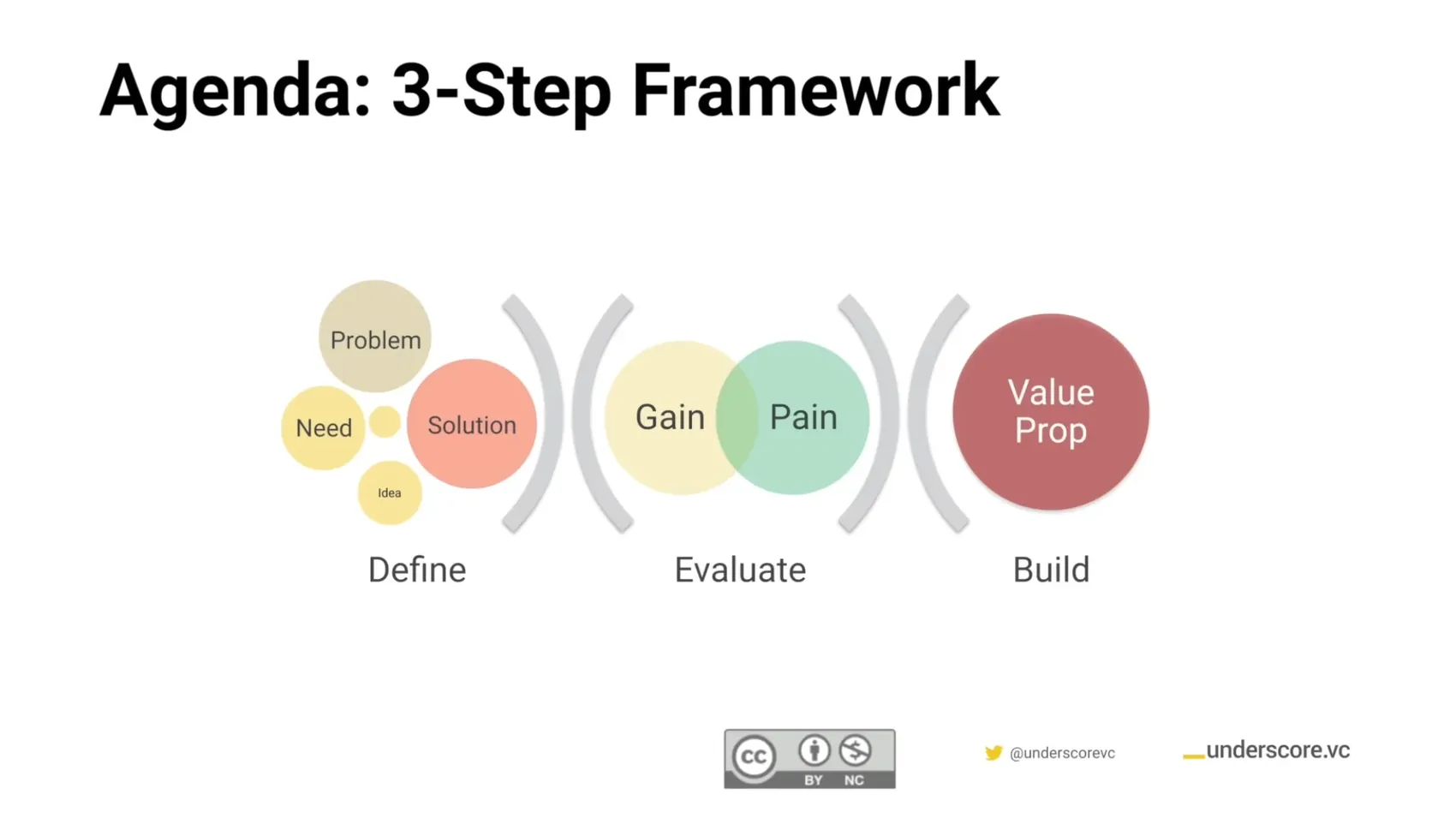
First define, then evaluate, and finally make it into a clear, easy-to-use version that can be sold and used to raise funds.
The “end point sentence pattern” he gave (which is also the value proposition that you must be able to finish in one breath) is to the general effect:
For a group of people who are dissatisfied with what due to unmet need, you offer a product that solves the problem and brings enough key benefits that they are really willing to buy it.
Note: Not willing to try, but willing to buy. The gap between the two is not your copywriting skills, but your depth of understanding of the market truth.
Define’s first move: not for everyone, but for the smallest viable customer group
The first word Michael Skok wrote in the “Define” stage was very important: For who.
He even said it almost dogmatically: If you think your customer is everyone, you are almost destined to fail, because you are going to boil the entire ocean.
I completely agree with this paragraph, especially in the Taiwan market:
The market is small, the channels are fragmented, the cost of trust is high, and the decision-making chain is extremely long - in other words, if you want to hit everyone at the same time, you will often end up empty-handed and hit nothing!
Michael Skok further talked about a concept that I think is very practical: Minimum Viable Segment (Minimum Viable Segment) - it should be able to dance with your MVP (Minimum Viable Product), as he said a good dance partner: the same group of people, the same need, you can use the same product to sell it over and over again, without having to customize it to explode every time you sell an order.
I translated it into a more vernacular version:
You need to find a group of people first. Only when the pain points of the problem are the same can you have the opportunity to make a productized solution that delivers consistent delivery.
This is what I often tell lecturers, consultants, or content creators: Don’t rush to make a big, complete product, make a small and accurate version first. It’s not that you don’t work hard enough, you’re just too greedy.
When the user and the person paying are not the same: you actually have to make two value propositions
In class, a classmate asked a classic question: When User and Customer are different, who should I write for who?
Michael Skok’s answer is crucial: both are important, but we must start with the users, because without the “pull” of users, those who pay will not spend money; and those who pay (government, enterprises, donors or executives) still need to see the return after users adopt it before they are willing to invest.
Well, I think this section is particularly fatal for Taiwan’s B2B industry.
Because I have seen too many SaaS, internal training platform or AI introduction cases, and they all died on the same thing:
- Supervisor thinks “it looks good”
- But front-line employees think “I can just use Excel”
- Final adoption rate is very low
- The supervisor turned around and said, “Forget it, this method doesn’t work.”
Therefore, your value proposition cannot be written just for the boss, nor can it be written only for the users. You must answer both:
- Why do users use it? (Save time, make fewer mistakes, get scolded less, or work overtime)
- Why should the buyer pay? (Production capacity improvement, cost reduction, risk reduction or target achievement)
This is not marketing talk, but product strategy.
Define’s second move: Only by answering the question correctly can you be qualified to talk about the solution.
Michael Skok (opens in a new tab) quoted an old saying: A problem well stated is half solved.
If you can’t even explain the problem clearly, your team will get lost, your product will drift, and your market will misjudge—and you’ll end up with something that “seems complete, but no one needs it.”
He provided a check that I thought was very “entrepreneur-friendly”: the four Us
- Unworkable (If you don’t understand, something will happen, and it will be serious enough that someone may be held responsible or even lose your job)
- Unavoidable (reality that has to be faced, like taxes, aging, health)
- Urgent (The ranking is very high at the moment, you will get stuck if you don’t solve it)
- Underserved (insufficient market supply, or ignored)
I particularly like these four U’s because it’s not like the kind of theory that “looks lofty” but cannot be implemented. It just pulls you back to the scene:
- What will happen if you don’t do it?
- What are they most urgent about now?
- Why hasn’t the market solved it yet?
- If someone has already solved it, why can you still win?
Here, I can add another common case in Taiwan’s workplace.
I have heard several startup teams talk about providing services related to AI conference minutes. But for most companies, meeting minutes are not Unworkable - no one will be fired if they don’t do it; it is also not Unavoidable; Urgent is often not ranked in the top three; as for Underserved, there are already a bunch of tools.
Therefore, this type of product must either find sharper market segments (such as legal compliance meetings, medical handovers, or major project decision-making records), or it must move closer to situations where not doing anything will cause trouble, otherwise it will fall into Nice to have.
The truth about B2C: What you sell is probably not painkillers, but human needs
A classmate asked Michael Skok (opens in a new tab): So what is Unworkable that Facebook solves?
He said very frankly: Many B2C businesses do not rely on Unworkable / Unavoidable, but rely on deeper human needs, that is, socialization, connection and belonging.
He uses latent → blatant to describe demand evolution:
- Latent / Aspirational: potential, yearning (good-looking, more face-saving, more convenient)
- Blatant/Critical: Obvious, critical (you can’t do it without it, or it has become the main flow of life)
Using this framework to look at AI tools, I think it’s very accurate.
For example, when many people first use ChatGPT, Notion AI or various generation tools, they are still in the early adopter stage, as long as they are fun, easy to use or cool. Well, it’s latent.
But when it becomes the core of your workflow: writing letters, writing plans, organizing materials, making lesson plans, designing course outlines - it becomes blatant.
At this time you are not selling tools, you are selling new ways of working.
I like Michael Skok (opens in a new tab)’s reminder:
You need to figure out whether your product is Nice-to-have or Must-have in the minds of users.
The method of judgment is still very simple: ask, see, and verify.
I most want to post this on my wall: Stop talking about faster and cheaper
Michael Skok (opens in a new tab) said almost with disgust: Faster / Better / Cheaper is dangerous.
Because large companies have more resources, they can use their scale to flatten you. If you only rely on “20% cheaper” or “30% faster”, you will easily be copied and overtaken by competitors, or be hit by advertising and disappear.
Therefore, he wants everyone to use 3D to think about differentiation:
- Disruptive (destructive: changing the rules of the game)
- Discontinuous (discontinuous: it couldn’t be done before, but now it is suddenly possible)
- Defensible (defensible: moat)
To me, this section is the most worthwhile sobriety shot for entrepreneurs in the whole process.
Because I’ve heard too many presentations about entrepreneurship that were stuck on the feature list but didn’t answer why you won’t be copied?
And Michael Skok (opens in a new tab) makes the moat very specific:
- IP/Patent
- Switching costs
- Network effects
- Data moat
Well, let me use the content industry as an analogy:
If your course only teaches how to install and execute a certain tool, then you will always be in the quagmire of faster/better/cheaper. But if you can build a system of methodology + case library + community mutual assistance + homework feedback, so that students can put workflow, notes or templates, and even team collaboration into your framework - that is switching cost.
In addition, you continue to accumulate common mistakes among students, excellent examples, and industry differences - that is the data moat. In the end, a community is formed to help each other - that is the network effect. This way, you’re no longer just teaching a class, but creating a system that people can’t live without.
Evaluate: What you want to estimate is not how good it is, but whether it is worth replacing.
Michael Skok (opens in a new tab) provides two tools that I really like during the evaluation phase:
1) Before / After: Take the result to the extreme
He wants you to explain clearly: what the world was like before using your product, and what world it becomes after using it.
And it’s best to say it to the extent of killing or rebirth, because that will drive customers to buy.
Hearing this, it also reminds me that many products around me only talk about After (very convenient and time-saving), but dare not talk about Before (you are actually in pain now, you are just used to it).
When you dare not say Before, you cannot awaken the demand.
2) Gain / Pain Ratio: You must be big enough to overcome inertia and risk
Michael Skok reminds: The pain of adopting a new thing is not only the learning cost, but also includes:
- discover you
- try you (try)
- import you (adopt)
- Training/workflow
- and “will you fail” (startup risk)
Therefore, he suggests that you ask your customers a tough question:
Please tell me all the reasons why you “won’t buy it”.
I would like to give this sentence to everyone who wants to be a high-priced consultant or enterprise import:
Don’t rush to convince, you have to dig out the reasons for rejection first. Because the reason for rejection is the real product requirements list.
On the business side of Taiwan, this is especially true:
Many projects die not because they are bad, but because they do not want to change.
What you have to do is not to add more functions, but to make the Gain large enough to overwhelm the Pain, or to make the Pain so low that it is almost insensitive.
I condensed the entire entrepreneurship class: Create a sellable value proposition in seven days
If you ask me: After listening to this, what do I want to use most immediately? I will give you a seven-day version, the focus is on implementation.
Day 1: Write down what you think for who (the more specific, the better)
Don’t write “small and medium-sized enterprises” or “all creators”. Write down “job + situation + pain points”. For example:
“A PM who has to do cross-department progress briefings once a week and is often slapped in the face by his supervisor because of confusing data versions.”
Day 2: Do 10 interviews and only ask 3 things
- What is your most urgent concern recently? (priority)
- How do you solve it now? (alternative)
- Why do you hate it? (source of pain points)
Day 3: Use the four Us to force yourself to tell the truth
Which one of Unworkable / Unavoidable / Urgent / Underserved is your question?
If there are none of the four, you either need to change the customer base or the problem.
Day 4: Write Before / After (write to extremes)
- Before: What’s the worst that could happen if it’s not resolved?
- After: What would be the best if it were solved?
Day 5: List 20 reasons why you “won’t buy”
You have to take the initiative to shoot you for the market. Only then can you design countermeasures in advance.
Day 6: Upgrade differentiation to 3D
Where are you Disruptive, Discontinuous, and Defensible?
If you can’t talk about a moat, don’t rush to get bigger.
Day 7: Write a one-sentence version of the value proposition, and then test whether someone is willing to pay
Don’t take “someone said yes” as verification. The real verification is “someone paid.”
Michael Skok’s last words are actually the gentlest reminder to entrepreneurs.
Michael Skok (opens in a new tab) mentioned at the end: the value proposition must “build around you” in the end - do you understand this issue uniquely? Are you really better suited to solve it than others?
I really like how he focused this passage on you. Because this makes the value proposition no longer just a marketing technique, but a life choice.
In an era where AI makes everything faster, cheaper, and easier to generate, what is truly scarce is not output, but:
-Who do you know?
- What do you know about pain?
- Can you talk about the pain to the point where the other person feels “I can’t deal with it”?
- Can you make the solution “He is willing to change, willing to pay, and willing to stay”?
All in all, I think this entrepreneurship class is not only teaching us how to write a beautiful value proposition, but also teaching us: how to spend our life on worthwhile issues?
Further reading:
- A cruel watershed in the AI era: Why has the income of 95% of freelance workers been cut in half, while the income of 5% has doubled?
- Can you use AI to write
Further reading
- Profit Awakening of Knowledge Workers: From Cash Flow Thinking to Survival Rules in the Micro-Organization Era
- How to start an online business by yourself: The ultimate guide to making money with the least effort and lowest cost
- Reading experience of “Winning in the AI Era: Secrets of Marketing Yourself”: Creating a Unique and Critical Value Proposition
Next step
Bring this topic to your team
Vista Cheng speaks and runs workshops on AI workflows, writing and content systems for companies, schools and public agencies.