I read "Good Companies of the Future in the Eyes of Top Investors": First ask how big the problem is, and then ask how big the market is.

I have thought about that sentence on the book cover for a long time.
I got “Good Companies of the Future in the Eyes of Top Investors (opens in a new tab)”. Before I even opened the inner pages, a sentence on the back of the book made me stop: ordinary people look for business opportunities worth one billion US dollars, while top investors first look for problems that affect a billion people.
Author Hemante. Hemant Taneja is the CEO of General Catalyst, a global investment company. He has been selected on the Forbes list of the world’s best venture capitalists for many years in a row. He invested early on in Stripe, Snap, Grammarly, Anduril and Canva, several of which grew into super unicorns valued at tens of billions of dollars within ten years.
When a person like this publishes a book, I originally thought it would be a book that teaches you how to spot the trend and how to pick out a unicorn. After reading it, I discovered that he spent most of the book talking about something that is rarely said loudly in the venture capital circle: whether a company can go far.
In the past two years, I have been doing in-house training and consulting in companies. The question most often asked by bosses is: AI is coming, what should our company do? To put it bluntly, the answer given in this book is very simple. First, look back and ask yourself what problem you are solving.

The same market, two endings
What struck me most in the book was a set of comparisons in principle four, “Create your own game.”
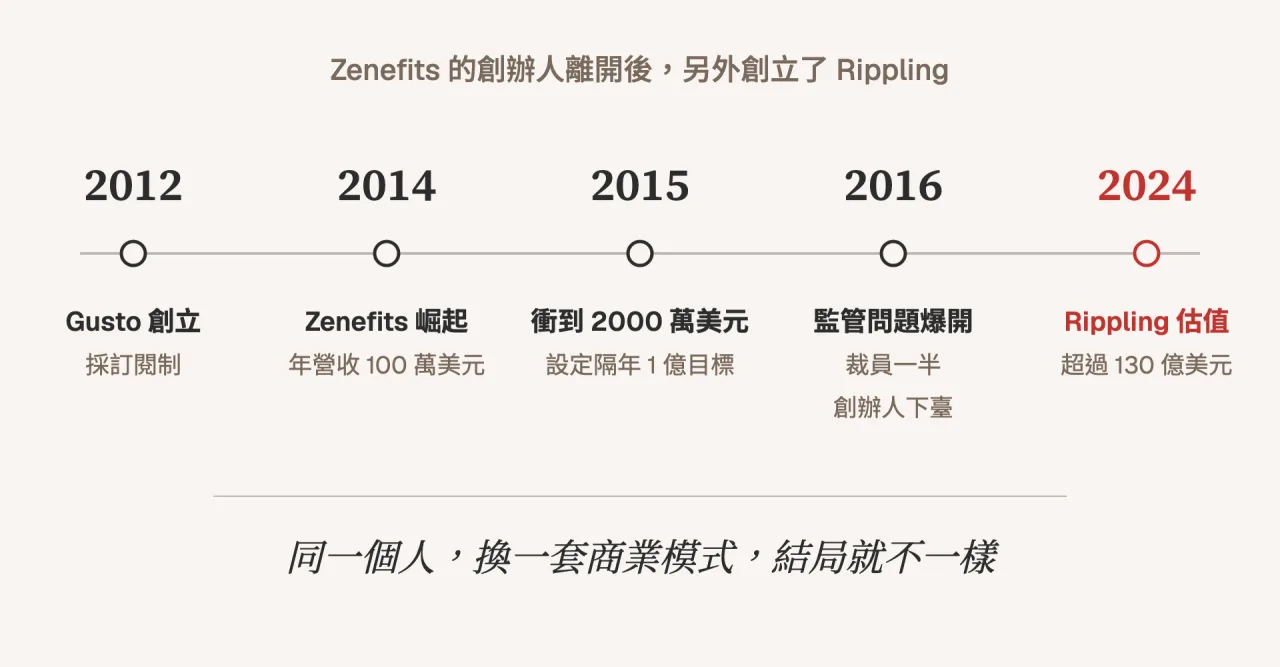
Around 2014, cloud HR platforms were hot, and Zenefits was the leader at the time. It gave its software to businesses for free and charged commissions to insurance companies. Annual recurring revenue jumped from $1 million to $20 million in one year. But in order to maintain growth, employees were forced to sell customers products they didn’t need. Problems broke out in 2016. Regulations came to the door, customers were lost, half of the staff were laid off, the market value was cut in half, and the founder sadly stepped down.
In the same market, Gusto’s product, founded in 2012, is not outstanding at first glance, but it has chosen a different path: subscription. If customers don’t feel the value, they can cancel at any time, so employees can only provide good service and have no room to take advantage of customers.
| Zenefits | Gusto | |
|---|---|---|
| Charging method | Software is free, relying on insurance commission | Subscription system |
| Sources of stress for employees | Sell more products | Retain every customer |
| Indicators that the company cares about | Revenue growth rate | Customer churn rate, employee morale |
| Later | Regulatory issues, layoffs, market value cut in half | Long-term stable growth |
My favorite detail is that Gusto regularly surveys employees: Would you recommend friends to work here? If employees are exhausted and don’t want to recommend, it means that the company is growing faster than the management ability. This indicator rarely appears in financial reports, but it tells you what’s wrong with the company earlier than the revenue curve.
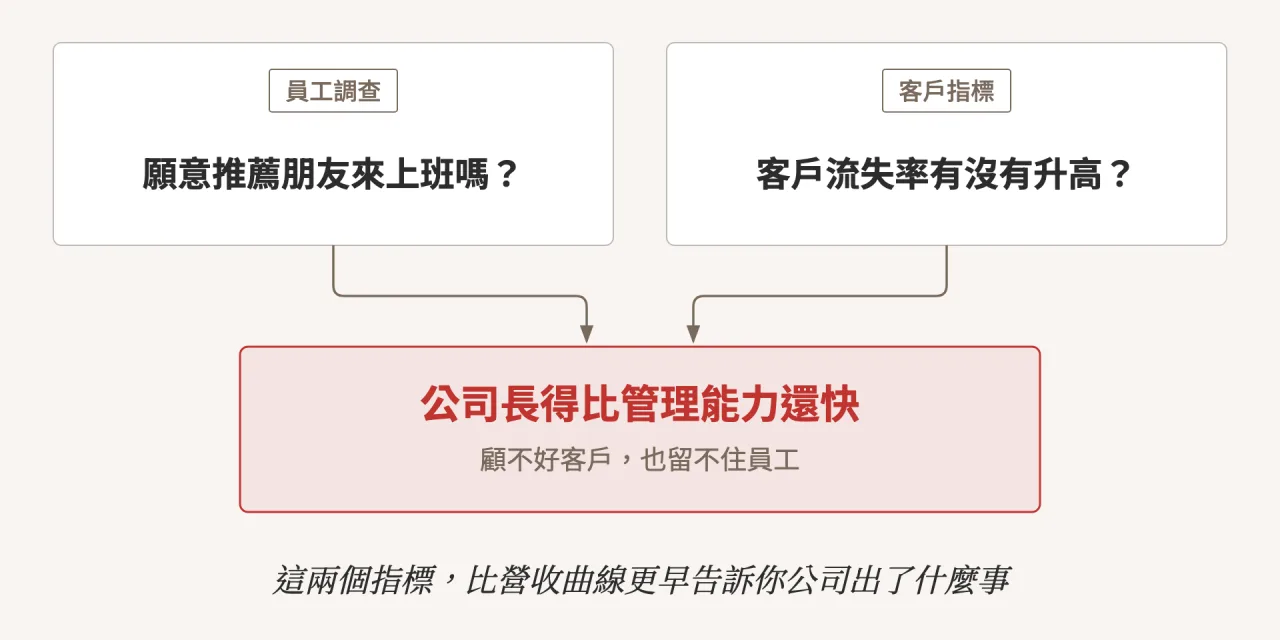
This reminds me of many platforms I have seen in the e-commerce circle in the past. Relying on subsidies and commissions to drive up the transaction volume, the numbers were very good. When the subsidies stopped, customers followed suit. Taneja said in the book that if a company can only compete in the game set by others, it may already be losing. Zenefits certainly found its way, but it was a game that didn’t last long.
The book also adds a postscript: After the founder of Zenefits left, he founded Rippling. This time he chose a more responsible business approach, and its valuation in 2024 has exceeded US$13 billion. If the same person changes a business model, the outcome will be different.
Just getting faster and cheaper is not enough
In principle three, “Creating the future is better than improving existing things,” Taneja shared his way of looking at proposals: If a proposal always emphasizes making something faster or cheaper, then the product is just improving existing things.
The examples he gave are easy to understand. Airbnb could have sold its software to hoteliers, and Uber could have sold its ride-hailing technology to taxi companies, but they both chose to create a new experience.
Reading this, I thought of the many AI import projects I have seen this year. Most of the goals state: reduce the report production time by half and allow customer service to respond 30% faster. These are certainly valuable, but they only make the old process run a little faster. Few people stop and ask: If this process was designed from scratch today, would it still need to look like this?
Taneja didn’t say anything. He mentioned that Applied Intuition sells software tools to existing automakers and is also building a new future centered on software and autonomous driving. The key is not who you sell to, but how far away the end point is in your mind. He said that the entrepreneurs he is looking for must look at the current situation with a beginner’s perspective and believe that the situation can be completely different, not just better.

Besides disruptive innovation, there is another way
Silicon Valley loves to talk about disruptive innovation. But the title of Principle 6 is very straightforward: Deep collaboration trumps disruptive innovation.
He used the medical company Homeward to illustrate. Founder Jennifer. Jennifer Schneider grew up in a small town of more than 20,000 people in Minnesota. Her father ran an auto parts distribution company. Whenever something broke, someone would drive to deliver the parts after receiving a call. She said something that impressed me deeply: “If your arm is broken, no one will take the initiative to come to your home to treat you.”
So when Homeward decides to enter a town, it will first send people to the local area to see what the residents need and what doctors and clinics are nearby. Agricultural supply stores have plenty of space, so they can set up clinics in their stores; a mobile clinic can also be parked in the post office parking lot. They receive a fixed fee from Medicare, and the better the patients are and the fewer hospitalizations they make, the more the company makes and the insurance company saves money. In severe cases, referrals are made to local specialists.
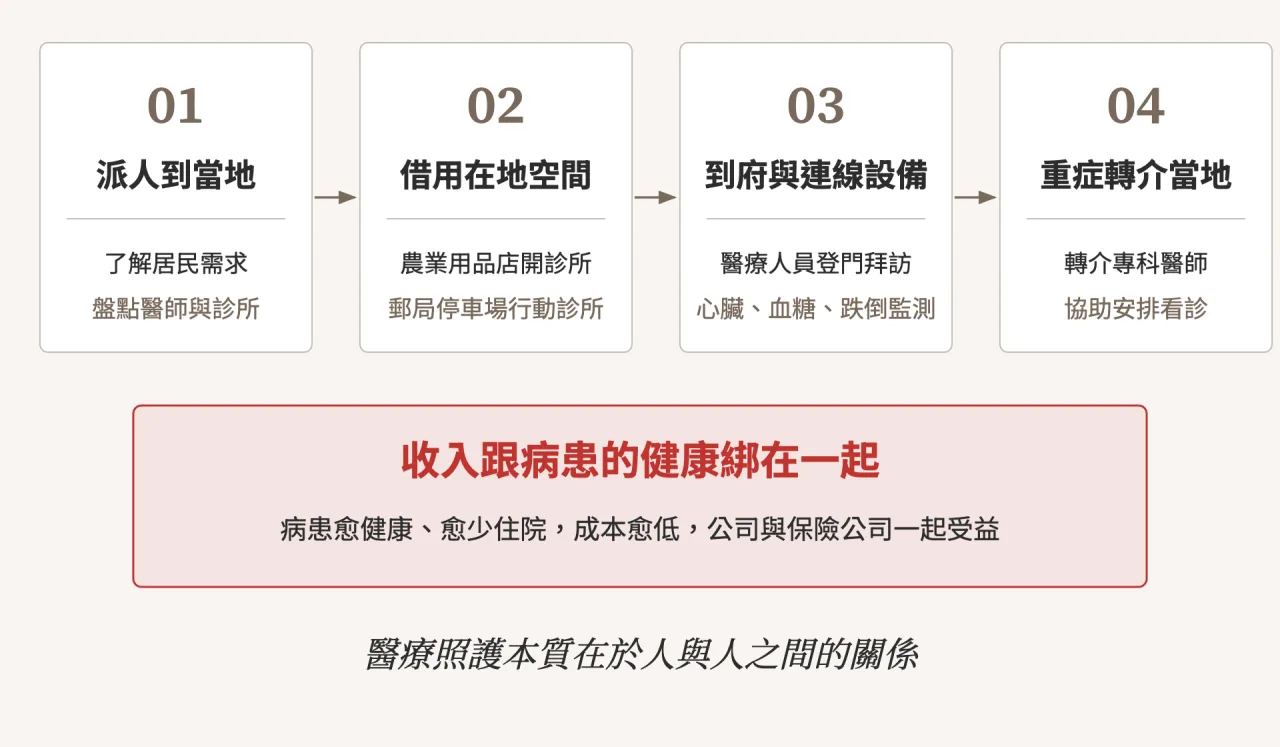
Jennifer said: “We can use technology to expand our scale and serve more people, but the essence of medical care is the relationship between people.”
After reading this paragraph, I think it is particularly suitable for business owners in Taiwan. Systems such as medical care, energy, and finance will never collapse just by shouting destruction. Innovation that can truly be implemented often involves finding existing stores, doctors, and systems to work together to get things done.
Nine principles, I would read them like this
There are nine principles in the book, ranging from “Businesses must have a soul” to “Be curious and be willing to share.” If time is limited, I would recommend reading the following three chapters first:
- Principle 3: Check whether you are creating something new or just optimizing an old process
- Principle 4: Understand clearly what kind of behavior your business model will force employees to do
- Principle 6: In industries that cannot be entered by force, learn to find partners
In addition, the conclusion talks about how the transformation principle is applied in the field of AI. For executives thinking about AI strategies, this chapter can be read as a condensed version of the entire book.
Who is this book for? I would recommend it to three types of people: entrepreneurs who are thinking about the next stage of growth, senior executives who want to provide direction for the company’s AI transformation, and investors who want to distinguish which companies are just running fast and which companies have the opportunity to go far.
The size of the problem determines how far you can go
After reading this book, I looked back at what I had done over the years and asked myself a question: Are the problems I am solving my own or the problems of many people?
How big the market is often depends on how big the problem is. This sentence is written to venture capital, and also to everyone who wants to have a long-term career.
Book information: “Good companies of the future in the eyes of top investors (opens in a new tab)”, Hemat. Hemant Taneja, Kevin. Written by Kevin Maney, translated by Huang Yuan, Tianxia Culture, published on October 30, 2026.
Next step
Bring this topic to your team
Vista Cheng speaks and runs workshops on AI workflows, writing and content systems for companies, schools and public agencies.